

Key takeaways
- A Dubai customs code is the business code Dubai Customs issues when a licensed company registers with it, so the company can import, export and re-export through Dubai’s ports, airports and land borders in its own name. Traders also call it the Dubai customs client code, importer code or exporter code.
- The official fee is AED 100 plus AED 20 Knowledge and Innovation fees per business type, and AED 25 to renew. Amendments are free unless you add a business type. No deposit is listed for the Dubai customs code itself.
- Two official processing times exist. Dubai Customs says one working day; the Dubai Trade registration pages say three business days. Plan for the longer one.
- The Dubai customs code lives and dies with your licence. Its validity “is associated with the validity of the License”, and it can be renewed only after the licence.
- A clearing agent does not replace your own code. Dubai Trade says an importer using an agent still needs its own Mirsal 2 code; it only skips the digital certificate.
- Free zone companies register too: Dubai free zone companies as business type “Free Zone” with a facility, free zone companies from other emirates as “Importer and Exporter”.
- The code is only the start. Each shipment needs a declaration, 5% customs duty on the CIF value for most non-GCC goods, 5% import VAT and permits for restricted goods.
A Dubai customs code (officially the “Business code” issued under Dubai Customs’ Request Business Registration service) is the registration number that lets a licensed business import, export and clear goods with Dubai Customs in its own name. You apply online on the Dubai Trade portal with a valid trade licence and your authorised person’s identity documents; the published fee is AED 100 plus AED 20; and the code stays valid as long as your licence does. Your forwarder, clearing agent and the Mirsal 2 declaration system then use it to tie every shipment to your company.
This guide explains how to get Dubai customs code approval, what the Dubai customs registration costs, what Dubai Customs asks for, and what happens next: the first declaration, duty, import VAT, inspection and release. It also answers what most pages skip: free zone companies, clearing agents, renewal, cancellation and the difference between a customs code and an import-export licence. If you are still choosing a licence, start with our Dubai mainland licence types guide; for a trader in many unrelated goods, our general trading licence guide covers that activity and its restricted goods. This page goes deep on Dubai Customs itself.
Every fee, time and rule below comes from an official source checked on 26 September 2026: Dubai Customs’ Services Guide (version 9), Customer Guide and e-service pages, Dubai Trade’s FAQs, the Dubai Legislation Portal, ICP, the Federal Tax Authority, u.ae, DP World, Dubai Airports, Sharjah Customs and the GCC Common Customs Law. Archived copies and secondary reports are labelled.
Dubai customs code at a glance
| Question | Short answer | Official source (checked 26 September 2026) |
|---|---|---|
| Official name | “Business code”, issued through “Request Business Registration”; brokers call it the Mirsal 2 or M2 code | Dubai Customs Customer Guide; Dubai Trade FAQs |
| Issued by | Dubai Customs, part of the Ports, Customs and Free Zone Corporation (PCFC) | Dubai Law No. 1 of 2001; pcfc.ae |
| Who can register | “Any business licensed by a competent Authority in the UAE or in the GCC States” | Customer Guide |
| Where to apply | Dubai Trade: Service Centre, Dubai Customs, Request Business Registration, New | Dubai Trade FAQ; Services Guide v9 |
| Documents | Licence, authorised person’s passport and Emirates ID; Dubai Trade adds residence and labour card copies and an undertaking letter | Services Guide v9; Dubai Trade FAQ (archived November 2024) |
| Government fee | AED 100 per business type + AED 20 | Services Guide v9 |
| Processing time | 1 working day (Dubai Customs) or 3 business days (Dubai Trade) | Services Guide v9; Dubai Trade FAQ |
| Validity and renewal | Follows the licence; renewal AED 25 after the licence renewal | Customer Guide; Services Guide v9 |
| Amendment | Free, unless adding a business type (AED 100 + AED 20) | Services Guide v9 |
| Cancellation | Client clearance certificate: AED 100 + AED 20, at least 10 working days, AED 3,000 more if audited | Services Guide v9 |
| Deposit or guarantee | None for the code; minimum AED 10,000 or AED 25,000 for optional duty accounts | Services Guide v9; Customer Guide |
| Duty and VAT | 5% of CIF for most non-GCC goods (50% alcohol, 100% tobacco); 5% import VAT | Customer Guide; u.ae; FTA |
| Other emirates | Dubai registration only; Abu Dhabi and Sharjah run their own | ICP; Sharjah Customs; ATLP |
Dubai customs code registration: how MIRDXB PRO helps
Most delays with a Dubai customs code have nothing to do with Dubai Customs being slow. They come from a licence activity that does not fit the business type, residence details not ready for the form, the wrong business type for a free zone company, or a container that lands before anyone has thought about the code, the HS codes or a permit. We check those first.
MIRDXB PRO is an independent PRO and business-setup consultancy in Al Barsha 1, Dubai. We are not Dubai Customs, Dubai Trade or DP World, and we are not a licensed customs broker. We prepare and submit your Dubai customs registration, or show you how to do it yourself, and work alongside your forwarder or clearing agent.
What we do
- Check your licence, activities and ownership against the business type Dubai Customs expects, and flag any licence amendment needed first.
- Prepare the Dubai Trade registration, upload the documents and track it until the business code and Mirsal 2 code arrive.
- Set up portal users and the online authorisation for your clearing agent.
- Renew the Dubai customs code after each licence renewal, and amend it after changes of name, activity, partners or address.
- Handle the files around customs, from licence amendments to establishment cards and visas, through our corporate PRO services in Dubai.
- If you have no licence yet, set up the company first through our company formation support, with the customs step built in.
How it works
- Message us on WhatsApp with your licence (or planned activities), what you will import or export, and through which port or airport.
- We reply in writing with the business type, documents, government fees with sources, timeline and our fee.
- Once you agree, we file the Dubai customs registration and answer any query.
- We send the business code, the Mirsal 2 code and a note of next steps: users, broker authorisation, the VAT link and the renewal date.
What it costs
Government fees are passed on at cost, on the official receipt: AED 120 for a new Dubai customs code with one business type, AED 25 to renew. Our own fee is quoted in writing before we start and depends on the work; a company with its visas in order is simpler than a new company with a free zone facility or a pending licence amendment. Our published service fees are on our fees page, and all government charges we track are in our UAE government fees list for 2026.
Why companies use us
- We work from Dubai Customs’ own service guide and name the source for every figure.
- We tell you when you do not need us: the Dubai customs registration is an online service you can complete yourself once your licence and residence details are ready.
- We look at the whole file, so the licence, Chamber membership, establishment cards and customs code renew in the right order.
- Our office is in Al Barsha 1, open Monday to Thursday and Saturday 09:00 to 18:00 and Friday 09:00 to 12:00. Owners abroad can instruct us under a power of attorney.
What Dubai Customs is, and who it answers to
Dubai Customs is one of the emirate’s oldest government departments. Its history page says it was known as “Al Furdah”, Arabic for a berth, and called “the Mother of Government Departments” because other agencies once worked from its building and relied on its revenue.
Legal basis: the Ports, Customs and Free Zone Corporation
Dubai Law No. 1 of 2001 established the Ports, Customs and Free Zone Corporation (PCFC). Article 4 places the Customs Department, the Dubai Ports Authority and the Free Zone Authority under it, and the law names Jebel Ali, Port Rashid and Al Hamriya as the ports concerned. Article 7 keeps customs revenue separate from PCFC’s own revenue. PCFC’s website now lists Dubai Customs alongside Trakhees, JAFZA, the Dubai Maritime Authority and the Dubai Ports Authority, which Law No. 4 of 2023 re-established to supervise ports and terminals.
The federal layer: ICP and the GCC customs union
Federal Decree-Law No. 14 of 2021 created the Federal Authority for Identity, Citizenship, Customs and Port Security (ICP), which calls itself “the governing body overseeing customs affairs in the United Arab Emirates”. ICP lists seven local customs departments: Abu Dhabi Customs, PCFC for Dubai, and the customs departments of Sharjah, Ajman, Ras Al Khaimah, Fujairah and Umm Al Quwain. Each registers its own clients, which is why a Dubai customs code is a Dubai registration.
Above both sits the GCC customs union, which ICP says “officially commenced on 1 January 2003”: a common 5% tariff on goods from outside the union (with listed exemptions and 100% on tobacco), one unified customs law, and the “single entry point” rule, under which the first GCC entry point inspects, clears and collects the duty. Dubai Customs applies the GCC Common Customs Law to declarations, inspections, brokers and offences; we quote its articles where they matter.
How Dubai’s ports, airports and land borders work for trade
Your Dubai customs code works wherever Dubai Customs has a customs centre. Its locations page shows the reach:
| Gateway | Facility operator | Dubai Customs centres listed |
|---|---|---|
| Jebel Ali Port | DP World; supervised by the Dubai Ports Authority | Jebel Ali and TECOM customer service and inspection centres |
| Port Rashid, Hamriya Port, Dubai Creek | Supervised by the Dubai Ports Authority | Port Rashid, Hamriya, Creek and Deira Wharfage centres; Creek Marine Operations |
| Dubai International (DXB) | Dubai Airports | Cargo Village Customs Centre; terminals 1, 2 and 3 |
| Dubai World Central, Al Maktoum International (DWC) | Dubai Airports | Al Maktoum cargo inspection and airport customs centres |
| Free zones | The zone authority | Airport Free Zone and Silicon Oasis, DMCC, Dubai Logistics City, DUCAMZ |
| Inland and land border | Dubai Customs | Dry Port and Textile Customs Centre; Hatta Customs Centre |
DP World describes Jebel Ali Port as four terminals with 27 berths and more than 80 weekly services to over 150 ports, with “direct connections to Dubai’s economic zones”. Dubai Airports says it “owns and manages the operation and development of both of Dubai’s airports”, DXB and DWC; DWC opened for cargo on 27 June 2010. These operators run the terminals; Dubai Customs clears the goods. Your Dubai customs code is not a DP World registration, although DP World services such as delivery orders run on the same portal.
Dubai Trade and Mirsal 2: the systems behind the code
Dubai Trade calls itself a portal that “combines all electronic services provided by DP World, Economic Zones World and Dubai Customs”. You register, create users, pay and track there. Declarations are filed in Mirsal 2, Dubai Customs’ declaration system, reached through Dubai Trade; your broker’s “M2 code” is the Mirsal 2 code issued with your Dubai customs registration.
Goods are classified under the Integrated Customs Tariff, which Dubai Customs calls “the unified reference for classifying goods”; the GCC has adopted a unified 12-digit structure. PwC reports that Dubai Customs Notice No. 10 of 2025 (23 July 2025) set a flexible implementation from 1 August 2025. That detail is secondary, so check the current phase on Dubai Customs’ tariff page before relying on an 8-digit code from an old invoice.
What a Dubai customs code actually is (and what it is not)
Dubai Customs’ Customer Guide says that on registering you give “the details of valid license, business address, activities, facilities, users, business group etc.” and receive a unique “Business code”. It lets every declaration be matched to a known, licensed company.
Dubai Customs registers several business types: trading (importer and exporter), non-trading (professional, service, government, charity), customs brokers, shipping and airline agents, clearing and forwarding, free zone, customs warehouses, couriers and cargo handlers. A trader normally needs one; Dubai Trade lets you add more “provided that you have the necessary license activities to do so”.
A Dubai customs client code, an importer code and an exporter code are the same registration. The confusion comes from the other numbers a trader collects:
| Number | Issued by | What it does |
|---|---|---|
| Dubai customs code (business code) | Dubai Customs | Lets your company import or export in its own name |
| Mirsal 2 (M2) or agent code | Generated with the Dubai customs registration | Entered by brokers as importer or consignee in declarations |
| Trade licence number | DET or a free zone | Your permission to trade; the code is issued against it |
| Tax registration number (TRN) | Federal Tax Authority | VAT identity; you add your customs number to your FTA record |
| HS or tariff code | GCC tariff | Classifies each product and sets its duty and restrictions |
| Establishment card | GDRFA and MOHRE | Immigration and labour file for visas (see our establishment card guide) |
| Import permit | The controlling authority | Permission for a restricted product; your code does not replace it |
Customs code vs import-export licence
You usually need both. The licence comes from the Department of Economy and Tourism (DET) or a free zone; DET says commercial licences cover “trading activities such as general trading, import/export, wholesale and retail”. The Dubai customs code comes from Dubai Customs once the licence exists. A licence without customs registration cannot clear a shipment in the company’s name, and a customs registration cannot exist without a valid licence.
So an “import-export licence with customs code” means a trade licence with import-export activity plus the Dubai customs registration done straight after. The two steps keep separate fees and renewals. Our mainland company formation guide covers the route to the licence.
Who needs a Dubai customs code
If goods will cross Dubai Customs with your company named as importer, exporter or consignee, your company needs its own Dubai customs code. The decision tree works through the cases.
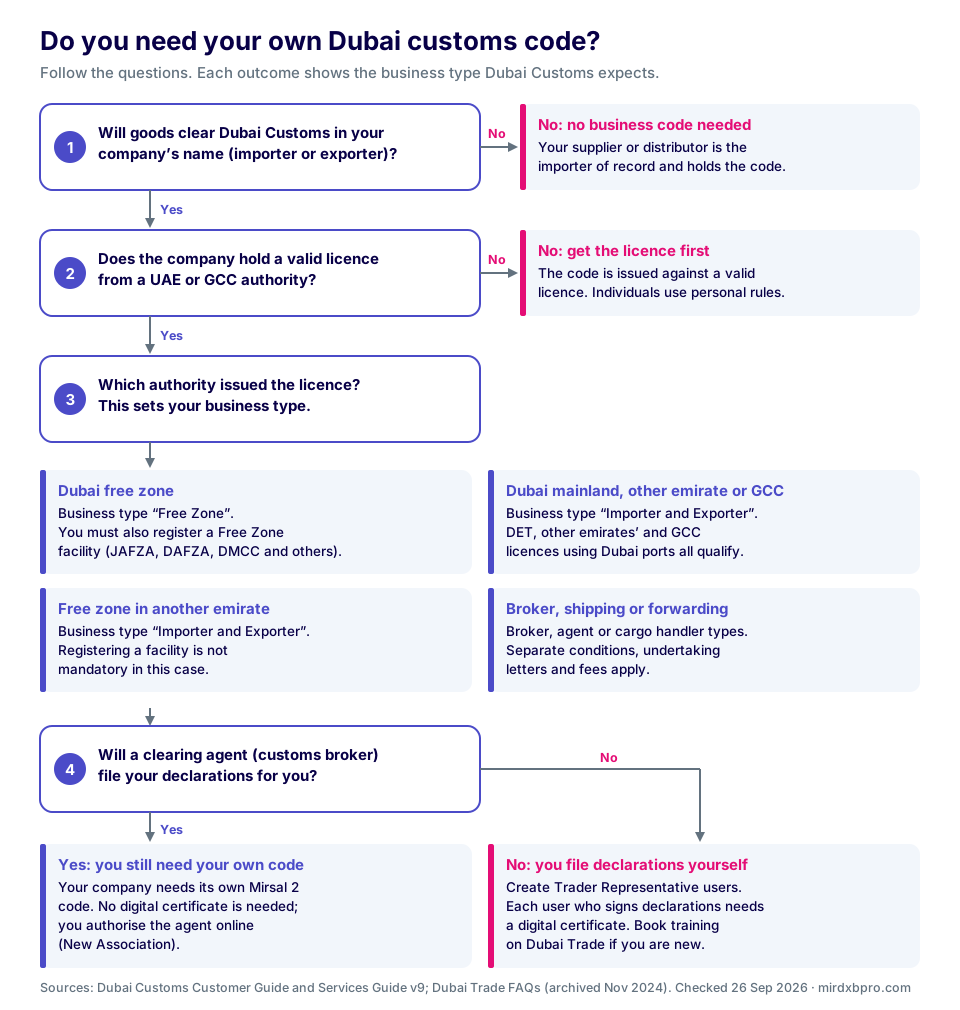
Companies that need one
- Mainland traders that import, export or re-export, including e-commerce sellers importing their own stock.
- Dubai free zone companies moving goods in or out of their zone (business type “Free Zone” with a facility).
- Companies licensed in another emirate or GCC state using Dubai’s ports: Dubai Trade says companies “licensed by any authorities that will use Dubai Ports and Customs to import and export their own cargo can register”.
- Manufacturers, under the business type “Importer (Industrial) and Exporter (Commercial)”.
- Service and professional companies importing their own equipment, as non-trading clients with an undertaking letter.
- Brokers, agents, forwarders, couriers and cargo handlers, each under their own type and conditions.
When you may not need one
- A UAE distributor imports under its own code and delivers to you.
- You sell from abroad to a UAE buyer who imports under the buyer’s code.
- You are an individual bringing personal effects; passenger and personal rules apply. Dubai Trade notes a new arrival can import personal goods before residency with a sponsor’s letter confirming the visa.
Unsure? Ask your supplier and forwarder which party is consignee on the bill of lading and importer on the declaration. That party needs the code.
Dubai customs code for a free zone company
u.ae says free zones offer “0 per cent customs duty on goods imported into the free zone” and that goods “only become subject to the UAE customs duty if moved into the mainland market”. Free zone companies still move goods on customs declarations, so they still register.
Dubai Trade’s rule: with a Dubai free zone licence, choose business type “Free Zone” and register a “Free Zone” facility; with a free zone licence from another emirate, choose “Importer and Exporter”, and a facility is not mandatory. Companies licensed by JAFZA, National Industries Park, Dubai Auto Zone and Textile City get a Dubai Trade account automatically, but still apply for the Dubai customs registration and link that login.
Selling into the mainland is separate: u.ae says free zone companies sell locally through a licensed mainland distributor or a mainland branch, and Dubai’s Executive Council Resolution No. 11 of 2025 added a DET branch licence and operating permit. See our guides to JAFZA company setup for port-side logistics, DAFZA company setup for airport-linked trade, Dubai South free zone company setup near DWC, and free zones in the UAE.
Before you apply: eligibility and licence activity
1. A valid licence from a recognised authority
The Customer Guide opens registration to “any business licensed by a competent Authority in the UAE or in the GCC States”. An expired licence is the first thing that stops a Dubai customs registration; see our trade licence renewal guide if yours has lapsed.
2. An activity that fits the business type
A consultancy licence with no trading activity fits a non-trading type, not “Importer and Exporter”; a broker registration needs the “Customs Broker” activity. If the activity is missing, amend the licence first, as our trade licence amendment guide explains.
3. Residence details for the owner and authorised person
Dubai Trade’s FAQ says: “It is mandatory to enter the residence permit details of owner and/or authorised person at the time of registration. You will not be able to proceed with the registration process otherwise.” At least one owner and one authorised person must be registered. A foreign owner still waiting for a visa should appoint a resident manager or authorised person. The Services Guide lists only passport and Emirates ID, a real difference we show in the documents section.
For a new mainland company the usual order is licence, establishment cards, the owner’s or manager’s residence visa and Emirates ID, then the Dubai customs code. If the first shipment is due before the visa, decide who the authorised person will be, or ask the supplier to hold the goods.
Documents required for Dubai customs registration
Dubai Customs publishes its document list in several places, and the lists do not match:
| Document | Services Guide v9 and e-service page | Customer Guide (v3.03) | Dubai Trade FAQ (archived 3 Nov 2024) |
|---|---|---|---|
| Trade licence copy | Yes | Yes (valid licence) | Yes (valid licence) |
| Passport copy | Authorised person | Authorised person, new registrations only | Authorised person and owner |
| Emirates ID copy | Yes | Not listed | Authorised person and owner |
| Residence permit and labour card copies | Not listed | Not listed | Authorised person and owner; residence details mandatory in the form |
| Undertaking letter | Not listed | Professional companies only | Importers (template in the application), clearing and shipping agents |
| Facility details | Not listed | Recorded in the registration | Free Zone facility for Dubai free zone companies; cargo handlers and bonded warehouses |
The Services Guide gives the minimum for the service; the Dubai Trade registration form reflects what the online application asks. Because it will not proceed without residence details, prepare the fuller set. An owner who is not on a UAE work permit has no labour card; enter what the form allows and expect a query if something is missing.
Practical checklist
- Valid trade licence (all pages) with an activity that fits your business type.
- Passport, residence details and Emirates ID of the owner and the authorised person; labour card details if the authorised person is an employee.
- Undertaking letter on letterhead, signed and stamped, from the template in the application.
- For a Dubai free zone company: the facility details to register a free zone facility.
- A company email someone reads daily, plus any Dubai Trade login your free zone created.
UAE-issued documents do not normally need attestation here. If Dubai Customs asks for a document issued abroad, such as a parent company resolution, ask whether it must be legalised; our document attestation service can handle the chain.
How to get a Dubai customs code: step by step
The Dubai customs registration is fully online. Dubai Customs’ service card summarises it as “submit application”, “pay service fees” and “receive email containing company registration and customs code”; Dubai Trade’s cargo-owner pages give more detail.
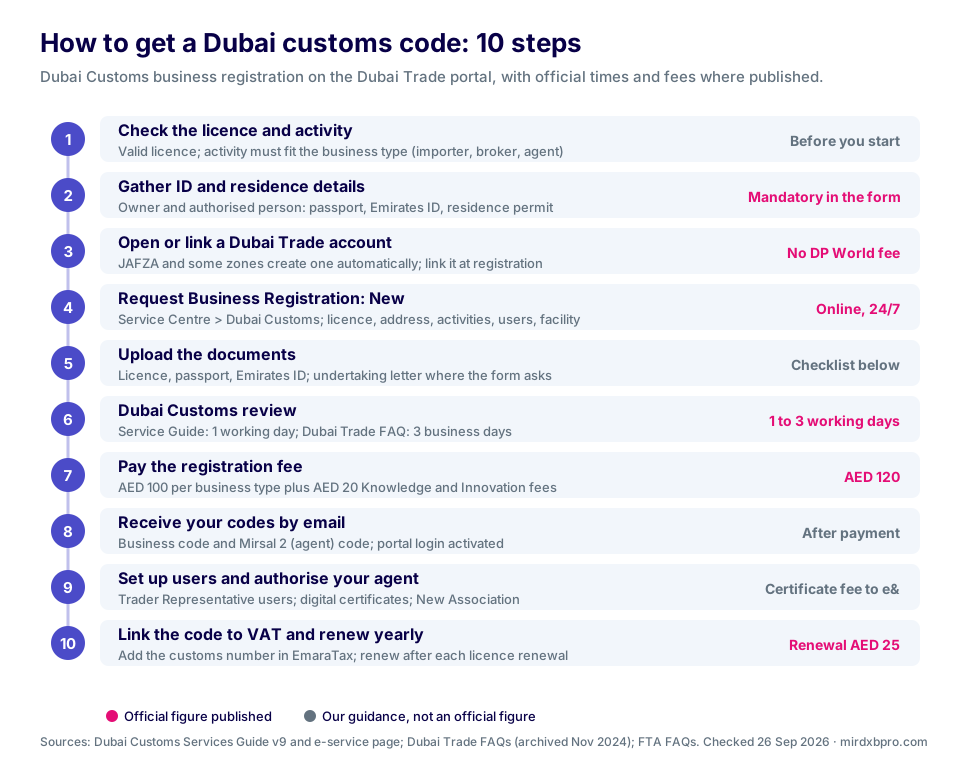
- Check the licence and activity against the business type you will choose.
- Choose the owner and authorised person and have their passport, residence and Emirates ID details ready.
- Open or link your Dubai Trade account. The Dubai Trade registration for DP World roles is free; if your free zone created a login, use it.
- Start the application: Service Centre, Dubai Customs, Request Business Registration, New. Dubai Trade’s answer to “How do I register and apply for a Dubai Customs code?” (9 December 2020) says: “Fill in the mandatory fields, upload the required documents then submit for approval.”
- Complete the profile: licence details, address, activities, business type, facilities, users and business group.
- Upload the documents, including the undertaking letter if asked.
- Wait for review: one working day per the Services Guide, “within 3 business days” per Dubai Trade.
- Pay AED 100 per business type plus AED 20. Dubai Trade says you pay after approval “using registration enquiry service”; the Dubai Customs card lists payment before the email, so your screen may differ.
- Receive your codes. Dubai Trade: “Agent Code and Business Code will be generated after you pay successfully, and your Dubai Trade login will be activated.”
- Set up users with the Trader Representative role; each user who signs declarations needs a digital certificate.
- Authorise your clearing agent through New Association in your admin account.
- Link the code to VAT by adding your customs registration number to your FTA record.
Digital certificates for users who declare
Dubai Trade’s FAQ says declarations are signed with a business user digital certificate from Etisalat (now e&), in the user’s name as registered on Dubai Trade. Its last published charges were AED 275 plus VAT for one year, AED 385 for two and AED 495 for three. The page carries a 2018 copyright line, so confirm current prices with e&. You need no certificate if a clearing agent files everything.
Dubai customs code cost: every official fee
The Services Guide states that “AED 20 Knowledge and Innovation fees will be added on top of any service costs AED 50 and above”. That is why registration is AED 120 and the AED 25 renewal has nothing added.
| Service | Official fee | Official time |
|---|---|---|
| New registration (Dubai customs code) | AED 100 per business type + AED 20 | 1 working day (Dubai Trade: 3 business days) |
| Renewal | AED 25 | 1 working day |
| Amendment | Free; AED 100 + AED 20 to add a business type | 1 working day |
| Representative card (staff dealing with customs) | AED 150 + AED 20; late renewal AED 50 per month | 1 working day |
| Goods classification (HS ruling) | AED 25 per tariff item | 2 working days |
| Customs opinion (tariff, origin, valuation, restrictions) | Free | 2 working days |
| Customs declaration | AED 15 to 100 by type, + AED 20 where AED 50 or more | 2 working hours |
| Inspection you request | AED 150 + AED 20 (free when Customs requires it) | 2 working hours |
| Duty account (credit or standing guarantee) | Free; deposit or bank guarantee needed | 1 working day |
| Refund claim (deposit or guarantee) | AED 50 per declaration + AED 20 | 5 working days |
| VAT registration certificate from Dubai Customs | AED 100 + AED 20 | 2 working hours |
| Client clearance certificate (includes code cancellation) | AED 100 + AED 20; AED 3,000 more if audited | At least 10 working days |
All rows: Dubai Customs Services Guide v9, checked 26 September 2026. For a single importer, the government cost of the Dubai customs code is AED 120 in year one and AED 25 a year after. Providers quoting “customs code registration from AED X” are adding their own fee to the AED 120; ask them to show both.
Is there a deposit or bank guarantee?
Not for the Dubai customs code itself. No published registration service lists one, and Dubai Trade confirms “there is no longer a requirement of paying a deposit to Dubai Customs for Customs Broker/Clearing agent registration”. Guarantees apply elsewhere:
- Duty accounts, if you want duty debited rather than paid per shipment: minimum AED 10,000 for a credit account and AED 25,000 for a standing guarantee account (Customer Guide).
- Import for re-export: a deposit equal to the duty, refunded when you prove re-export in time.
- Customs warehouses: at least AED 50,000 (private) or AED 1.5 million (public).
Processing time, validity, renewal and amendment
How long the Dubai customs registration takes
Dubai Customs says one working day; Dubai Trade says approval “within 3 business days”, then payment and code generation. We plan on three working days from a complete application.
Validity and customs code renewal
The Customer Guide says “the validity of this Business code is associated with the validity of the License”, and “Clients can request for the renewal of the business code only after the renewal of the License from the competent licensing authority.” Renewal costs AED 25, takes one working day and needs only the renewed licence. Put it in the same reminder as your licence and Chamber renewals.
We found no published late-renewal fine for the Dubai customs code in the Services Guide, the Customer Guide or the offences list. The practical penalty is that an expired code cannot be used, so goods wait at the terminal. Representative cards do carry a fine: AED 50 per month of delay.
Amendment
Amend the registration after any licence change: name, legal form, activities, partners or managers, address or authorised person. It is free unless you add a business type. The clearance certificate service lists “ownership change” and “partner addition” among its purposes, so a change of owners may need one too; ask Dubai Customs before filing.
Cancelling a Dubai customs code
There is no stand-alone cancellation service. Cancellation runs through Request Client Clearance Certificate, issued for company termination, ownership change, partner addition or “business code cancellation”.
- Documents: a company letter stating the business code and the owner’s or authorised person’s passport; if the owner is unavailable, a power of attorney, share certificate or licensing authority letter.
- Fee: AED 100 plus AED 20, and AED 3,000 more if a customs audit is required. Time: at least 10 working days.
- First: settle open declarations, claim back deposits and guarantees, and cancel representative cards (“all arrears have to be paid”).
Closing a company? Apply early: 10 working days is the longest published service time in this guide.
Your first shipment with a Dubai customs code: declaration to release
With the Dubai customs code issued, every consignment moves on a declaration. Article 47 of the GCC Common Customs Law requires a detailed declaration “when clearing any goods, even if exempted from customs taxes”, so duty-free goods are declared too.
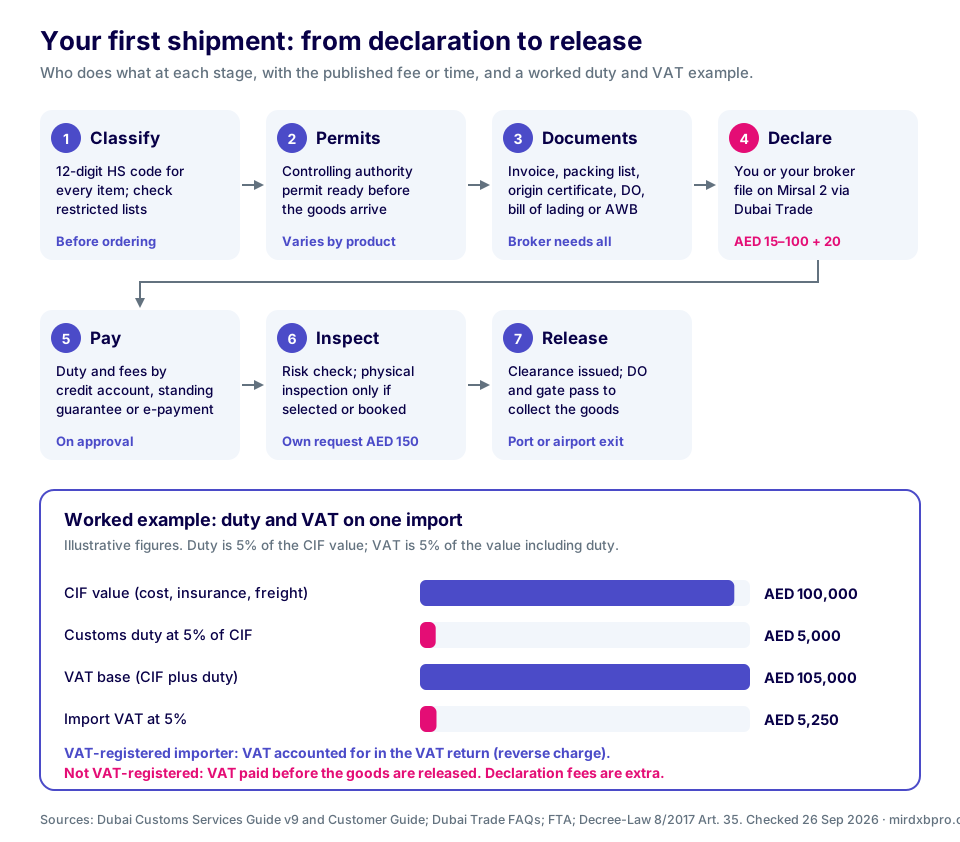
1. Classify every product
Each invoice line needs a tariff code, which sets the duty rate, any restriction and the permit needed. Dubai Customs will classify an item for AED 25 per tariff line in two working days (send data sheets for chemicals, catalogues or photos for other goods), or give a free “customs opinion” on tariff, origin, valuation or restrictions. Do this before you order.
2. Get permits before the goods arrive
Dubai Trade’s FAQ says customs “will require in most cases a permit from the authority that restricts the goods imported, so permit must be ready”. The restricted goods table below names the authorities.
3. Collect the shipping documents
The Services Guide lists invoice, packing list, certificate of origin and any restriction permit. Dubai Trade adds the delivery order and the bill of lading, or manifest for land. It also says a certificate of origin is not required for air shipments; confirm with your broker, because origin can matter for GCC or agreement rates.
4. File the declaration on Mirsal 2
You file through Dubai Trade, or your clearing agent files against your Mirsal 2 code. Service time is two working hours; fees run from AED 15 to AED 100 by declaration type, plus AED 20 where the fee is AED 50 or more. The fee appendix shows, for example, AED 70 (dutiable) or AED 80 (non-dutiable) for an import to the local market from abroad, AED 100 for temporary admission, and AED 50 or AED 15 for transit.
5. Pay duty, VAT and fees
Dubai Trade lists two routes: a credit (CDR) or standing guarantee account debited directly, or e-payment by card, direct debit or e-Dirham, where the declaration is approved first and then shows “payment pending”.
6. Risk check and inspection
Article 52 of the GCC law lets the officer “examine the goods wholly or partially after registering the customs declarations”. Inspection Dubai Customs requires is free; one you book costs AED 150 plus AED 20. If a declaration is suspended, Dubai Trade says the reason appears under Declaration, Track Request, and you can resubmit.
7. Release and collection
Cleared goods are released against the delivery order and the terminal’s gate procedures. Dubai Trade says a cleared declaration can be amended or cancelled online, with excess payments claimed through a refund claim.
Customs duty on imports into Dubai
The Customer Guide sets the GCC common tariff at “5% on CIF value of all foreign goods imported from outside of the Customs union”, 50% on alcohol and 100% on tobacco (on value or quantity, whichever is higher); u.ae, updated 14 September 2026, gives the same Dubai rates. CIF means cost, insurance and freight, so duty is charged on the landed value.
- GCC-origin goods meeting origin rules move without duty under the customs union.
- Exempt goods: ICP refers to 417 exempted goods; the Customer Guide adds conditional categories such as personal effects, returned goods, diplomatic and charitable imports.
- Goods into a free zone pay no duty until they enter the local market; re-exports can clear against a refundable deposit.
VAT on imports, your TRN and the Dubai customs code
The Federal Tax Authority says that if the importer “is a registered person with the Federal Tax Authority for VAT purposes, VAT would be due on that import using a reverse charge mechanism”; if not, “VAT would need to be paid before the goods are released”. A registered importer reports import VAT in its return instead of paying at the port.
Article 35 of Federal Decree-Law No. 8 of 2017 sets the VAT value as the customs value “including the value of insurance, freight, any customs duties and any excise taxes”. So AED 100,000 CIF plus AED 5,000 duty gives a VAT base of AED 105,000 and VAT of AED 5,250.
For the reverse charge to work, link your Dubai customs code to your VAT record. The FTA’s instruction is to edit the VAT section of your account “and enter your Customs Registration Number. This will automatically update your records.” Mandatory VAT registration applies above AED 375,000 of taxable supplies and imports; voluntary from AED 187,500. Our corporate tax and VAT registration guide covers the FTA side. Dubai Customs also issues a VAT registration certificate to code holders (AED 100 plus AED 20, two working hours).
Prohibited and restricted goods: which authority controls what
A Dubai customs code lets you declare goods; it does not make every product importable. Dubai Customs prohibits narcotic drugs, gambling devices, nylon fishing nets, live swine, used and reconditioned tyres, radiation-contaminated goods, items contrary to Islamic faith and public morals, paan and betel leaves, and other goods banned by law. Restricted goods need the controlling authority’s approval, and Dubai Customs’ page still uses some older names:
| Goods | Authority named by Dubai Customs | Current position we found |
|---|---|---|
| Live animals, plants, fertilisers, insecticides | MOCCAE | Unchanged |
| Arms, ammunition, explosives, fireworks | Ministry of Defence, Armed Forces, Ministry of Interior | Unchanged |
| Pharmaceuticals, medical and surgical instruments | MOHAP | MOHAP says these services moved to the Emirates Drug Establishment |
| Print, publications, media products | National Media Council | Replaced by the National Media Authority (December 2025) |
| Nuclear-related products | Federal Authority for Nuclear Regulation | Unchanged |
| New tyres, e-cigarettes, electronic hookah | Emirates Authority for Standardization and Metrology | Now MoIAT |
| Transmitters and radio equipment | Telecommunications Regulatory Authority | Now the TDRA |
| Alcoholic beverages | Dubai Police | Unchanged |
| Food, personal care, cosmetics | Dubai Municipality | Unchanged; product registration first |
| Rough diamonds | UAE Kimberley Process Office | Unchanged |
Follow the authority that issues the permit today, and ask your broker which permit reference Mirsal 2 expects. Our general trading licence guide goes product by product.
Customs broker or your own code: who should handle what
Article 110 of the GCC Common Customs Law accepts declarations from “the owners of the goods or their authorized representatives” meeting the Director General’s conditions, and from “licensed customs brokers”. Either way, goods clear against your Dubai customs code. A broker needs the customs broker activity and a Dubai Customs no-objection certificate (AED 700 for a new licence), and Article 109 ties the profession to a licence. A PRO consultancy like ours is not a broker and does not file declarations.
| Task | Yourself | PRO consultancy (MIRDXB PRO) | Licensed clearing agent |
|---|---|---|---|
| Licence, amendments, renewals | Possible online | Yes, core work | Not usually |
| Dubai customs registration and renewal | Yes, on Dubai Trade | Yes | Some offer it |
| Users and broker authorisation | Yes, from the admin login | We set it up with you | Tells you what it needs |
| HS codes and permits | Possible, with customs rulings | We coordinate permits | Yes, daily |
| Declarations, duty, inspections, release | Yes, with trained users and certificates | No | Yes, core work |
| Visas, establishment cards, Chamber | Possible | Yes, core work | No |
Who should handle it? With one or two shipments a month, most companies do best with their own Dubai customs code, a clearing agent for declarations and a PRO for the licence and code administration. Steady volumes and trained staff justify filing yourself. With restricted goods, involve the broker before the first order.
Customs codes in Abu Dhabi, Sharjah and the other emirates
- Abu Dhabi registers importers on the Advanced Trade and Logistics Platform (ATLP), under a service titled “Issuance of Importer Number Request” with a renewal service. Both pages returned “page not found” on 26 September 2026, so we could not verify the fee or documents; contact ATLP on 800 2857.
- Sharjah Customs’ “Importer or agent code” costs AED 100 new and AED 25 to renew, with the company stamp, a licence copy and a PRO ID or customs ID copy, through its e-portal.
- Ajman, Ras Al Khaimah, Fujairah and Umm Al Quwain each have a local customs department listed by ICP; check its service pages.
Under the single entry point rule, duty is collected where goods first enter the GCC. Goods landing at Jebel Ali for Abu Dhabi are cleared by Dubai Customs; goods landing at Khalifa Port by Abu Dhabi. Register where your goods will be declared; a company can hold registrations in several emirates.
Common rejection reasons and how to fix them
Dubai Customs publishes no rejection statistics. These are the points where the official requirements most often catch applicants.
| What goes wrong | Why | Fix |
|---|---|---|
| Licence expired | Registration and renewal need a valid licence | Renew the licence, then apply or renew the Dubai customs code |
| Form will not proceed | Residence details of owner or authorised person missing | Finish the visa and Emirates ID, or appoint a resident authorised person |
| Business type rejected | No matching licence activity | Amend the licence, or pick the type it supports |
| Dubai free zone company queried | Chose Importer and Exporter or no facility | Select “Free Zone” and add the facility |
| Non-Dubai free zone company queried | Chose “Free Zone” | Select “Importer and Exporter” |
| Missing undertaking letter | Required for importers, professional companies and agents | Use the template in the application |
| Name mismatches | Names differ from licence or passports | Copy names exactly |
| Declarations fail after approval | Certificate not linked, broker not authorised, wrong M2 code | Link the certificate; approve the association; check the code |
Penalties and violations to know before you trade
Dubai Customs’ offences page lists administrative fines, including: wrong declaration AED 500; incorrect tariff (HS) code AED 500; late document submission AED 50; returned cheque AED 500; free zone goods not re-exported 10% of CIF; and late deposit claims cut by 15%, 30% or 45%, with claims more than 120 days after expiry rejected. Late representative card renewal is AED 50 a month.
Smuggling, which Article 142 of the GCC law defines as bringing goods in or out in breach of the law without paying the duties due, in whole or in part, is a criminal offence. Under Article 145, for ordinary goods the fine is at least double the duty and up to the value of the goods, with one month to one year in prison, or either; for prohibited goods, one to three times the value and six months to three years, or either, with confiscation and doubling for repeat offences. Accurate classification and valuation are the protection.
Worked cases
These cases are built from the situations we see most often. Names and identifying details are left out, and the figures are the published ones.
Case 1: a new mainland trader with a container on the water
A new mainland trading LLC ordered its first container before thinking about customs. The owner’s visa was still in process, so the Dubai customs registration form would not proceed. The company named its resident manager as authorised person, paid AED 120 and authorised the forwarder’s clearing agent once the Dubai customs code arrived. Lesson: choose the authorised person before the licence is issued, and do not let a supplier ship until the code exists.
Case 2: a JAFZA company that thought its free zone login was enough
A JAFZA distributor assumed the Dubai Trade account created with its licence was its Dubai customs registration. It was not. It applied as business type “Free Zone”, registered its warehouse as a free zone facility and linked its login. Mainland sales went through a licensed distributor clearing under its own Dubai customs code. See our JAFZA company setup guide.
Case 3: a Sharjah free zone company shipping through Jebel Ali
A Sharjah free zone company shipped through Jebel Ali, where its Sharjah importer code meant nothing to Mirsal 2. It obtained a Dubai customs code as “Importer and Exporter” (no facility needed outside Dubai) for AED 120 and now renews both registrations after each licence renewal, AED 25 in each emirate.
Case 4: a consultancy importing its own equipment
A consultancy with no trading activity needed to import survey equipment. Dubai Customs registers non-trading business types and asks professional companies for an undertaking letter, so it registered that way instead of adding a trading activity. Its clearing agent paid the 5% duty, and import VAT went through the reverse charge because its Dubai customs code was linked in its FTA account.
Case 5: a customs code that expired silently
A company renewed its licence but forgot the Dubai customs code, and its next declaration failed. The fix was one online request and AED 25, but the container waited at the terminal meanwhile. It now renews licence, Chamber membership and Dubai customs code in one sitting, in that order.
What circulates online that is not true
| Claim | What the official sources say |
|---|---|
| “You need a special import-export licence to get a Dubai customs code.” | You need a valid UAE or GCC licence with an activity that fits your business type. |
| “A Dubai customs code costs AED 1,000 or more.” | The government fee is AED 100 plus AED 20 per business type. Higher figures include a provider’s fee. |
| “You must pay a deposit or bank guarantee to get the code.” | No deposit is listed for registration. Guarantees apply to optional duty accounts, re-export deposits and customs warehouses. |
| “If I use a clearing agent, I can use the agent’s code.” | Dubai Trade says the importer still needs its own Mirsal 2 code; only the digital certificate is not needed. |
| “Free zone companies do not need a Dubai customs code.” | Dubai free zone companies register as business type “Free Zone” with a facility. |
| “The code is valid for all emirates.” | Each emirate’s customs department registers its own clients; Sharjah and Abu Dhabi run separate registrations. |
| “The code is renewed automatically with the licence.” | Renewal is a separate request (AED 25), allowed only after the licence is renewed. |
| “There is no duty in Dubai.” | Goods from outside the GCC entering the local market pay 5% on CIF (50% alcohol, 100% tobacco), plus 5% import VAT. |
| “Dubai customs registration takes weeks.” | Published times are one working day (Dubai Customs) or three business days (Dubai Trade). Weeks usually mean a missing document or licence issue. |
- Licence valid, with an activity that fits your business type.
- Owner and authorised person chosen; passport, residence and Emirates ID details ready.
- Dubai Trade account opened, or free zone login found.
- Business type chosen: Importer and Exporter, Free Zone (with facility), Industrial, non-trading, broker or agent.
- Undertaking letter signed and stamped if the form asks.
- AED 120 ready for payment after approval.
- Business code and Mirsal 2 code saved and shared with your forwarder.
- Users created; digital certificates if you declare yourself; clearing agent authorised if not.
- Customs number added to your FTA account once VAT-registered.
- HS codes and permits checked before the first order.
- Renewal date in the calendar, straight after the licence renewal.
How to verify every figure in this guide
| Figure or rule | Where to check it |
|---|---|
| Registration AED 100 + AED 20; renewal AED 25; amendment free; 1 working day | Dubai Customs Services Guide (version 9), Request Business Registration, Renewal and Amendment; Dubai Customs e-service card |
| AED 100 per business type; 3 business days; residence details mandatory; documents | Dubai Trade FAQs, cargo owner and broker registration (archived copy dated 3 November 2024) |
| Code validity linked to licence; renewal only after licence renewal | Dubai Customs Customer Guide (version 3.03), registration section |
| Duty account minimums AED 10,000 and AED 25,000; warehouse guarantees | Dubai Customs Customer Guide |
| Declaration fees AED 15 to 100; inspection AED 150; classification AED 25; clearance certificate AED 100 + 3,000 audit | Dubai Customs Services Guide v9 and its fee appendix |
| Administrative fines (AED 500, AED 50, 10% of CIF) | Dubai Customs, customs offences page |
| 5% duty on CIF; 50% alcohol; 100% tobacco | Dubai Customs Customer Guide; u.ae customs duty page (updated 14 September 2026) |
| Import VAT reverse charge; customs number in FTA account; thresholds | Federal Tax Authority FAQs |
| Value of imported goods for VAT | Federal Decree-Law No. 8 of 2017, Article 35 (uaelegislation.gov.ae) |
| PCFC and Dubai Customs legal basis | Dubai Legislation Portal, Law No. 1 of 2001; Dubai Customs history page; pcfc.ae |
| ICP role; local customs departments; GCC customs union from 1 January 2003 | icp.gov.ae, overview of UAE customs and GCC customs union pages |
| Brokers, declarations, inspection, smuggling penalties | GCC Common Customs Law, Articles 47, 52, 110 and 145 (GCC Secretariat copy) |
| Sharjah importer code AED 100 / AED 25 | Sharjah Customs, Importer or agent code page |
| Customs centres, ports and airports | Dubai Customs locations page; dpworld.com; dubaiairports.ae |
What we will and will not do
We will check your eligibility and business type before you pay anything, prepare and submit the Dubai customs registration, renewals and amendments, set up your portal users and broker authorisation, and handle the licence, Chamber, establishment card and visa work that sits around customs as your outsourced company PRO. We will tell you plainly when you can do the registration yourself.
We will not act as a customs broker or file declarations; classify your goods or give binding customs, legal or tax advice; promise that Dubai Customs or any regulator will approve a file, because they decide; help anyone misdescribe or undervalue goods; or act as a nominee owner or manager. Where you need a licensed customs broker, auditor or tax agent, we say so.
Related guides
- General trading licence in Dubai: scope, restricted goods and fees
- Mainland company formation in Dubai, step by step
- Dubai mainland licence types and activities
- Trade licence amendment in Dubai
- Corporate tax and VAT registration in the UAE
- JAFZA company setup
- DAFZA company setup
- Dubai South free zone company setup
- Free zones in the UAE
- UAE government fees list 2026
- Establishment card explained
Last reviewed 26 September 2026. Checked against Dubai Customs’ Services Guide (version 9), Customer Guide, e-service, locations, offences, tariff and restricted goods pages; Dubai Trade FAQs (live and archived copies); the Dubai Legislation Portal; pcfc.ae; icp.gov.ae; the Federal Tax Authority; uaelegislation.gov.ae; u.ae; DP World; Dubai Airports; Sharjah Customs; and the GCC Common Customs Law. We will update this guide when Dubai Customs, Dubai Trade or the Federal Tax Authority change a fee or rule quoted here.
Dubai customs code: frequently asked questions
What is a Dubai customs code?
It is the business code Dubai Customs issues when a licensed company registers through the Request Business Registration service. It identifies your company in the Mirsal 2 declaration system so you can import, export, re-export or transit goods through Dubai’s ports, airports and land borders in your own name. It is also called the Dubai customs client code, importer code or exporter code.
How do I get a Dubai customs code?
With a valid licence, go to the Dubai Trade portal, choose Service Centre, Dubai Customs, Request Business Registration, New. Enter your licence, address, activities, business type, facilities and users, upload the licence, passport and Emirates ID copies (and residence details and an undertaking letter if asked), then pay AED 100 plus AED 20 after approval. The codes arrive by email.
How much does a Dubai customs code cost?
Dubai Customs charges AED 100 per business type plus AED 20 Knowledge and Innovation fees, so AED 120 for a typical importer. Renewal is AED 25 a year and amendments are free unless you add a business type. Declarations, duty, VAT, permits and any broker or consultant fees are separate.
How long does Dubai customs registration take?
Dubai Customs’ Services Guide and e-service page say one working day. The Dubai Trade registration pages say approval within three business days, followed by payment and code generation. Allow three working days from a complete application, and longer if Dubai Customs raises a query about your licence, business type or documents.
What documents are required for a Dubai customs code?
The Services Guide lists a trade licence copy, the authorised person’s passport copy and an Emirates ID copy. The Dubai Trade application also asks for residence permit and labour card copies of the owner and authorised person, and an undertaking letter for importers. Dubai free zone companies must also register a free zone facility.
Can I get a Dubai customs code without a residence visa?
Dubai Trade says it is mandatory to enter the residence permit details of the owner and/or authorised person, and the application cannot proceed otherwise. If the owner has no UAE residence yet, a resident manager or authorised person can usually be named on the customs file. Confirm the exact requirement with Dubai Customs for your case.
Does a free zone company need a Dubai customs code?
Yes, if goods move through Dubai Customs in its name. A company licensed by a Dubai free zone registers as business type “Free Zone” and registers a free zone facility. A free zone company licensed in another emirate registers as “Importer and Exporter”. Selling into the mainland also needs a mainland distributor, branch or permit.
If I use a clearing agent, do I still need my own Dubai customs code?
Yes. Dubai Trade’s FAQ says an importer using a clearing agent still needs its own Mirsal 2 code. What it does not need is a digital certificate. You authorise the agent to declare for you through the New Association option in your admin account, and the agent files declarations against your Dubai customs code.
Is there a deposit or bank guarantee for a Dubai customs code?
No deposit is listed for the registration, and Dubai Trade says brokers no longer pay one either. Guarantees apply to optional duty accounts (minimum AED 10,000 for a credit account and AED 25,000 for a standing guarantee), to goods imported for re-export, and to customs warehouses.
How do I renew a Dubai customs code?
Renew your trade licence first, then submit the business registration renewal online with the renewed licence. It costs AED 25 and takes one working day. Dubai Customs allows the renewal only after the licence has been renewed, because the Dubai customs code’s validity follows the licence’s.
Is a Dubai customs code valid in Abu Dhabi or Sharjah?
It is a Dubai Customs registration. Abu Dhabi registers importers through ATLP, and Sharjah Customs issues its own importer or agent code (AED 100 new, AED 25 renewal). Register with the customs department where your goods will be declared, which under the GCC single entry point rule is usually where they first land.
What is the difference between a customs code and an import-export licence?
The licence, from DET or a free zone, gives your company permission to trade and lists its activities. The Dubai customs code, from Dubai Customs, registers that licensed company so it can declare goods. You need the licence first; the code is issued against it and expires with it.
How much customs duty will I pay on imports into Dubai?
Most goods from outside the GCC pay 5% of the CIF value. Alcohol pays 50% and tobacco 100%. GCC-origin goods meeting origin rules and listed exempt goods pay no duty. Import VAT of 5% is charged on the customs value plus duty, and VAT-registered importers account for it through their VAT return.
How do I cancel a Dubai customs code?
Apply for a client clearance certificate, which Dubai Customs issues for business code cancellation and company termination. It needs a company letter with the code and the owner’s or authorised person’s passport, costs AED 100 plus AED 20, takes at least 10 working days, and costs AED 3,000 more if a customs audit is required.
Can MIRDXB PRO get my Dubai customs code for me?
Yes. We check your licence and business type, prepare the Dubai Trade registration, submit it, answer any query and hand over the business code and Mirsal 2 code with a note of next steps. Government fees are passed on at cost; our fee is quoted in writing before we start. We are an independent consultancy, not Dubai Customs or a customs broker.
Can MIRDXB PRO set up my trading company and customs code together?
Yes. We plan the licence activities, legal form and premises, run the licence and Chamber membership, open the establishment cards and visas, then register the company with Dubai Customs so the first shipment is not held up. You get one written plan with every government fee and our quote before we start.
Registering, renewing and amending your Dubai customs code alongside your licence, visas and establishment cards is what our PRO services in Dubai team handles, and it sits within our corporate PRO support for companies. If you are still at the licence stage, our business setup in Dubai service builds the customs step into the plan.
- Dubai Customs: Services Guide, version 9
- Dubai Customs: Customer Guide, version 3.03
- Dubai Customs: Request Business Registration service card
- Dubai Customs: Customs centres
- Dubai Customs: Customs offences and administrative fines
- Dubai Customs: Prohibited and restricted goods
- Dubai Customs: Integrated Customs Tariff (12-digit)
- Dubai Customs: History and background
- Dubai Trade: How do I register and apply for a Dubai Customs code? (read via archived copy of 3 November 2024)
- Dubai Trade: FAQs on the Dubai Trade portal
- Dubai Trade: Dubai Customs FAQs (archived copy)
- Dubai Legislation Portal: Law No. 1 of 2001 establishing the Ports, Customs and Free Zone Corporation
- PCFC: Dubai Customs
- PCFC: Dubai Ports Authority (Law No. 4 of 2023)
- ICP: Overview of UAE customs
- ICP: Customs union for GCC states
- ICP: Dubai Customs
- GCC Secretariat: Common Customs Law
- Federal Tax Authority: FAQs
- UAE Legislation: Federal Decree-Law No. 8 of 2017 on VAT (Article 35)
- u.ae: Customs duty and tariff
- u.ae: Running a business in a free zone
- DP World: Jebel Ali Port
- Dubai Airports: Who we are
- Sharjah Customs: Importer or agent code
- ATLP: Abu Dhabi Advanced Trade and Logistics Platform
Secondary source, labelled in the text: PwC Middle East tax alert on Dubai Customs Notice No. 10 of 2025 (12-digit tariff implementation).
Please note. The fees, times and rules in this guide are taken from Dubai Customs, Dubai Trade, the Dubai Legislation Portal, PCFC, ICP, the Federal Tax Authority, u.ae, the GCC Common Customs Law, Sharjah Customs and the port and airport operators named above, verified 26 September 2026. Fees and procedures can change without notice, and the Dubai Customs system shows the fee that applies on the day you apply. MIRDXB PRO is an independent PRO and business-setup consultancy; we are not Dubai Customs, Dubai Trade, DP World or a licensed customs broker, and this guide is general information, not legal, customs or tax advice.


