

Key takeaways
- International Humanitarian City Dubai (IHC) now operates as Dubai Humanitarian, a non-profit free zone authority founded in 2003 and governed by Dubai Law No. 1 of 2012. Its website says: “We are now Dubai Humanitarian – previously known as the International Humanitarian City.”
- It licenses two kinds of member: humanitarian organisations (UN agencies, intergovernmental bodies, international NGOs, foundations) and commercial entities that supply goods and services to the humanitarian sector. It is not a general-purpose free zone.
- Commercial members must be linked to humanitarian work. The Dubai Humanitarian Authority Regulations (effective December 2025) say commercial applicants “must conduct business related to humanitarian activities”, as a branch or as an FZ-LLC.
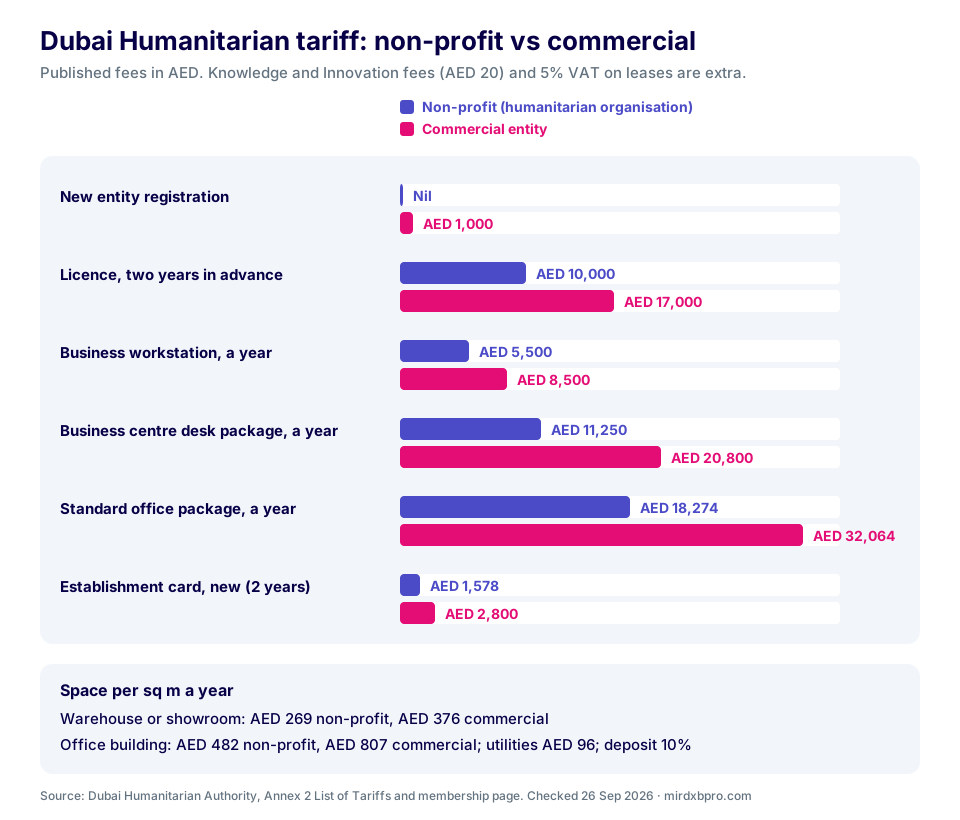
- Licences run for two years. The official tariff lists a new two-year licence at AED 10,000 for non-profits and AED 17,000 for commercial entities, with registration free for non-profits and AED 1,000 for commercial entities.
- An FZ-LLC needs AED 50,000 minimum share capital (Regulations, Art. 93), and humanitarian applicants must show international presence and “impartiality, independence, and neutrality”.
- The Authority itself sponsors members’ staff. Employment visas cost AED 3,000 (normal) or AED 4,500 (express) on the tariff; the standard office package includes two visas.
- Only humanitarian organisations may fundraise, and only with prior approval; commercial entities may not, and direct sales to outside customers are prohibited.
- “International Humanitarian City – Jebel Ali” is on the FTA’s VAT designated zone list, and Dubai Humanitarian describes itself as a qualifying free zone for corporate tax purposes.
International Humanitarian City Dubai is the humanitarian free zone founded by His Highness Sheikh Mohammed bin Rashid Al Maktoum in 2003, by merging Dubai Aid City and Dubai Humanitarian City, and now run as Dubai Humanitarian by the Dubai Humanitarian Authority under Dubai Law No. 1 of 2012. It describes itself as “the only non-profit, independent, humanitarian free-zone Authority” and as the largest humanitarian hub in the world. Its roughly 80 members, including UN organisations, NGOs and commercial suppliers, use about 135,000 to 150,000 sq m of offices and warehouses about ten minutes from Jebel Ali Port and Al Maktoum International Airport to store relief stock and move it to emergencies.
This guide is for organisations deciding whether to register there: international NGOs and foundations opening a regional hub, UN-related bodies, and companies that supply tents, food, medical kits, logistics or services to aid agencies. It sets out who may join, the legal forms, the published tariff, the visa and office rules, tax and compliance. If you are a general business looking at free zones for business setup in Dubai, this zone will not fit unless your business serves the humanitarian sector; our Dubai free zones list compares the alternatives.
Every figure below comes from Dubai Humanitarian’s own website and its published Regulations and annexes (licence activities, tariffs, fines), read on 26 September 2026, plus the federal tax rules. Where the documents are silent, we say so.
International Humanitarian City Dubai at a glance
| Question | Short answer | Official basis |
|---|---|---|
| Current name | Dubai Humanitarian (formerly International Humanitarian City, IHC); ihc.ae redirects to dubaihumanitarian.ae | dubaihumanitarian.ae |
| Authority | Dubai Humanitarian Authority; owned within the Mohammed bin Rashid Al Maktoum Global Initiatives family | Regulations, Art. 2; dubaihumanitarian.ae |
| Legal basis | Law No. 1 of 2012 concerning Dubai Humanitarian; Dubai Humanitarian Authority Regulations (effective December 2025, replacing the 2013 regulations) | Regulations, Arts. 3 and 4 |
| Established | 2003 (merger of Dubai Aid City and Dubai Humanitarian City); moved to its current site in 2011 | dubaihumanitarian.ae “About” |
| Location | Near Al Maktoum International Airport and Jebel Ali Port; Building 4, Dubai Industrial City Complex, Sheikh Mohammed Bin Zayed Road; city office in the Meydan Free Zone building | dubaihumanitarian.ae “Contact” |
| Who may join | Humanitarian organisations (UN, IGOs, NGOs, foundations) and commercial entities serving the humanitarian sector | Regulations, Arts. 5, 10, 11, 13 |
| Legal forms | Branch of a humanitarian organisation; branch of a commercial company; FZ-LLC | Regulations, Arts. 5 and 11 |
| Licence term | Two years | Regulations, Art. 19 |
| Minimum capital | AED 50,000 for an FZ-LLC; shares of at least AED 1,000 | Regulations, Art. 93 |
| Licence fee | Two-year licence AED 10,000 (non-profit) / AED 17,000 (commercial) | Annex 2, Tariffs |
| Visas | Sponsored by the Authority; standard office and business centre packages include 2 visas | Regulations, Art. 41; membership page |
| VAT designated zone | Yes: “International Humanitarian City – Jebel Ali” | Cabinet Decision 59/2017 list |
| Corporate tax | Registration compulsory for all entities; described as a qualifying free zone | Compliance and regulations page |
| Contact | +971 4 577 6308; info@dubaihumanitarian.ae | dubaihumanitarian.ae |
What International Humanitarian City is known for
Dubai Humanitarian’s pitch is logistics for emergencies. From its site, it says, two-thirds of the world’s population living in hazard-prone areas can be reached within four to eight hours, and cargo can move from sea to air “in as little as 10 minutes”. That is why UN agencies and large NGOs keep pre-positioned relief stock there, and why suppliers of relief goods want to sit next to them. Wikipedia, citing earlier reporting, notes that at least eight UN agencies were based there by the 2010s and that UNHCR keeps a global stockpile at the site.
The ecosystem
- About 80 members from more than 68 nationalities, with around 500 people working on site.
- Facilities: offices (about 11,766 sq m) and warehouses (about 93,500 sq m), a semi-automated kitting centre launched in 2020 for assembling relief kits, and a 500 sq m cold-chain facility for vaccines and medical items.
- Services: emergency response coordination, a humanitarian logistics databank, training, and government services for members (visas, establishment cards, NOCs, RTA letters, fundraising approvals).
What makes it different from other free zones
Every other Dubai free zone is built to attract businesses; this one is built to serve humanitarian operations, and it screens members for that purpose. Applications go through “multi layered authorities’ approvals for due diligence”, in the words of its FAQ. The practical consequences are a narrow activity list, a ban on fundraising by commercial members, and rules against selling directly to outside customers. For a supplier whose main customers are aid agencies, those limits cost little and the proximity is valuable. For anyone else, a general zone such as Jafza or Dubai South is the better fit.
Who may join International Humanitarian City Dubai
The Dubai Humanitarian Authority Regulations define two member types and set conditions for each.
Humanitarian organisations
A humanitarian organisation is a branch of a local, international, governmental, non-governmental or non-profit organisation licensed in the free zone, and the definition includes UN agencies (Art. 5). The applicant must be validly registered, inside or outside the UAE (Art. 10), and must show international presence and “impartiality, independence, and neutrality” (Art. 13). Dubai Humanitarian’s members page groups these as UN organisations, specialised agencies, international NGOs, intergovernmental organisations and foundations.
Commercial entities
A commercial entity is either a branch of a commercial company or an FZ-LLC licensed by the Authority (Arts. 5 and 11), and it must “conduct business related to humanitarian activities” (Art. 13). The membership page describes them as “manufacturers and suppliers of goods and services to humanitarian agencies”. Typical members are makers and traders of shelter, water and sanitation equipment, food and nutrition products, medical supplies, vehicles and spare parts, and logistics and freight providers.
Who cannot join
- Individuals: the FAQ says individuals cannot become members; they can only apply for jobs.
- Businesses with no humanitarian link, such as a general consultancy or trading company selling to the public.
- Organisations that cannot show the neutrality and international presence the Regulations require.
The FAQ is also clear that Dubai Humanitarian does not give financial aid to individuals or organisations and does not offer volunteering placements.
Legal forms, capital and liability
| Form | Who uses it | Capital and liability |
|---|---|---|
| Branch of a humanitarian organisation | UN agencies, IGOs, international NGOs, foundations | No share capital; the parent organisation stands behind the branch |
| Branch of a commercial company | A foreign or UAE supplier that wants to operate under its own name | No separate capital; the parent is liable |
| FZ-LLC | A supplier that wants a separate company in the free zone | Minimum issued share capital AED 50,000, shares of at least AED 1,000 (Art. 93); liability limited to capital |
The tariff also lists a fee of AED 5,000 to convert a branch into an FZ-LLC, which suits a supplier that started as a branch and later wants a ring-fenced company. Every entity must keep a registered office in the free zone at all times (Art. 24).
Licence activities: ten segments
Annex 1 to the Regulations groups about 70 activities into ten segments. Only one activity is licensed from one segment unless the Authority explicitly approves more, and adding a segment carries its own fee (AED 1,000 on the tariff).
| Segment | Examples | Open to |
|---|---|---|
| 1. Humanitarian aid and relief | Emergency assistance, food and non-food items, construction and rehabilitation | Both |
| 2. Humanitarian development | Health awareness, education support, microfinance | Both |
| 3. Environmental | Waste management, pollution control, climate programmes | Both |
| 4. Agriculture | Irrigation, agribusiness, equipment supply | Both |
| 5. Coordination and liaison | Representative offices | Both |
| 6. Logistics and warehousing | Shipping, air cargo, warehouse management | Both |
| 7. Professional services | Legal, accounting, event management | Both (with the relevant professional licence in Dubai or the UAE) |
| 8. Retail services | Kiosks, restaurants, cafes | Commercial only |
| 9. Ancillary services | Insurance, banking, e-commerce, fundraising platforms | Commercial only |
| 10. Vehicles and equipment | Auto parts trading, fleet management | Both |
What is prohibited
The Regulations prohibit manufacturing unless approved, and ban flammable and radioactive materials, arms, ammunition, explosives and goods that infringe intellectual property (Art. 26). Direct sales to outside customers are not allowed, though customers may visit the premises (Art. 27). A commercial entity also cannot transfer shares in a way that changes its activity in its first year (Annex 1).
How to register with International Humanitarian City Dubai
Dubai Humanitarian asks applicants to “express your interest” through its humanitarian community portal. The steps below combine that with the Regulations.
| Step | What happens | Official time |
|---|---|---|
| 1. Expression of interest | Online form describing the organisation and its humanitarian activity | Not published |
| 2. Eligibility and due diligence | “Multi layered” approvals; checks on registration, neutrality, international presence or humanitarian link | Not published |
| 3. Activity and space | Segment and activity from Annex 1; office, business centre desk, workstation or warehouse | Not published |
| 4. Registration and licence | Registration (AED 0 / 1,000) and two-year licence (AED 10,000 / 17,000); licence valid two years from issue (Art. 19) | Not published |
| 5. Establishment card | New card AED 1,578 (non-profit) / 2,800 (commercial), valid two years | Not published |
| 6. Visas | Employment visas sponsored by the Authority; medical test and Emirates ID | Normal and express options; times not published |
| 7. Tax and UBO | Corporate tax registration (compulsory for all); UBO filing under Cabinet Decision 109/2023 | Corporate tax within 3 months of licensing (FTA Decision 3/2024) |
Documents for Dubai Humanitarian membership
Dubai Humanitarian does not publish a document checklist on its membership page. From the Regulations’ eligibility conditions and the usual free zone file, expect to provide the following.
Humanitarian organisations
- Proof of legal registration of the parent organisation, and its constitution or statutes.
- Evidence of international presence and humanitarian mandate: annual reports, programme countries, accreditation or partnerships with UN agencies.
- A board or governing body resolution to open the branch, naming the branch manager, with a power of attorney.
- Passport copies of the manager and signatories; UBO or controlling-person details where applicable.
Commercial entities
- For a branch: the parent’s certificate of incorporation, memorandum and articles, good standing, and a board resolution.
- For an FZ-LLC: shareholder passports or corporate documents, proposed share capital of at least AED 50,000, manager details and UBO declaration.
- Evidence of the humanitarian link: contracts, tenders or supplier registrations with UN agencies or NGOs.
- Any professional licence required for segment 7 activities.
Foreign documents usually need legalisation for UAE use. Our document attestation service handles the UAE end, and our UBO register guide covers beneficial ownership.
International Humanitarian City Dubai costs: the official tariff
Dubai Humanitarian publishes a full tariff (Annex 2 to its Regulations) and a simpler package table on its membership page. Both were read on 26 September 2026.
| Tariff line | Non-profit (AED) | Commercial (AED) | Source |
|---|---|---|---|
| New entity registration | Nil | 1,000 | Annex 2 |
| New licence, two years paid in advance | 10,000 | 17,000 | Annex 2 |
| New licence, yearly instalment | 5,000 | 8,500 | Annex 2 |
| Office building, per sq m a year | 482 | 807 | Annex 2 |
| Warehouse or showroom, per sq m a year | 269 | 376 | Annex 2; membership page |
| Open yard, per sq m a year | 32 | 54 | Annex 2 |
| Utilities charge, per sq m a year | 96 | 96 | Annex 2 |
| Business workstation, a year | 5,500 | 8,500 | Annex 2 |
| Standard office package (20 sq m, 2 visas), a year | 18,274 | 32,064 | Membership page |
| Business centre desk package (2 visas), a year | 11,250 | 20,800 | Membership page |
| Establishment card, new / renewal (two years) | 1,578 / 1,678 | 2,800 / 2,900 | Annex 2 |
| Employment visa, normal / express | 3,000 / 4,500 | 3,000 / 4,500 | Annex 2 |
| Employment visa renewal, normal / express | 1,250 / 1,875 | 1,250 / 1,875 | Annex 2 |
| Medical test, standard to VIP | 450 to 810 | 450 to 810 | Annex 2 |
| Licence cancellation | 1,000 | 1,000 | Annex 2 |
| Rent deposit | 10% of the lease, refundable | 10% of the lease, refundable | Annex 2 |
All tariffs carry AED 10 Knowledge and AED 10 Innovation fees; registration services add the Economic Registry fee, and leases attract 5% VAT. Amendments are priced separately: for example, share capital change AED 1,500, share transfer AED 1,000, adding an activity segment AED 1,000, address change AED 250, manager name change AED 500 and licence re-issue AED 500.
What a first year looks like
Using only published lines, a commercial FZ-LLC taking a business centre desk package would pay AED 1,000 registration, AED 17,000 for a two-year licence and AED 20,800 for a year’s desk package, plus the establishment card (AED 2,800) and two employment visas (AED 3,000 each before medicals, Emirates ID and insurance). A non-profit branch taking the same desk would pay no registration, AED 10,000 for two years’ licence, AED 11,250 for the desk, AED 1,578 for the card and the same visa fees. These are illustrations from the tariff, not quotations.
Where the documents differ
The membership page gives warehouse rates per sq m that match the tariff (AED 269 and 376), but it does not say whether the office package prices include the utilities charge and deposit. Confirm the package terms in writing before you sign.
Offices, warehouses and visas at Dubai Humanitarian
| Space | What is included | Visas |
|---|---|---|
| Standard office | 20 sq m, utilities, Wi-Fi, security, meeting facilities, free metro transport | 2 |
| Business centre desk | Hot desk, common services, pantry, minimum 10 hours a week | 2 |
| Business workstation | Priced per year on the tariff | Not published |
| Warehouse, showroom, open yard | Priced per sq m; 10% refundable deposit | Not published; ask the Authority |
Dubai Humanitarian also advertises a two-year licensing option that halves the number of renewals, and help from its government services team with customs and visas.
International Humanitarian City Dubai visas: how residency works
At Dubai Humanitarian the Authority sponsors the staff of both humanitarian organisations and commercial entities (Art. 41). That is different from most free zones, where the company is the sponsor on the establishment card. The employer must pay all visa costs, air fares and processing fees and cannot charge them to employees (Art. 44).
- Employment visas: AED 3,000 normal or AED 4,500 express; renewal AED 1,250 or AED 1,875; in-country and outside-country applications are both offered.
- Visit visas for missions: 14-day visas at AED 450 (normal), one-month at AED 750, three-month at AED 1,500, with express options.
- Non-sponsored staff: allowed only for UAE and GCC nationals, people sponsored by relatives, employees of affiliates, unpaid volunteers and holders of UN diplomatic cards (Art. 42).
- Family: once resident, staff sponsor family through the usual Dubai rules; see our family visa salary guide.
Medical tests are on the Authority’s tariff (AED 450 standard to AED 810 VIP). Emirates ID is handled in the usual way; our Emirates ID services and free zone visa service can support the file.
Banking for Dubai Humanitarian members
Banks treat NGO branches as higher-scrutiny customers under the UAE’s anti-money-laundering rules, so expect questions about the source and use of funds, donor profiles and programme countries. Prepare the licence, the parent’s registration and governing documents, the board resolution, audited accounts, the list of controlling persons and a description of the funds that will flow through the UAE account. Dubai Humanitarian’s government services team issues NOC letters and salary certificates for banks. Our corporate bank account guide covers the general requirements.
Tax, customs and compliance
Corporate tax
Dubai Humanitarian’s compliance page says every registered entity must “register for UAE Corporate Tax without any exception”, and describes the zone as a “qualified free zone” offering “0% Corporate Tax rate on qualifying income”. Under the federal law, a Qualifying Free Zone Person must meet the conditions of Cabinet Decision 100/2023 and earn qualifying income under Ministerial Decision 265/2023; logistics services and distribution of goods from a designated zone are on the qualifying list. Many humanitarian organisations may instead qualify as exempt persons or have no taxable income, which is a question for a tax adviser. See our corporate tax registration guide.
VAT and customs
“International Humanitarian City – Jebel Ali” appears on the FTA’s list of designated zones under Cabinet Decision 59/2017, as amended, and Dubai Humanitarian lists “Designated Free Zone” among member benefits. Goods held there under customs control can be outside the scope of UAE VAT, while services are taxed normally. Relief goods moving out to emergencies are exports; goods entering the UAE market are imports.
Compliance calendar
| Obligation | Rule | Source |
|---|---|---|
| Licence renewal | Apply 60 days before expiry; licence runs two years | Regulations, Arts. 19 and 65 |
| Annual activity report | By 1 February: humanitarian spending, goods, donations and beneficiaries | Regulations, Art. 58 |
| Audited accounts | Within six months of year end, by an auditor from the Authority’s approved list | Regulations, Art. 59 |
| UBO | Federal rules (Cabinet Decision 109/2023) and the Authority’s own UBO regulations | Compliance page |
| AML | Federal Decree-Law 10/2025 and Cabinet Resolution 134/2025 | Compliance page |
| Fundraising | Humanitarian organisations only, with prior approval; commercial entities not authorised | Regulations, Arts. 54 and 55 |
| Economic substance | The compliance page still describes ESR notifications and reports; federal ESR reporting was cancelled for periods after 2022 (Cabinet Decision 98/2024), so confirm what the Authority still expects | Compliance page; Cabinet Decision 98/2024 |
| Inactivity | A licence can be terminated for inactivity beyond 90 days, among other grounds | Regulations, Art. 72 |
Fines
Annex 3 sets first-instance fines by risk level. High-risk breaches, such as failing to renew the licence on time, operating without a licence, letting sponsored staff work for third parties or not reporting absconding within five days, cost AED 500 for humanitarian organisations and AED 1,000 for commercial entities. Medium-risk breaches, such as operating outside the free zone without approval, failing to renew a staff visa, unauthorised fundraising, or missing the activity report or audit deadline, cost AED 200 and AED 400. Low-risk breaches start with a notice. The establishment card late renewal fine is AED 121 a month. A grievance can be filed within 30 days to the Grievances Committee (Art. 77).
Working outside the free zone
Operating outside the free zone without approval is a listed violation, and direct sales to outside customers are prohibited. Programme work happens mostly abroad, which the zone is designed for. A commercial member that wants to sell to customers on the Dubai mainland needs the same routes as any Dubai free zone company: a DET branch or a permit under Executive Council Resolution 11/2025, which the compliance page lists among its rules. For mainland operations, see our free zone vs mainland guide.
Planning a regional hub at Dubai Humanitarian: a practical checklist
Most delays we see come from preparation, not from the Authority. Before you submit an expression of interest, work through these points.
- Decide the member type first. A non-profit branch and a commercial FZ-LLC face different tests, tariffs and fundraising rules. A foundation that also sells goods may need two entities or a clear decision about which activity comes first.
- Pick one activity per segment. Annex 1 licenses one activity from each segment unless the Authority agrees otherwise. Map your programme to the segment list, and budget AED 1,000 for each extra segment.
- Size the space from the stock plan. Pre-positioned stock is measured in pallets and cubic metres, not desks. Warehouse space is priced per sq m (AED 269 or 376 a year) plus AED 96 utilities and a 10% deposit, so a realistic stock plan avoids paying for idle space.
- Start the attestation chain early. The parent’s statutes, registration certificate and board resolution usually need legalisation in the home country before they are accepted in the UAE. This is often the longest step.
- Plan staffing around the sponsorship rules. The Authority sponsors staff, and only listed categories may work without its sponsorship. Seconded UN or international staff and local hires follow different paths, so list them separately.
- Set up reporting from day one. The activity report is due every 1 February and audited accounts within six months of year end. Record humanitarian spending, goods and beneficiaries as you go.
- Clear fundraising before announcing it. Any appeal needs prior approval, even on social media.
International Humanitarian City: pros and cons
| Advantages | Drawbacks |
|---|---|
| Next to Jebel Ali Port and Al Maktoum airport, with sea-to-air transfers in minutes | Only for humanitarian organisations and their suppliers |
| Full tariff and Regulations published, with lower non-profit rates | Due diligence adds time; no official processing times |
| Two-year licence; Authority sponsors staff | No direct sales to outside customers; no fundraising for commercial members |
| Community of UN agencies, NGOs and suppliers; kitting and cold-chain facilities | Annual activity report and audit deadlines, with fines |
| VAT designated zone listing | AED 50,000 minimum capital for an FZ-LLC |
Who it suits
- International NGOs and foundations wanting a regional logistics and coordination hub.
- UN agencies and intergovernmental organisations pre-positioning relief stock.
- Manufacturers and traders of relief goods whose customers are aid agencies.
- Logistics providers serving the humanitarian sector.
Who should look elsewhere
- General traders and distributors: Jafza.
- Air-cargo and e-commerce businesses: Dubai South.
- Consultancies and service firms without a humanitarian customer base: Meydan Free Zone or IFZA.
- Local charities raising funds from the UAE public: the fundraising and charity regulators, not a free zone licence.
International Humanitarian City Dubai in practice: four cases
These cases are built from the situations we see most often. Names and identifying details are left out, and the figures are the published ones.
1. An international NGO opening a regional hub
An NGO registered in Europe wanted to store relief stock for the Middle East and Africa. It applied as a humanitarian organisation branch, with its statutes, annual reports and a board resolution attested for UAE use. It paid no registration fee, AED 10,000 for the two-year licence, and took warehouse space at AED 269 per sq m a year. The Authority sponsored its two staff.
2. A tent manufacturer supplying UN agencies
A manufacturer whose customers were UN agencies and NGOs formed an FZ-LLC with AED 50,000 capital, licensed in the humanitarian aid and relief segment. It paid AED 1,000 registration and AED 17,000 for two years, and took a business centre desk package and a small warehouse. It could not sell tents to walk-in customers or to the public, which did not matter to its model.
3. A consultancy that did not qualify
A management consultancy hoped to register because of the location and low non-profit tariff. Its clients were mostly corporates, so it did not meet the requirement to “conduct business related to humanitarian activities”, and it would not have qualified for non-profit rates anyway. A general free zone was the right route.
4. A foundation that wanted to raise funds
A foundation registered as a humanitarian organisation planned a fundraising campaign. Under the Regulations, only humanitarian organisations may fundraise, and each announcement needs prior approval from the Authority and the relevant authorities. It applied for approval before launching; unauthorised fundraising is a medium-risk violation.
International Humanitarian City myths: what circulates online that is not true
| Claim | The position |
|---|---|
| “Any company can set up in International Humanitarian City.” | Commercial members must conduct business related to humanitarian activities (Regulations, Art. 13). |
| “IHC closed or merged into another zone.” | It operates as Dubai Humanitarian; ihc.ae redirects to dubaihumanitarian.ae. |
| “Licences are renewed every year.” | The licence term is two years (Art. 19); a yearly instalment option exists on the tariff. |
| “NGO branches can fundraise freely in Dubai.” | Only humanitarian organisations may fundraise, with prior approval; commercial entities cannot. |
| “There is no minimum capital.” | An FZ-LLC needs AED 50,000 (Art. 93). Branches have no share capital. |
| “Humanitarian members pay no tax and need no registration.” | All entities must register for corporate tax; whether tax is due depends on status and income. |
How to verify every figure in this guide
| Figure | Where to check it |
|---|---|
| Name, history, size, members | dubaihumanitarian.ae home, “About” and “Freezone” pages |
| Eligibility, forms, capital, licence term, visas, audit, fundraising | Dubai Humanitarian Authority Regulations (effective December 2025) |
| Activities and segments | Annex 1, List of Licence Activities |
| Fees | Annex 2, List of Tariffs; “Become a member” page |
| Fines | Annex 3, List of Fines and Penalties |
| Tax and AML rules | Dubai Humanitarian “Compliance and regulations” page |
| Designated zone | FTA VAT designated zones list |
International Humanitarian City Dubai: how MIRDXB PRO helps
MIRDXB PRO is an independent PRO and business-setup consultancy in Al Barsha 1, Dubai. We are not Dubai Humanitarian or an official partner of the Authority, and it does not list us. We help organisations prepare a clean application and then run the government work that follows.
What we do
- Check whether you fit as a humanitarian organisation or a commercial entity, and which segment and activity to apply for.
- Prepare the application file and coordinate attestation and legal translation of the parent’s documents.
- Budget the licence, space, establishment card and visas from the published tariff.
- Support visas, medicals, Emirates ID and family sponsorship after licensing, through our company formation support and PRO team.
- Prepare corporate tax registration and a calendar for the activity report, audit and renewal deadlines.
How it works
- Message us on WhatsApp with your organisation, registration country and planned activities.
- We reply with a written plan: eligibility view, route, tariff lines, documents and our fee.
- We prepare and check the file before you submit your expression of interest.
- After approval, we support visas and set up your compliance calendar.
What it costs
Dubai Humanitarian’s tariff and all government fees are paid at cost. Our fee is quoted in writing before we start; see our fees page.
Why organisations use us
- We work from the Authority’s own Regulations and tariff and cite them, as this guide does.
- We tell you early if you are unlikely to qualify, before you spend on attestation.
- Our Al Barsha 1 office is open Monday to Thursday and Saturday 09:00 to 18:00 and Friday 09:00 to 12:00; organisations abroad can instruct us under a power of attorney.
For companies choosing between zones, see our business setup service.
What we will and will not do
- We will give you an honest view of eligibility; we cannot influence the Authority’s due diligence or approvals.
- We will prepare and check your documents; we will not present your organisation as something it is not.
- We will explain the tax framework; your exempt or qualifying status needs a tax adviser’s opinion.
Related guides
- Free zones in the UAE
- Dubai free zones list
- JAFZA company setup
- Dubai South free zone company setup
- Corporate tax registration in the UAE
- Corporate bank account in the UAE
- UBO register in the UAE
International Humanitarian City Dubai: frequently asked questions
Is International Humanitarian City the same as Dubai Humanitarian?
Yes. The organisation now calls itself Dubai Humanitarian, and its website says it was “previously known as the International Humanitarian City”. The old ihc.ae address redirects to dubaihumanitarian.ae. It is run by the Dubai Humanitarian Authority under Law No. 1 of 2012, and its current Regulations took effect in December 2025.
Who can join International Humanitarian City Dubai?
Humanitarian organisations, meaning branches of UN agencies, intergovernmental bodies, NGOs, non-profits and foundations that show international presence and neutrality, and commercial entities whose business is related to humanitarian activities, such as suppliers of relief goods and logistics services. Individuals cannot become members.
How much does it cost to register with Dubai Humanitarian?
The published tariff charges no registration for non-profits and AED 1,000 for commercial entities, and a two-year licence of AED 10,000 (non-profit) or AED 17,000 (commercial). A business centre desk package costs AED 11,250 or AED 20,800 a year, and an establishment card AED 1,578 or AED 2,800. Visas, Knowledge and Innovation fees and VAT on leases are extra.
What legal forms can a commercial company use?
A commercial company can register as a branch of its existing company or as an FZ-LLC. An FZ-LLC needs minimum issued share capital of AED 50,000 in shares of at least AED 1,000 each. A branch can later convert into an FZ-LLC for AED 5,000.
How long is a Dubai Humanitarian licence valid?
Two years from the date of issue under Article 19 of the Regulations. Renewal requests are due 60 days before expiry. The tariff also allows the licence fee to be paid in yearly instalments of AED 5,000 (non-profit) or AED 8,500 (commercial).
Who sponsors visas for staff at International Humanitarian City?
The Authority sponsors staff for both humanitarian organisations and commercial entities (Art. 41), and the employer pays all visa costs. Employment visas are AED 3,000 normal or AED 4,500 express. Standard office and business centre packages include two visas. Some staff, such as GCC nationals and UN diplomatic cardholders, may work without sponsorship.
Can a member sell goods to customers in Dubai?
Not directly. The Regulations prohibit direct sales to outside customers, though customers may visit the premises, and operating outside the free zone without approval is a listed violation. Goods for relief operations are shipped out; a commercial member wanting mainland sales needs a separate route such as a DET branch or permit.
Can an NGO fundraise from the Dubai Humanitarian free zone?
Only humanitarian organisations may fundraise, and every campaign or announcement needs prior approval from the Authority and the relevant authorities. Commercial entities are not authorised to fundraise. Unauthorised fundraising is a medium-risk violation carrying a fine.
Is International Humanitarian City a VAT designated zone?
“International Humanitarian City – Jebel Ali” is on the FTA’s designated zone list under Cabinet Decision 59/2017, as amended, and the Authority lists designated free zone status among member benefits. Goods held under customs control can be outside the scope of VAT; services are taxed normally.
Do members pay corporate tax?
Every entity must register for UAE corporate tax without exception, according to the Authority. A commercial member can pay 0% on qualifying income if it meets the Qualifying Free Zone Person conditions; many humanitarian organisations may be exempt or have no taxable income. Take tax advice on your status.
What reports must members file each year?
An annual activity report by 1 February covering humanitarian spending, goods, donations and beneficiaries, and audited accounts within six months of year end from an approved auditor. Missing either is a medium-risk violation fined AED 200 for humanitarian organisations and AED 400 for commercial entities at first instance.
Can MIRDXB PRO help us register with Dubai Humanitarian?
Yes, as an independent consultancy. We assess eligibility, prepare and check the application, coordinate attestation, budget from the published tariff and support visas afterwards. Fees to the Authority are paid at cost, and our fee is quoted in writing. We are not an official partner of Dubai Humanitarian.
Can MIRDXB PRO handle visas for an existing member?
We can support medicals, Emirates ID, family visas and document attestation for staff of existing members, working alongside the Authority’s government services team, which remains the sponsor. Send us your requirements on WhatsApp for a written quote.
Handling attestation, Emirates ID and family visa files for humanitarian staff is part of what our PRO services in Dubai team does every day.
- Dubai Humanitarian (formerly International Humanitarian City): home
- Dubai Humanitarian: About
- Dubai Humanitarian: Free zone
- Dubai Humanitarian: Become a member (packages)
- Dubai Humanitarian: Members
- Dubai Humanitarian: FAQs
- Dubai Humanitarian: Government services
- Dubai Humanitarian: Compliance and regulations
- Dubai Humanitarian Authority Regulations
- Annex 1: List of Licence Activities
- Annex 2: List of Tariffs
- Annex 3: List of Fines and Penalties
- Dubai Humanitarian: Contact
- Federal Tax Authority: VAT designated zones
Checked on 26 September 2026 against Dubai Humanitarian’s website, its Regulations (effective December 2025) and Annexes 1 to 3, and the federal tax rules. The Authority’s approval and its invoice are final.
Please note. This guide is general information, verified 26 September 2026, and is not legal or tax advice. MIRDXB PRO is an independent consultancy and is not affiliated with Dubai Humanitarian, the Dubai Humanitarian Authority or any UN agency. The cases are illustrative, not records of named clients.


