

Key takeaways
- A corporate bank account (UAE) is opened under the Central Bank’s anti-money laundering rules, not under your licence. The bank must identify the company, every beneficial owner and the signatories, and understand where the money comes from, before it lets the corporate bank account transact.
- The rulebook changed recently. Federal Decree-Law No. 10 of 2025 replaced Decree-Law No. 20 of 2018 (in force 14 October 2025), and Cabinet Resolution No. 134 of 2025 replaced Cabinet Decision No. 10 of 2019 (in force 14 December 2025). Guides that still quote only the old texts are out of date.
- Low-risk SME accounts have a three business day target. The Central Bank’s SME Customer Protection Regulation (C 2/2026, in force 13 September 2026) says banks must have systems to open them within three business days of a complete file, and a non-compliance delay may not exceed two weeks. Financial crime checks can lawfully take longer.
- Beneficial owners are traced to real people. Banks identify every individual with 25% or more, or who controls the company another way, and look through every corporate layer in between.
- Minimum balances are set by each bank, not by the Central Bank. Published examples run from nil (with a monthly fee) to AED 50,000 and above; we quote only figures from the banks’ own pages and schedules.
- Refusals are usually about the file, not the founder: unclear ownership, a business profile that does not match the licence, no evidence of real activity or premises, or funds that cannot be traced.
- Complaints go to the bank first, then to Sanadak, the Central Bank’s free ombudsman unit for consumers and SMEs. Sanadak does not review a bank’s anti-money laundering policy itself.
- Keeping the account is ongoing work: renew the licence and Emirates IDs on time, answer periodic reviews, and update the bank after every amendment or ownership change.
A corporate bank account in the UAE is a business bank account held in the name of a licensed company, opened by a bank licensed by the Central Bank of the UAE (CBUAE) only after it has completed customer due diligence on the company, its beneficial owners and its authorised signatories under Federal Decree-Law No. 10 of 2025 and its executive regulation. In practice that means a complete document file, a clear ownership chain, a credible account of where the money comes from and what the company will do, and, for many banks, a meeting or video call with the owners. For low-risk small and medium-sized businesses, the Central Bank now expects accounts to be opened within three business days of a complete application.
This guide covers the whole life of a company bank account: the Central Bank rules that apply, the full KYC document list, beneficial owner and source of funds evidence, meetings and site visits, realistic timelines, published minimum balances and fees, why applications are refused, how to complain, the digital banks, the Dubai Unified Licence channel and how to keep the company bank account open year after year. It is written for founders, investors and SME owners. It is general information, not financial advice, and it does not recommend any particular bank.
The bank account is step 12 of our mainland company formation guide, which shows where it sits in the full route. If you have not chosen a legal form yet, see types of companies in Dubai first, because the form decides which documents the bank asks for. If you would rather hand over the whole set-up, our company formation support team runs it end to end.
Corporate bank account UAE at a glance
The short answers to the questions founders ask most, each with the rule or published page behind it. Every row is explained in detail further down.
| Question | Short answer | Where it comes from |
|---|---|---|
| Who regulates business bank account opening? | The CBUAE, through the AML law, its executive regulation and the CBUAE Rulebook | Decree-Law 10/2025; Cabinet Resolution 134/2025; CBUAE guidance |
| How fast must a bank open a low-risk SME account? | Systems to open it within three business days of a complete file | SME Customer Protection Regulation C 2/2026, Art. 4.46 |
| What if there is a delay not caused by compliance checks? | The bank must explain it; the delay must not exceed two weeks; the bank account may open with limits | C 2/2026, Art. 4.48 |
| Can compliance checks take longer? | Yes. The three-day obligation is waived where the bank is applying financial crime rules, with the reason documented | C 2/2026, Art. 4.46 |
| Who is a beneficial owner? | Each individual owning or controlling 25% or more, or controlling the company another way | CBUAE CDD/KYC guidance; CBUAE legal persons guidance |
| Is there a legal minimum balance for a company bank account? | No Central Bank minimum; each bank sets its own and must give you the fee schedule in writing | C 2/2026, Arts. 4.39 to 4.45; banks’ schedules |
| Can I deposit before the bank account is approved? | Yes, but the funds stay blocked until all checks are done, and the bank must tell you in writing | C 2/2026, Art. 4.51 |
| What if I am refused or ignored? | Complain to the bank (reply within 30 business days), then to Sanadak, which is free for SMEs | C 2/2026, Art. 6; Sanadak |
| How often will the bank review us? | Risk-based; the CBUAE’s example is yearly (high risk), every two years (medium), every three years (low) | CBUAE CDD/KYC guidance, section 3.4.1 |
| When does an unused bank account go dormant? | After three years with no transactions and no contact | Dormant Accounts and Unclaimed Funds Regulation C 9/2025, Art. 2.2 |
Corporate bank account UAE: how MIRDXB PRO helps
We are not a bank, we cannot approve a bank account and we never promise that one will be opened. What we do is make sure the file a bank receives is complete, consistent and easy to approve, because most delays and refusals we see come from gaps between the licence, the memorandum, the owners’ documents and the story the founder tells the bank. We are an Amer and Tasheel partner in Al Barsha 1, Dubai, and we prepare the company’s government records every day, so we can fix those gaps at source rather than work around them.
What we do for your company bank account
- Pre-check the file against CBUAE-style KYC. We compare your licence, memorandum or local service agent agreement, Ejari, establishment card and owners’ documents, and flag every mismatch in names, activities, addresses and shareholdings before a bank sees them.
- Map the beneficial owners. For corporate or layered ownership we draw the chain to the individuals, list the documents each layer needs, and arrange attestation and legal translation of foreign corporate documents.
- Prepare the business profile. We help you write the activity description, expected counterparties, countries and monthly volumes that the bank’s customer profile form asks for, in terms that match your licence.
- Fix the government side. Licence amendments, missing establishment cards, expired Emirates IDs, Chamber membership, corporate tax registration and beneficial owner filings are our daily work.
- Keep the bank account open. We diarise licence renewal, Emirates ID expiry and ownership changes so the bank’s periodic review never finds an expired document.
How it works
- Message us on WhatsApp with your licence (or the one you plan), the owners, where each lives, and how the company will earn and spend money.
- We reply in writing with a gap list: what the banks will ask for, what is missing or inconsistent, what we can fix, and our fee.
- You approve, we correct the government records and assemble the file, and you choose the banks you want to apply to.
- You or your authorised signatory submit to the bank and attend its meeting or video call; we answer follow-up document requests with you until the bank decides.
What it costs
Government fees for any records we fix are passed on at cost, on the authority’s receipt. Bank charges are set by the bank and paid to the bank. Our own fee depends on the legal form, the number of ownership layers and whether documents need attestation, and it is always quoted in writing before we begin. See our fees page for how we price.
Why founders use us
- We publish our sources: every rule and figure on this page links to the Central Bank, the Rulebook, a named bank’s own page or schedule, or an official government portal.
- We cover the government records banks check: DET licences and amendments, GDRFA and ICP establishment cards, MOHRE files, Emirates IDs and tax registration, through our corporate PRO services.
- We tell you when you do not need us: a resident owner with a simple sole establishment and a clean file can often open a digital business bank account alone, and we will say so.
- Owners abroad can give us a power of attorney for the government steps; the bank’s own identification of owners and signatories stays with the bank.
- Our office is in Al Barsha 1, open Monday to Thursday and Saturday 09:00 to 18:00 and Friday 09:00 to 12:00.
The rules behind a corporate bank account in the UAE
No UAE law says “a company must have a bank account”, and no law says a bank must give you one. What the law does is tell banks how to decide. Three layers of rules apply to every business bank account opened onshore, and knowing which one a bank is relying on explains most of what happens to your application.
| Rule | What it does for your company bank account | Status (as read 25 September 2026) |
|---|---|---|
| Federal Decree-Law No. 10 of 2025 on anti-money laundering and combating the financing of terrorism and proliferation | Requires financial institutions to apply customer due diligence and ongoing monitoring, and to refuse anonymous or fictitious-name accounts (Art. 19(1)(b) and (c)) | In force from 14 October 2025 (CBUAE Rulebook); replaced Decree-Law No. 20 of 2018 |
| Cabinet Resolution No. 134 of 2025 (executive regulation) | Sets the detailed CDD steps: what to collect from a legal person, how to identify beneficial owners, when checks may be completed, record-keeping for at least five years | In force 14 December 2025; replaced Cabinet Decision No. 10 of 2019 |
| CBUAE Guidance on Customer Due Diligence/Know Your Customer and Record-Keeping | Explains how banks should verify companies, trace ownership, assess source of funds and wealth, and run periodic reviews | In force from 7 November 2025 |
| CBUAE Guidance for Licensed Financial Institutions Providing Services to Legal Persons and Arrangements | Ownership chains, nominees, shell company red flags | In force from 7 June 2021 |
| CBUAE Guidance on Digital Identification for CDD | Allows non-face-to-face identification of individuals using reliable digital ID (UAE PASS, ICP’s validation gateway) | In force from 31 October 2022 |
| SME Customer Protection Regulation (Circular C 2/2026) | Account opening timelines, disclosure of document requirements, fees, closure fees, complaints | In force 13 September 2026; cancelled the SME Market Conduct Regulation C 1/2021 |
| Dormant Accounts and Unclaimed Funds Regulation (C 9/2025) | When a company account becomes dormant and what the bank must do first | In force 31 December 2025 |
| Cabinet Decision No. 109 of 2023 (beneficial owner procedures) | Your company’s own beneficial owner register, filed with the licensing authority; banks compare it with what you tell them | In force; see our UBO register guide |
Many pages still describe account opening under Federal Decree-Law No. 20 of 2018 and Cabinet Decision No. 10 of 2019, and quote the SME Market Conduct Regulation’s softer wording that banks “should seek” to open low-risk accounts in three business days. All three have been replaced. The substance of customer due diligence did not change much, but the SME timing rule is now written as “must have appropriate systems in place”, and banks must document and explain delays.
What the Central Bank’s SME regulation says about opening a company bank account
The SME Customer Protection Regulation applies to “all Banks and Finance Companies licensed by the Central Bank” (Scope), including Islamic banks, when they deal with a “Customer”, which it defines as a small or medium-sized enterprise, including sole proprietors. The “Bank Account” it protects is “a transactional basic business account that allows the making of payment, deposit and withdrawal of funds”. Its bank account opening clauses are short and worth reading in full.
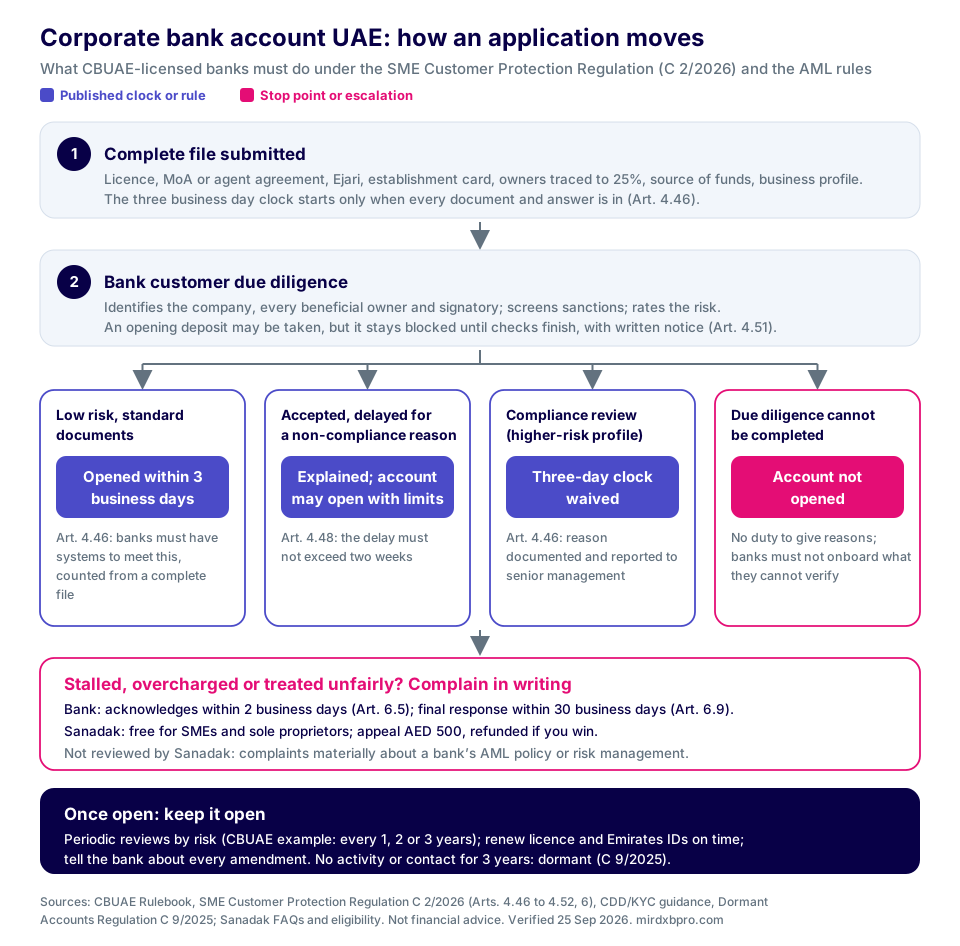
- Three business days, for low-risk files (Art. 4.46). Banks “must have appropriate systems in place to ensure that the opening of a Customer Bank Account is completed within three (3) business days” where the bank has assessed the applicant as presenting low money laundering and terrorist financing risk and “is satisfied with standard Customer due diligence documentation”. The clock runs from the day you made the request “and has provided all documents and information necessary”.
- The compliance waiver (Art. 4.46). “The obligation to open a Bank Account within three (3) business days is waived where the Financial Institution is adhering to the UAE’s Financial Crime Compliance requirements.” The bank must document the reason and report it to senior management.
- Other delays: two weeks at most (Art. 4.48). If the application is accepted but something other than compliance holds it up, the bank “must explain the delay to the Customer and document the reason”. It may open the bank account for a low-risk customer and give you the account number, with limits on transactions, transfers, remittances or cheques until the issue is fixed. “The delay in opening the Bank Account must not exceed two (2) weeks.”
- Clear document lists (Art. 4.49). Banks must have “clear, transparent and consistent disclosure regarding the minimum documentary requirements” for opening and for ongoing due diligence.
- Opening does not mean transacting (Art. 4.50). A bank account can be opened while transactions stay restricted until all due diligence is complete.
- Blocked deposits (Art. 4.51). A bank may take your opening deposit, but the funds “must be blocked” until everything is fulfilled, and it must tell you so in writing and get your confirmation.
- A register of every request (Art. 4.52). Banks record requests received through all channels, including rejected applications “and the reasons for rejection”.
- No discrimination (Arts. 4.31 and 4.32). Banks must “avoid rejection of the application … based on discriminatory grounds”.
Two practical points follow. First, the three days only start when your file is complete, so an incomplete file has no clock at all. Second, “low risk” is the bank’s own assessment. A company with foreign corporate shareholders, cash-heavy activities or cross-border trade is unlikely to be assessed as low risk, and its opening will follow the compliance route with no fixed deadline.
Is your company an SME for these rules?
The regulation borrows the federal SME definition in Cabinet Resolution No. 22 of 2016, which classifies micro, small and medium businesses by number of employees and annual turnover, with different thresholds for trading, manufacturing and services. Almost every newly licensed company applying for its first business bank account falls inside it. Large corporates, and banks that are not licensed by the CBUAE, fall outside: banks in the DIFC and ADGM are supervised by their own financial regulators, so the CBUAE’s SME regulation and Sanadak do not cover bank accounts held there.
Why the bank decides on a corporate bank account (UAE rules), not the licensing authority
Your trade licence proves the company exists and may carry on its activity. It does not prove who is behind it, where the money comes from or whether the activity matches what will pass through the business bank account. The AML law puts those questions on the bank, with heavy penalties for getting them wrong: law firm summaries of Decree-Law No. 10 of 2025 report administrative penalties of up to AED 5 million for supervised institutions, and fines for corporate offenders of AED 5 million to AED 100 million. That is why the same company bank account application can be accepted by one bank and declined by another: each applies the same law through its own risk appetite.
The same logic applies when due diligence cannot be finished. The UAE’s AML framework has long said a bank must not start or continue a relationship it cannot complete due diligence on, and should consider reporting it to the Financial Intelligence Unit. The CBUAE guidance puts it simply: banks “should not establish or maintain relationships with customers who are unable or unwilling to provide required CDD/KYC information” (section 3.1).
Documents for a corporate bank account (UAE): the full KYC list
The CBUAE does not publish one national checklist; Art. 4.49 of the SME regulation instead obliges each bank to disclose its own minimum document list. The lists overlap heavily because they all implement the same due diligence rules. The CBUAE CDD guidance says a bank verifying a legal person should obtain its corporate name, legal form and incorporation documents, principal business address and UAE representative, ownership structure and beneficial owners, senior management and authorised signatories, and the nature of the business and the countries it operates in.
The table below combines that with the published lists of named banks. ADCB’s business bank account pages ask for a “valid trade license, power of attorney (if applicable) and a valid tenancy contract”. Habib Bank AG Zurich’s UAE business bank account checklist (April 2024) is one of the fullest published: trade licence, tenancy agreement, passport copies for all signatories and beneficial owners, visa pages and Emirates IDs for residents, CRS and US-person self-certifications, a notarised power of attorney if used, bank statements, address evidence, audited financial statements if available, the memorandum and articles, an authority to open the bank account, a site visit report with pictures and a customer profile form.
| Whose document | What banks usually ask for | Common problem |
|---|---|---|
| The company | Trade licence; commercial register extract; memorandum and articles of association (or local service agent agreement); Chamber certificate; Ejari or tenancy contract; establishment card; tax registration number once issued | Activities, company name or address differ between the licence, the MoA and the Ejari |
| Each individual owner of 25% or more | Passport; UAE visa and Emirates ID if resident; proof of residential address; CV or profile; source of wealth evidence | Non-resident owner with no UAE address or local bank history |
| Each corporate shareholder | Certificate of incorporation, articles, register of shareholders and directors, board resolution, good-standing certificate; attested and translated where foreign | One layer missing, so the bank cannot reach the individuals at the top |
| Manager and authorised signatories | Passport, Emirates ID, visa; the MoA clause or board resolution appointing them; power of attorney if someone signs for an owner | Signatory named on the application is not the manager in the MoA |
| The business | Company profile or business plan; expected monthly turnover, cash, countries and counterparties; contracts, invoices or letters of intent; website and social media | Generic plan that could describe any company; activity differs from the licence |
| Tax and reporting forms | CRS and FATCA self-certification for the company and controlling persons | Forms left blank for “passive” entity status |
Two items catch many founders out. The first is the tax registration number: the CBUAE Rulebook’s text of the new executive regulation lists a tax registration number among the data to collect from a legal person, so register for corporate tax on time (see our corporate tax registration guide) and give the bank the TRN as soon as it issues. The second is the Ejari: a bank will compare the tenancy contract with the licence address, and some banks inspect the premises. Our office space for a trade licence guide explains what premises a Dubai licence needs.
Company bank account documents by legal form
The legal form changes the constitutional document the bank reads to understand who owns and controls the company. Pick the row that matches your licence.
| Legal form | Constitutional document the bank reads | Who usually signs | Extra items |
|---|---|---|---|
| Mainland LLC (one owner or several) | Attested memorandum of association in Arabic (and translation) | Manager(s) named in the MoA | Shareholder resolution to open the bank account if the MoA is silent on banking powers |
| Sole establishment or civil company (professional) | Licence; local service agent agreement if the owner is foreign | The owner | Some banks ask to meet the service agent or see the agreement terms |
| Branch of a foreign company | Parent’s incorporation documents, board resolution appointing the manager, MOET registration | Branch manager per the parent’s resolution | Parent’s audited accounts and group structure chart |
| Free zone company | Certificate of incorporation, share certificates, register of directors and shareholders issued by the free zone | Director(s) | Free zone lease or flexi-desk agreement |
| Company under formation | Initial approval or free zone letter confirming name, shareholders and directors | Proposed manager | Some banks accept capital placement against a letter; the bank account is released when the licence issues |
Detail on each form is in our guides to the memorandum of association, the local service agent, the professional licence and a branch of a foreign company. Foreign corporate documents need legalisation and Arabic translation before most banks accept them; our document attestation service and legal translation service handle both.
Beneficial owners: how banks trace them
The CBUAE legal persons guidance, quoting the AML regulation, tells banks to “obtain and verify the identity of all individuals who, individually or jointly, have a controlling ownership interest in the legal person of 25% or more”. The newer CDD guidance adds that “the UBO of a legal person or arrangement should be an individual”, and that ownership must be traced through every intermediate company until individuals are reached. Where no one reaches the threshold, the bank identifies whoever exercises control by other means; where no one does, it records the senior managing official.
In practice, for your company bank account this means:
- Every layer must be documented. If a Dubai LLC is owned by a holding company in one country, which is owned by a trust or another company elsewhere, the bank wants the constitutional documents and registers for each level.
- Control counts, not only shares. A person who holds 10% but can appoint the manager or veto decisions may be treated as a beneficial owner.
- Nominees are a red flag. The legal persons guidance asks banks to identify nominee shareholders and directors. Cabinet Resolution No. 134 of 2025 defines nominees and, per law firm summaries, requires nominee status to be disclosed. If someone holds shares for another person, say so and document it.
- Your register must match. Every mainland company keeps a beneficial owner register and files it with the licensing authority under Cabinet Decision No. 109 of 2023. Banks increasingly compare the two. A mismatch is one of the fastest ways to a refusal; our UBO register guide explains the filing.
Source of funds and source of wealth
The CBUAE CDD guidance separates two questions. Source of funds is the direct origin of the money that goes into the company bank account: the owner’s capital injection, a customer’s payment, a loan. Source of wealth is how the owners built their overall net worth: salary over a career, a business sold, an inheritance, investments. Banks ask about source of funds for every corporate bank account and about source of wealth for higher-risk owners, and the guidance lists as red flags generic answers such as “inheritance” with no documents, a declared wealth that does not fit the person’s profile, and funds from sanctioned jurisdictions.
| Money going into the bank account | Evidence banks usually accept |
|---|---|
| Owner’s first deposit or capital | Owner’s personal bank statements showing the funds, plus how they were built (salary slips, sale deed, dividend records) |
| Parent company funding a subsidiary or branch | Parent’s board resolution, audited accounts and bank statement for the transfer |
| Customer receipts | Signed contracts, purchase orders, invoices, letters of intent from named clients |
| Investor or shareholder loan | Loan agreement, the investor’s identity and source of wealth |
The business profile: why accuracy matters more than ambition
Every bank asks for an expected bank account profile: monthly credits and debits, cash deposits and withdrawals, main countries, main customers and suppliers, and the products or services involved. Founders are tempted to inflate these numbers to look substantial. Do not. The executive regulation requires banks to monitor transactions for consistency with what they know about the customer, and the CBUAE guidance lists business model shifts and changes in activity as triggers for review. A business bank account that turns over ten times the declared figure, or receives money from a country you never mentioned, generates alerts, questions and sometimes restrictions.
A good profile names your first customers or suppliers and matches the activities on your licence. To add activities later, amend the licence first; our trade licence amendment guide explains how.
Meetings, video calls and site visits
No CBUAE rule we could find requires company owners to attend a branch in person to open a company bank account. The CBUAE digital identification guidance allows non-face-to-face identification of individuals using reliable digital ID, naming UAE PASS and the validation gateway of the Federal Authority for Identity and Citizenship, and says such onboarding “may present a standard level of risk, and may even present a lower level of risk” with higher assurance levels. It is explicitly limited to natural persons and does not cover how a bank identifies a legal person’s representatives or beneficial owners.
So the choice is the bank’s. What we see most often:
- Resident owners and signatories with Emirates ID and UAE PASS can often complete digital onboarding, especially at digital banks.
- Traditional banks usually hold a meeting or video call with the owners and signatories, and ask questions about the business, the customers and the source of funds. Treat it as an interview: the answers are recorded and compared with the file.
- Non-resident owners are often asked to attend once in person, or to be identified at a branch of the same bank group abroad where one exists.
- Some banks send an officer to the premises. Habib Bank AG Zurich’s published checklist includes a “Site Visit Report with pictures”. An empty or shared office that does not match the Ejari invites questions; the CBUAE legal persons guidance lists “lack of employees or physical presence” and “use of mailbox addresses” among shell company indicators.
How to open a corporate bank account in the UAE, step by step
The order below is the one that avoids the most common delays. Steps 1 to 3 happen before you approach any bank; most refusals trace back to one of them.
- Finish the government records first. Licence issued, MoA attested, Ejari registered, Chamber membership, immigration establishment card, and the owners’ and signatories’ residence visas and Emirates IDs where they are moving to the UAE. A bank will not open a corporate bank account on documents that are about to change. Our establishment card guide covers the card most banks ask to see.
- Make every document tell the same story. Same company name spelling, same address, same activities, same shareholders and percentages, same manager, across the licence, MoA, Ejari, establishment card and beneficial owner register.
- Prepare the ownership chart and evidence pack. One page showing every owner and layer to the individuals, with percentages; source of funds evidence for the opening deposit; contracts or letters of intent; a short company profile.
- Choose the bank for your profile. Compare published minimum balances, fees, whether they serve your activity and owners’ nationalities, WPS salary payments, cash handling, trade finance and multi-currency needs (see the comparison section below).
- Apply through the bank’s channel. Online or in the app for digital products; through a relationship manager or branch for traditional accounts. Ask for the bank’s written document list, which Art. 4.49 of the SME regulation obliges it to disclose.
- Attend the meeting or video call. Owners and signatories answer questions about the business, customers, suppliers, countries and funds. Bring originals if asked.
- Answer follow-up requests quickly and completely. The three business day target counts only from a complete file. Partial answers restart the cycle.
- Receive the decision and activate the company bank account. Online banking, signatory rights, cards and cheque books. Any opening deposit is released once checks are complete (Art. 4.51).
- Connect the bank account to the rest of the company. Register it for WPS salary payments with MOHRE (see our WPS guide), give the IBAN to the tax authority and suppliers, and diarise the renewal dates the bank will check.
Timeline for a company bank account: what the rules say and what to plan for
| Situation | Published clock | Source |
|---|---|---|
| Low-risk SME, standard documents, complete file | Systems to open within 3 business days of the complete request | C 2/2026, Art. 4.46 |
| Accepted, but delayed for a reason other than compliance | Explained in writing; account may open with limits; delay not more than 2 weeks | C 2/2026, Art. 4.48 |
| Higher-risk profile or compliance review | No fixed deadline; the bank must document why the 3-day rule is waived | C 2/2026, Art. 4.46 |
| Accounts opened through the Dubai Unified Licence service provider project | Average fell from 65 days to 5 days | Government of Dubai Media Office, 12 November 2025 |
| Wio Business (digital bank) | Account “in 3 working days”, as advertised | Wio business page, read 25 September 2026 |
| Bank complaint | Acknowledged within 2 business days; final response within 30 business days | C 2/2026, Arts. 6.5 and 6.9 |
For planning, count from a complete file, not from first contact. A resident owner with a simple LLC and a clean file can expect the regulation’s clock to apply. Foreign corporate shareholders, a general trading licence or non-resident owners mean weeks, so run the bank stage alongside the licence stage, before the three-month corporate tax deadline and the first payroll.
The Dubai Unified Licence banking channel
Every Dubai business, mainland and free zone, now has a Dubai Unified Licence (DUL), described by the Government of Dubai Media Office as “a unique, government-verified digital identity”. On 12 November 2025 the Media Office reported that DUL’s service provider project, launched in October 2024 by the Dubai Business Registration and Licensing Corporation under DET, had cut “the average time required to open a business bank account by 90% – from 65 days to just five”, with more than 3,000 new business accounts opened and over 134,000 business banking profiles updated. It named seven integrated banks: Emirates Islamic, Mashreq, Commercial Bank of Dubai, First Abu Dhabi Bank, Emirates NBD, Emirates Development Bank and Ruya.
The announcement does not describe the application route or what data is shared, so we do not guess. In practice, if you hold a Dubai licence, ask the banks you shortlist whether your business bank account application can use your DUL record; verified licence data means fewer documents to upload and fewer mismatches. It does not replace the bank’s own due diligence on owners and funds.
Choosing a bank for your business bank account
The Central Bank’s register of licensed institutions lists the UAE’s national and foreign banks. Among the national banks it lists are the large Dubai and Abu Dhabi groups, Islamic banks, and newer digital-first banks such as Wio Bank and Zand Bank, plus Ruya Community Islamic Bank, a specialised Islamic bank. Wio’s and Zand’s own sites state that each is licensed by the Central Bank of the UAE. Being CBUAE-licensed matters: the SME regulation’s timelines and fee rules, and Sanadak’s complaint route, apply only to banks and finance companies the CBUAE licenses.
| What to compare | Why it matters for your company bank account |
|---|---|
| Minimum balance and fall-below fee | A new company’s balance often dips in the first months; a zero-balance product with a flat fee may cost less |
| Who the product is for | Some products are limited by legal form, turnover or owner residence; Mashreq’s Express Business Account, for example, lists “Sole proprietors (Non POA) only” and turnover up to AED 10 million |
| WPS and payroll | Mainland employers pay salaries through WPS; check the bank or its partner handles it |
| Cash handling | Cash-heavy activities need deposit machines or branches and draw closer monitoring |
| International payments | Per-transfer fees and currencies differ widely between plans |
| Trade finance and cheques | Letters of credit, guarantees and cheque books are often limited on digital-only accounts |
Digital banks and digital business bank accounts
A digital-first business bank account suits resident owners with simple structures. Wio’s business page advertises accounts opened “in 3 working days”, with an Essential plan at AED 99 a month for “freelancers & small businesses” and a Grow plan at AED 249 a month for “medium & large businesses”; the page does not state VAT treatment, so check the key fact statement. Mashreq’s NeoBiz Lite is a “zero balance account” at AED 200 a month. Zand Bank says it is “licensed by the Central Bank of the UAE” but its home page did not show SME account pricing when we checked. Eligibility for each depends on legal form, owners and activity: read the bank’s own page before applying, and expect the same due diligence as a traditional bank, delivered through an app.
Minimum balances and fees: published figures only
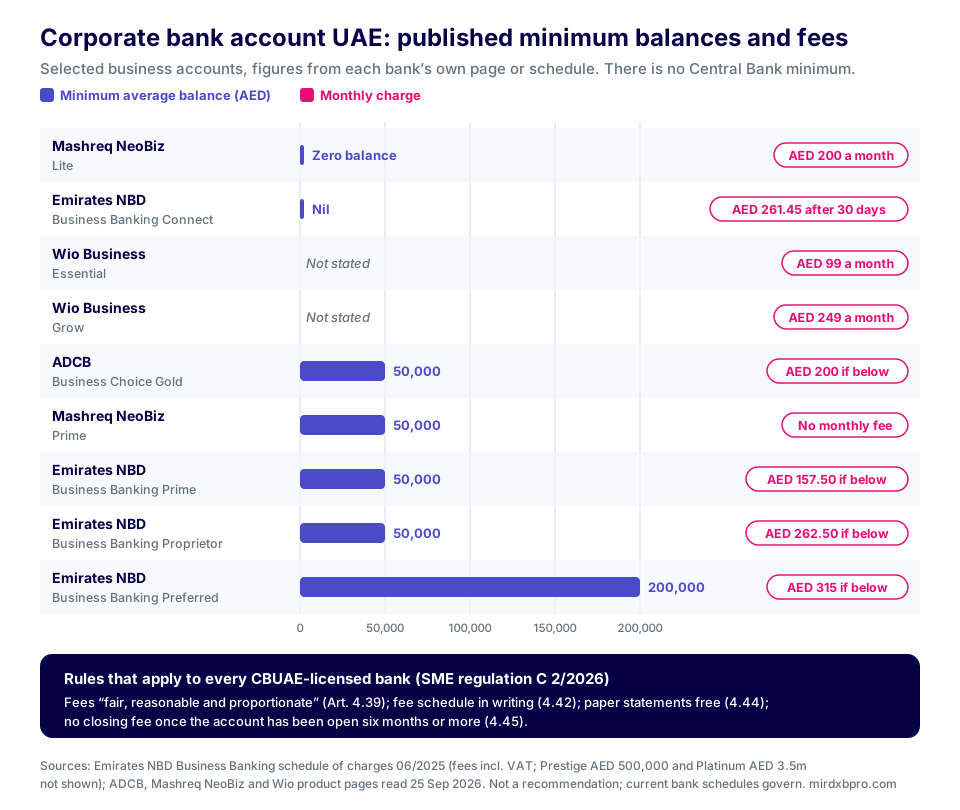
There is no Central Bank minimum balance for a company bank account. Each bank sets its own, and the SME regulation governs how fees are charged: they “must be fair, reasonable and proportionate” (Art. 4.39); the bank must give you “a schedule of applicable Fees in Writing” (Art. 4.42); original paper statements are free (Art. 4.44); and a bank “must not impose a closing Fee / penalty where the Bank Account has been open for a period of six (6) months or more” (Art. 4.45). The table below shows only figures published by the banks themselves, as read on 25 September 2026. Products and prices change; the bank’s current schedule and key fact statement govern.
| Bank and product | Minimum balance (published) | Charge (published) | Source |
|---|---|---|---|
| Emirates NBD Business Banking Connect | Nil | First 30 days free, then AED 261.45 maintenance fee | Emirates NBD Business Banking schedule of charges, 06/2025 |
| Emirates NBD Business Banking Proprietor | AED 50,000 monthly average relationship balance | AED 262.50 a month if not maintained | Same schedule |
| Emirates NBD Business Banking Prime | AED 50,000 | AED 157.50 a month if not maintained | Same schedule |
| Emirates NBD Business Banking Preferred | AED 200,000 | AED 315 a month if not maintained | Same schedule |
| Emirates NBD Business Banking Prestige / Platinum | AED 500,000 / AED 3,500,000 | AED 787.50 / AED 1,575 a month if not maintained | Same schedule |
| ADCB Business Choice Current Account, Gold | AED 50,000 minimum average balance a month | AED 200 a month if below | ADCB product page |
| Mashreq NeoBiz Lite | Zero balance | AED 200 a month | Mashreq NeoBiz pages |
| Mashreq NeoBiz Prime | AED 50,000 monthly average balance | No monthly fee | Mashreq Express Business Account page |
| Wio Business Essential / Grow | Not stated on the page | AED 99 / AED 249 a month | Wio business page |
Emirates NBD’s schedule states that its fees include VAT, and lists an account closure fee of AED 105 for most business packages if the bank account is closed within six months (AED 525 Prestige, AED 1,050 Platinum), with no charge if closed within 14 days of opening. ADCB’s Silver business bank account, at AED 10,000, was shown as discontinued for new customers from 20 May 2026, so it is not in the table. We do not quote balances from comparison sites or agents: if a figure is not on the bank’s own page or schedule, it is not here.
Why corporate bank account (UAE) applications are refused, and how to fix each
Banks rarely publish why they decline a file, and there are no official refusal statistics. The reasons below are the patterns we see in files we are asked to repair, matched to the CBUAE’s own red flags and due diligence expectations. Almost all of them are fixable before you apply.
| Reason | Why the bank cares (rule or guidance) | Fix before applying |
|---|---|---|
| Incomplete or inconsistent documents | Banks must not proceed where CDD cannot be completed; the three-day clock never starts (C 2/2026, Art. 4.46) | Align licence, MoA, Ejari, cards and UBO register; submit the full list at once |
| Ownership chain not traceable to individuals | The beneficial owner “should be an individual” (CBUAE CDD guidance) | Provide registers and resolutions for every layer, attested and translated |
| Nominee or undisclosed controller | Legal persons guidance: identify nominee shareholders and directors | Disclose the arrangement and document it; restructure if needed |
| No evidence of real activity | Shell company indicators: no employees or physical presence, mailbox addresses, rapid formation then inactivity (legal persons guidance) | Real premises matching the Ejari, contracts or letters of intent, a website, staff or hiring plan |
| Profile does not match the licence | Transactions are monitored against the customer profile | Amend the licence to add activities before you trade in them |
| Source of funds unexplained | Generic or undocumented source of wealth is a red flag (CDD guidance) | Bank statements and documents showing how the deposit was built |
| Higher-risk activity or countries | Sector guidance for real estate and precious metals; sanctions screening; high-risk jurisdictions | Explain controls, counterparties and flows in writing; expect enhanced due diligence |
| Politically exposed owner | Enhanced due diligence and senior management approval for PEPs | Declare it up front; provide source of wealth evidence |
| Adverse history | Previous account closures, negative news, unpaid debts | Explain openly; hiding it is worse than the history itself |
| Owners not yet resident | Harder to verify identity and address; no UAE PASS | Complete residence visas and Emirates IDs first, or choose a bank that onboards non-residents |
High-value activities such as general trading attract more questions because they move goods and money across borders; our general trading licence guide covers the licence side. The CBUAE has published separate guidance for banks serving the real estate and precious metals and stones sectors, and dealers in those sectors should expect closer review.
Can a bank refuse without giving a reason?
The regulation does not require a bank to give an applicant its reasons for declining a bank account. It does require the bank to record “rejected applications and the reasons for rejection” internally (Art. 4.52), to explain non-compliance delays to you (Art. 4.48), and not to refuse on discriminatory grounds (Art. 4.32). If a refusal is linked to a suspicion report, the AML law forbids the bank from telling you. If you complain, the bank’s final response must “clearly accept or reject the validity of the Complaint” and give “detailed reasons for the rejection” of the complaint (Art. 6.10).
The practical route after a refusal is to ask the bank, politely and in writing, whether any documents were missing or inconsistent, fix what you can, and apply to a bank whose risk appetite fits your profile. Applying to many banks at once with the same unfixed file rarely helps.
Complaints: the bank first, then Sanadak
- Complain to the bank in writing. It must acknowledge “within two (2) business days” with a reference number (Art. 6.5) and send a final response within 30 business days (Art. 6.9). The final response must tell you about escalation to “the Ombudsman Unit (Sanadak)” (Art. 6.10).
- Escalate to Sanadak if unresolved. Sanadak is “an independent financial unit, established by the Central Bank of the UAE to resolve consumer complaints … free of charge” (u.ae). Its FAQ confirms complaints are “free to file for Consumers and SMEs”; only natural persons, sole proprietors and SMEs can file.
- Know what it will not review. Sanadak’s eligibility page excludes complaints that “materially relate to an LFI or Insurance Company’s risk management, internal pricing policy, or anti-money laundering policies”, matters before a court, and matters already settled. A refusal driven by the bank’s AML risk assessment will usually fall outside it; a delay beyond the regulation’s clocks, an unfair fee or discriminatory treatment may fall inside.
- Appeal if needed. A Sanadak decision can go to its appeals committee for AED 500, refunded if the appeal succeeds; the committee aims to decide within twenty working days.
Sanadak’s contact number is 800 72 623 25 (800SANADAK). One point where official sources differ is how long you must wait after complaining to the bank before going to Sanadak; see the table of disagreements below.
Keeping your corporate bank account (UAE): KYC refresh, renewals and changes
Opening the company bank account is the easier half. Banks are required to keep customer information “up to date and relevant”, and the CBUAE CDD guidance gives an example of periodic reviews “annually for customers rated as high risk; … every two years for customers rated as medium risk; and … every three years for customers rated as low risk” (section 3.4.1), with event-driven reviews in between. What triggers restrictions in practice:
- An expired trade licence. Renew within the last month before expiry (Dubai Law 13/2011, Art. 8(b)) and send the bank the renewed licence. See our trade licence renewal guide and, if it has already lapsed, our expired trade licence guide.
- Expired Emirates IDs or passports of signatories and owners. Many banks restrict online banking until the new ID is uploaded.
- Ownership, manager or activity changes. Each licence amendment should be followed by the attested MoA amendment, the updated UBO register (changes within 15 days under Cabinet Decision 109/2023) and a notice to the bank with the new documents.
- Unexplained changes in activity. Large new flows, new countries or cash deposits that do not fit the profile lead to questions; tell the bank in advance when the business genuinely changes.
- Unanswered review requests. The CBUAE guidance lets a bank that cannot complete its review impose “sufficient restrictions on customer’s account(s)” and “work towards reducing the balance to zero”, which in practice means an exit.
- Dormancy. Under the Dormant Accounts and Unclaimed Funds Regulation (C 9/2025), a company bank account with no transactions or customer contact for three years becomes dormant; before transferring funds the bank must try to contact you and wait three months for a reply.
Annual audited accounts matter too: every LLC needs an auditor (Commercial Companies Law, Art. 102), and banks use the audited statements at review. Keep corporate tax and VAT filings current, because banks increasingly ask for them. Our trade licence renewal service and WPS compliance service keep the government side current.
Free zone and offshore companies: what differs
Free zone companies open a business bank account with the same CBUAE-licensed banks under the same AML rules. The documents differ: a certificate of incorporation, share certificates and a register of directors and shareholders issued by the free zone, instead of a DET licence and MoA. A flexi-desk or shared-office package can raise the substance questions described above, so have contracts and evidence of activity ready. For the choice between the two routes, see our free zone vs mainland comparison. A bank account held in the DIFC or ADGM is regulated by those centres’ own regulators, not by the CBUAE’s SME regulation.
Offshore companies (non-resident entities registered in a UAE offshore registry) have no trade licence to operate in the UAE and usually no premises, staff or local owner. Banks treat them as higher risk and ask for full evidence of the business abroad and of the owners’ wealth. Some banks do not onboard them at all. If an offshore company needs to trade in the UAE, a licensed mainland or free zone entity is usually the better answer.
What circulates online that is not true
| Claim | What the rules and published pages say |
|---|---|
| “The Central Bank sets a minimum balance of AED 50,000 for a company bank account” | No CBUAE minimum exists; each bank sets its own, from nil (with a fee) upward |
| “Banks must open your bank account in three days” | Only for low-risk SME files with standard documents, from the day the file is complete; compliance checks waive the clock (Art. 4.46) |
| “With a licence, the bank has to accept you” | No rule obliges a bank to onboard any company; banks must not open a bank account they cannot complete due diligence on |
| “An agent can get your bank account approved for a fee” | Only the bank decides; nobody outside it can guarantee approval |
| “You can complain to Sanadak about any refusal” | Complaints materially about a bank’s AML policy or risk management are excluded |
| “Closing a new account always costs a penalty” | No closing fee once the bank account has been open six months or more (Art. 4.45) |
Where official sources are silent or disagree
| Point | What we found | How we handle it |
|---|---|---|
| Waiting time before going to Sanadak | Sanadak’s FAQ and eligibility page: 15 calendar days after complaining to the bank; u.ae: 30 calendar days; the SME regulation gives banks 30 business days for a final response | Complain to the bank, then escalate once Sanadak’s own threshold is met; keep all dates in writing |
| A national corporate account document list | None published; each bank discloses its own (Art. 4.49) | We combine the CBUAE’s CDD elements with named banks’ lists |
| How the DUL banking channel works | Media Office gives results and banks, not the application steps | Ask your shortlisted banks whether they can use your DUL record |
| Details of Cabinet Resolution No. 134 of 2025 | Effective date and repeal confirmed; its official PDF could not be opened from our tools, so some detail relies on the CBUAE Rulebook and law firm summaries | Article-level quotes are taken from the Rulebook and CBUAE guidance instead |
How to verify every figure on this page
| Figure or rule | Where to check it yourself |
|---|---|
| Three business days, two weeks, blocked deposits, fees | CBUAE Rulebook, SME Customer Protection Regulation, Article 4 |
| Complaint clocks | CBUAE Rulebook, same regulation, Article 6 |
| Sanadak rules and fees | sanadak.gov.ae, FAQs and complaint eligibility |
| Beneficial owner threshold and review cycles | CBUAE Rulebook, CDD/KYC guidance and legal persons guidance |
| Business bank account minimum balances and fees | The bank’s own product page, schedule of charges and key fact statement |
| Whether a bank is licensed | CBUAE register of licensed financial institutions |
Worked cases: company bank account files we see most often
These cases are built from the situations we see most often. Names and identifying details are left out, and the figures are the published ones.
Case 1: a resident founder with a one-person LLC
A Dubai resident with a UAE salary history licenses a one-person mainland LLC for consultancy, with an office Ejari and an attested MoA naming herself as manager. Her file is standard and low risk. She applies for a business bank account at one digital bank and one traditional bank. The digital bank opens within its advertised window; the traditional bank asks for a meeting and contracts, then opens. Her main decision was cost: a zero-balance plan with a flat monthly fee against a package needing an AED 50,000 average balance she could not yet keep.
Case 2: two foreign partners, one through a holding company
A Dubai LLC is owned 60% by a holding company in Europe and 40% by an individual abroad. The first bank stops the corporate bank account file because the holding company’s own shareholders are not documented. The fix is a one-page ownership chart, the holding company’s register of shareholders and board resolution, attested and translated, and source of wealth evidence for the individual at the top. The second application goes to compliance review, which the regulation allows to exceed three days, and is approved after the owners attend one meeting.
Case 3: licence says consultancy, business says trading
A company licensed for management consultancy plans to import and resell electronics. The bank’s profile questions reveal the mismatch and the bank account application is declined. The owner amends the licence to add the trading activity, updates the Ejari to a space that can carry it, and reapplies with supplier contracts and a realistic volume forecast. The lesson: transactions are monitored against the licence and the profile, so the licence must describe what you actually do.
Case 4: a branch of a foreign company
An overseas group opens a Dubai branch. The bank asks for the parent’s incorporation documents, audited accounts, group chart to the ultimate individual owners and the board resolution appointing the branch manager. Because the parent’s documents were attested and translated for the licence, the company bank account file is quick to assemble. The manager, resident in Dubai, is the signatory; the parent’s directors are identified from their documents without travelling.
Case 5: an established company whose account is restricted
A three-year-old company finds online banking on its company bank account blocked. The trade licence renewed late, the manager’s Emirates ID expired, and two review emails went unanswered. Nothing suspicious happened; the bank simply could not complete its periodic review. Renewing the licence, uploading the new Emirates ID and answering the review questionnaire lifted the restriction. Had the review stayed unanswered, the CBUAE guidance would have allowed the bank to restrict further and reduce the balance to zero.
What we will and will not do
| We will | We will not |
|---|---|
| Check your file against published bank and CBUAE requirements and list every gap in writing | Promise or guarantee that any bank will open a bank account |
| Fix government records: licence amendments, establishment cards, Emirates IDs, tax and UBO filings | Present any document, figure or ownership detail that is not true |
| Arrange attestation and legal translation of foreign corporate documents | Act as a nominee shareholder or hide a beneficial owner |
| Help you write an accurate business profile and ownership chart | Give financial, investment or tax advice, or recommend a bank as “best” |
| Diarise renewals and reviews so the bank account stays open | Deal with a bank’s compliance team on your behalf where the bank requires the owner |
Related guides
- Mainland company formation: the full step-by-step route in Dubai
- Mainland business setup cost in Dubai
- UBO register in the UAE
- Corporate tax registration in the UAE
- Trade licence amendment in Dubai
- Types of companies in Dubai
- 100% foreign ownership in Dubai
- Dubai Chamber membership
- Instant licence in Dubai
- Home business licence in Dubai
- Why companies need PRO services
- UAE government fees list 2026
Corporate bank account UAE: frequently asked questions
How long does it take to open a corporate bank account in the UAE?
For a low-risk small or medium-sized business with standard documents, the Central Bank’s SME Customer Protection Regulation requires banks to have systems to open the business bank account within three business days of a complete file. Delays not caused by compliance checks must be explained and may not exceed two weeks. Compliance reviews of higher-risk files have no fixed deadline, so complex ownership often takes several weeks.
What is the minimum balance for a business bank account in the UAE?
There is no Central Bank minimum. Each bank sets its own. Published examples include zero-balance plans with a monthly fee, such as Mashreq NeoBiz Lite at AED 200 a month, and packages needing an AED 50,000 average balance at Emirates NBD, ADCB and Mashreq, with a monthly charge if you fall below. Check the bank’s current schedule of charges.
Which documents do I need for a company bank account?
Usually the trade licence, memorandum of association or local service agent agreement, Ejari, establishment card, Chamber certificate, passports and Emirates IDs of owners and signatories, proof of address, an ownership chart to the individuals, source of funds evidence, a business profile with expected turnover and counterparties, and CRS and FATCA forms. Each bank must disclose its own minimum list.
Can a non-resident owner open a corporate bank account in the UAE?
Often yes, but it is harder. The bank must identify every owner of 25% or more and every signatory, and non-residents have no Emirates ID or UAE PASS for digital verification. Many banks ask non-resident owners to attend once in person or appoint a resident manager as signatory. Some digital products are limited to resident owners.
Do I have to visit the bank in person?
No Central Bank rule requires it for company owners. The CBUAE’s digital identification guidance lets banks identify individuals remotely through reliable digital ID such as UAE PASS, but each bank decides its own process. Traditional banks often hold a meeting or video call with owners and signatories; some also visit the premises.
Why was my business bank account application rejected?
Banks do not have to tell you, and if a refusal is linked to a suspicion report the law forbids them from doing so. The usual causes are incomplete or inconsistent documents, an ownership chain that cannot be traced to individuals, no evidence of real activity or premises, a profile that does not match the licence, or unexplained source of funds. Fix the file before applying elsewhere.
Can I complain if a bank delays or refuses my account?
Yes. Complain in writing to the bank first: it must acknowledge within two business days and send a final response within 30 business days. If you are still not satisfied, SMEs and sole proprietors can escalate to Sanadak free of charge. Sanadak does not review complaints that are materially about a bank’s anti-money laundering policy or risk management.
What is a beneficial owner for a bank account?
An individual who owns or controls, alone or jointly, 25% or more of the company, or who controls it by other means, traced through every holding company in between. If no one meets that test, the bank records the senior managing official. Your company’s beneficial owner register filed under Cabinet Decision 109 of 2023 should show the same people.
Can I deposit capital before the bank account is fully approved?
A bank may accept funds while it establishes the relationship, but under Art. 4.51 of the SME regulation those funds must stay blocked until all requirements, including financial crime checks, are met. The bank must tell you this in writing and you must confirm you received the notice.
Are digital banks like Wio or Zand licensed by the Central Bank?
Yes. Both appear as national banks on the Central Bank’s register of licensed financial institutions, and each bank’s site says it is licensed by the Central Bank of the UAE. The same anti-money laundering rules apply to them, and the SME regulation’s timelines, fee rules and complaint route apply to their business accounts.
Does the Dubai Unified Licence help with opening a bank account?
According to the Government of Dubai Media Office (12 November 2025), accounts opened through the Dubai Unified Licence service provider project took about five days on average instead of 65, across seven integrated banks. The announcement does not set out the application steps, so ask your shortlisted banks whether they can use your DUL record.
Can a bank close my company bank account?
Yes. A bank that cannot complete its periodic review may restrict the company bank account and reduce the balance to zero, according to CBUAE guidance. Expired licences and Emirates IDs, unanswered review requests and unexplained changes in activity are common triggers. Accounts with no transactions or contact for three years become dormant under the CBUAE’s dormancy regulation.
Is there a fee to close a new business bank account?
Under the SME regulation, a bank must not charge a closing fee or penalty once the bank account has been open for six months or more. Before that, the bank’s schedule applies: Emirates NBD, for example, lists AED 105 for most business packages if closed within six months, and nothing if closed within 14 days of opening.
Can MIRDXB PRO open the bank account for us?
No one outside the bank can open or approve a bank account. We prepare the file: we check the licence, MoA, Ejari, cards, beneficial owner register and owners’ documents against what banks ask for, fix the government records, arrange attestation and translation, and help you write an accurate profile. You then apply and attend the bank’s meeting. Our fee is quoted in writing first.
What does MIRDXB PRO charge to prepare a bank file?
It depends on the legal form, how many ownership layers need documents, and whether foreign documents need attestation or government records need correcting. We quote in writing before starting, and government fees are passed on at cost on the authority’s receipt. Bank charges are separate and paid to the bank. See our fees page for how we price.
Preparing company files for banks, keeping licences, establishment cards and Emirates IDs current, and filing the amendments that follow is what our PRO services in Dubai team handles every day.
Checked against official sources on 25 September 2026: the CBUAE Rulebook (SME Customer Protection Regulation C 2/2026 and the cancelled C 1/2021, Federal Decree-Law No. 10 of 2025, Cabinet Resolution No. 134 of 2025, the CDD/KYC, legal persons and digital identification guidance, and the Dormant Accounts and Unclaimed Funds Regulation C 9/2025), the CBUAE register of licensed institutions, Sanadak, u.ae, the Government of Dubai Media Office, and the product pages and schedules of Emirates NBD, ADCB, Mashreq, Wio, Zand and Habib Bank AG Zurich. Bank products and prices change often; the bank’s current documents govern.
- CBUAE Rulebook: SME Customer Protection Regulation (C 2/2026, effective 13 September 2026)
- CBUAE Rulebook: C 2/2026 Article 4, Responsible Conduct (fees, account opening, Arts. 4.39 to 4.52)
- CBUAE Rulebook: C 2/2026 Article 6, Complaint Management and Resolution
- CBUAE Rulebook: C 2/2026 Article 1, Definitions
- CBUAE Rulebook: C 2/2026 Scope
- CBUAE Rulebook: C 2/2026 Article 10, cancellation of C 1/2021
- CBUAE Rulebook: SME Market Conduct Regulation C 1/2021, Account Opening (cancelled)
- CBUAE Rulebook: Federal Decree-Law No. 10 of 2025 on AML/CFT and proliferation financing
- CBUAE Rulebook: Cabinet Resolution No. 134 of 2025 (executive regulation)
- CBUAE Rulebook: Cabinet Decision No. 10 of 2019 (superseded)
- CBUAE Rulebook: Guidance on Customer Due Diligence/Know Your Customer and Record-Keeping
- CBUAE Rulebook: Guidance for institutions providing services to legal persons and arrangements
- CBUAE Rulebook: Guidance on Digital Identification for Customer Due Diligence
- CBUAE Rulebook: Dormant Accounts and Unclaimed Funds Regulation (C 9/2025)
- Central Bank of the UAE: Register of licensed financial institutions (January 2025)
- Sanadak: FAQs
- Sanadak: Complaint eligibility
- u.ae: Raising complaints against financial institutions and insurance companies
- Government of Dubai Media Office, 12 November 2025: Dubai Unified Licence cuts business bank account opening time
- Emirates NBD: Business Banking schedule of charges (06/2025)
- Emirates NBD: Business Banking packages
- ADCB: Business Choice Current Account, Gold
- ADCB: Business Account, Silver (closed to new customers from 20 May 2026)
- Mashreq NeoBiz: Lite account
- Mashreq NeoBiz: Express Business Account (Lite and Prime plans)
- Wio Bank: Business plans
- Zand Bank: licensing statement
- Habib Bank AG Zurich UAE: Business account opening requirements (April 2024)
- Secondary: Herbert Smith Freehills Kramer, The UAE introduces landmark new AML and CFT law
- Secondary: CMS, Operationalising the new UAE AML law: the 2025 Executive Regulations
Please note. This guide describes the rules for opening and keeping a corporate bank account in the UAE as published by the Central Bank of the UAE in its Rulebook and register, by Sanadak, on u.ae and by the Government of Dubai Media Office, and the products and charges published by the named banks on their own pages, verified 25 September 2026. Some details of Cabinet Resolution No. 134 of 2025 are summarised from the Rulebook and law firm briefings. Banks set their own criteria, products and fees, and their current documents govern. Naming a bank is not a recommendation. The cases are built from common situations and are illustrative, not the records of named clients. This guide is general information, not financial, legal or tax advice.


