

Key takeaways
- Corporate tax registration (UAE) is compulsory for every company, profit or not. A new mainland or free zone company files with the Federal Tax Authority (FTA) within three months of incorporation (FTA Decision No. 3 of 2024).
- Missing the deadline costs AED 10,000 (Cabinet Decision No. 10 of 2024), waived automatically if your first return is filed within seven months of your first tax period ending.
- Registration is free and online: five sections on EmaraTax, 20 business days to process, and a Corporate Tax Registration Number and certificate at the end.
- Individuals register only above AED 1 million turnover in a calendar year, by 31 March of the following year.
- VAT registration is separate but uses the same EmaraTax account: mandatory above AED 375,000 of taxable supplies (past 12 months or next 30 days), voluntary from AED 187,500, applied for within 30 days.
- Your first return is due nine months after your first tax period ends; that first period can run from 6 to 18 months (FTA clarification CTP003).
- Small Business Relief now runs to 2029 (Ministerial Decision No. 131 of 2026), for revenue up to AED 3 million. You still register and file.
- Closing down has a deadline too: deregister within three months of ceasing business (FTA Decision No. 6 of 2023).
Corporate tax registration in the UAE is the application every taxable person files with the Federal Tax Authority on its EmaraTax platform to obtain a Corporate Tax Registration Number, due for a new UAE company within three months of its incorporation, whether or not it has yet earned revenue or made a profit. It is required by Article 51 of Federal Decree-Law No. 47 of 2022 on the Taxation of Corporations and Businesses, and the timelines are set by FTA Decision No. 3 of 2024. The application is free, but a late one carries a fixed AED 10,000 penalty.
This guide is written for founders, investors and SME owners who have just received, or are about to receive, a trade licence. It covers who must register, the deadlines for each type of person, the EmaraTax steps and documents, what happens after you submit, the late registration penalty and how the waiver works, your first tax period and return, Small Business Relief, VAT registration in the same account, tax groups, free zone companies, amendments and deregistration.
It is part of our mainland series. For the full set-up route, start with our mainland company formation guide, where tax registration is one of the final steps. If you would rather hand the whole file over, our company formation support team runs it from licence to tax registration.
This guide explains the registration rules as the FTA and the Ministry of Finance publish them. It does not tell you how much tax you will pay or how to structure your business. The FTA is the final authority on every registration, deadline and penalty; where your facts are unusual, ask the FTA or a registered tax agent.
Corporate tax registration UAE at a glance
The table gives the short answer for each kind of person. Every row is explained below with its legal source.
| Who | Must register for corporate tax? | Deadline | Source |
|---|---|---|---|
| New UAE company (LLC, one-person LLC, joint stock company), mainland or free zone | Yes, from incorporation, even with no revenue | 3 months from incorporation, establishment or recognition | FTA Decision No. 3 of 2024, Art. 3(3) |
| Foreign company effectively managed and controlled in the UAE | Yes, as a resident | 3 months from the end of its financial year | FTA Decision No. 3 of 2024, Art. 3(3) |
| Foreign company with a UAE permanent establishment (for example a branch) | Yes, as a non-resident | 6 months from the permanent establishment existing | FTA Decision No. 3 of 2024, Art. 4(2) |
| Foreign company with another nexus in the UAE | Yes, as a non-resident | 3 months from the nexus arising | FTA Decision No. 3 of 2024, Art. 4(2) |
| Resident individual in business (sole establishment, freelancer) | Only if business turnover exceeds AED 1 million in a calendar year | 31 March of the following year | FTA Decision No. 3 of 2024, Art. 5; Cabinet Decision No. 49 of 2023 |
| Non-resident individual in business in the UAE | Only above AED 1 million turnover | 3 months from meeting the conditions | FTA Decision No. 3 of 2024, Art. 5 |
| UAE branch of a UAE company | No separate registration; covered by the head office | Not applicable | FTA registration service card |
| Employee earning only a salary | No | Not applicable | FTA registration service card |
VAT registration is a separate test based on turnover, not on legal form. A new company can be registered for corporate tax and not for VAT, or for both. Both are done in the same EmaraTax account, and we cover VAT in its own section below.
Corporate tax registration UAE: how MIRDXB PRO helps
New company owners usually ask three things: when is my deadline, what exactly does the FTA want, and do I need VAT as well. We answer in writing first, then prepare and file the application. We are an Amer and Tasheel partner in Al Barsha 1, Dubai, so tax registration sits in the same file as your licence, visas and renewals.
What we do
- Work out your deadline from your licence, legal form and residence, including whether it has already passed and whether the waiver can still apply.
- Prepare the document set the FTA’s service card lists, in PDF and under 15 MB each, and check that names, dates and numbers match your licence and memorandum.
- Set up access properly: the EmaraTax user under the right UAE PASS, the taxable person profile and the authorised signatory.
- Complete and submit the corporate tax registration, answer any FTA request for additional information and send you the certificate.
- Handle VAT registration in the same account when your turnover requires it or you choose to register voluntarily.
- Keep the tax record current when your licence changes, and deregister for tax in the right order when a company closes.
How it works
- Message us on WhatsApp with your licence, your legal form and, if you have one, your expected turnover for the next 12 months.
- We reply in writing with your corporate tax deadline, whether VAT applies now, the document list and our fee.
- You send the documents and approve the application before we submit; you keep ownership of your EmaraTax account and UAE PASS.
- We submit, follow up and send you the certificate, with the dates your first return and payment will fall due.
What it costs
The FTA charges nothing for corporate tax or VAT registration; both service cards list the service as free of charge. Any government fee in your wider file (licence amendment, attestation, translation) is passed on at cost on the authority’s own receipt. Our fee depends on the legal form, whether VAT is included and whether a penalty or late position needs sorting out, and is quoted in writing before we start. Our general approach to pricing is on the fees page, and the full list of set-up costs is in our mainland business setup cost guide.
Why founders use us
- We publish our sources, name the FTA decision behind each deadline and tell you where official pages disagree or are silent.
- We tell you when you do not need us: registration is free, and a founder with UAE PASS and a clear file can do it alone with this guide.
- We prepare and file; tax advice belongs with your accountant or an FTA-registered tax agent, and we say when you need one.
- Office in Al Barsha 1, open Monday to Thursday and Saturday 09:00 to 18:00, Friday 09:00 to 12:00.
The service itself sits within our company formation support, and ongoing filings for existing companies are covered by our corporate PRO services.
The legal basis for corporate tax registration in one place
Corporate tax registration rests on a short chain of instruments. Knowing which one sets which rule helps when a website, a bank or an adviser quotes something different.
| Instrument | What it does for registration |
|---|---|
| Federal Decree-Law No. 47 of 2022, Art. 51 | “Any Taxable Person shall register for Corporate Tax with the Authority in the form and manner and within the timeline prescribed by the Authority and obtain a Tax Registration Number.” The FTA may also register a person itself, backdated to when it became taxable (Art. 51(3)). |
| Same law, Art. 52 | Deregistration on cessation; no deregistration until all tax and penalties are paid and all returns filed. |
| Same law, Arts. 48 and 53 | Return and payment no later than nine months from the end of the tax period. |
| FTA Decision No. 3 of 2024 (issued 22 February 2024, in force 1 March 2024) | The registration deadlines for each category of person. |
| Cabinet Decision No. 75 of 2023, as amended by Cabinet Decision No. 10 of 2024 | The penalty schedule, including AED 10,000 for late registration from 1 March 2024. |
| FTA Decision No. 6 of 2023 | Deregistration within three months of cessation. |
| Ministerial Decision No. 73 of 2023, as amended by Ministerial Decision No. 131 of 2026 | Small Business Relief: AED 3 million revenue, tax periods ending by 31 December 2029. |
| Federal Decree-Law No. 8 of 2017 on VAT and the FTA’s VAT registration card | VAT thresholds (AED 375,000 mandatory, AED 187,500 voluntary) and the 30-day application window. |
The English texts of the FTA and Ministry of Finance decisions are published as “unofficial translations”; the Arabic text in the Official Gazette governs. Nothing in the registration rules depends on the emirate that issued your licence: the same federal timelines apply in Dubai, Abu Dhabi, Sharjah and every free zone.
Who must register for corporate tax
The Corporate Tax Law taxes “persons”, and the registration duty follows the person, not the licence. The FTA’s registration service card summarises it in two lines: juridical persons register under the timelines of FTA Decision No. 3 of 2024, and natural persons register once their business revenue exceeds AED 1 million in a calendar year. The detail below matters when you are deciding which line you fall into.
UAE companies: every one registers
A juridical person incorporated in the UAE is a resident person under Article 11 of the law. That covers the mainland LLC, the one-person LLC, the private and public joint stock company and every free zone company. The registration duty does not depend on revenue, profit, a bank account or whether trading has started. A company that has only just received its licence is already a taxable person and its three-month clock is already running.
Free zone companies are no exception. The Ministry of Finance’s corporate tax FAQ is explicit: “All Free Zone Persons will be required to register, obtain a Tax Registration Number, and file a Corporate Tax return, irrespective of whether they are a Qualifying Free Zone Person or not.” FTA Decision No. 3 of 2024 lists “a Free Zone Person” in the same three-month row as mainland companies.
Foreign companies managed from the UAE
A company incorporated abroad whose board or senior management actually runs it from the UAE can be resident here because it is “effectively managed and controlled” in the State. Its deadline is different: three months from the end of its financial year, because residence of this kind is usually only clear in hindsight.
Foreign companies with a branch or other nexus
A foreign company that opens a branch or otherwise has a fixed place of business in the UAE usually has a permanent establishment. It registers as a non-resident within six months of the permanent establishment existing. A non-resident with another kind of nexus, which Cabinet Decision No. 56 of 2023 ties to immovable property in the UAE, registers within three months. The rules for a foreign company’s Dubai branch, including when a representative office is not a permanent establishment, are in our branch of a foreign company guide.
A UAE branch of a UAE company is different. The FTA’s service card says such branches “are not required to separately register or file”, and the EmaraTax user manual confirms that registration “will be in the name of the Head Office” with one registration however many emirates you trade in. You list the branches inside the head office’s application.
Individuals in business
A natural person becomes a taxable person only when the turnover of their businesses in the UAE exceeds AED 1 million in a Gregorian calendar year (Cabinet Decision No. 49 of 2023). The FTA’s card excludes salary, personal investment income and income from personal real estate investment. A resident individual who crosses the line registers by 31 March of the following year; a non-resident individual within three months.
This is where sole establishments and freelancers get caught. The threshold is turnover, not profit, and once it is crossed the whole taxable income is in scope. Our professional licence guide covers the natural person rules in depth, with a worked example; here we deal with the registration itself.
Exempt persons
Some bodies are exempt, such as government entities and qualifying public benefit entities, but several exempt categories must still register: the Ministry of Finance says a qualifying investment fund or a pension or social security fund “must first register for Corporate Tax” and then apply for the exemption.
Do I need to register? A quick decision table
| Your situation | Corporate tax registration | What starts the clock |
|---|---|---|
| You have just licensed an LLC on the Dubai mainland | Required | Incorporation (in practice, the date on your licence and commercial register) |
| You formed a free zone company that expects 0% as a qualifying free zone person | Required | Incorporation |
| Your company is licensed but has not traded or opened a bank account | Required | Incorporation |
| You hold a sole establishment licence with AED 600,000 turnover this year | Not yet | Turnover above AED 1 million in a calendar year |
| You are an employee who also rents out your own flat | Not for the rent or the salary | Personal real estate and wages are excluded |
| Your overseas parent has opened a Dubai branch | Required for the parent, as a non-resident | The permanent establishment existing |
| Your Dubai LLC has opened a branch in Abu Dhabi | No separate registration | Listed in the head office’s registration |
Corporate tax registration deadlines under FTA Decision No. 3 of 2024
FTA Decision No. 3 of 2024 was issued on 22 February 2024 and came into force on 1 March 2024. For anyone setting up a company now, only the rows for persons established on or after 1 March 2024 matter.
| Category (on or after 1 March 2024) | Deadline for the registration application |
|---|---|
| Juridical person incorporated, established or recognised in the UAE, including a free zone person | 3 months from the date of incorporation, establishment or recognition |
| Juridical person incorporated abroad but effectively managed and controlled in the UAE | 3 months from the end of its financial year |
| Non-resident juridical person with a permanent establishment | 6 months from the date the permanent establishment exists |
| Non-resident juridical person with a nexus | 3 months from the date the nexus is established |
| Resident natural person, turnover above the threshold (2024 onwards) | 31 March of the following Gregorian year |
| Non-resident natural person, turnover above the threshold | 3 months from meeting the conditions |
Article 6 of the decision says that anyone who misses these timelines faces the administrative penalty under Cabinet Decision No. 75 of 2023, which is the AED 10,000 discussed below.
Working out your date
The decision counts from “the date of incorporation, establishment or recognition”. For a mainland company, that is normally the date DET issues the licence and enters the company in the commercial register; for a free zone company, the date on its certificate of incorporation or licence. EmaraTax asks for the “Date of Incorporation” in the first section of the form, and the FTA checks it against the documents you upload.
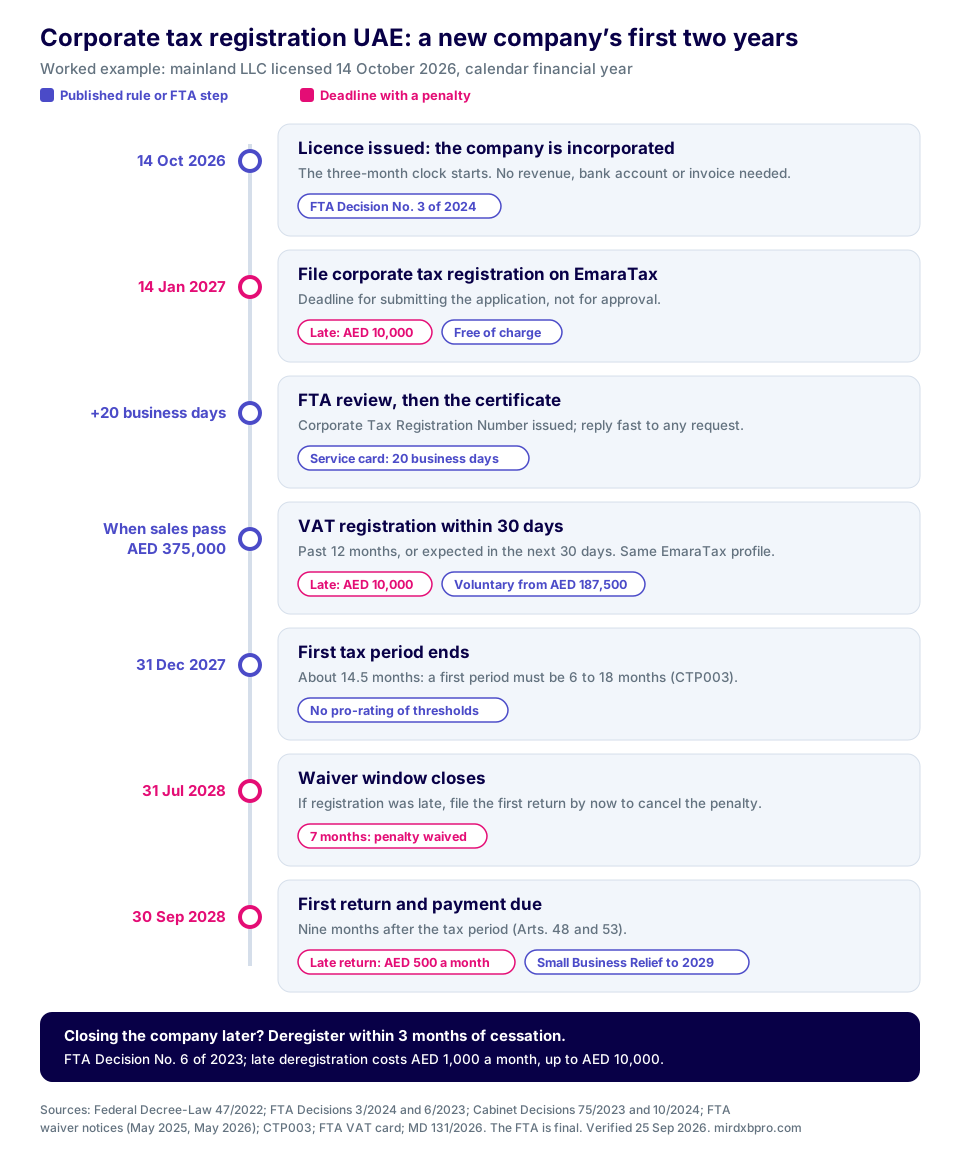
- Licence issued 14 October 2026: file by 14 January 2027.
- Licence issued 2 March 2026: the deadline was 2 June 2026. If you have not registered, you are already late; see the waiver section.
- Several licences: for companies that existed before 1 March 2024, the decision tells you to use the licence with the earliest issue date. A new company normally has one licence; if it has more, use the earliest to be safe.
The deadline is for submitting the application, not for approval. File in the first weeks rather than on the last day: if the FTA returns the application for more information, you want time to respond.
Companies that existed before March 2024
Companies licensed before 1 March 2024 had deadlines between 31 May and 31 December 2024, set by the month their licence was issued. All have passed: an older company found unregistered today is late and should register at once, then check whether the waiver can still help.
Before you start: what to prepare
A corporate tax registration takes about 25 minutes to submit, according to the FTA’s service card, if everything is ready. Most delays come from what happens before the form: access, documents that do not match, and signatories without authority.
Access: UAE PASS and EmaraTax
- UAE PASS. The FTA website currently shows the banner “FTA services are only available through UAEPass!”. The person who logs in needs a verified UAE PASS account, which requires an Emirates ID.
- EmaraTax user account. Your UAE PASS logs you in to EmaraTax. Decide who owns the login: ideally a director or manager of the company, not a staff member who may leave.
- Taxable person profile. Inside the account you create a profile for the company (the “Taxable Person” tile). One user can manage several profiles, which is useful for groups and for advisers.
- Existing VAT or excise registration. The EmaraTax manual notes that you “can self-register for Corporate Tax if you are not registered for Value Added Tax or Excise Tax yet”. If the company already has a VAT profile, open that profile and register for corporate tax from it, so both taxes sit together.
The documents the FTA lists
The FTA’s corporate tax registration card lists these documents. All uploads must be PDF, with a maximum of 15 MB per document.
| Document | What to check before uploading |
|---|---|
| Certificate of incorporation, memorandum of association or partnership agreement | The notarised memorandum for a mainland LLC; the certificate of incorporation for a free zone company. Pages complete and legible. |
| Commercial registration certificate or official licensing document | The commercial register extract or equivalent for your authority. |
| Valid trade licence, including branch licences | Current, not expired; licence number, legal name and activities as they appear on the licence. |
| Emirates ID and passport of owners holding more than 25%, and of authorised signatories | Both sides of the Emirates ID; passport photo page; not expired. |
| Proof of authorisation for the signatory | The memorandum clause appointing the manager, a board resolution or a power of attorney that covers tax matters. |
| Decree-law (government entities) or Cabinet decision (qualifying public benefit entities) | Only for those categories. |
Decisions to make before you open the form
- Your financial year. EmaraTax asks for the “Corporate Tax Period” in the first section and fills in the rest. Your memorandum or articles usually fix the financial year; if they do not, decide with your accountant now, because the choice sets your first return date.
- Who the authorised signatory is. The person named must have documented authority. For a one-person LLC this is usually the owner-manager; for a multi-partner LLC, the manager named in the memorandum.
- Your business activities. You add each activity on the licence to the form. Copy them from the licence rather than describing them freely.
- Your ownership details. The form asks whether any owner holds more than 25%. Prepare the names and identity documents of those owners; they should match your UBO register (see our UBO register guide).
- A company email and mobile number that someone reads daily; FTA requests arrive by email with a time limit.
Corporate tax registration UAE step by step on EmaraTax
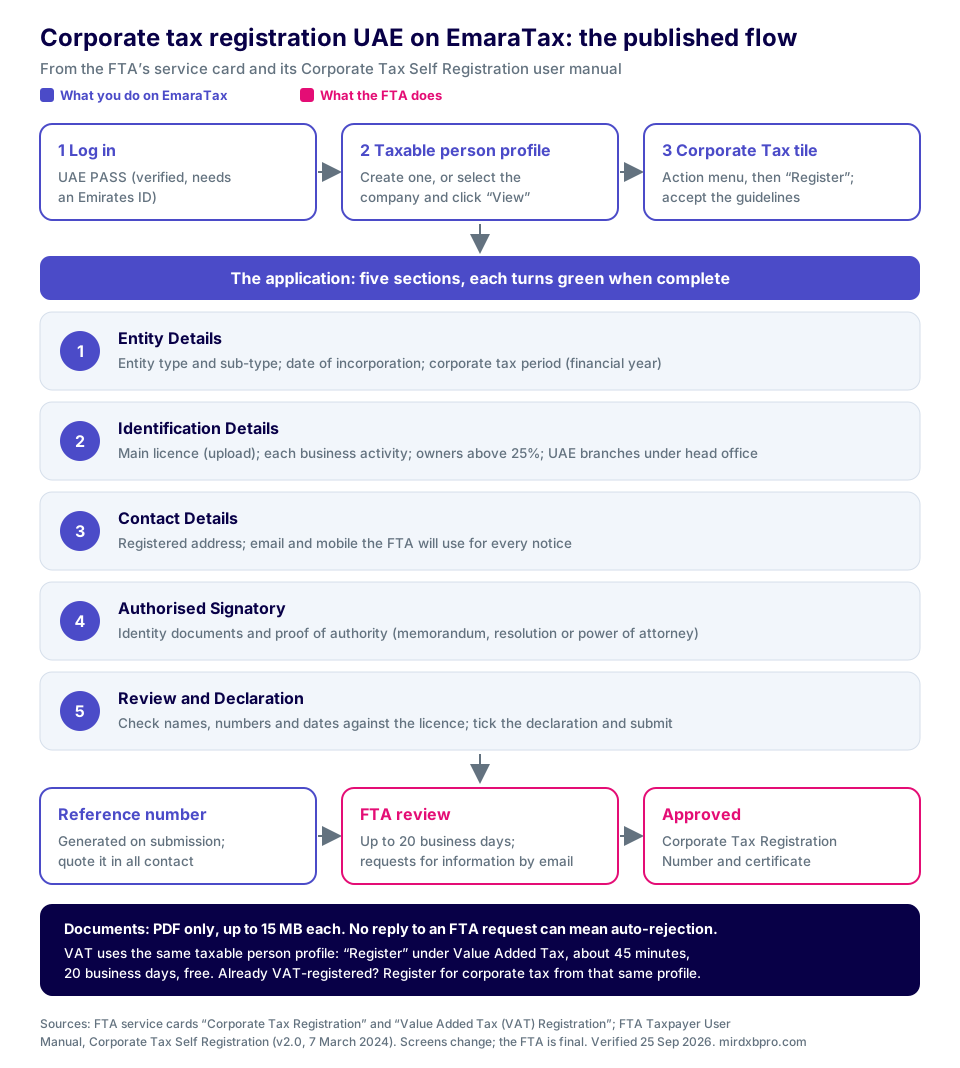
The steps below follow the FTA’s service card and its “Corporate Tax Self Registration” taxpayer user manual (version 2.0, 7 March 2024). Screens are updated from time to time, so labels may differ slightly, but the structure has stayed the same: an application in five sections, each marked green once complete.
Step 1: log in and open the taxable person profile
Log in with UAE PASS. Create a new taxable person profile for the company, or select the existing one and click “View”.
Step 2: start the corporate tax application
On the dashboard, find the Corporate Tax tile, open its action menu and click “Register”. EmaraTax shows the instructions and guidelines; read them, tick the box to confirm, and start the application. You can “Save as Draft” at any point and come back, but the manual warns that drafts left untouched receive a reminder and are then cancelled automatically.
Step 3: Entity Details
- Entity type and entity sub-type. For a mainland or free zone LLC, choose the legal person type and the sub-type that matches your licence. The fields that follow change with the type chosen, so pick carefully.
- Country of incorporation (United Arab Emirates for a UAE company) and date of incorporation. This date drives your deadline, so enter the date on your documents.
- Qualifying public benefit entity: answer “No” unless a Cabinet decision lists you.
- Corporate tax period: enter your financial year; EmaraTax fills in the related fields.
Step 4: Identification Details
- Main licence details: issuing authority, licence number, issue and expiry dates, with the licence uploaded.
- Business activities: click “Add Business Activity” for each activity on the licence.
- Owners: say whether any owner holds more than 25% and add their details and identity documents.
- Branches: add any local branches in other emirates or zones. The manual is clear that the registration is in the head office’s name and that one registration covers all UAE branches.
Step 5: Contact Details
Enter the company’s registered address and contact details. The manual asks you to “Ensure that your Contact Number and Email are accurate”: every FTA notice, including requests for more information and the approval itself, comes through them.
Step 6: Authorised Signatory
Click “Add Authorised Signatory” and enter the person’s details, identity documents and proof of authority. You can add more than one signatory. This is the section most often questioned when the proof of authority does not clearly cover the person named.
Step 7: Review and Declaration, then submit
EmaraTax shows everything entered across the sections. Check the legal name, licence number, dates and activities against the licence, tick the declaration that the information is correct, and submit. A reference number is generated: note it, because it identifies the application in all later correspondence.
Mistakes that trigger a request for more information
- A legal name typed differently from the licence (abbreviations, missing “L.L.C”, a changed trade name not yet updated).
- An expired licence or Emirates ID uploaded, or the licence renewed while the application sat in draft.
- A signatory whose authority is not shown in the documents uploaded.
- A date of incorporation that does not match the licence or certificate.
- Scanned documents that are incomplete, rotated or unreadable, or files over the 15 MB limit.
After you submit: review time, TRN and certificate
The FTA’s service card gives a processing time of 20 business days from receipt of a complete application. In that time the FTA can approve the application, reject it, or send it back for additional information.
- Acknowledgement. You receive a submission acknowledgement with the reference number.
- Additional information. If the FTA needs more, you receive an email setting out what is required. The manual warns of an “Application auto rejection notification” if you do not respond within the time allowed, so reply promptly.
- Approval. On approval the status in your dashboard changes, and a Corporate Tax Registration Certificate is issued. You find it under “Certificates” in the taxable person account.
- Rejection. You are told the reason. Correct the problem and apply again quickly: a rejection does not stop your deadline running.
What the Tax Registration Number is used for
The corporate tax registration gives the company a Corporate Tax Registration Number (the law’s “Tax Registration Number”), shown on the certificate. You use it on your corporate tax returns and in correspondence with the FTA. Keep the certificate PDF with your licence documents; banks and larger customers often ask for it.
If the company is also registered for VAT, it holds a separate VAT registration certificate with its own number, and that is the number that goes on tax invoices. Do not assume the two numbers are interchangeable; quote each where it belongs.
Keeping the registration up to date
Your tax record must follow your licence. When you change your trade name, address, activities, owners, manager or legal form, update the record on EmaraTax. Cabinet Decision No. 75 of 2023 fines a registrant who fails to inform the FTA of a case that requires the tax record to be amended AED 1,000 for the first time and AED 5,000 for a repeat within 24 months. The DET side of those changes is in our trade licence amendment guide; the FTA update should follow in the same week.
The AED 10,000 late registration penalty and the waiver
Cabinet Decision No. 10 of 2024, issued on 27 February 2024 and in force from 1 March 2024, amended the penalty schedule in Cabinet Decision No. 75 of 2023. The line is simple: “Failure of the Taxable Person to submit a Tax Registration application within the timeframe” costs AED 10,000. The Ministry of Finance said it set the penalty to align with the late registration penalties for VAT and excise tax.
It is a fixed amount: it does not grow with the delay, nor shrink if you were only days late.
How the waiver works
In April 2025 the FTA launched the Corporate Tax Late Registration Penalty Waiver Initiative. Its registration service card describes it this way: taxable persons are exempted from the AED 10,000 penalty “provided that they submit their first Tax Return (or Annual Declaration for exempt persons, where applicable) within 7 months from the end of their first tax period”.
- It is automatic. The FTA said on 14 May 2026 that if a person meets the conditions, the penalty “will be waived automatically, without the need to submit a reconsideration or waiver request”.
- Paid penalties come back as a credit. If you have already paid, “a credit equal to the penalty amount will be automatically added” to your EmaraTax account, which you can use against other tax or ask to be refunded.
- It applies only to the first tax period. The waiver “applies only to the first Tax Period of the Taxable Person”.
- It covers late registrations back to 1 June 2023, and applies whether or not you had already registered when the penalty was imposed.
The FTA announcement of 14 May 2026 gives no end date for the initiative. It is an administrative initiative rather than a rule in the Corporate Tax Law, so check the FTA’s registration card before relying on it for a late file.
What the waiver does not cover
- Late registration where the first return is filed after the seven-month window: the full nine months are still available to file, but the waiver is lost.
- Any later penalty, such as late filing, late payment or failing to update your record.
- VAT late registration: the initiative is for corporate tax only.
If the waiver cannot apply
If you are outside the waiver, the penalty stands unless the FTA agrees to reconsider it. The Tax Procedures Law gives a route to ask the FTA to reconsider a decision, including a penalty, within the time limit stated in the law and on the notice. It needs reasons and evidence; take it to an FTA-registered tax agent, as we do not represent clients in tax disputes.
“We will register when we start making money.” For companies, the deadline counts from incorporation, not from trading, and it is the same for a company that never trades. A company licensed in March and first invoicing in October is already late in June.
Your first tax period and first return
Registration is only the first filing. Once registered, the company must file a return for every tax period, even one with no revenue, and pay any tax due, both within nine months of the period’s end (Articles 48 and 53 of the Corporate Tax Law).
How long the first tax period can be
The tax period is the financial year: normally the calendar year, or the 12-month period for which you prepare financial statements (Article 57). For a new company the first financial year is usually not 12 months. The FTA’s public clarification CTP003 (13 August 2024) says the first tax period “can be a period between 6 months and 18 months”, and that there is “no pro-rating of the various thresholds” when it is shorter or longer than 12 months. The AED 375,000 zero-rate band and the AED 3 million Small Business Relief threshold apply in full to a long or short first period.
Worked example: company licensed 14 October 2026, calendar financial year
| Event | Date | Rule |
|---|---|---|
| Licence issued (incorporation) | 14 October 2026 | Starts the registration clock |
| Corporate tax registration deadline | 14 January 2027 | 3 months (FTA Decision No. 3 of 2024) |
| First tax period | 14 October 2026 to 31 December 2027 | About 14.5 months; a first period ending 31 December 2026 would be under 6 months (CTP003) |
| Waiver window, if registration was late | First return filed by 31 July 2028 | 7 months from the end of the first tax period |
| First return and payment due | 30 September 2028 | 9 months (Arts. 48 and 53) |
| Records to keep until at least | 31 December 2034 | 7 years after the tax period ends (Art. 56) |
To change year-end later, Article 58 lets you apply to the FTA to change the tax period.
Rates, audit and records in brief
- Rates. 0% on taxable income up to AED 375,000 and 9% above, for mainland companies and for free zone income that does not qualify.
- Accounts. Every LLC must appoint an auditor under the Commercial Companies Law (Art. 102). For tax, Ministerial Decision No. 82 of 2023 requires audited financial statements from taxable persons with revenue above AED 50 million and from qualifying free zone persons.
- Records. Keep records supporting every return for seven years after the end of the tax period (Art. 56). Failing to keep them costs AED 10,000, or AED 20,000 for a repeat within 24 months (Cabinet Decision No. 75 of 2023).
Small Business Relief: now available to 2029
Small Business Relief lets a resident taxable person whose revenue is AED 3 million or less elect to be treated as having no taxable income for the tax period. It comes from Article 21 of the Corporate Tax Law and Ministerial Decision No. 73 of 2023.
The original decision limited the relief to tax periods ending on or before 31 December 2026. Ministerial Decision No. 131 of 2026, issued on 29 July 2026 and announced by the Ministry of Finance on 7 August 2026, amended it so that the threshold “shall continue to apply to subsequent Tax Periods that end on or before 31 December 2029”. The AED 3 million threshold did not change.
Conditions
- Resident persons only, companies or individuals. Non-residents cannot elect it.
- Revenue of AED 3 million or less in the tax period and in every previous tax period. The Ministry of Finance’s FAQ says that once revenue exceeds AED 3 million in any period, the relief is lost for that period “and any future Tax Periods”.
- Not a qualifying free zone person, and not a member of a multinational group with consolidated revenue above AED 3.15 billion.
- No artificial splitting. The Ministerial Decision allows the FTA to deny the relief where a business has been artificially separated to stay under the threshold.
What it does not change
The relief is an election made in the return, not an exemption from the system. A company that expects to use it still registers within three months, still files a return for every period and still keeps records. What it does is simplify the calculation: while the relief applies, the law’s provisions on exempt income, reliefs, deductions and tax losses do not (Article 21(2)). Because the tax loss rules are switched off for a relief period, a start-up that expects early losses should ask its accountant whether electing the relief, or keeping the losses for later years, works better before it elects.
VAT registration in the same EmaraTax account
Corporate tax registration depends on what you are; VAT registration depends on what you sell. Both are applied for from the same taxable person profile on EmaraTax.
The thresholds
| Test | Threshold | Result | Source |
|---|---|---|---|
| Taxable supplies and imports in the previous 12 months | More than AED 375,000 | Mandatory VAT registration | FTA VAT registration card and VAT topics |
| Taxable supplies and imports expected in the next 30 days | More than AED 375,000 | Mandatory VAT registration now | Same |
| Taxable supplies, imports or taxable expenses in the previous 12 months (or next 30 days) | AED 187,500 or more | Voluntary registration allowed | Same |
| Non-resident business making taxable supplies in the UAE | No threshold | Mandatory registration | FTA VAT registration card |
The forward-looking test catches many new companies. A consultancy that signs a single AED 400,000 contract to be invoiced next month does not wait 12 months: it expects to pass the threshold within 30 days and must apply now.
The 30-day application window
The FTA’s VAT registration card says a person required to register “must submit a registration application … within 30 days of being required to register”. The clock starts when you cross the 12-month threshold or when you first expect to cross it within the next 30 days. Keep a running 12-month total of taxable sales from the day you are licensed, updated monthly, and diarise the contracts that could push you over.
Voluntary registration: when it makes sense
Registering voluntarily from AED 187,500 lets a business recover the VAT on set-up costs and equipment, at the cost of returns, tax invoices and penalties. A company selling to VAT-registered businesses usually gains; one selling to consumers may simply become 5% dearer. The voluntary test includes taxable expenses, so a start-up with heavy set-up spending can qualify before it has sales.
Documents and processing
The VAT card lists broadly the same identity and licence documents as corporate tax, plus evidence of turnover: an “official declaration letter stating the total taxable supplies and monthly sales”, supporting invoices, contracts or purchase orders, customs details if you import, and optionally a bank letter. Submission takes about 45 minutes, the FTA’s processing time is 20 business days, and the service is free. The output is a VAT registration certificate in your dashboard.
After VAT registration
- Tax invoices must show your VAT registration number from the effective date the FTA sets.
- Returns. The FTA assigns your tax period, usually quarterly; the return and payment are due within 28 days after each period ends.
- E-invoicing is coming. Under the Ministry of Finance’s timeline, businesses with annual revenue below AED 50 million must appoint an accredited service provider by 31 March 2027 and implement e-invoicing from 1 July 2027. Larger businesses must go live on 1 January 2027, with the provider appointed by 30 October 2026 after the Ministry’s May 2026 extension. Build this into your accounting software choice now.
VAT penalties that matter at the start
- Late VAT registration: AED 10,000. The corporate tax waiver does not apply to VAT.
- Late deregistration: AED 1,000 a month, up to AED 10,000.
- Late payment: since 14 April 2026, Cabinet Decision No. 129 of 2025 replaced the old 2% plus 4% monthly structure with a penalty of 14% a year, charged monthly on the unpaid amount. According to law firm summaries of the decision, the registration and deregistration penalties above were not changed.
Corporate tax and VAT registration compared
| Point | Corporate tax registration | VAT registration |
|---|---|---|
| Who | Every company; individuals above AED 1 million turnover; non-residents with a permanent establishment or nexus | Any business above AED 375,000 of taxable supplies and imports (mandatory) or from AED 187,500 (voluntary) |
| Trigger | Incorporation | Turnover, past 12 months or next 30 days |
| Deadline | 3 months from incorporation (new company) | 30 days from the obligation arising |
| Late penalty | AED 10,000, waivable for the first period if the first return is filed within 7 months | AED 10,000; no equivalent waiver initiative |
| Output | Corporate Tax Registration Number and certificate | VAT registration certificate and number |
| Returns | Once a year, 9 months after the tax period | Usually quarterly, 28 days after each period |
| Leaving | Deregister within 3 months of cessation | Deregister within 30 business days of the obligation arising |
Tax groups in brief
A tax group lets two or more UAE resident companies be treated as a single taxable person, filing one return. It is optional and only formed if the companies apply and the FTA approves. Under Article 40 of the Corporate Tax Law, the parent must hold at least 95% of each subsidiary’s share capital, voting rights and profits (directly or indirectly), all members must be resident juridical persons with the same financial year and accounting standards, and none can be an exempt person or a qualifying free zone person.
- Each company registers first. A new subsidiary still files its own corporate tax registration within three months of incorporation.
- The parent and subsidiaries apply jointly, naming the first tax period of the group. The FTA’s tax groups guide (CTGTGR1) says the request “should be filed before the end of the Tax Period for which the formation of the Tax Group is requested”.
- The parent carries the compliance: consolidated financial statements, one return within nine months and payment for the whole group.
- One band, not several. The Ministry of Finance notes that a tax group benefits from one AED 375,000 zero-rate band, not one per member.
- VAT groups are separate, with their own conditions and a separate application on EmaraTax.
Free zone companies in brief
A free zone company registers in exactly the same way and on the same three-month timeline as a mainland company. What differs is how it is taxed afterwards. A qualifying free zone person can pay 0% on qualifying income, but only if it meets every condition (adequate substance in the zone, qualifying income, audited accounts, transfer pricing compliance and a de minimis limit on other income). It cannot elect Small Business Relief or join a tax group.
The rules and trade-offs are set out in our free zone vs mainland Dubai guide. For registration, the practical point is that “we are in a free zone” is never a reason not to register.
Changes, closure and deregistration
When the company changes
Update the tax record whenever the licence changes (see “Keeping the registration up to date” above). The common triggers after set-up are a new activity, a change of manager or signatory, a share transfer that changes who holds more than 25%, a new address and a new branch. Failing to tell the FTA is a separate penalty from anything DET charges.
When the company closes
FTA Decision No. 6 of 2023 requires a juridical person to file its corporate tax deregistration application “within 3 months of the date the entity ceases to exist, cessation of the Business, dissolution, liquidation or otherwise”. A natural person has three months from ceasing the business.
- Conditions. The FTA will not deregister a person until it “has paid all Corporate Tax and Administrative Penalties due and filed all Tax Returns due”, including a return for the period up to the date of cessation (Article 52(2)).
- Documents. The FTA’s deregistration card asks, depending on the reason, for licence cancellation documents and financial statements “up to and including license cancellation date”, or merger and sale agreements.
- Processing. Up to 40 working days; if the FTA asks for more information you have 60 calendar days to respond, after which the application may be rejected.
- Penalty. Late deregistration costs AED 1,000 a month, up to AED 10,000 (Cabinet Decision No. 75 of 2023).
- VAT. Where deregistration is mandatory, the VAT application is due within 30 business days of the obligation arising, and the final VAT return and payment within 28 days of the effective date of deregistration.
The order matters: staff visas and permits, then the licence, then tax. Our company liquidation and visa cancellation service runs the closing sequence, and we coordinate the tax filings with your accountant.
Penalties at a glance
| Failure | Penalty | Source |
|---|---|---|
| Corporate tax registration application late | AED 10,000 (waivable for the first period if the first return is filed within 7 months) | Cabinet Decision No. 75 of 2023 as amended by No. 10 of 2024; FTA waiver initiative |
| Corporate tax deregistration application late | AED 1,000 a month, up to AED 10,000 | Cabinet Decision No. 75 of 2023 |
| Not informing the FTA of changes to the tax record | AED 1,000; AED 5,000 if repeated within 24 months | Cabinet Decision No. 75 of 2023 |
| Corporate tax return late | AED 500 a month for the first 12 months, then AED 1,000 a month | Cabinet Decision No. 75 of 2023 |
| Corporate tax paid late | 14% a year, charged monthly on the unpaid amount | Cabinet Decision No. 75 of 2023 |
| Records not kept | AED 10,000; AED 20,000 if repeated within 24 months | Cabinet Decision No. 75 of 2023 |
| VAT registration late | AED 10,000 | VAT penalty schedule (unchanged by Cabinet Decision No. 129 of 2025, per law firm summaries) |
| VAT paid late (from 14 April 2026) | 14% a year, charged monthly | Cabinet Decision No. 129 of 2025 |
What goes wrong most often
- Waiting for the first invoice. The company clock starts at incorporation.
- Assuming the formation provider did it. Many set-up packages end at the licence. Ask in writing whether tax registration is included and ask for the certificate.
- Registering under an employee’s UAE PASS. When that person leaves, access leaves with them. Use an owner or manager, and add others as needed.
- Forgetting VAT’s forward-looking test. A large contract signed in month two can make VAT mandatory immediately.
- Letting a request for information lapse. The auto-rejection leaves you unregistered, with the deadline still running.
- Closing the licence and forgetting tax. The three-month deregistration clock runs from cessation, and the monthly penalty adds up.
What circulates online about corporate tax registration that is not true
| Claim | The position |
|---|---|
| “Companies earning under AED 375,000 do not need to register.” | AED 375,000 is the zero-rate band for taxable income, not a registration threshold. Every company registers. |
| “Free zone companies are exempt, so no registration.” | “All Free Zone Persons will be required to register” (Ministry of Finance FAQ), qualifying or not. |
| “The late registration penalty is AED 10,000 a month.” | It is a single AED 10,000 (Cabinet Decision No. 10 of 2024). The monthly penalties are for late returns and late deregistration. |
| “You must apply for the waiver.” | The FTA applies it automatically when the first return is filed within seven months (FTA, 14 May 2026). |
| “Small Business Relief ends in 2026.” | Ministerial Decision No. 131 of 2026 extended it to tax periods ending on or before 31 December 2029. |
| “With Small Business Relief you do not need to register or file.” | It is an election in the return. You still register, file and keep records. |
| “Freelancers register at AED 1 million profit.” | The threshold is AED 1 million of turnover in a calendar year (Cabinet Decision No. 49 of 2023). |
| “Each branch in another emirate registers separately.” | UAE branches of a UAE company are covered by the head office’s single registration. |
Worked cases: corporate tax registration in practice
These cases are built from the situations we see most often. Names and identifying details are left out, and the figures are the published ones.
1. A new one-person LLC that registers on time
Situation. A founder’s Dubai mainland one-person LLC was licensed on 14 October 2026. The bank account is still being opened and there are no sales yet.
What applies. A juridical person incorporated after 1 March 2024 registers within three months of incorporation, whether or not it trades (FTA Decision No. 3 of 2024). A first tax period ending 31 December 2026 would be under six months, so the first period runs to 31 December 2027 (CTP003).
Outcome. Registration filed in November 2026 under the founder’s UAE PASS as manager; certificate issued within the FTA’s 20 business days. First return and payment diarised for 30 September 2028, with Small Business Relief to consider if revenue stays at AED 3 million or less.
Lesson. Register as soon as the licence is issued.
2. A trading company that registered six weeks late
Situation. A general trading LLC licensed on 5 February 2026 assumed its formation package included tax registration. It registered on 20 June 2026, about six weeks after its 5 May deadline, and the AED 10,000 penalty appeared on its EmaraTax account.
What applies. The late registration penalty is fixed at AED 10,000 (Cabinet Decision No. 10 of 2024). The FTA’s waiver applies automatically if the first return is filed within seven months of the end of the first tax period.
Outcome. With a first tax period of 5 February to 31 December 2026, the company planned to file its first return by 31 July 2027 instead of using the full nine months to 30 September 2027.
Lesson. A late registration is recoverable for the first period, but only if the accounts are ready two months earlier than the normal deadline. Brief the accountant as soon as the year ends.
3. A consultancy caught by VAT’s 30-day test
Situation. A newly licensed management consultancy had registered for corporate tax. In its second month it signed a contract worth AED 420,000, to be invoiced in full the following month.
What applies. VAT registration is mandatory where taxable supplies are expected to exceed AED 375,000 in the next 30 days, and the application is due within 30 days of the obligation arising (FTA VAT registration card).
Outcome. VAT registration filed from the same EmaraTax profile within the month, with the signed contract and a declaration of expected supplies as evidence, so that the invoice could be issued as a tax invoice.
Lesson. Check the VAT threshold every time you sign a large contract.
4. A dormant company being closed
Situation. An owner licensed an LLC in 2025 for a project that never went ahead. The company was registered for corporate tax but never traded, and the owner decided not to renew the licence.
What applies. Deregistration is due within three months of cessation (FTA Decision No. 6 of 2023), but only once every return is filed, including one up to the date of cessation, and any penalties are paid (Article 52(2)). Late deregistration costs AED 1,000 a month, up to AED 10,000.
Outcome. The owner cancelled the licence through DET’s liquidation route, filed nil returns up to the cessation date with Small Business Relief elected, and applied to deregister with the licence cancellation documents and final financial statements within the three months.
Lesson. A company that never traded still has returns to file and a deregistration to make. Letting the licence lapse does not close the tax record.
5. A sole establishment that crossed AED 1 million
Situation. A designer working through a sole establishment licence invoiced AED 1.15 million in 2026, having been below AED 1 million in 2025.
What applies. A resident natural person whose business turnover exceeds AED 1 million in a calendar year registers by 31 March of the following year (FTA Decision No. 3 of 2024; Cabinet Decision No. 49 of 2023).
Outcome. Registration as a natural person on EmaraTax before 31 March 2027, with the 2026 calendar year as the first tax period and the return due by 30 September 2027. With revenue under AED 3 million, Small Business Relief could be elected for 2026 on her adviser’s advice.
Lesson. For individuals the trigger is turnover in the calendar year. See our professional licence guide.
How to verify every corporate tax registration figure
| Figure or rule | Where to check it |
|---|---|
| Who registers; documents; free of charge; 20 business days; waiver wording | FTA service card “Corporate Tax Registration” (tax.gov.ae, Services) |
| Registration deadlines by category | FTA Decision No. 3 of 2024 (FTA Legislation, Corporate Tax) |
| EmaraTax sections and what happens after submission | FTA “Taxpayer User Manual: Corporate Tax Self Registration”, version 2.0 |
| AED 10,000 late registration penalty | Cabinet Decision No. 10 of 2024; Ministry of Finance news release |
| Waiver: 7 months, automatic, credit of paid penalties | FTA news, 7 May 2025 and 14 May 2026 |
| All other corporate tax penalties | Cabinet Decision No. 75 of 2023 and its amendments (Ministry of Finance) |
| First tax period of 6 to 18 months; no pro-rating | FTA public clarification CTP003, 13 August 2024 |
| Return and payment within 9 months; records 7 years; tax groups | Federal Decree-Law No. 47 of 2022, Arts. 40, 48, 53, 56 and 57 |
| Small Business Relief to 31 December 2029 | Ministerial Decision No. 131 of 2026; Ministry of Finance news, 7 August 2026 |
| Deregistration within 3 months | FTA Decision No. 6 of 2023; FTA “Corporate Tax Deregistration” card |
| VAT thresholds, 30-day rule, documents | FTA “Value Added Tax (VAT) Registration” card and “Registration for VAT” topic |
| VAT deregistration within 30 business days | FTA “VAT Deregistration” card |
| E-invoicing dates | Ministry of Finance news, 29 September 2025 and 10 May 2026 |
If an official page has changed since we checked it, the official page wins. The FTA’s own verification is final for every registration question.
What we will and will not do
We will work out your corporate tax and VAT deadlines from your documents; prepare the document set; set up EmaraTax access under the right person; file the corporate tax registration and, where needed, the VAT registration; answer FTA requests for information on the registration; update the tax record after licence changes; and coordinate tax deregistration when a company closes. Government fees, where any apply, are passed on at cost, and our fee is quoted in writing before we start.
We will not give tax advice on how much tax you will pay, whether to elect Small Business Relief, or whether you qualify as a qualifying free zone person; prepare your accounts or tax returns; represent you in a tax dispute or reconsideration before the FTA; hold your UAE PASS credentials; or tell you a deadline can be ignored. We will tell you when you need an accountant or an FTA-registered tax agent.
Related guides
Each guide below goes deeper on a step that sits next to corporate tax registration.
- Mainland company formation in Dubai: the full process
- Mainland business setup cost in Dubai
- Types of companies in Dubai: every mainland legal form
- Professional licence in Dubai, including tax for sole establishments
- Branch of a foreign company in Dubai, including permanent establishment tax
- Free zone vs mainland Dubai, including qualifying free zone persons
- Opening a corporate bank account in the UAE
- UBO register in the UAE
- Trade licence amendment in Dubai
- How to renew a trade licence in Dubai
- Why companies need PRO services
- UAE government fees list 2026
Corporate tax registration UAE: frequently asked questions
Is corporate tax registration mandatory for every UAE company?
Yes. Every company incorporated in the UAE, on the mainland or in a free zone, is a taxable person and must register with the FTA, whatever its revenue or profit. FTA Decision No. 3 of 2024 gives a new company three months from incorporation. Only individuals have a turnover threshold (AED 1 million), and UAE branches of a UAE company are covered by the head office.
What is the deadline for a new company to register?
Three months from the date of incorporation, establishment or recognition, for any company incorporated in the UAE on or after 1 March 2024, including free zone companies (FTA Decision No. 3 of 2024, Art. 3). A company licensed on 14 October 2026 must file by 14 January 2027. The deadline is for submitting the application, not for approval.
What if my company has not started trading?
It still registers. The deadline counts from incorporation, not from the first sale, bank account or profit. A company that never trades must also file returns for each tax period and, when it closes, deregister within three months of cessation. Small Business Relief can simplify those returns if revenue is AED 3 million or less.
How much is the late registration penalty?
AED 10,000, fixed, under Cabinet Decision No. 75 of 2023 as amended by Cabinet Decision No. 10 of 2024, in force since 1 March 2024. It does not increase monthly. The FTA waives it for the first tax period if the first return is filed within seven months of that period’s end, and credits back any amount already paid.
How do I get the late registration penalty waived?
File your first corporate tax return (or annual declaration, for exempt persons that must register) within seven months of the end of your first tax period. The FTA says the waiver is then applied automatically, “without the need to submit a reconsideration or waiver request”, and a penalty already paid is credited to your EmaraTax account for use or refund.
How long does the FTA take to approve a registration?
The FTA’s service card gives 20 business days from receipt of a complete application for both corporate tax and VAT registration. If the FTA needs more information it emails you; if you do not respond in time, the application can be rejected automatically. Submitting a complete, consistent file is the best way to stay within 20 business days.
What documents do I need for corporate tax registration?
The FTA lists: the certificate of incorporation, memorandum or partnership agreement; the commercial registration or licensing document; a valid trade licence including branch licences; Emirates ID and passport of owners with more than 25% and of authorised signatories; and proof of the signatory’s authority. All in PDF, maximum 15 MB each.
Is there a government fee for registering?
No. The FTA’s service cards list both corporate tax registration and VAT registration as free of charge. You pay nothing to the FTA to register. Any fee you pay is to an adviser or service provider for preparing and filing the application, and MIRDXB PRO quotes its fee in writing before starting.
Do I need a UAE PASS to register?
In practice, yes. The FTA website currently states that “FTA services are only available through UAEPass!”. The person logging in to EmaraTax needs a verified UAE PASS, which requires an Emirates ID. Use an owner or manager of the company rather than an employee who may leave, and add other users where needed.
When is my first corporate tax return due?
Within nine months of the end of your first tax period, together with any tax payable (Articles 48 and 53). For a new company the first tax period can be 6 to 18 months long (FTA clarification CTP003). A company licensed on 14 October 2026 with a calendar year has a first period to 31 December 2027 and a return due by 30 September 2028.
Has Small Business Relief been extended?
Yes. Ministerial Decision No. 131 of 2026 extended Small Business Relief to tax periods ending on or before 31 December 2029. Resident persons with revenue of AED 3 million or less, in the period and all earlier periods, can elect to be treated as having no taxable income. Qualifying free zone persons and members of large multinational groups cannot elect it.
Do I need VAT registration as well?
Only if your turnover requires it or you choose to. VAT registration is mandatory once taxable supplies and imports exceed AED 375,000 in the past 12 months, or are expected to in the next 30 days, and voluntary from AED 187,500. Apply within 30 days of the obligation arising, from the same EmaraTax profile. Late VAT registration costs AED 10,000.
Does a free zone company need to register for corporate tax?
Yes. The Ministry of Finance says “All Free Zone Persons will be required to register, obtain a Tax Registration Number, and file a Corporate Tax return, irrespective of whether they are a Qualifying Free Zone Person or not.” The deadline is the same three months from incorporation. Whether its income is taxed at 0% or 9% depends on qualifying conditions.
What happens to my tax registration when I close the company?
You must apply to deregister within three months of cessation, dissolution or liquidation (FTA Decision No. 6 of 2023), after filing every return up to the cessation date and paying all tax and penalties. The FTA takes up to 40 working days. Late deregistration costs AED 1,000 a month, up to AED 10,000. VAT deregistration is a separate application.
Can MIRDXB PRO register my company for corporate tax and VAT?
Yes. We work out your deadlines, prepare the documents, set up EmaraTax access under your UAE PASS, file the corporate tax registration and, where required, the VAT registration, and handle the FTA’s requests for information. Registration itself is free at the FTA; our fee is quoted in writing before we start. We do not give tax advice or prepare returns.
My company’s deadline has passed. Can you still help?
Yes. Send us your licence and any FTA notice. We file the registration at once and tell you in writing the date by which your first return must be filed for the waiver to apply, so your accountant can plan for it. If the waiver cannot apply, we tell you so and suggest an FTA-registered tax agent for a reconsideration.
Registering new companies for corporate tax and VAT, alongside their licences, visas and renewals, is what our PRO services in Dubai team handles every week.
Checked against official sources on 25 September 2026: the FTA’s corporate tax registration, deregistration, VAT registration and VAT deregistration service cards; the FTA’s corporate tax self registration user manual; FTA Decisions No. 3 of 2024 and No. 6 of 2023; the FTA’s waiver announcements of 7 May 2025 and 14 May 2026; public clarification CTP003; Federal Decree-Law No. 47 of 2022; Cabinet Decision No. 75 of 2023 and its amendments; Ministerial Decision No. 131 of 2026 and the Ministry of Finance’s announcement of 7 August 2026; and the Ministry of Finance’s e-invoicing announcements. FTA Decision No. 12 of 2026 (August 2026) concerns top-up tax registration for large multinational groups only and does not change the deadlines in this guide.
- Federal Tax Authority: Corporate Tax Registration service card (documents, fee, processing time, waiver)
- FTA: Taxpayer User Manual, Corporate Tax Self Registration (version 2.0, 7 March 2024)
- FTA Decision No. 3 of 2024 on the timeline for corporate tax registration
- FTA news: new decision on specified timeframes for corporate tax registration
- Ministry of Finance: AED 10,000 penalty for late corporate tax registration (Cabinet Decision No. 10 of 2024)
- Cabinet Decision No. 75 of 2023 and its amendments: corporate tax administrative penalties
- FTA news, 7 May 2025: waiver of the late corporate tax registration penalty
- FTA news, 14 May 2026: late registration penalty waiver initiative
- FTA public clarification CTP003: first tax period of a juridical person
- Federal Decree-Law No. 47 of 2022 on the Taxation of Corporations and Businesses (Arts. 11, 21, 40, 48, 51 to 53, 56 to 58, 69)
- Ministry of Finance: Corporate tax FAQ (free zone persons, exempt persons, Small Business Relief, tax groups)
- Ministry of Finance, 7 August 2026: Small Business Relief extended to 31 December 2029
- Ministerial Decision No. 131 of 2026 amending Ministerial Decision No. 73 of 2023 on Small Business Relief
- FTA Corporate Tax Guide: Tax Groups (CTGTGR1)
- FTA: Corporate Tax Deregistration service card
- FTA Decision No. 6 of 2023 on the tax deregistration timeline
- FTA: Value Added Tax (VAT) Registration service card
- FTA: Registration for VAT (thresholds)
- FTA: VAT Deregistration service card
- FTA: Corporate tax legislation (including FTA Decision No. 12 of 2026 on top-up tax registration)
- Ministry of Finance, 29 September 2025: e-invoicing scope and timelines
- Ministry of Finance, 10 May 2026: amendments to the e-invoicing decisions
- u.ae: Corporate tax
- Secondary: Andersen UAE, key amendments to administrative penalties (Cabinet Decision No. 129 of 2025)
- Secondary: BDO UAE, revision in administrative penalties for violation of tax laws
Please note. This corporate tax registration guide sets out the rules published by the Federal Tax Authority and the Ministry of Finance, and in Federal Decree-Law No. 47 of 2022 and its implementing decisions, verified 25 September 2026. English texts of UAE tax legislation are unofficial translations; the Arabic text governs. The FTA is the final authority on every registration, deadline, penalty and waiver, and its initiatives can change without notice. The cases are built from common situations and are illustrative, not the records of named clients. MIRDXB PRO prepares and files registrations; it is not giving tax advice, and this guide is general information, not tax or legal advice. For advice on your tax position, consult an FTA-registered tax agent or a qualified adviser.


