

Key takeaways
- The UBO register (UAE) is two records every licensed company must keep and file: a Beneficial Owner’s Record and a Register of Partners or Shareholders, under Cabinet Decision No. 109 of 2023. In Dubai the registrar for mainland companies is the Department of Economy and Tourism (DET).
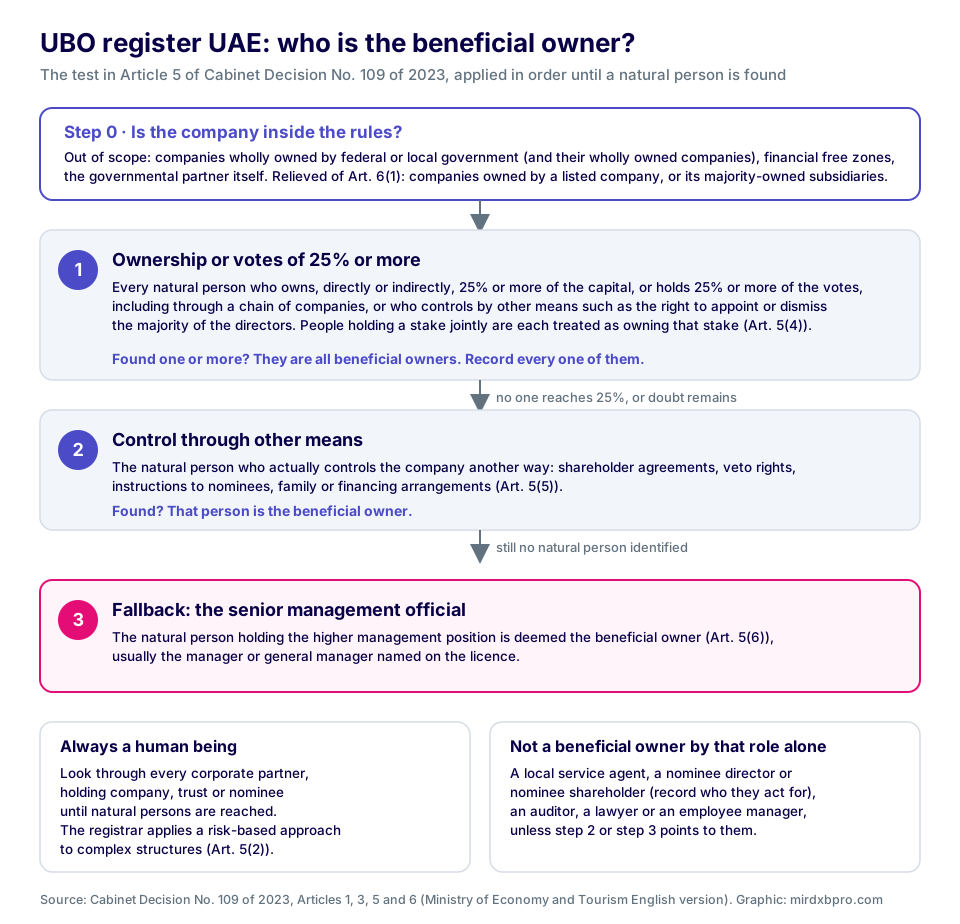
- A beneficial owner is always a natural person: anyone who owns or controls 25% or more of the capital or votes, directly or through other companies; failing that, anyone who controls the company by other means; failing that, the senior management official.
- Two deadlines matter most. File both registers with the registrar within 60 days of the licence being issued, and report any change within 15 days of it.
- Nominees must be disclosed. A nominee director or manager tells the company within 15 days, and the register must show whom each nominee or trustee acts for.
- The register is not public. DET and the Ministry may share it only with the owner’s written consent, with UAE authorities on request, or under anti-money laundering and tax-exchange agreements.
- Penalties follow a ladder under Cabinet Resolution No. 132 of 2023: a written warning, then fines from AED 5,000 to AED 50,000, then AED 10,000 to AED 100,000 and possible licence suspension on the third breach.
- Banks run their own beneficial owner checks under the anti-money laundering rules, and they compare them with what you filed. A mismatch slows or stops an account.
A UBO register in the UAE is the record of the natural persons who ultimately own or control a company, which every licensed or registered legal person (mainland or commercial free zone) must create, keep up to date and file with its registrar under Cabinet Decision No. 109 of 2023, together with a register of its partners or shareholders; the data goes to the registrar within 60 days of licensing, changes within 15 days, and breaches are fined under Cabinet Resolution No. 132 of 2023. For a Dubai mainland company the registrar is DET, and the filing is part of the licence file.
This guide explains the whole system in plain English: who counts as a beneficial owner, who is exempt, the two registers and what goes into them, nominee and trust disclosures, the filing and update deadlines, who can see the data, the full penalty schedule, how free zones and banks handle beneficial ownership, and templates you can use. It is written for founders, investors and SME owners. It is general information, not legal advice. For disputed ownership, trusts or cross-border holding structures, instruct a UAE-qualified lawyer.
It is part of our mainland series. The full set-up route is in our guide to mainland company formation, and if you would rather hand over the government side, our company formation support team files the licence, the beneficial owner data and the later changes for you.
UBO register UAE at a glance
The short answers, each with the article of the law it comes from. The detail and the edge cases follow further down.
| Question | Short answer | Source |
|---|---|---|
| What law applies? | Cabinet Decision No. 109 of 2023 on regulating the beneficial owner procedures, in force since 16 November 2023; it replaced Cabinet Decision No. 58 of 2020 | CD 109/2023, Arts. 22 and 23; CBUAE Rulebook |
| Who must comply? | Legal persons licensed or registered in the UAE, including commercial free zones | Art. 3(1) |
| Who is exempt? | Companies wholly owned by federal or local government (and their wholly owned companies), financial free zones, the governmental partner; companies owned by a listed company are relieved of the duty to collect beneficial owner data | Arts. 3(2) and 6(2) |
| Who is a beneficial owner? | A natural person with 25% or more of capital or votes, directly or indirectly, or control such as appointing most directors; then control by other means; then the senior management official | Art. 5 |
| Which registers? | Beneficial Owner’s Record and Register of Partners or Shareholders, including nominee and trustee details | Arts. 8 and 10 |
| Filing deadline | Within 60 days of licensing or registration | Arts. 8(1) and 11(1) |
| Changes | Recorded and sent to the registrar within 15 days | Arts. 8(1), 10(1) and 15(2) |
| Who files in Dubai? | The company’s legal representative, at least one of the managers, through DET’s channels | DET beneficial owner service card (2023) |
| Government fee for filing | None published | DET service card; CD 109/2023 sets no fee |
| Is it public? | No. Disclosure only with consent, to UAE authorities, or under AML and tax-exchange obligations | Arts. 16 and 17 |
| Penalties | Written warning, then AED 5,000 to 50,000, then AED 10,000 to 100,000 plus possible licence suspension | Cabinet Resolution No. 132 of 2023 |
UBO register UAE: how MIRDXB PRO helps
Most beneficial owner problems are not about the form. They come from a corporate shareholder nobody looked through, a nominee arrangement nobody declared, or a share transfer filed with DET while the beneficial owner data stayed old. We map the ownership first and file second. We are an Amer and Tasheel partner in Al Barsha 1, Dubai.
What we do
- Identify the beneficial owners. We draw the ownership and control chain from the licence and memorandum up to natural persons, apply the 25%, control and fallback tests, and write down why each person is or is not recorded.
- Build both registers. We prepare the Beneficial Owner’s Record and the Register of Partners or Shareholders with every field Cabinet Decision 109/2023 requires, including nominee and trustee details.
- File with DET through its service channels at licensing, and again within 15 days of any change, alongside the trade licence amendment that usually triggers it.
- Collect the documents behind it. Passports, Emirates IDs, corporate registers and resolutions for foreign parent companies, with attestation and legal translation where needed.
- Answer registrar notices within the 14-day window and help you correct a breach inside the warning period, before a fine applies.
How it works
- Message us on WhatsApp with the licence and a line on the owners (for example, “two individuals at 40% each and a Cyprus company at 20%”).
- We send a written plan: who we think the beneficial owners are and why, the documents per person and per company, the deadline you are working to and our fee.
- We draft the registers and send them to you, and to your lawyer if you use one, for review and signature.
- We file with DET, keep a copy of what was filed and the date, and set the reminders for the next change or renewal.
What it costs
DET publishes no separate government fee for filing beneficial owner data; if a voucher line appears for a linked service, it is passed on at cost on the official receipt. Attestation, legal translation and any notary fees are shown to you before you commit. Our fee is always quoted in writing before we start; see our fees page. The full cost of a new mainland company is in our mainland business setup cost guide.
Why business owners use us
- We publish our sources. Every deadline and fine here links to the Cabinet Decision, Resolution or service card it comes from, and we say where the official record is silent or dated.
- We see the whole file. Licence, memorandum, establishment cards, bank and tax records have to tell the same ownership story; we check them together.
- We tell you when you need a lawyer, not us. Trust deeds, nominee agreements, disputed ownership and sanctions questions go to a UAE-qualified lawyer; we run the government filings.
- We are easy to reach. Al Barsha 1, Dubai; Monday to Thursday and Saturday 09:00 to 18:00, Friday 09:00 to 12:00. We act for owners abroad under a valid, attested power of attorney where the step allows it.
For ongoing filings year after year, see our corporate PRO services.
The law behind the UBO register: Cabinet Decision 109 of 2023
The UAE first set up a national beneficial owner regime with Cabinet Decision No. 58 of 2020. Its penalties were in Cabinet Decision No. 53 of 2021. Dubai’s economic department asked every registered business to file its beneficial owner data by 15 June 2021, “irrespective of their category (e.g. Commercial, Professional or Industrial) or legal form”, according to the Dubai Media Office announcement of 2 June 2021.
Both were replaced at the end of 2023. Cabinet Decision No. 109 of 2023 was issued on 6 November 2023, published in Official Gazette issue 763 and has been in force since 16 November 2023 (Article 22 repeals Decision 58/2020). Cabinet Resolution No. 132 of 2023, issued on 15 December 2023 and published in Official Gazette issue 766, set the new penalty schedule and repealed Decision 53/2021 (Article 8).
Where it sits in the anti-money laundering framework
The beneficial owner rules exist to stop companies being used to hide who is behind money. Decision 109/2023 refers to Federal Decree-Law No. 20 of 2018 and Cabinet Decision No. 10 of 2019. Both have since been replaced: Federal Decree-Law No. 10 of 2025 has been in force since 14 October 2025, and its executive regulation, Cabinet Resolution No. 134 of 2025, since 14 December 2025. The CBUAE Rulebook still lists Decision 109/2023 as in force, so the company-side duties below continue to apply.
The regime matters beyond compliance. When the Financial Action Task Force removed the UAE from its list of jurisdictions under increased monitoring in February 2024, it noted that the UAE had developed “a better understanding of risk of abuse of legal persons” and was “implementing risk-based mitigating measures to prevent their abuse”. Registrars have a stake in showing that the data is real, which is why DET collects it at licensing and renewal.
Who must keep a UBO register, and who is exempt
Article 3(1) applies the Decision to “the Registrar and licensed or registered legal persons in the State including the commercial free zones”. In practice that covers every mainland LLC, one-person LLC, civil company, partnership, private joint stock company and branch licensed by DET, and every company in a commercial free zone. DET’s service card adds that it covers all activity types (commercial, industrial, professional, tourism) and all licence types.
The exemptions in the Decision
- Government-owned companies. “Companies wholly owned by the Federal or Local Government or any other companies wholly owned by such companies” (Art. 3(2)(a)). A company that is only partly government-owned is still in scope for its private owners.
- Financial free zones (Art. 3(2)(b)). DIFC and ADGM run their own beneficial ownership rules, covered below.
- The governmental partner (Art. 3(2)(c)): a federal or local government that holds shares in a company does not itself have to be looked through.
- Companies owned by a listed company. Article 6(2) relieves a UAE company owned by a company listed on a regulated market with adequate disclosure rules, or a majority-owned subsidiary of that listed company, from the Article 6(1) duty to collect beneficial owner data. The Decision does not say whether such a company must still keep the partners register; we assume it does.
Legal forms DET treats as outside the regime
DET’s beneficial owner service card (last updated 12 November 2023) lists “licensed legal forms not subject to the provisions of the Cabinet Decision”: business forum, cooperative, government liaison office, international organisation and public shareholding company. Its FAQ adds that public shareholding companies and companies wholly owned by federal or local government bodies, or by companies wholly owned by them, are excluded. That list predates the current Decision’s wording, so for anything unusual ask DET before assuming an exemption.
Common Dubai mainland structures
| Structure | In scope? | Who is usually recorded |
|---|---|---|
| LLC owned by individuals | Yes | Each partner at 25% or more; if none, whoever controls; if none, the manager |
| One-person LLC | Yes | The owner, or the individuals behind a corporate owner |
| Sole establishment or civil company with a local service agent | Yes | The owner or partners. The local service agent has no ownership and is not recorded for that role |
| LLC with a UAE or foreign corporate partner | Yes | The natural persons behind the corporate partner, traced through every layer |
| Branch of a foreign company | Yes | The persons who control the parent. DET’s FAQ: the beneficial owner is “the one who actually controls the company whether in the country of origin or registered in the UAE” |
| Subsidiary of a listed company | Relieved of Art. 6(1) | Keep evidence of the listing and the ownership |
| Company wholly owned by a government or its wholly owned company | No | Keep evidence of the ownership chain |
| Public shareholding company | Excluded by DET | Disclosure is handled under securities-market rules |
Who is a beneficial owner: the 25% and control tests
Article 1 defines the beneficial owner as “the natural person who ultimately owns or exercises ultimate control over a legal person, directly or through a chain of ownership or control, or other indirect means”, as well as the natural person on whose behalf transactions are conducted or who exercises ultimate effective control. Three points follow from that wording: the answer is always an individual, never a company; indirect holdings count; and control can matter as much as shares.
Step 1: ownership or votes of 25% or more
Article 5(1) makes a beneficial owner of whoever “owns or exercises ultimate control over a legal person, through shares or stocks of direct or indirect ownership by 25% or more of the legal person’s capital, or has the right to vote in it by 25% or more”. It expressly includes ownership held “through a chain of ownership or control” and control “by any other means, such as the right to appoint or dismiss the majority of their Directors”.
- Capital or votes, whichever is higher. A partner with 20% of the capital but 30% of the votes under the memorandum is a beneficial owner.
- Several owners are all recorded. Up to four people can each hold 25% or more; every one of them goes on the record.
- Joint holdings. Article 5(4): if more than one person owns or controls a percentage together, “they shall all be treated as owners and controllers of this percentage”. Two siblings who jointly control a 30% block are both beneficial owners.
- Appointment rights. A person who can appoint or remove most of the managers is a beneficial owner, whatever their shareholding.
Indirect ownership: tracing through companies
Where a partner is a company, you look through it, and through its owners, until you reach individuals. Article 5(3) makes the point that ownership may run “through any number of legal persons or any arrangements of any kind”, and Article 5(2) tells the registrar to apply its risk-based approach, “especially in Complex Ownership Structures”.
The Decision does not publish a calculation method for indirect percentages. Two readings are used in practice, and we record the result of both:
- Multiplying through the chain. An individual who owns 50% of a holding company that owns 60% of your LLC has an indirect economic interest of 30%, so is a beneficial owner.
- Control of the intermediate company. An individual who controls a holding company (more than half its votes, for example) controls whatever that holding company owns. If it holds 30% of your LLC, the controller can be treated as controlling that 30%, even where the multiplied economic interest is lower.
Where the two readings give different answers, record the wider set of people or ask DET. Leaving someone out is the riskier error: Resolution 132/2023 fines a failure to disclose the layers of a complex structure at AED 50,000 on the second breach and AED 100,000 on the third.
Worked ownership structures
| Structure | Beneficial owners to record | Why |
|---|---|---|
| A 60%, B 40% | A and B | Both at 25% or more |
| A 30%, B 30%, C 20%, D 20% | A and B; C and D only if they control by other means | C and D are below 25% |
| Five partners at 20% each, no agreement | No one passes step 1; look for control by other means; otherwise the manager | Art. 5(5) and 5(6) |
| A 100% of HoldCo; HoldCo 100% of the LLC | A | Indirect 100% |
| A and B 50/50 of HoldCo; HoldCo 60% of the LLC; C 40% | A, B and C | A and B each 30% indirect; C 40% direct |
| A 10% but can appoint the majority of managers | A, plus any holder of 25% or more | Control through appointment rights |
| Nominee N holds 51% for X | X (and N appears in the partners register as nominee for X) | X is the person on whose behalf the shares are held |
| Shares held by a trustee for a family trust | The individuals who control the trust arrangement; the register records the trustee and the persons it represents | Arts. 1, 10(2) and 10(3) |
Step 2: control through other means
If “all possible means have been exhausted” and no one is identified at step 1, or there is doubt whether the person controlling through other means is the true beneficial owner, Article 5(5) makes “the natural person who exercises control over the legal person through other means” the beneficial owner. Typical examples are shareholder agreements giving vetoes, a financier with step-in rights, family arrangements where one member directs the others, or nominees who follow instructions.
Step 3: the senior management official
Where no natural person is found, Article 5(6) deems “the natural person who holds the position of a higher management official” to be the beneficial owner. DET’s FAQ says the same in practical terms: the beneficial owner does not have to hold shares; it can be “the natural person who occupies a senior management position (controlling the company’s decisions)”. For most LLCs that is the manager named on the licence. It is a last resort, not a shortcut: recording the manager because the ownership is inconvenient to trace is exactly what the risk-based review looks for.
Who is not a beneficial owner by that role alone
A local service agent (a contractor with no ownership), a nominee director, manager or shareholder (recorded as a nominee, with the person behind them as the beneficial owner), professional advisers acting as such, and an employee manager are not beneficial owners by that role alone, unless step 2 or step 3 points to them.
DET’s FAQ also confirms there is no minimum age for a beneficial owner, that a non-resident who has never entered the UAE must still be recorded, and that a branch cannot have a different beneficial owner from its main licence.
The registers every company must keep
Decision 109/2023 requires two registers, plus several supporting records. Keep them together, in the company’s own files, and file their contents with the registrar. Article 11(1) also requires “reasonable measures to protect their records from damage, loss or destruction”, and failing to do so is a listed violation.
1. The Beneficial Owner’s Record (Article 8)
For each beneficial owner, Article 8(2) requires:
- full name, nationality, and date and place of birth;
- place of residence, or the address to which notices under the Decision should be sent;
- passport or identity card number, with the issuing country and the dates of issue and expiry;
- the basis on which, and the date from which, the person became a beneficial owner (for example “40% of capital held directly since 3 March 2026”);
- the date on which the person ceased to be a beneficial owner.
DET’s own online form asked for eight data items: name, gender, date of birth, passport number, nationality, residence address, mobile number and Emirates ID. Collect both sets.
2. The Register of Partners or Shareholders (Article 10)
Every partner or shareholder, whether or not they are a beneficial owner, goes in this register with:
- the number of shares held, their class and the voting rights attached;
- the date they became a partner or shareholder;
- for individuals: full name as in the passport or ID card, nationality, address, place of birth, and the name and address of their employer, with a true copy of a valid ID or passport;
- for companies: the basic data in Article 4(1), meaning name, legal form, articles, head office address (or, for a foreign company, its legal representative in the UAE), the statute or equivalent, and the senior managers with their ID details.
Record changes within 15 days of becoming aware of them (Art. 10(1)). The Commercial Companies Law adds that an LLC share transfer takes effect against the company and third parties only from its entry in the commercial register; our memorandum of association guide covers the drafting side.
3. Nominee and trustee details
Where a partner or shareholder acts as a trustee or as a nominee, Article 10(2) requires their data in the partners register, and Article 10(3) requires the data of “the persons represented by each Trustee or Nominee Board Member”, using the same fields as the beneficial owner record.
Nominee directors and managers have their own duties under Article 9: tell the company they are a nominee and provide the Article 10 data within 15 days of taking up the role, report any change in that data within 15 days, and report that they have stopped being a nominee within 15 days. The Decision defines a nominee board member as “any natural person acting in accordance with the directions, instructions or will of another person”.
The Decision does not ban nominees, but it requires them to be disclosed with the person behind them. The Ministry of Economy and Tourism’s 2026 guidance for trust and company service providers lists “requests nominee directors or shareholders to hide ownership” and the use of “nominee agreements, shelf companies, or offshore trusts to obscure beneficial ownership” as red flags. Undisclosed arrangements also carry risks under the anti-money laundering law. Take legal advice before signing any nominee agreement.
4. Supporting records
- The UAE-resident contact person. Article 11(4): each company must give the registrar the name of a natural person residing in the UAE who is authorised to disclose the data required, with address, contact details and a valid ID or passport copy.
- Transferee statements. Article 8(5): the company may not register or give effect to a document changing its ownership unless the buyer (or someone for them) states whether the transfer changes the beneficial owner and, if so, gives the new beneficial owner’s data.
- Enquiry and notice letters under Articles 7 and 8(3), with proof of sending.
No bearer shares, and disclosure of shares in others’ names
A UAE-licensed company “should not issue bearer share warrants” (Art. 11(5)). When a company issues shares “in the name of persons or Board members”, it must disclose the details and the identity of those persons to the registrar within 15 days (Art. 11(6)).
When a possible beneficial owner will not answer
Article 7 sets a procedure. If it appears that someone may be a beneficial owner and they are not correctly recorded, the company asks them. If 15 days pass without an answer, it sends a formal notice setting out the details it believes are correct and asking the person to confirm, correct and complete them. If the person does not comply within 15 days of that notice, the company records the notified details anyway. A written answer can be relied on unless there are reasonable grounds to think it is misleading; then the company records what it believes and tells the person.
Separately, if a person is entered as a beneficial owner without having supplied the data themselves, the company must tell them within 15 days (Art. 8(3)). Anyone with an interest can ask the registrar to correct the record where a name was added or removed without sufficient reason (Art. 8(4)).
Keeping records at dissolution
If the company goes into dissolution or liquidation, the liquidator must deliver both registers, or true copies, to the registrar within 30 days of appointment (Art. 11(7)), and keep the records for at least five years from dissolution or liquidation (Art. 11(8)). The registrar keeps its copies for five years after the company is struck off (Art. 13(8)). Our company liquidation service builds this into the closing file.
Filing the UBO register with DET: deadlines and steps
The filing duty is in Article 11(1): within 60 days from the date of licensing and registration, the company submits “the data of the Beneficial Owner’s Records and the Register of Partners or Shareholders to the Registrar”. Article 8(1) sets the same 60 days for creating the record itself. Companies that already existed in November 2023 had 60 days from the Decision’s entry into force.
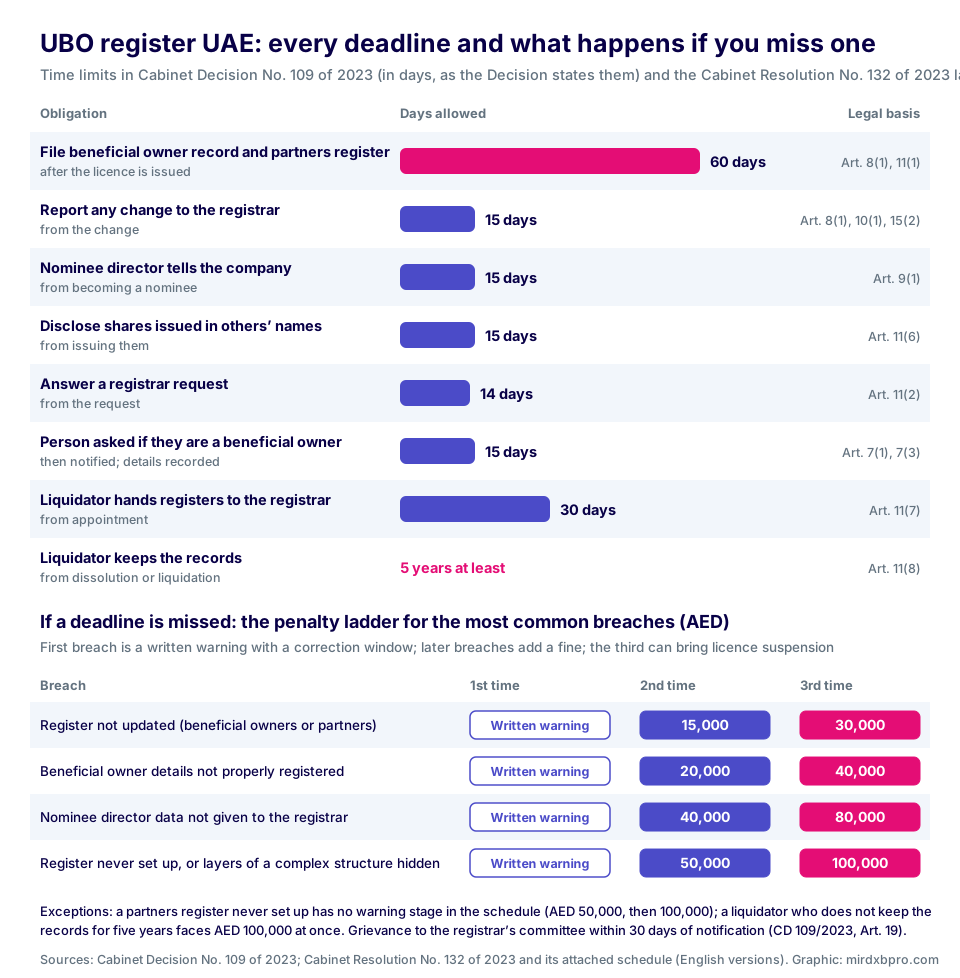
All the time limits in one place
| Duty | Time limit | Runs from | Article |
|---|---|---|---|
| Create the beneficial owner record | 60 days | Licensing or registration | 8(1) |
| File both registers with the registrar | 60 days | Licensing or registration | 11(1) |
| Update the beneficial owner record | 15 days | Learning of the change | 8(1) |
| Update the partners register | 15 days | Becoming aware of the change | 10(1) |
| Send any change to the registrar | 15 days | The change | 15(2) |
| Answer a registrar request for more data | 14 days | The request | 11(2) |
| Nominee tells the company (and of changes or cessation) | 15 days | Becoming a nominee, the change or cessation | 9 |
| Disclose shares issued in others’ names | 15 days | Issue | 11(6) |
| Formal notice after an unanswered enquiry | 15 days, then 15 more | The enquiry, then the notice | 7 |
| Tell a person they were recorded without supplying data | 15 days | Entry in the record | 8(3) |
| Liquidator delivers registers | 30 days | Appointment | 11(7) |
| Liquidator keeps records | At least 5 years | Dissolution or liquidation | 11(8) |
| Grievance against a penalty | 30 days | Notification of the penalty | 19(1) |
The Decision states these periods in days, not working days. We count calendar days and file early.
How DET collects the data
DET’s beneficial owner service card, last updated 12 November 2023 (archived copy of 6 December 2023; we could not read a newer version), describes three routes:
- At a service centre. When any procedure is started on a licence, before the payment voucher is issued, the system texts the customer a link to enter the beneficial owner data. You can also ask the centre to send the link without starting another procedure.
- At renewal by SMS. When renewal is requested by text to 6969, an SMS link asks for the beneficial owner data; once it is entered, the renewal completes and the voucher link follows.
- Online. Registered eServices users could open the beneficial owner page, select the licence and choose “Add / Modify the Beneficial Owner”.
The card says the declaration “must be submitted by the company’s legal representative, such as, at least, one of the directors”, and it offered a downloadable “Declaration of the Beneficial Owner” form. DET’s customer channels have since moved to the Invest in Dubai platform, which did not display a beneficial owner page to us, so we cannot confirm today’s screens from an official page. Article 11(3) still requires the basic data at incorporation, licensing, renewal and modification. Confirm the current route with DET or with us before you rely on a particular one.
Step by step for a new Dubai mainland company
- Map the ownership from the licence and memorandum to individuals, including any corporate partner’s registers.
- Apply the three tests and write down the result and the reason.
- Collect the documents: passports, Emirates IDs for residents, proof of address, and for corporate partners a certificate of incorporation, register of members and directors, and a structure chart, attested and translated where required.
- Complete both registers and the nominee and trustee sections. Get each beneficial owner to confirm their entry in writing.
- Name the UAE-resident contact person and record their details.
- Submit through DET’s channel, signed by the legal representative, within 60 days of the licence. Keep the confirmation.
- Diary the triggers. Every amendment, share issue or change in a corporate partner starts a new 15-day clock; renewal is the moment to re-check.
Changes that trigger a 15-day update
Most late filings are not deliberate. The change happens somewhere else (in a parent company abroad, in a family, in a bank) and nobody connects it to the register in Dubai. These are the events we see most often.
| Event | Which record changes | Also update |
|---|---|---|
| Share transfer or new partner | Partners register; beneficial owners if anyone crosses 25% | DET licence amendment, establishment card, bank, FTA |
| Capital increase not in proportion | Both, if percentages move | Amended memorandum, bank |
| A corporate partner is sold or restructured abroad | Beneficial owners (the company itself may not change) | Bank, FTA if its records hold owner data |
| Voting or shareholder agreement signed | Beneficial owners, if it creates control | Memorandum if voting rights change |
| Manager changes where the manager is the fallback beneficial owner | Beneficial owners | Licence, establishment card, bank mandate |
| A nominee appointed, replaced or released | Partners register nominee section; beneficial owners | Nominee’s own 15-day notice |
| Death of a partner and inheritance | Both, once heirs are registered | Licence, bank, visas |
| Beneficial owner renews a passport, moves or changes nationality | Beneficial owner data | Bank KYC |
| Liquidation starts | Registers pass to the liquidator (30 days) | DET cancellation, immigration and labour files |
Renewal is a checkpoint, not a deadline. If something changed six months ago, the 15 days expired long before the renewal screen asks you to confirm the data. See our trade licence renewal guide for the rest of the renewal file.
Who can see the UBO register
The UAE register is not a public register. Article 16(1) prohibits the Ministry and the registrar from disclosing the beneficial owner record or the partners register “to any person, unless they obtain written approval from the Beneficial Owner or the nominee management member”. The exceptions are disclosures the Decision itself requires, and obligations under laws and international agreements, “especially the provisions related to combating money laundering crimes, combating the financing of terrorism, financing illegal organizations, and exchanging information in tax matters” (Art. 16(2)).
- UAE authorities. The Ministry provides the basic data and both registers “to the concerned entities in the State upon request” (Art. 17(1)), and the registrar discloses them “at the request of the concerned authorities” (Art. 13(9)).
- Foreign authorities. The Ministry facilitates access by competent foreign authorities to basic data, exchanges partner and shareholder information and uses its powers to obtain beneficial owner data for foreign counterparts (Art. 17(2)).
- The public gets only basic company data. Registrars must keep the Article 4(1) data (name, legal form, address, managers and so on) accurate and “available to the public” (Art. 13(6)); that is what licence look-ups show.
- Banks have no general right to read your filed register. They identify beneficial owners themselves as part of customer due diligence, and ask you for your register as evidence.
The registrar’s powers
Article 12 lets the registrar require the company, its employees or its agents to produce beneficial owner and nominee data within a set period, take copies, and require a person to appear and answer questions. Lawyers, independent legal professionals and statutory auditors are exempt from producing information obtained while assessing the company’s legal position or representing it, where professional secrecy applies (Art. 12(3)). Each registrar also has an anti-money laundering unit reporting to the Ministry (Art. 14).
UBO penalties in the UAE: the full Cabinet Resolution 132 of 2023 schedule
Article 18 of Decision 109/2023 lets the registrar impose penalties from a list set by Cabinet decision. That list is the schedule attached to Cabinet Resolution No. 132 of 2023. It applies to legal persons “licensed or registered in the country, including non-financial free zones” (Art. 2), and it sits alongside, not instead of, any penalty under the anti-money laundering law (Art. 3(1)).
Every row has three stages. The first breach is usually a written warning with a window to correct the violation. The second adds a fine and a new correction window. The third doubles the fine, and under Article 3(2) the registrar “may suspend the commercial licence and close the commercial store”, with the suspension lifted once the fine is paid and the violation corrected. The table below is the complete schedule, read from the English version of the Resolution.
| # | Violation | CD 109 article | First time | Second time (AED) | Third time (AED) |
|---|---|---|---|---|---|
| 1 | Beneficial ownership details not properly registered | 6 and 7 | Written warning, correct within 15 days | 20,000 + warning, 15 days | 40,000 + notice to correct |
| 2 | Required data (Art. 8(2)) missing from the beneficial owner register | 8 | Written warning, 15 days | 20,000 + warning, 15 days | 40,000 + notice to correct |
| 3 | Beneficial owner register not set up or not maintained | 8(1) | Written warning, 30 days | 50,000 + warning, 30 days | 100,000 + notice to correct |
| 4 | Beneficial owner register not updated | 8(1) | Written warning, 15 days | 15,000 + warning, 15 days | 30,000 + notice to correct |
| 5 | Nominee director or manager data not provided to the registrar | 10 | Written warning, 30 days | 40,000 + warning, 15 days | 80,000 + notice to correct |
| 6 | Register of partners or shareholders not set up | 10 | No warning stage listed | 50,000 + warning, 30 days | 100,000 + notice to correct |
| 7 | Partners register not updated within 15 days | 10 | Written warning, 30 days | 15,000 + warning, 15 days | 30,000 + notice to correct |
| 8 | Partner or shareholder details not kept, or Art. 10(1) data missing | 10 | Written warning, 30 days | 30,000 + warning, 15 days | 60,000 + notice to correct |
| 9 | Registers not provided to the registrar, or not protected from damage or loss | 11(1) | Written warning, 30 days | 15,000 + warning, 15 days | 30,000 + notice to correct |
| 10 | Additional data not provided within 14 days of a registrar request | 11(2) | Written warning, 30 days | 15,000 + warning, 15 days | 30,000 + notice to correct |
| 11 | Ownership layers of a complex structure not disclosed | 5 | Written warning, 30 days | 50,000 + warning, 30 days | 100,000 + notice to correct |
| 12 | No UAE-resident authorised person named to the registrar | 11(4) | Written warning, 30 days | 10,000 + warning, 15 days | 20,000 + notice to correct |
| 13 | Shares issued in others’ names not disclosed within 15 days | 11(6) | Written warning, 30 days | 15,000 + warning, 15 days | 30,000 + notice to correct |
| 14 | Registers not delivered to the liquidator within 30 days of appointment | 11(7) | Written warning, 30 days | 5,000 + warning, 15 days | 10,000 + notice to correct |
| 15 | Liquidator does not keep the records for 5 years | 11(8) | AED 100,000 | Not listed | Not listed |
How to read the ladder
- The warning is your chance. Correcting inside the warning window is the cheapest outcome in almost every row. Treat a DET warning letter as a deadline, not a notice.
- Breaches stack. One untidy file can breach several rows at once: a register never set up (row 3), a partners register never set up (row 6) and registers not provided to the registrar (row 9).
- Row 6 is harsher. The schedule shows no warning stage for a partners register that was never set up; its first fine listed is AED 50,000. Whether DET applies that on a first breach is not stated.
- Days and months. For collecting fines, “a part of the day shall be considered a full day and a part of the month shall be considered a full month” (Art. 6(2)).
- Challenging a penalty. A grievance goes to the registrar’s grievances committee within 30 days of notification; you can ask for the penalty to be suspended meanwhile, and the committee decides within 45 working days (CD 109/2023, Art. 19).
Other penalty regimes that can apply
Resolution 132/2023 covers the company’s beneficial owner duties. Businesses that are themselves supervised for anti-money laundering (designated non-financial businesses and professions such as dealers in precious metals, real estate brokers, auditors and corporate service providers) face a separate schedule in Cabinet Resolution No. 71 of 2024 for breaches of their own AML measures. Deliberately hiding a beneficial owner to launder money is a matter for the criminal provisions of Federal Decree-Law No. 10 of 2025, which is outside the scope of this guide.
Free zones and their own UBO registers
Decision 109/2023 applies to commercial free zones, so a DMCC, JAFZA, IFZA, Meydan or Hamriyah company keeps the same two registers and files them with its free zone authority, which is its registrar. The Ministry of Economy described the registrars in 2022 as coming “from all economic development departments and free zones in the country”, 39 entities at the time. Each free zone sets its own forms and portal. DMCC, for example, publishes a UBO declaration form with a “revised threshold of 25% and more”, and Hamriyah Free Zone points its companies to its e-portal. Penalties follow Resolution 132/2023, which applies to “non-financial free zones”.
The two financial free zones are outside Decision 109/2023 (Art. 3(2)(b)) and run their own rules:
- DIFC: the Ultimate Beneficial Ownership Regulations 2018, issued under the DIFC Companies Law (DIFC Law No. 5 of 2018).
- ADGM: the Beneficial Ownership and Control Regulations 2022. ADGM’s guidance uses the same 25% ownership or voting threshold, requires changes to be notified to its Registrar within 15 days, and does not make the record public.
A mainland branch of a free zone company needs its own beneficial owner data on the DET file; the controllers are the same people. For choosing between the two regimes, see our free zone vs mainland guide.
How banks use your UBO data
A bank does not open or keep a company account on the strength of your DET filing. It must do its own customer due diligence under Federal Decree-Law No. 10 of 2025 and Cabinet Resolution No. 134 of 2025. Article 10 of that Resolution tells banks to identify the natural person who owns “an actual controlling ownership interest or shares in the Legal Person of 25% (twenty-five percent) or more”, then anyone who controls by other means, and failing that the senior management, the same ladder as your register.
In practice the bank asks for your beneficial owner register, the partners register, the memorandum and the licence, and compares them. If the bank’s chart and your register disagree, it will ask why, and an unexplained difference can hold up the application until it is resolved. After any change, send the bank the updated register with the amended licence.
The full document list, timelines and refusal reasons are in our corporate bank account guide.
Complex structures, trusts and foundations
The Decision defines a complex ownership structure as “an institutional mechanism that identifies a legal person as part of a group of different entities that are intricately linked to each other with the aim of concealing the identity of the natural person who owns or controls the legal person”. A group structure is not suspicious in itself; a structure that makes the owner hard to find is. The registrar applies a risk-based approach to such structures (Art. 5(2)), and failing to disclose the layers is row 11 of the penalty schedule.
- Holding companies. Provide the chain chart and, for each layer, the register of members and directors or an extract from the official registry, with attestation and legal translation where the registrar asks for it.
- Trusts. The Decision defines trustor, trustee and trust fund. Record the trustee in the partners register and, under Article 10(3), the persons it represents. Identify the individuals who control the trust arrangement.
- Foundations and funds. Identify the individuals who control them in fact, typically through the council or the founder’s reserved powers, and record the basis. Take legal advice; the Decision does not list foundation roles one by one.
- Listed groups. Keep evidence of the listing and of majority ownership if you rely on the Article 6(2) relief.
UBO register templates and checklists
These templates are our own working layouts, built from the fields that Articles 7 to 11 of Decision 109/2023 require. They are not official DET forms: use DET’s online screens for the filing itself, and keep these as the company’s internal record and evidence. Adapt the wording with your lawyer where your structure is unusual.
Template 1: beneficial owner identification worksheet
- List every partner or shareholder on the licence and memorandum with capital percentage and voting percentage.
- For each corporate partner, list its owners and their percentages; repeat until every branch ends in an individual, a listed company or a government owner.
- Calculate each individual’s indirect percentage by multiplying through the chain, and separately note who controls each intermediate company.
- Mark everyone at 25% or more of capital or votes, by either reading.
- List any rights to appoint or dismiss most managers, vetoes, voting agreements, options or nominee instructions, and mark the individuals they point to.
- If no one is marked, record the senior management official and write down the steps taken to find an owner.
- Sign and date the worksheet; keep it with the registers.
Template 2: Beneficial Owner’s Record
| Field | Example entry | Basis |
|---|---|---|
| Full name (as in passport) | [Name] | Art. 8(2)(a) |
| Nationality; date and place of birth | [Nationality]; [DD/MM/YYYY]; [City, country] | Art. 8(2)(a) |
| Residence or address for notices | [Full address] | Art. 8(2)(b) |
| Passport or ID number, issuing country, issue and expiry dates | [Number]; [Country]; [dates] | Art. 8(2)(c) |
| Emirates ID, gender, mobile, email | [If held] | DET data items |
| Basis of beneficial ownership | “40% of capital and votes held directly” or “30% indirect via HoldCo Ltd (50% of HoldCo, which holds 60%)” | Art. 8(2)(d) |
| Date became beneficial owner | [Date of licence, transfer or agreement] | Art. 8(2)(d) |
| Date ceased | [Blank until it happens] | Art. 8(2)(e) |
| Notified under Art. 8(3)? | [Date and method, if data not supplied by the person] | Art. 8(3) |
| Filed with registrar on | [Date and reference] | Art. 11(1), 15(2) |
Template 3: Register of Partners or Shareholders
| Column | Individual partner | Corporate partner |
|---|---|---|
| Name | As in passport or ID | Registered name and legal form |
| Identity | Nationality, place of birth, valid ID or passport copy | Articles or statute; head office; UAE legal representative if foreign |
| Address | Residential address | Registered address |
| Employer | Name and address of employer | Not applicable |
| Management | Not applicable | Senior managers with ID numbers, issuer and dates |
| Holding | Number and class of shares, voting rights | Number and class of shares, voting rights |
| Date became partner | Date | Date |
| Nominee or trustee? | Yes or no; if yes, the represented person’s full data | Yes or no; if yes, the represented person’s full data |
Template 4: nominee declaration (Article 9)
“I, [name], [passport number], confirm that I hold the position of [manager / board member / shareholder of X shares] in [company] as a nominee, acting on the directions of [name of the person represented, passport number, nationality, address]. I became a nominee on [date]. I will inform the company within 15 days of any change in these details and within 15 days if I cease to act as a nominee. Signed [ ], dated [ ].”
Template 5: enquiry and notice to a possible beneficial owner (Article 7)
First letter: “Our records indicate that you may be a beneficial owner of [company] within the meaning of Article 5 of Cabinet Decision No. 109 of 2023, because [basis]. Please confirm whether you are, and provide the details listed below, within 15 days.” If there is no answer, send the formal notice described above, with evidence of this letter attached.
Template 6: transferee statement (Article 8(5))
“In connection with the transfer of [number] shares in [company] from [seller] to [buyer] dated [date], the transferee states that the transfer [does / does not] result in a change in the beneficial owner of the company. [If it does:] The new beneficial owner is [full name, nationality, date and place of birth, address, passport number, issuing country, issue and expiry dates], who becomes a beneficial owner on [date] on the basis of [basis].” Signed by or for the transferee.
Checklist: at licensing
- Ownership chart to individuals, with the worksheet signed.
- Both registers complete, including nominee and trustee sections.
- Written confirmation from each beneficial owner of their entry.
- Resident contact person resolution.
- Filed with DET within 60 days of the licence, with the confirmation kept.
- No bearer shares; any shares in others’ names disclosed within 15 days.
- Same owners and percentages in the licence, memorandum, registers and bank file.
Checklist: every change
- Transferee statement obtained before the transfer is given effect.
- Partners register and beneficial owner record updated, and the registrar told, within 15 days.
- DET licence amendment, establishment card, Chamber and bank updated.
- Federal Tax Authority records updated within 20 business days where they change.
- Old entries closed with a “ceased” date, not deleted.
Checklist: every year, before renewal
- Ask each beneficial owner and corporate partner to confirm nothing has changed, in writing.
- Check passport and Emirates ID expiry dates on the record.
- Check the resident contact person is still in the UAE and still authorised.
- Re-read any shareholder agreements for new control rights.
- Confirm the DET data matches before the renewal voucher is paid.
What goes wrong with UBO filings
- Recording the company, not the person. “ABC Holdings Ltd, 100%” is a partner, not a beneficial owner. The record must end in individuals.
- Stopping at the first layer. A foreign parent’s own shareholders are never looked at, so the real owner is missing.
- Using the manager as a shortcut. The senior management fallback applies only when no owner or controller can be found after real effort.
- Forgetting control. A 20% partner with the right to appoint the manager, or a lender with vetoes, is left off.
- Filing once and never again. A share transfer is amended with DET but the beneficial owner data is not, or an upstream sale abroad is never reported.
- Undeclared nominees. A relative or employee holds shares for someone else and neither register says so.
- Ignoring a warning letter. The first stage is free to fix; the second is not.
- Losing the records at closure. Nobody hands the registers to the liquidator, who then cannot keep them for five years.
UBO register UAE in practice: five cases
These cases are built from the situations we see most often. Names and identifying details are left out, and the figures are the published ones.
1. Two founders and a new LLC
Two individuals set up a Dubai mainland LLC at 70% and 30%, with the 70% partner as manager. Both are beneficial owners at step 1. The company completes both registers, names the manager as the UAE-resident contact person and files with DET within 60 days of the licence. No government fee is published for the filing. The same two names, percentages and passport numbers go to the bank in the account application, so the bank’s check and the register agree.
2. A foreign parent company
A Dubai LLC is owned 100% by a UK company, which is owned 50/50 by two individuals. The partners register lists the UK company with its articles, registered address and directors. The beneficial owner record lists both individuals, each with 50% indirect ownership, and gives the basis (“50% of the UK parent, which holds 100%”). The UK company’s register of members and directors, attested and translated, sits in the file. When one individual later sells to the other abroad, the Dubai company’s partners register does not change, but the beneficial owner record does, and the change goes to DET within 15 days.
3. Five equal partners
Five friends hold 20% each, with no shareholder agreement. No one reaches 25%, and none of them controls the company by other means. After recording why steps 1 and 2 found no one, the company records the general manager as beneficial owner under Article 5(6). Two years later, two of the partners sign a voting agreement to vote together on all matters. Jointly they control 40% of the votes, and on our reading of Article 5(4) each is treated as controlling that 40%. Both are now beneficial owners, and the update is due within 15 days of the agreement.
4. A share transfer filed late
A 40% partner sells to an outsider. The DET licence amendment is done, but nobody updates the beneficial owner data. Months later DET sends a written warning under row 4 of the schedule with 15 days to correct. The company updates the record inside the window and pays nothing. Had it ignored the warning and been caught again, the second stage would be AED 15,000 plus a new 15-day warning, and the third AED 30,000 with possible licence suspension.
5. A nominee holding brought into the open
A founder abroad had a relative in Dubai hold 51% of a trading LLC “for” him, with no written agreement and nothing on the registers. Before opening a new bank account, the founder takes legal advice. The relative signs a nominee declaration, the partners register records the relative as nominee for the founder with the founder’s full data, and the beneficial owner record names the founder. The company files the change with DET. Whether to keep or unwind the nominee arrangement is a legal decision; the registers now tell the truth either way.
UBO register UAE: where the official sources are silent or disagree
| Point | What the sources say | How we handle it |
|---|---|---|
| Current DET filing screens | The detailed DET service card dates from 12 November 2023 and still cites the repealed Decision 58/2020; Invest in Dubai did not display a current beneficial owner page to us | We describe the 2023 routes as the latest published and confirm the live screen before filing |
| How to calculate indirect ownership | Article 5 covers indirect ownership and chains, but gives no formula | We test both multiplication and control of intermediate companies and record the wider result |
| The fallback clause | Article 5(6) (English version) refers to “Clause (4)” where the context points to Clause (5) | We apply the fallback only after steps 1 and 2 fail |
| 60 days from what, for the record itself | Article 8(1) says from issue of the Decision or the company’s “existence”; Article 11(1) says from entry into force or licensing | We work to 60 days from the licence date |
| Partners register never set up (row 6) | The schedule shows no warning stage and AED 50,000 as the first fine listed | We treat it as fined from the first breach |
| Listed-company relief | Article 6(2) relieves the duty in Article 6(1) only; it does not mention the partners register | We still keep and file the partners register |
| AML references | Decision 109/2023 cites Decree-Law 20/2018 and Decision 10/2019, both since replaced by Decree-Law 10/2025 and Resolution 134/2025 | We apply the Decision as in force (CBUAE Rulebook) and the new AML texts for bank checks |
UBO rules: what circulates online that is not true
| What circulates | The position |
|---|---|
| “The UBO register is only for free zone companies” | It applies to all licensed or registered legal persons, mainland and commercial free zones (Art. 3(1)) |
| “Under 25%, you are never a beneficial owner” | Control by other means, such as appointing most managers, makes you one at any percentage (Art. 5(1) and 5(5)) |
| “A holding company can be the beneficial owner” | The beneficial owner is always a natural person (Art. 1) |
| “The UBO filing is public, anyone can look up the owner” | Only basic data is public; the registers are confidential except for authorities and consent (Arts. 13 and 16) |
| “You only update the UBO at renewal” | Changes are due within 15 days (Arts. 8(1), 10(1), 15(2)) |
| “The local service agent is the beneficial owner of a professional licence” | The agent holds no ownership; the owner or partners are recorded |
| “UBO fines start at AED 100,000” | Most rows start with a written warning; AED 100,000 is the third-stage fine for the most serious rows and the liquidator’s retention breach |
| “Nominee arrangements are illegal” | The Decision requires nominees to be disclosed with the persons they represent; hiding them is the breach |
How to verify every figure in this guide
| Rule or figure | Where to check it |
|---|---|
| Definitions, scope, exemptions, tests, registers, deadlines, confidentiality, grievance | Cabinet Decision No. 109 of 2023, Arts. 1 to 19 (MOET English version; CBUAE Rulebook) |
| Penalties and licence suspension | Cabinet Resolution No. 132 of 2023, Arts. 2, 3, 6 and the attached schedule |
| DET filing routes; bank checks; DIFC and ADGM | DET beneficial owner service card (2023); Cabinet Resolution No. 134 of 2025, Art. 10; DIFC and ADGM regulations |
If an official page has changed since we checked it, the official page wins.
Checked against official sources on 25 September 2026: the English texts of Cabinet Decision No. 109 of 2023 and Cabinet Resolution No. 132 of 2023 (including the full penalty schedule), the CBUAE Rulebook entries for Decision 109/2023 and Resolution 134/2025, DET’s beneficial owner service card (archived 6 December 2023), the Dubai Media Office announcement of 2 June 2021, the FATF statement of February 2024, MOET guidance, and the DIFC, ADGM and DMCC pages linked below.
What we will and will not do
We will map your ownership and control to individuals, apply the Article 5 tests and explain the result, prepare both registers with the nominee, trustee and resident-contact records, file with DET at licensing and within 15 days of each change, help you answer registrar requests and warning letters in time, and keep the licence, memorandum, establishment card, bank and tax records consistent with the register.
We will not act as a nominee shareholder, nominee manager or beneficial owner for anyone, leave a known owner off a register, file data we have reason to believe is untrue, give legal or tax advice on trusts, nominee agreements or holding structures, or promise that DET, a bank or any authority will accept a filing another body decides on.
Related guides
- Mainland company formation: the complete route
- Trade licence amendment in Dubai
- Corporate bank account in the UAE
- Memorandum of association in Dubai
- Types of companies in Dubai mainland
- 100% foreign ownership in Dubai
- Corporate tax registration in the UAE
- Expired trade licence in Dubai: fines and fixes
- Why companies need PRO services
UBO register UAE: frequently asked questions
What is a UBO register in the UAE?
It is the record of the natural persons who ultimately own or control a company, kept by the company and filed with its registrar under Cabinet Decision No. 109 of 2023. It sits alongside a register of partners or shareholders. For a Dubai mainland company the registrar is the Department of Economy and Tourism. Both registers are due within 60 days of licensing, and changes within 15 days.
Who counts as an ultimate beneficial owner?
Any individual who owns or controls, directly or through other companies, 25% or more of the capital or the votes, or who can appoint or dismiss most of the managers. If there is no such person, it is whoever controls the company by other means. If there is still no one, the senior management official is recorded as the beneficial owner.
Does a mainland LLC in Dubai need a UBO register?
Yes. The Decision applies to every legal person licensed or registered in the UAE, including mainland LLCs, one-person LLCs, civil companies, sole establishments and branches, whatever the activity. The main exemptions are companies wholly owned by government, financial free zone entities and, for the duty to collect beneficial owner data, companies owned by a listed company.
What is the deadline to file the UBO declaration?
Within 60 days from the date the company is licensed and registered, under Article 11(1) of Cabinet Decision 109/2023. Both the beneficial owner record and the register of partners or shareholders go to the registrar. After that, every change must be recorded and reported within 15 days, and any extra information the registrar asks for is due within 14 days.
How do I file beneficial owner data with DET?
DET’s published service card describes three routes: a link sent by text when a service centre starts any procedure on the licence, a link sent during SMS renewal via 6969, and an “Add / Modify the Beneficial Owner” option in its online services. The company’s legal representative, at least one manager, submits the declaration. Confirm today’s screen on Invest in Dubai before filing.
What are the UBO penalties in the UAE?
Cabinet Resolution No. 132 of 2023 sets fifteen violations. Most start with a written warning and 15 or 30 days to correct, then a fine from AED 5,000 to AED 50,000, then AED 10,000 to AED 100,000. Failing to update the register is warning, AED 15,000, then AED 30,000. After a third breach the registrar may suspend the licence until the fine is paid and the breach corrected.
Can the manager be recorded as the beneficial owner?
Only as a last resort. Article 5(6) deems the senior management official the beneficial owner where no individual owning or controlling 25% or more, and no one controlling by other means, can be identified after all possible steps. Keep a note of the steps taken. Recording the manager when a real owner exists is an incorrect filing.
Is the UAE UBO register public?
No. Article 16 prohibits the Ministry and the registrar from disclosing the beneficial owner record or partners register without the beneficial owner’s written consent. Exceptions cover UAE authorities on request, obligations under the Decision itself, and anti-money laundering and tax-exchange agreements. Basic company data such as the name, legal form, address and managers is public.
What if a shareholder abroad refuses to give their details?
Follow Article 7. Ask them in writing; if 15 days pass without an answer, send a formal notice with the details you believe are correct, asking them to confirm, correct and complete them. If they still do not comply within 15 days, record the notified details. Keep copies of both letters as evidence for the registrar.
Do free zone companies file with DET?
No. Commercial free zone companies file with their own free zone authority, which acts as their registrar under the same Cabinet Decision and penalty schedule. DIFC and ADGM companies are outside the Decision and follow their own beneficial ownership regulations. A mainland branch of a free zone company files its beneficial owner data with DET.
Will my bank ask for the UBO register?
Usually, yes. Banks must identify every individual with 25% or more, or control by other means, under Cabinet Resolution No. 134 of 2025, and they commonly ask for your beneficial owner and partners registers with the licence and memorandum. If their findings and your filing differ, expect questions. Send the updated register to the bank after every change.
Can MIRDXB PRO prepare and file our UBO register?
Yes. We map the ownership to individuals, apply the Article 5 tests, prepare both registers with the nominee, trustee and resident-contact records, file with DET within the deadline and handle later changes alongside licence amendments. Government charges, if any, are passed on at cost; our fee is quoted in writing before we start. We never act as a nominee.
We received a DET warning about beneficial owner data. Can you help?
Yes, and quickly is best. The written warning in Resolution 132/2023 gives 15 or 30 days to correct before any fine applies. Send us the letter, the licence and the ownership details. We identify what is missing, correct the registers, file the update within the window and, where a penalty has already been imposed, explain the 30-day grievance route.
Keeping ownership records, licence amendments and filings in step across DET, immigration, labour and the bank is what our PRO services in Dubai team handles.
- Ministry of Economy and Tourism: Cabinet Decision No. 109 of 2023 on regulating the beneficial owner procedures (English version)
- CBUAE Rulebook: Cabinet Decision No. 109 of 2023, status and articles
- UAE Legislation: Cabinet Resolution No. 109 of 2023
- Cabinet Resolution No. 132 of 2023 on administrative penalties, with schedule (English version, copy published by Masdar City Free Zone)
- CBUAE Rulebook: Cabinet Resolution No. 134 of 2025, executive regulation of the AML law
- UAE Legislation: Cabinet Resolution No. 71 of 2024 on AML violations and penalties
- Department of Economy and Tourism: Beneficial Owner service card (last updated 12 November 2023; archived 6 December 2023)
- Dubai Media Office: Dubai Economy urges registered businesses to provide beneficial owner data (2 June 2021)
- Ministry of Economy: workshop on the UBO framework with registrars (26 September 2022)
- Ministry of Economy and Tourism: Supplemental Guidance for Trust and Company Service Providers (2026)
- FATF: Jurisdictions under increased monitoring, 23 February 2024
- DIFC: Companies Law and Ultimate Beneficial Ownership Regulations 2018
- ADGM: Beneficial ownership and control obligations
- DMCC: UBO declaration form (25% threshold)
- Hamriyah Free Zone Authority: UBO update
Please note. This guide was verified against the official sources listed above on 25 September 2026. Laws, service channels and penalties change; the registrar’s current requirements and the text of the law always prevail. It is general information about UAE beneficial owner rules, not legal, tax or financial advice. For trusts, nominee agreements, disputed ownership or cross-border structures, take advice from a UAE-qualified lawyer. MIRDXB PRO is a private PRO services company and is not a government body.


