

Key takeaways
- 100% foreign ownership in Dubai is the default for mainland companies, not a special permit. Since June 2021 most commercial and industrial activities can be fully foreign-owned, with no Emirati partner, no extra fee, no guarantee and no additional capital (Dubai Economy, 3 June 2021).
- The legal basis is Article 10 of Federal Decree-Law No. 32 of 2021 on Commercial Companies, which replaced the old rule that every company needed UAE partners holding at least 51% (Federal Law No. 2 of 2015, Art. 10). The change was made by Federal Decree-Law No. 26 of 2020.
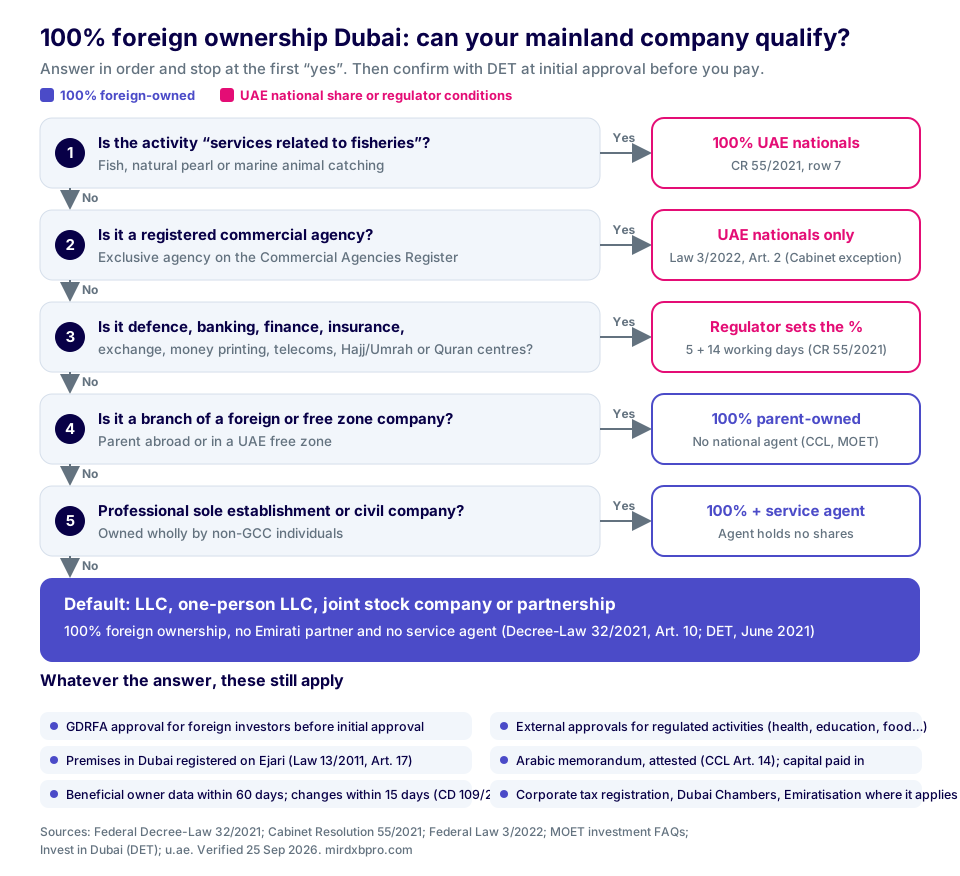
- Strategic impact activities are the exception. Cabinet Resolution No. 55 of 2021 lists seven: security and defence, banks, exchange, finance and insurance, money printing, telecoms, Hajj and Umrah, Quran memorisation centres and fisheries. The regulator sets the national share for each; fisheries services stay 100% with UAE nationals.
- Dubai publishes its own restriction list. DET’s Invest in Dubai page names 92 activity entries that do not allow full foreign ownership, including commercial agencies, which Federal Law No. 3 of 2022 reserves to UAE nationals and companies wholly owned by them.
- A service agent is still needed in one place: professional sole establishments and civil companies owned by non-GCC individuals. The agent holds no shares. Branches of foreign companies no longer need a national agent.
- Full ownership does not remove the other conditions: GDRFA approval for foreign investors, external approvals, premises on Ejari, an attested memorandum, beneficial owner filings, corporate tax, Dubai Chambers and Emiratisation where it applies.
- Existing 51/49 companies may keep their structure or buy out the Emirati partner through a notarised share transfer and a licence amendment. Nothing converts automatically.
100% foreign ownership in Dubai means a mainland company licensed by the Department of Economy and Tourism (DET) can be owned entirely by foreign individuals or companies, with no UAE national shareholder, for any activity that is not on the federal list of strategic impact activities or Dubai’s own restriction list. The rule comes from Article 10 of Federal Decree-Law No. 32 of 2021 on Commercial Companies, and Dubai has applied it since 1 June 2021. For restricted activities such as banking, insurance, telecoms, defence and commercial agencies, the regulator or the law decides the share that must be held by UAE nationals.
This guide explains the rule behind full foreign ownership, what the law actually says, which activities are still restricted in Dubai (with the official lists reproduced), where a local service agent or an Emirati partner is still needed, the conditions that apply whoever owns the company, how existing 51/49 companies move to full foreign ownership, and how to check your own activity before you pay a single fee.
It is one guide in our mainland series. For the whole set-up route, from activity and trade name to licence, visas, bank and tax, start with our mainland company formation guide. If you want the licence handled for you, our company formation support team runs the full file.
100% foreign ownership Dubai at a glance: who can own what
The table below is the short answer on 100% foreign ownership Dubai rules for the structures founders ask about most. The rest of the guide explains each row and the source behind it.
| Structure or activity | Can foreigners own 100%? | UAE national needed? | Source |
|---|---|---|---|
| LLC or one-person LLC, ordinary commercial or industrial activity | Yes | No Emirati partner, no service agent | Decree-Law 32/2021, Arts. 10 and 71; Dubai Economy, June 2021 |
| Private or public joint stock company, general or limited partnership | Yes, in all legal forms of the Commercial Companies Law | No, unless the Cabinet or the competent authority decides otherwise | MOET investment FAQs |
| Branch of a foreign company or of a UAE free zone company | Yes, owned by the parent | No national agent | Decree-Law 26/2020, Art. Six (repeal of old Art. 329); MOET FAQs |
| Professional sole establishment or civil company owned by non-GCC individuals | Yes, the owner holds 100% | A local service agent (no shares, no profit) | MOET FAQ on single-owner businesses; u.ae; Invest in Dubai |
| Strategic impact activities: defence, banking, finance, insurance, exchange, money printing, telecoms, Hajj and Umrah, Quran centres | Possible, subject to the regulator | The regulator sets the national and foreign percentages | Cabinet Resolution 55/2021; MOET FAQs |
| Services related to fisheries (fishing, natural pearls, marine animals) | No | 100% UAE nationals | Cabinet Resolution 55/2021, row 7; Invest in Dubai list |
| Registered commercial agency | No, save a Cabinet exception | UAE nationals or companies wholly owned by them | Federal Law 3/2022, Art. 2 |
| Real property outside Dubai’s designated freehold areas | Not by a foreign-owned company | Ownership limited to UAE and GCC nationals and their wholly owned companies | Dubai Law 7/2006, Art. 4 |
100% foreign ownership in Dubai: how MIRDXB PRO helps
Most founders who ask us about full foreign ownership have already read that “foreigners can now own 100%” and want to know two things: does it apply to my activity, and what else will DET ask for? We answer both in writing before you pay, then run the file. We are an Amer and Tasheel partner in Al Barsha 1, Dubai, and ownership questions sit at the start of every mainland file we handle.
What we do for 100% foreign ownership in Dubai
- Check the activity against the official lists. We match your business to the DET activity name and code, then check it against Cabinet Resolution No. 55 of 2021, Dubai’s restriction list and the external approvals that activity needs.
- Recommend the structure that fits the owners. One-person LLC, multi-partner LLC, professional sole establishment or civil company, or a branch of your existing company, with the ownership, liability and agent consequences of each set out plainly.
- Prepare the owner documents. Passports, visas or entry permits, and for corporate owners the parent’s licence, board resolution and memorandum, legalised, attested and legally translated where DET requires it.
- Run the DET file. Trade name, initial approval, the memorandum or service agent contract, and the licence on Invest in Dubai, with the ownership shown correctly from day one.
- Restructure existing 51/49 companies. Where an Emirati partner is leaving, we coordinate the share transfer, the amended memorandum and the licence amendment, then update MOHRE, GDRFA and the beneficial owner register.
- Hand over the compliance calendar. Beneficial owner filing, corporate tax registration, Dubai Chambers and licence renewal dates in one document.
How it works
- Message us on WhatsApp with the activity in plain words, the owners (individuals or companies, nationalities, in or outside the UAE) and whether the company exists already.
- We reply in writing with the ownership answer for your activity and the source, the recommended structure, the documents each owner must supply, the government fees and our fee.
- You approve, and we start with the trade name and initial approval, which is where DET confirms the ownership for your exact activity.
- We complete the licence and the knock-on files, and diarise the beneficial owner and tax deadlines that start on the licence date.
What it costs
Full foreign ownership itself carries no extra government fee: Dubai Economy said in June 2021 that no additional fees, guarantees or capital are required. You pay the normal licensing fees, which are passed on at cost on DET’s own voucher, plus any notary, attestation, Ejari and approval fees your file needs. Our fee depends on the structure, the number of owners and whether corporate documents must be legalised abroad, and it is always quoted in writing before we start. See our fees page, and for every government line of a mainland set-up with worked totals, our mainland business setup cost guide.
Why founders use us
- We publish our sources. Every rule in this guide links to the law, the ministry or the DET page it came from, and where official pages disagree we show both.
- We tell you when you do not need us. If your activity is unrestricted and you are comfortable with Invest in Dubai, we will say so and point you to the right screens.
- We cover the whole chain. DET, Dubai Chambers, GDRFA, MOHRE and ICP files are handled by one team, so the ownership on the licence matches the establishment cards, visas and beneficial owner records.
- We are easy to reach. Our office is in Al Barsha 1, Dubai (Monday to Thursday and Saturday 09:00 to 18:00, Friday 09:00 to 12:00), and we act under power of attorney for owners abroad where the step allows it.
From the 51/49 rule to full foreign ownership: how the law changed
For years the answer to “can a foreigner own a company on the Dubai mainland?” was no, not a majority. Understanding how that rule worked, and how it was removed, explains why some old habits (and some online advice) still assume an Emirati partner is needed.
The 51% Emirati partner rule under the old Companies Law
The rule most founders remember is Article 10 of Federal Law No. 2 of 2015 on Commercial Companies, the law that replaced the first federal companies law of 1984. It read: “any company established in the State shall have one or more UAE partner holding at least 51% of the share capital of the company”. In general partnerships and the general partners of limited partnerships, every such partner had to be a UAE national. That is the origin of the familiar 51/49 split.
In practice, many foreign founders held 49% on paper and signed separate side agreements with the Emirati partner, who received a fixed annual fee rather than a real share of profit. Professional firms were already outside the rule: as Gulf News reported in November 2018, law firms, architects and engineers could be wholly foreign-owned through professional licences with a local service agent.
The 2018 Foreign Direct Investment Law
Federal Decree-Law No. 19 of 2018 on Foreign Direct Investment allowed ownership above 49% in sectors approved by the Cabinet. It was a limited opening, and it no longer exists: Federal Decree-Law No. 26 of 2020 repealed it in full (Article Six, clause 2). Articles that still quote its “positive list” or “negative list” of sectors are describing a law that ended in 2020.
Federal Decree-Law No. 26 of 2020
Issued on 27 September 2020, Decree-Law 26/2020 rewrote Article 10 of the 2015 law. Instead of a 51% national shareholding, the new Article 10 set up a Cabinet committee to identify activities with a strategic impact and the controls for licensing them. It also repealed old Article 329, which had required branches of foreign companies to appoint a UAE national agent.
The timing matters. Article Eight brought the decree-law into force on 2 January 2021, but Article Seven delayed the ownership changes: “The amendments to the provisions of Articles (10), (151) and (329) … shall come into force six months from the date of its publication in the Official Gazette.” The Cabinet’s list of strategic impact activities then took effect on 1 June 2021, and Dubai Economy (now DET) started applying full foreign ownership the same day.
100% foreign ownership in Dubai from 1 June 2021
On 3 June 2021 the Government of Dubai Media Office published Dubai Economy’s clarifications. The key points, which remain the basis of DET practice:
- “100% foreign ownership is available for more than 1,000 commercial and industrial activities excluding economic activities with a strategic impact, which are in seven sectors only.”
- “No additional fees, guarantees or capital required for full foreign ownership.”
- “Full ownership does not bring any change to current procedures or requirements for licensing, except that it’s no longer mandatory to have an Emirati partner or specify a fixed quota ratio for him/her.”
- Companies with an Emirati partner may keep their structure, or reduce or remove the partner’s share following the legal procedures.
- An LLC cannot be converted into a sole proprietorship under a foreign name, but it can be moved to a one-person LLC.
- Branches of foreign companies do not need an Emirati agent.
At that date, 59 investors in Dubai had already used the new rule, in activities from general trading, contracting, gold and jewellery to building materials, a school and a hotel.
Federal Decree-Law No. 32 of 2021: the current law
The whole Commercial Companies Law was then re-enacted as Federal Decree-Law No. 32 of 2021, issued on 20 September 2021 and in force from 2 January 2022. It keeps the 2020 approach, and it is the law your memorandum of association is written under today. Its Article 71 lets “any single natural or legal person” own a limited liability company, and its Article 10, below, governs national participation.
| Date | Change | Effect on foreign ownership |
|---|---|---|
| 1984 | First federal Commercial Companies Law (Federal Law No. 8) | Replaced by the 2015 law |
| 1 April 2015 | Federal Law No. 2 of 2015, Art. 10 | UAE partners to hold at least 51%; general partners all UAE nationals |
| 2018 | Federal Decree-Law No. 19 of 2018 on Foreign Direct Investment | Above 49% possible in Cabinet-approved sectors only |
| 27 September 2020 | Federal Decree-Law No. 26 of 2020 issued | New Art. 10 (strategic impact), branch agent article repealed, FDI Law repealed |
| 2 January 2021 | Decree-Law 26/2020 in force (general provisions) | Ownership articles delayed six months after gazette publication |
| 1 June 2021 | Cabinet Resolution No. 55 of 2021 in force; Dubai starts applying full foreign ownership | Over 1,000 Dubai activities open to 100% foreign ownership |
| 2 January 2022 | Federal Decree-Law No. 32 of 2021 in force | Current law; same Article 10 approach |
| 2022 (in force six months after publication) | Federal Law No. 3 of 2022 Regulating Commercial Agencies | Commercial agencies kept for UAE nationals, with a Cabinet exception |
| 18 April 2026 (archived copy) | Invest in Dubai “Foreign ownership restrictions” list | 92 activity entries named as not allowing full foreign ownership |
What Article 10 actually says about full foreign ownership
Article 10 of Decree-Law 32/2021 is short, and most summaries of it are wrong in one direction or the other. It does not say “every activity is open”. It says who decides. In full, it has four clauses:
- A committee, with representatives of the competent authorities, proposes “activities with a strategic impact and the controls required to license the companies that engage in any of these activities”.
- The Cabinet, on the committee’s recommendation, issues a resolution “defining the activities with a strategic impact and the controls for licensing” them. That resolution is Cabinet Resolution No. 55 of 2021.
- The competent authority (for a Dubai mainland company, DET) may “determine a particular ratio for the contribution of UAE nationals to the capital or the boards of directors of all companies that are incorporated within the scope of its competence”, and approves incorporation applications and fees within the Cabinet’s controls.
- The Cabinet may relieve a company whose activity is regulated by special legislation from any rule on the percentage of national ownership or management.
So there are two layers. The federal layer is the Cabinet’s strategic impact list. The local layer is each emirate’s power to set a national ratio for activities in its own list. That is why Dubai, Abu Dhabi and the other emirates each published their own lists in 2021, and why the practical answer for your company always comes from DET’s system, not from a general statement that “100% is allowed”.
Decree-Law 32/2021 uses “Competent Authority” for the local body that licenses companies in each emirate. For a mainland company in the emirate of Dubai, that is the Department of Economy and Tourism. Free zone authorities license their own companies under their own rules.
Strategic impact activities: the federal list
Cabinet Resolution No. 55 of 2021 “Determining the List of Activities with a Strategic Impact” was issued on 30 May 2021 and came into force on 1 June 2021. Its Article 2 table lists seven activities, the regulator for each and the controls. These strategic impact activities are not closed to foreigners; they are licensed on the regulator’s terms.
| Row | Strategic impact activity | Regulatory authority | Conditions and controls |
|---|---|---|---|
| 1 | Security and defence activities and activities of a military nature | Ministry of Defence and Ministry of Interior | Approval and requirements of the ministry on the percentage of capital participation, board membership and other conditions |
| 2 | Banks, exchange houses, finance companies and insurance activities | Central Bank of the UAE | Approval and requirements of the Central Bank on capital participation, board membership and other controls |
| 3 | Money printing | Central Bank of the UAE | As row 2 |
| 4 | Telecoms | Telecommunications and Digital Government Regulatory Authority | Approval and requirements on capital and board participation and other conditions |
| 5 | Pilgrimage (Hajj) and Umrah activities | Islamic affairs and endowments authority | Approval on board participation and other conditions |
| 6 | Quran memorisation centres | Islamic affairs and endowments authority | As row 5 |
| 7 | Services related to fisheries | Not specified | “The percentage of national participation in this activity shall be 100%” |
How a strategic impact application is decided
Article 3 of the resolution sets two clocks. The competent authority (DET, for Dubai) forwards the application to the regulator within 5 working days, and the regulator decides “within a maximum period of (14) fourteen working days”, either approving with conditions or rejecting. The Ministry of Economy and Tourism’s investment FAQs add that the decision must state “the percentage of national and/or foreign shareholders in the company’s capital” and any other conditions.
The resolution does not say what happens if the regulator does not answer in time. Do not treat silence as approval. Article 4 adds that companies licensed in strategic impact activities must comply with all other applicable legislation, which for banks, exchange houses and insurers means the Central Bank’s own licensing regime on top of DET’s licence.
What the Ministry of Economy and Tourism says about them
MOET’s investment FAQs answer the questions founders ask about strategic impact activities directly:
- “A foreign investor may partake in any of the strategic impact activities by being a shareholder in the company’s capital or Board membership, subject to the approval of the relevant regulatory authority.”
- “The activities of services related to fisheries are 100% exclusive for UAE nationals only.”
- “A UAE agent is not required to carry out any strategic impact activity, however, a certain percentage of national shareholders may be required, based on the prerequisites determined by the relevant regulatory authority.”
- Strategic impact activities may be carried on through any legal form in the Commercial Companies Law.
In short: for strategic impact activities, the question is not “can I own 100%?” but “what share will the regulator accept?” The answer is set case by case, in writing, and it binds your memorandum of association.
DET’s list: activities excluded from 100% foreign ownership in Dubai
DET publishes its restrictions on the Invest in Dubai platform, under Mainland companies, “Foreign ownership restrictions”: “Find out which business activities do not allow for 100% foreign ownership.” The page loads its content by script and did not display to us directly on 25 September 2026, so we read the copy archived on 18 April 2026 (the site’s own footer on that copy reads “Site last updated 18/04/2026”). It names 92 activity entries in four groups, matching the Cabinet’s strategic impact activities plus commercial agencies and fisheries.
| Group on the DET list | Entries | Activities named |
|---|---|---|
| Security and defence activities and activities of a military nature | 42 | Military garments manufacturing; military clothing and uniforms tailoring; light, medium and heavy military weapons manufacturing; metal badges and military insignia; military tools and supplies (manufacturing and trading); dismantling and destroying military equipment and weapons; military dress, weapons, equipment, ammunition, explosives, scrap and vehicle spare parts trading; unexploded ordnance and mines disposal; military ammunition, explosives, pyrotechnics and propellant powders manufacturing; military ships, aircraft, plants equipment, ballistic and guided missiles, fighting vehicles, tanks and armoured amphibious vehicles; toughened and laminated flat glass manufacturing; radar equipment; military remote-control systems; sensors and military communication systems; plating machinery and vehicles; repair and maintenance of military equipment, aircraft and ships; military reality-based training; defence and security companies’ representation; military consultancy; defence and surveillance systems, missiles and weapons technology, military aircraft safety systems, military technology R&D and control and command systems development |
| Banks, exchange, financing, insurance and bank note or coin production | 36 | Commercial, Islamic, credit and finance, investment, savings and wholesale banks; digital wallet for electronic payments; hawala brokers services; real estate, industrial and agricultural financing; e-finance; consumer loans; financing operations; accidents and civil liabilities, life, credit and saving, fire, theft, work compensation, motor, marine, aviation and transport, health, mechanical failure and other insurance; reinsurance and life reinsurance; money exchangers; money orders and travellers cheques exchangers; remittance of local and foreign currencies; e-banking; insurance actuaries, brokers and agents; banknotes printing; coin minting |
| Telecommunications | 8 | Radio broadcasting station; wired telecommunications; operating and maintaining switching and transmission facilities; cable distribution of data and television signals; television and radio broadcasting via encrypted and open channels; wireless telecommunications; satellite communications services; satellite ground station |
| Other categories | 6 | Commercial agencies; Hajj and Umrah organising; Holy Quran recitation institute; fish catching; natural pearl catching; marine animals catching |
Three details on this list catch people out:
- It reaches beyond obvious “banks”. Digital wallets, hawala brokers, consumer loans, real estate financing, insurance brokers, insurance agents and actuaries all sit in the financial group. A fintech or insurance intermediary is a Central Bank matter before it is a DET one.
- Some industrial activities are there for defence reasons. Toughened and laminated flat glass, radar equipment, and plating machinery and vehicles appear in the defence group, so a manufacturer in those lines should check before assuming the industrial list applies.
- Commercial agencies are listed although they are not in Cabinet Resolution 55/2021. They come from a separate federal law, explained below.
The page states which activities do not allow full ownership; it does not state the percentage that applies to each. For the strategic impact activities, that percentage is set by the regulator under Resolution 55/2021. For fisheries it is 100% UAE nationals. For commercial agencies, the Commercial Agencies Law decides. Invest in Dubai’s mainland overview puts it simply: “Most activities now allow 100% foreign ownership, although some may require an Emirati partner, depending on the business type.”
Dubai’s 2021 list of 1,059 activities open to full foreign ownership
When Dubai opened full ownership in June 2021, Dubai Economy published the opposite kind of list: the activities that were open. The document, “Full Foreign Ownership Activities” on ded.ae, was linked from the Media Office release. The old ded.ae address no longer serves it, but archived copies show the same file (identical content fingerprint) from September 2021 to December 2023. We counted it: 1,059 activities, each with an ISIC Rev. 4 based code, an English and Arabic name and an “activity master group”.
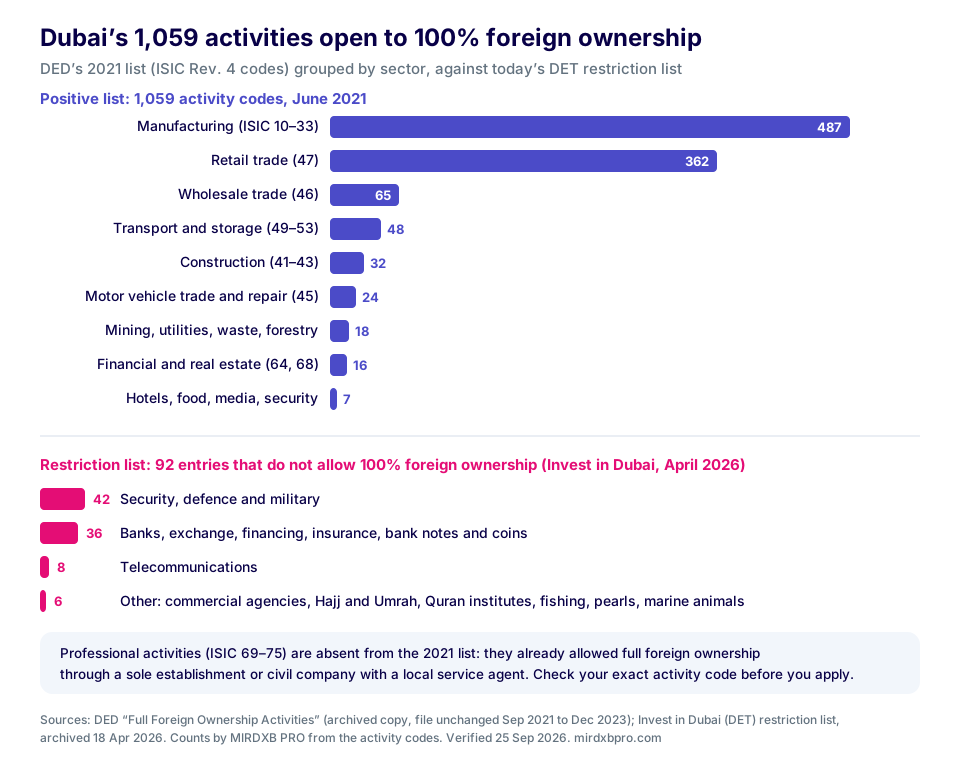
| Sector (ISIC divisions) | Activities on the 2021 list | Examples of the kind of activity |
|---|---|---|
| Manufacturing (10 to 33) | 487 | Food and drink (72), machinery, electrical and electronic equipment (100), basic and fabricated metals (74), chemicals and pharmaceuticals (47), non-metallic minerals (37), textiles, apparel and leather (37) |
| Retail trade (47) | 362 | Shops and specialised retail of goods |
| Wholesale trade (46) | 65 | Trading of goods to businesses, including general trading |
| Transport and storage (49 to 53) | 48 | Land transport, warehousing, logistics support, courier |
| Construction (41 to 43) | 32 | Building and civil engineering contracting, specialised works |
| Motor vehicle trade and repair (45) | 24 | Cars, trucks and parts trading and repair |
| Mining support, utilities, waste, forestry (02, 08, 09, 35, 38) | 18 | Quarrying support, waste collection and recycling |
| Financial and real estate (64, 68) | 16 | Holding and investment-type activities outside the restricted financial list |
| Hotels, food service, media, security services (55, 56, 59, 80) | 7 | Hotel apartments, catering, film production, security services |
| Total | 1,059 | Commercial and industrial activities only |
The examples in the right-hand column describe the ISIC divisions, not named DET entries, because the activity names in the file are embedded in a way that does not extract cleanly; the codes and counts are exact. Two conclusions matter for founders:
- The list is commercial and industrial. There are no codes from ISIC divisions 69 to 75 (legal, accounting, management consultancy, architecture and engineering, advertising, research). Those are professional activities, which had long been open to full foreign ownership through the professional licence route, so they did not need adding.
- DET has since moved to publishing the exceptions. The current Invest in Dubai pages tell you to check the restriction list and to search the activity itself on the Invest in Dubai portal. If your activity is on neither the old positive list nor the restriction list (a newer activity code, for example), treat DET’s initial approval as the answer, not either list.
Commercial agencies: outside 100% foreign ownership in Dubai
Commercial agencies are the one ordinary-looking commercial activity that remains closed to foreign-owned companies. Federal Law No. 3 of 2022 Regulating Commercial Agencies, Article 2(1), limits the activity to “individual citizens and companies and establishments wholly owned by” UAE nationals, public legal persons, or private legal persons owned by them. Two exceptions exist:
- Public joint stock companies established in the UAE in which UAE nationals hold at least 51% of the capital (Art. 2(3)).
- International companies the Cabinet permits to act as agent for their own products where there is no commercial agent for that agency in the UAE and the agency is new and not previously registered (Art. 2(2)).
Article 3 adds that the activity may be practised only by persons registered in the Ministry’s Commercial Agencies Register. The practical line is between a registered commercial agency, which is a protected legal status on that register, and ordinary buying and reselling of a brand’s goods under a supply or distribution contract. A fully foreign-owned trading LLC can import and sell branded goods; what it cannot do is register itself as the brand’s commercial agent. If an exclusive agency is central to your plan, take legal advice on the agency law before you choose your structure.
Professional licences: 100% foreign ownership in Dubai with a local service agent
A professional licence (consultancy, design, IT services, training and similar skills-based work) can be held by foreigners at 100%, but the form matters. The Ministry of Economy and Tourism’s FAQ explains why: single-owner businesses of this kind “are not subject to the provisions of Federal Decree Law No 26 of 2020 … The requirement for a national agent still exists when incorporating single-shareholder companies subject to the legislation of local authorities.” In other words, a sole establishment is not a company under the Companies Law, so the local rules on agents still apply to it.
u.ae’s mainland steps page states the Dubai position in one line: “Businesses owned completely by non-GCC residents require a local service agent from the UAE”, appointed “under an agreement attested by the notary public or the court”. Invest in Dubai’s licensing steps likewise list “Submit a service agent contract (if required for your business type)”.
The agent is not an Emirati partner. The local service agent is a UAE national who represents the business with government departments. The agent does not own shares, share in profit or manage the business; the foreign owner keeps 100% of the ownership. DET’s fee schedule (Executive Council Resolution No. 13 of 2011, Schedule 1) carries a service agent line of AED 700; the agent’s own annual fee is a private matter agreed between you. Our local service agent guide covers the role, agreement terms and how to replace an agent, and our professional licence guide covers the licence itself.
| Option for a foreign professional | Ownership | Service agent | Liability |
|---|---|---|---|
| Sole establishment, professional licence | 100% the individual | Required (non-GCC owner) | Unlimited: the owner and the business are one |
| Civil company of professionals | 100% the partners | Required (non-GCC partners) | Partners liable under civil law rules |
| One-person LLC for a permitted service activity | 100% the owner | Not required | Limited to the capital in the memorandum (Art. 71) |
Whether your particular professional activity can be licensed as an LLC rather than a sole establishment depends on the DET activity and any regulator (health, education, engineering and legal activities have their own). Our types of companies in Dubai guide compares the forms side by side.
Branches of foreign companies: full foreign ownership, no national agent
Before 2021, a branch of a foreign company had to appoint a UAE national service agent under Article 329 of the 2015 law. Decree-Law 26/2020 repealed that article, and MOET’s FAQ is explicit: “No, a UAE national agent is not required to be appointed by foreign companies wishing to conduct their activities within the UAE.” Dubai Economy said the same in June 2021.
A branch is owned 100% by its parent because it is the parent: it has no separate legal personality. What a branch needs instead is paperwork. Invest in Dubai lists a copy of the parent’s licence and parent documents “attested in the home country by the UAE Embassy and Ministry of Foreign Affairs”, counter-attested by the UAE Ministry of Foreign Affairs and “legally translated into Arabic and attested by the UAE Ministry of Justice”. MOET also lists a board resolution appointing the manager. Our branch of a foreign company guide covers the branch route and compares it with a subsidiary; our document attestation service and legal translation service handle the parent’s papers.
u.ae’s general line that businesses “owned completely by non-GCC residents require a local service agent” sits next to its own foreign ownership page, which says service agent requirements for foreign company branches were removed. Read together with MOET’s FAQs, the agent requirement applies to single-owner professional businesses (sole establishments) and civil companies, not to LLCs or branches. DET’s application screens show whether a service agent contract is requested for your file.
Conditions that still apply with full foreign ownership
Dubai Economy’s own words were that full ownership “does not bring any change to current procedures or requirements for licensing” other than removing the Emirati partner. Everything else in a mainland set-up still applies, and a few rules bite harder on foreign owners than on Emiratis.
| Condition | What it means for a foreign-owned company | Source |
|---|---|---|
| GDRFA approval | “Foreign investors must obtain the approval of the General Directorate of Residency and Foreigners’ Affairs before getting the initial approval.” In practice this is a background check run through the DET application. | u.ae, steps to start a business on the mainland (updated 16 July 2026) |
| Owner status documents | Passport copy for non-residents or Emirates ID for residents, and “Copy of the applicant’s residence visa or entry permit (for non-GCC nationals)”. For applicants outside the UAE, Invest in Dubai’s wording is that you “must hold a valid tourist or visit visa before applying for a licence”. | Invest in Dubai, mainland companies |
| External approvals | Regulated activities need the regulator’s approval whoever owns them; health, education, food, transport and many industrial activities are examples. | Decree-Law 32/2021, Art. 11; Invest in Dubai |
| Premises | A mainland licence needs premises in Dubai, registered on Ejari. | Dubai Law No. 13 of 2011, Art. 17 |
| Memorandum of association | Must be in Arabic and attested, or the company is void. DET issues the MoA for LLCs, one-person companies and civil companies; a notary for other forms. | Decree-Law 32/2021, Art. 14; Invest in Dubai |
| Capital | No fixed minimum in the law and no extra capital for full foreign ownership, but LLC capital must be “fully paid at the time of incorporation”. Regulated activities can carry their own capital rules. | Decree-Law 32/2021, Art. 76; Dubai Economy, June 2021 |
| Beneficial owners | Anyone who “owns or exercises ultimate control over a legal person … by 25% or more”, directly or indirectly, is recorded; data within 60 days of licensing and changes within 15 days. | Cabinet Decision No. 109 of 2023, Arts. 5, 8, 11, 15 |
| Corporate tax and VAT | Same rules as any UAE company: 0% up to AED 375,000 of taxable income, 9% above; registration within three months of licensing; AED 10,000 penalty for late registration. | FTA Decision No. 3 of 2024; Cabinet Decision No. 10 of 2024 |
| Dubai Chambers | Membership is mandatory for DET licensees. | Dubai Law No. 1 of 2022, Art. 16 |
| Emiratisation | Ownership does not change hiring targets: companies with 50 or more skilled workers, and those with 20 to 49 in specified sectors, must hire UAE nationals or pay contributions. | MOHRE (see our Emiratisation guide) |
| Owning land or buildings | A foreign-owned company can own real property only in areas designated for non-UAE nationals. Outside them, ownership is reserved to UAE and GCC nationals, companies wholly owned by them, and public joint stock companies. | Dubai Law No. 7 of 2006, Art. 4 |
The last row surprises owners of fully foreign-owned industrial companies. Your company can lease any premises that suit the activity, but if you plan to buy a plot or a warehouse, check first whether the location is in a designated area. The Emiratisation rules guide, corporate tax registration guide and UBO register guide cover their rows in depth.
Board seats in joint stock companies
For joint stock companies, MOET’s FAQ confirms that a foreign investor may “take full control of the Board membership in public joint stock companies, unless otherwise decided by a resolution of the Council of Ministers or the competent authority”. Article 151 (as amended in 2020) keeps a safety valve: where the Cabinet or the competent authority sets a national share of the board and it falls short, the gap must be filled within three months or board resolutions become void after that period.
Visas for the owners
Owning 100% of a mainland company entitles you to apply for residence as a partner or investor, subject to GDRFA’s own criteria, which are separate from the ownership rules. Investors with larger stakes may qualify for longer-term residence; our golden and investor visa service covers those routes, and staff visas follow the steps in our employment visa cost guide.
Existing 51/49 companies: keeping or buying out the Emirati partner
Thousands of Dubai LLCs were formed with an Emirati partner holding 51%. Nothing changed for them automatically in 2021. Dubai Economy confirmed that such companies may keep their structure, and that reducing the Emirati share or removing the partner is possible “according to the legal procedures followed”. That procedure is a normal share transfer and memorandum amendment.
- Check the activity. If any licensed activity is on the restriction list, the national share for that activity must stay or the activity must be removed first.
- Agree terms with the Emirati partner. In law the partner owns the registered shares, whatever any side agreement says. The price, the settlement of past fees and any mutual releases are a negotiation, and a lawyer should document them.
- Sign the share transfer and amended memorandum. The amended memorandum must be in Arabic and attested (Art. 14). DET issues memoranda for LLCs; other amendments go through the notary.
- Amend the licence with DET. The partner change and, if you like, a move to a one-person LLC where one owner remains. Dubai Economy noted that an LLC cannot become a sole proprietorship under a foreign name, but it can move to a one-person LLC.
- Update everything that copies the licence. MOHRE establishment card, the GDRFA or ICP immigration establishment card, partner visas, the bank’s mandate and KYC file, Dubai Chambers, and the beneficial owner register within 15 days of the change (Cabinet Decision 109/2023, Art. 15).
Our trade licence amendment guide covers the DET amendment steps and knock-on updates, and our memorandum of association guide covers drafting and notarisation.
Full foreign ownership removes the reason for nominee structures in most activities. It does not make an old side agreement safe. The registered memorandum and licence are what DET, banks and courts see first, and the beneficial owner rules look through ownership and control to the real owner at the 25% threshold. If your company still rests on a side agreement with a nominee partner, regularising the register is usually cheaper than a dispute later. Take legal advice on the agreement itself.
How to check whether your activity allows 100% foreign ownership in Dubai
You can check full foreign ownership for most activities yourself in under an hour. Work through these steps in order and keep a note of the activity code; it is the reference every later step uses.
- Name the activity the way DET does. Search the business activity list on the Invest in Dubai portal (linked from Invest in Dubai’s mainland page) and note the exact activity name and code. Many activities have near-duplicates; the code decides.
- Compare it with the restriction list. If the activity, or a close variant, appears in any of the four groups reproduced above, full foreign ownership is not available as of right.
- Check the federal strategic impact activities. If your business touches defence, banking, finance, insurance, exchange, payments, telecoms, Hajj and Umrah, Quran centres or fisheries, expect the regulator to set the ownership terms, even if the DET wording differs.
- Check the legal form. An LLC, one-person LLC or branch needs no agent. A professional sole establishment or civil company owned by non-GCC individuals needs a local service agent.
- Check external approvals. The same activity search shows whether another authority must approve. That approval may carry its own ownership or qualification conditions.
- Confirm at initial approval. DET’s initial approval is the official answer for your file. Do not sign a long lease, pay a partner or transfer capital before it.
- For an existing company, read the licence. The licence and the Dubai business directory on Invest in Dubai show the legal form and owners; the National Economic Register (via u.ae) lets you verify licences across emirates.
Foreign ownership in Dubai compared with other emirates and free zones
Each emirate applies Article 10 through its own licensing authority, so lists differ. Abu Dhabi, for example, announced a list of 1,105 commercial and industrial activities for full foreign ownership in May 2021 (Gulf News, May 2021), and its strategic list also included commercial agencies (Lex Mundi guide, 2023; secondary). If your company will be licensed outside Dubai, check that emirate’s own list; this guide covers the emirate of Dubai only.
Free zone companies have always been fully foreign-owned under their own regulations. The Companies Law still reaches their branches or offices outside the zone (Decree-Law 32/2021, Art. 5), and since 2025 Dubai has offered free zone companies routes to operate on the mainland, including DET branch licences under Executive Council Resolution No. 11 of 2025 and the Free Zone Mainland Operating Permit (Dubai Media Office, 8 October 2025). Invest in Dubai’s dual licence is available with named free zones including DMCC, DAFZA, DIFC, Dubai CommerCity, d3 and One Central. Our free zone vs mainland comparison sets out when each fits.
100% foreign ownership Dubai: where the official sources are silent or disagree
| Question | What the sources say | How we handle it |
|---|---|---|
| Is the DET restriction list the complete list? | Invest in Dubai names 92 entries; the 2021 positive list named 1,059 open activities. Neither covers every one of DET’s activity codes, and the positive list is no longer served. | We treat the restriction list as the current reference and initial approval as the answer. |
| What percentage applies to a restricted activity? | Resolution 55/2021 leaves it to the regulator, except fisheries (100% national). The DET page gives no percentages. | We ask the regulator’s requirement through DET before drafting the memorandum. |
| Does a service agent apply to all non-GCC-owned businesses? | u.ae’s steps page says businesses “owned completely by non-GCC residents” need one; MOET and u.ae’s ownership page say branches do not, and LLCs are under Art. 10. | We apply it to sole establishments and civil companies, and follow DET’s screen. |
| What if a strategic impact regulator does not answer within 14 working days? | Resolution 55/2021 sets the clock but says nothing about silence. | We never treat silence as approval; we follow up through DET. |
| Exact date the ownership articles took effect | Decree-Law 26/2020 says six months after gazette publication; Dubai applied the rule from 1 June 2021 with Resolution 55/2021. | We quote 1 June 2021 for Dubai practice. |
| Which activities are exempt from Chamber membership or have special capital? | Not published on the pages we could open. | We confirm at initial approval for the specific file. |
Foreign ownership in Dubai myths: what circulates online that is not true
| What you may read | What the official sources say |
|---|---|
| “You still need an Emirati partner holding 51% on the mainland.” | Not for most activities since 1 June 2021 (Decree-Law 32/2021, Art. 10; Dubai Economy, June 2021). |
| “Full foreign ownership costs extra or needs a bank guarantee.” | Dubai Economy: “No additional fees, guarantees or capital required for full foreign ownership.” |
| “Every foreign-owned company needs a local service agent.” | Only professional sole establishments and civil companies owned by non-GCC individuals; LLCs and branches do not. |
| “Oil exploration, water desalination and similar sectors are banned for foreigners.” | That echoes the negative list of the 2018 Foreign Direct Investment Law, which was repealed in 2020. The current federal list is Cabinet Resolution 55/2021. |
| “Strategic impact activities are completely closed to foreigners.” | Only fisheries services are 100% national. The others are open subject to the regulator’s percentages (MOET FAQs). |
| “Old 51/49 companies were converted to 100% automatically.” | No. They may keep their structure or transfer shares through the legal procedure. |
| “A foreign-owned trading company cannot sell branded goods.” | It can trade them. What it cannot do is register as a commercial agent (Federal Law 3/2022, Art. 2). |
| “The service agent owns part of the business.” | The agent holds no shares and takes no profit share; the owner holds 100%. |
How to verify every 100% foreign ownership Dubai figure in this guide
| Claim | Where to check it |
|---|---|
| Article 10, Art. 71, Art. 76 of the Companies Law | uaelegislation.gov.ae, Federal Decree-Law No. 32 of 2021 (download the full text) |
| Seven strategic impact activities, 5 and 14 working days | uaelegislation.gov.ae, Cabinet Resolution No. 55 of 2021; MOET investment FAQs |
| Delayed effect and repeal of the FDI Law and branch agent article | Federal Decree-Law No. 26 of 2020, Articles Six to Eight (u.ae media library) |
| Over 1,000 activities; no extra fee, guarantee or capital; 59 investors | Government of Dubai Media Office, 3 June 2021 |
| 92 restricted entries | Invest in Dubai, “Foreign ownership restrictions” (use an archive copy if the page does not display) |
| 1,059 activities by sector | DED “Full Foreign Ownership Activities” PDF (archive copies 2021 to 2023); counts are ours |
| Commercial agents must be UAE nationals | uaelegislation.gov.ae, Federal Law No. 3 of 2022, Arts. 2 and 3 |
| Service agent for non-GCC owners; GDRFA approval | u.ae, steps to start a business on the mainland |
| Beneficial owner 25%, 60 days, 15 days | MOET, Cabinet Decision No. 109 of 2023 |
| Real property ownership by non-UAE nationals | Dubai Legislation Portal, Law No. 7 of 2006, Art. 4 |
100% foreign ownership in Dubai in practice: six cases
These cases are built from the situations we see most often. Names and identifying details are left out, and the figures are the published ones.
1. Two foreign partners opening an IT services and hardware trading LLC
Situation: Two non-GCC residents want a mainland company to sell computer hardware and provide IT support, splitting the shares 60/40. A provider quoted them a “local sponsor fee” every year.
Assessment: Neither activity is on the DET restriction list or among the strategic impact activities. As an LLC they can hold 100% between them, with no Emirati partner and no service agent. The annual sponsor fee was for a structure the law has not required since June 2021. Route: LLC with the 60/40 split in the DET-issued memorandum, both partners’ visas and entry permits on file, GDRFA check through the application, then licence, Chamber and beneficial owner filing with both partners recorded.
2. A 51/49 general trading company buying out its Emirati partner
Situation: A general trading LLC formed in 2016 has an Emirati partner on 51% under a side agreement that pays him a fixed annual fee. The foreign partner wants to own the company outright.
Assessment: General trading is open to full foreign ownership, so the national share can go. The Emirati partner, however, is the registered owner of 51% and must sign the transfer. Route: terms agreed and documented by the partners’ lawyers; share transfer and amended memorandum attested; DET licence amended to a one-person LLC; MOHRE and GDRFA establishment cards, the partner visa file, the bank mandate and the beneficial owner register updated within 15 days. See our general trading licence guide.
3. An insurance broker from abroad
Situation: An overseas insurance brokerage wants a fully owned Dubai mainland company to place policies for UAE clients.
Assessment: “Insurance Broker” is on the DET restriction list, and insurance is a strategic impact activity regulated by the Central Bank under Resolution 55/2021. Full foreign ownership is not available as of right; the regulator sets the capital and board percentages and its own licensing conditions. Route: the founders were told plainly that this is a regulatory project first and a company formation second, and were referred to specialist counsel for the Central Bank application before any DET step.
4. A brand’s distributor who wanted an exclusive agency
Situation: A foreign-owned trading LLC holds a distribution contract for a European appliance brand and wants to register as the brand’s exclusive commercial agent in the UAE.
Assessment: Under Federal Law No. 3 of 2022, Art. 2, only UAE nationals and companies wholly owned by them (or the listed exceptions) can practise commercial agency and be entered on the register. The LLC can keep importing and selling the brand under its contract. Route: the company kept its structure and trading licence; the question of agency protection was passed to its lawyer. No ownership change was made to chase a registration it could not obtain.
5. A foreign consultant choosing between a sole establishment and a one-person LLC
Situation: A management consultant (non-GCC national) wants to invoice Dubai clients in her own name with no staff in year one.
Assessment: Both routes give her 100% ownership. A professional sole establishment needs a local service agent (DET’s service agent line is AED 700, plus the agent’s private fee) and leaves her personally liable. A one-person LLC, where DET allows the activity in that form, needs no agent and limits liability to the capital. Route: both compared in writing against her budget and risk; see our professional licence guide and local service agent guide.
6. An overseas manufacturer planning a branch and a factory plot
Situation: A foreign building-materials manufacturer wants a Dubai branch and later to buy land for a small plant.
Assessment: The branch needs no national agent and is owned by the parent, but the parent’s documents must be attested abroad, counter-attested and translated. Buying land is a separate question: under Dubai Law No. 7 of 2006, Art. 4, a foreign-owned entity can own property only in designated areas. Route: legalisation started abroad on day one, branch licensed first, and the land search limited to designated areas or a long lease. See our branch of a foreign company guide.
What we will and will not do
We will check your activity against the federal and Dubai lists before you pay; recommend a structure and explain its ownership, agent and liability consequences; prepare and attest the documents; run the DET file and the knock-on registrations; coordinate share transfers when an Emirati partner leaves; and tell you when a question belongs with a lawyer, a regulator or a tax adviser.
We will not act as your nominee shareholder or local service agent; draft or enforce side agreements; describe your activity in a way that does not match your business to avoid a restriction or an approval; promise that a regulator will accept a given ownership split; or give legal advice on disputes with an existing partner.
Related guides
- Mainland company formation Dubai: the complete step-by-step guide
- Types of companies in Dubai mainland
- Local service agent in Dubai
- Professional licence in Dubai
- Branch of a foreign company in Dubai
- Initial approval in Dubai
- Dubai mainland licence types
- Memorandum of association in Dubai
- Trade licence amendment in Dubai
- UBO register in the UAE
- Mainland business setup cost in Dubai
- Free zone vs mainland Dubai
Checked against official sources on 25 September 2026: Federal Decree-Law No. 32 of 2021, Federal Decree-Law No. 26 of 2020, Cabinet Resolution No. 55 of 2021, Federal Law No. 3 of 2022, Cabinet Decision No. 109 of 2023, the Ministry of Economy and Tourism’s investment FAQs, u.ae, Dubai Law No. 7 of 2006, the Government of Dubai Media Office and Invest in Dubai. Invest in Dubai’s pages did not display their content to us directly on that date, so DET’s restriction list and mainland page are quoted from copies archived on 18 April 2026 and 13 May 2026, and the 2021 activity list from the archived DED file.
100% foreign ownership Dubai: frequently asked questions
Can a foreigner own 100% of a company on the Dubai mainland?
Yes, for most activities. Since 1 June 2021, Dubai has allowed full foreign ownership of mainland companies in more than 1,000 commercial and industrial activities, under Article 10 of the Commercial Companies Law. The exceptions are the strategic impact activities in Cabinet Resolution 55/2021 and the entries on DET’s restriction list, such as banking, insurance, telecoms, defence, commercial agencies and fisheries.
Which law allows 100% foreign ownership in Dubai?
Federal Decree-Law No. 26 of 2020 amended the 2015 Commercial Companies Law to remove the 51% national shareholding rule, and Federal Decree-Law No. 32 of 2021, in force from 2 January 2022, is the current law. Its Article 10 lets the Cabinet define strategic impact activities and lets each emirate’s licensing authority set national ratios for its own activities.
What are strategic impact activities?
They are the activities listed in Cabinet Resolution No. 55 of 2021: security and defence; banks, exchange houses, finance companies and insurance; money printing; telecoms; Hajj and Umrah; Quran memorisation centres; and services related to fisheries. Foreigners can invest in most of them, but the regulator sets the national and foreign percentages. Fisheries services are reserved 100% for UAE nationals.
Do I need an Emirati partner for a Dubai mainland LLC?
Not for an unrestricted activity. An LLC or one-person LLC can be owned entirely by foreign individuals or companies. You need an Emirati partner only where the activity is on DET’s restriction list and the regulator requires a national share, or for commercial agencies and fisheries, which the law reserves to UAE nationals.
Is a local service agent the same as an Emirati partner?
No. A local service agent is a UAE national who represents a business with government departments under an attested agreement. The agent holds no shares, takes no share of profit and does not manage the business. In Dubai, an agent is needed for professional sole establishments and civil companies owned by non-GCC individuals, not for LLCs or branches of foreign companies.
Does 100% foreign ownership cost more?
No. Dubai Economy stated in June 2021 that “no additional fees, guarantees or capital” are required for full foreign ownership. You pay the normal licence fees on DET’s voucher, plus notary, Ejari, approvals and any attestation of foreign documents. Removing an Emirati partner avoids an annual partner fee but may involve a negotiated buy-out.
Is there a minimum capital for a foreign-owned company in Dubai?
The Commercial Companies Law sets no fixed minimum for an LLC; Article 76 lets the Cabinet set one and requires the capital to be fully paid at incorporation. Full foreign ownership needs no extra capital. Regulated activities, such as those supervised by the Central Bank, can carry their own capital requirements.
Can an existing 51/49 company switch to 100% foreign ownership?
Yes, if its activities are not restricted. The Emirati partner transfers the shares, the memorandum is amended and attested, and DET amends the licence. Nothing happens automatically, and the partner must agree to the transfer. Afterwards, update MOHRE, GDRFA, the bank and the beneficial owner register within 15 days of the change.
Can a foreign-owned company be a commercial agent in the UAE?
Generally no. Federal Law No. 3 of 2022 limits commercial agency to UAE nationals and companies wholly owned by them, with exceptions for public joint stock companies at least 51% owned by nationals and for international companies the Cabinet permits in specific conditions. A foreign-owned trading company can still import and sell branded goods under a normal contract.
Does a branch of a foreign company need a UAE national agent?
No. The requirement was in Article 329 of the 2015 law, which Decree-Law 26/2020 repealed. The Ministry of Economy and Tourism confirms that foreign companies do not need to appoint a UAE national agent. A branch still needs the parent’s documents attested, counter-attested and legally translated into Arabic.
How do I check if my activity allows full foreign ownership?
Find the exact activity name and code in DET’s activity search on Invest in Dubai, then compare it with DET’s foreign ownership restrictions list and the federal strategic impact activities. Check whether an external approval is needed. DET’s initial approval is the official confirmation for your file, so do not sign leases or pay partners before it.
Do GCC nationals follow the same rules?
For ownership of an LLC, the rules are the same for any nationality. The differences show up elsewhere: u.ae limits the local service agent requirement to businesses owned by non-GCC residents, Invest in Dubai asks only non-GCC applicants for a residence visa or entry permit, and Dubai’s property law treats GCC nationals like UAE nationals.
Can a 100% foreign-owned company buy property in Dubai?
Only in areas designated for ownership by non-UAE nationals. Dubai Law No. 7 of 2006, Article 4, reserves ownership elsewhere to UAE and GCC nationals, companies wholly owned by them and public joint stock companies. A foreign-owned company can lease premises anywhere that suits its activity and licence.
Does 100% foreign ownership exempt a company from Emiratisation?
No. Ownership and Emiratisation are separate rules. Companies with 50 or more skilled workers, and those with 20 to 49 employees in specified sectors, must meet MOHRE’s Emiratisation targets or pay contributions, whoever owns them. Our Emiratisation guide explains the targets and the 2026 contribution.
Can MIRDXB PRO set up my 100% foreign-owned mainland company?
Yes. We check the activity against the federal and DET lists, recommend the structure, prepare and attest documents, and run the trade name, initial approval, memorandum, licence, Chamber, establishment cards and visas. Government fees are passed on at cost and our fee is quoted in writing before we start. Message us on WhatsApp with the activity and owners.
Can you help us remove an Emirati partner from our existing company?
Yes, for the administrative side. Once you and the partner have agreed terms, ideally documented by a lawyer, we coordinate the attested share transfer and amended memorandum, the DET licence amendment, and the MOHRE, GDRFA, bank and beneficial owner updates. We do not negotiate or litigate partner disputes; we refer those to legal counsel.
Checking activities, structuring ownership and keeping licences, establishment cards and visas aligned is what our PRO services in Dubai team handles every day.
- u.ae: Full foreign ownership of commercial companies (updated 6 April 2026)
- u.ae: Steps to start a business on the mainland (updated 16 July 2026)
- u.ae: Verify business licences, trade names and activities (updated 6 April 2026)
- Federal Decree-Law No. 32 of 2021 on Commercial Companies (Arts. 5, 10, 11, 14, 71, 76)
- Federal Decree-Law No. 26 of 2020 amending Federal Law No. 2 of 2015 (Arts. Six to Eight, new Arts. 10 and 151)
- Ministry of Justice: Federal Law No. 2 of 2015 on Commercial Companies (original Art. 10)
- Cabinet Resolution No. 55 of 2021 Determining the List of Activities with a Strategic Impact
- Federal Law No. 3 of 2022 Regulating Commercial Agencies (Arts. 2 and 3)
- Ministry of Economy and Tourism: Investment FAQs (foreign ownership, strategic impact activities, national agent)
- Ministry of Economy and Tourism: Can a foreign investor have full ownership in all sectors? (updated 24 September 2026)
- Ministry of Economy and Tourism: Cabinet Decision No. 109 of 2023 on beneficial owner procedures
- Government of Dubai Media Office, 3 June 2021: Dubai Economy clarifies full ownership procedures for foreign investors
- Invest in Dubai (DET): Foreign ownership restrictions (read from the copy archived 18 April 2026)
- Invest in Dubai (DET): Mainland companies (read from the copy archived 13 May 2026)
- Dubai Legislation Portal: Law No. 7 of 2006 Concerning Real Property Registration (Art. 4)
- Dubai Legislation Portal: Law No. 13 of 2011 Regulating the Conduct of Economic Activities (Art. 17)
- Government of Dubai Media Office, 8 October 2025: Free Zone Mainland Operating Permit
Secondary, attributed: Gulf News, 5 November 2018 (professional firms outside the 51% rule); Gulf News, May 2021 (Abu Dhabi list of 1,105 activities); Bird & Bird, “FDI regime in the United Arab Emirates” (2024); Lex Mundi foreign investment restrictions guide (updated 24 October 2023). DED “Full Foreign Ownership Activities” PDF read from archived copies (September 2021 to December 2023).
Please note. The rules in this guide come from the UAE and Dubai legislation portals, the Ministry of Economy and Tourism, u.ae, the Dubai Media Office and Invest in Dubai, verified 25 September 2026. DET’s Invest in Dubai pages did not display their content to us directly on that date, so the restriction list and mainland page are quoted from archived copies, and DET’s initial approval is the final word on ownership for your activity. The activity counts by sector are our own count of the codes in DED’s 2021 list. The cases are built from common situations and are illustrative, not the records of named clients. This guide is general information and not legal advice.


