

Key takeaways
- Types of companies in Dubai (mainland) come from two laws working together. The federal Commercial Companies Law (Federal Decree-Law No. 32 of 2021) sets five company forms; Dubai Law No. 13 of 2011 says every business licensed by DET must be a sole proprietorship, a civil works company, a commercial company or a branch.
- The limited liability company (LLC) is the default for trading and most services: one owner or 2 to 50 partners, liability limited to the capital, no fixed minimum capital in the law (Arts. 71 and 76).
- A sole establishment is not a separate legal person. Dubai’s law defines it as a business owned by a natural person “whose legal personality is not distinct from its owner”, so the owner answers for its debts personally.
- Civil companies are partnerships of professionals practising together under Article 15 of Dubai Law No. 13 of 2011; foreign professionals need a UAE national local service agent, who carries no liability and takes no share.
- Joint stock companies are for scale. A public joint stock company needs at least five founders and AED 30 million in capital (Capital Market Authority service card); a private joint stock company cannot offer shares to the public.
- Partnerships (general and limited) still exist in the law, and the Ministry of Economy and Tourism says investors of any nationality may own them, but general partners are personally liable, which is why few founders choose them.
- 2025 changes matter: Federal Decree-Law No. 20 of 2025 (in force 15 October 2025, as reported) allows share classes in an LLC, conversion between forms without losing legal personality, and moving a company between emirates and free zones.
- Choose the form after the activity, not before. The activity decides whether you need a commercial or professional licence, which in turn narrows the forms open to you.
The main types of companies in Dubai on the mainland are the limited liability company (including the one-person LLC), the sole establishment, the civil company for professional partnerships, the branch of a UAE, free zone or foreign company, the private and public joint stock companies, and the general and limited partnerships. Which one you can use depends on your activity, who the owners are and how much liability they are prepared to carry. For most founders the real choice is between an LLC on a commercial or professional licence and a sole establishment or civil company on a professional licence.
This guide explains each legal form in plain language, with the article of the law that governs it: who can own it, how many owners it can have, how far the owners are liable, whether it needs a memorandum of association or a local service agent, and what it means later for visas, tax and the bank. It ends with a comparison table, a decision guide, worked cases and the questions founders ask us most.
It is one part of our mainland series. The full set-up route, from trade name to tax registration, is in our guide to mainland company formation, and if you want someone to run the whole file, our company formation support team does it for you.
Types of companies in Dubai at a glance: the comparison table
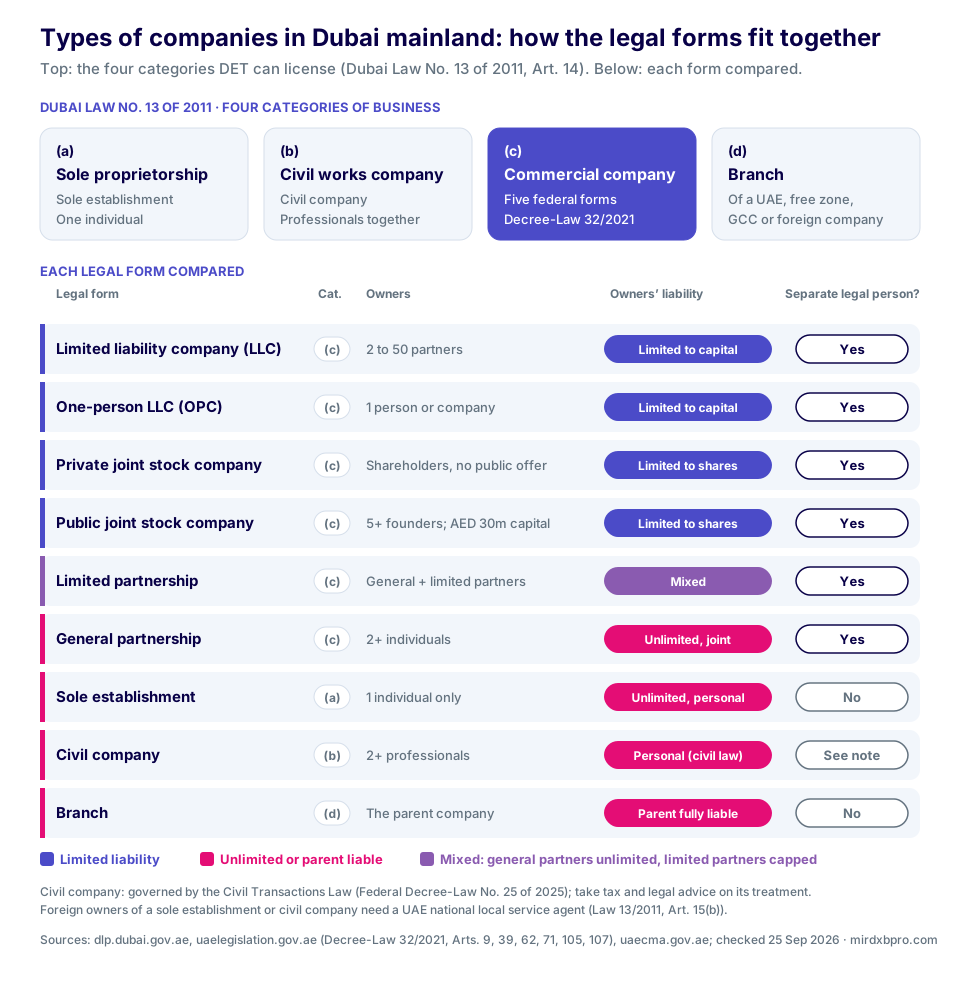
The table sets every mainland legal form side by side. “Liability” means how far the owners answer for the business’s debts with their own money. “Legal personality” means whether the business exists as a person in law, separate from its owners. The detail and the legal source for each row follow below.
| Legal form | Owners | Owners’ liability | Separate legal person? | Usual licence | Founding document |
|---|---|---|---|---|---|
| Limited liability company (LLC) | 2 to 50 partners, natural or legal persons | Limited to capital contribution | Yes, from registration | Commercial, professional, industrial, tourism | Memorandum of association, Arabic, attested |
| One-person LLC (OPC) | 1 natural or legal person | Limited to the capital in the MoA | Yes | As LLC | Memorandum of association |
| Sole establishment (sole proprietorship) | 1 natural person | Unlimited: the owner’s own assets | No | Commercial for UAE and GCC nationals; professional for others (in practice) | Licence; local service agent agreement for foreign owners of professional activities |
| Civil company (civil works company) | 2 or more professionals; a company may join if its activity is similar | Partners liable under civil law; not limited like an LLC | Treated as a company under civil law; confirm tax treatment | Professional | Partnership contract; LSA agreement for foreign partners |
| General partnership | 2 or more natural persons | Joint and several, unlimited | Yes | Commercial | Memorandum of association |
| Limited partnership | 1 or more general partners plus 1 or more limited partners | General partners unlimited; limited partners to their contribution | Yes | Commercial | Memorandum of association |
| Private joint stock company (PrJSC) | Several shareholders; shares not offered to the public | Limited to shares | Yes | Commercial, industrial, investment | Memorandum and articles of association |
| Public joint stock company (PJSC) | At least 5 founders, then public shareholders | Limited to shares | Yes | Any; the only form for banking and insurance | Memorandum and articles; Capital Market Authority approval |
| Branch of a UAE, free zone or foreign company | Owned by the parent | Parent fully liable | No, part of the parent | As the parent’s activity allows | Parent’s resolution and documents |
Types of companies in Dubai: how MIRDXB PRO helps you choose and set up
The legal form is the decision founders most often make in a hurry, usually because a package quote assumes one. It is also expensive to change later: new documents, a new memorandum, an amendment with DET and updates at every authority that holds your file. We look at your activity, owners, liability appetite and hiring plan first, explain which legal form fits and why, and only then start the DET file. We are an Amer and Tasheel partner in Al Barsha 1, Dubai.
What we do
- Match the legal form to the activity. We check the activity on DET’s list, the licence type it falls under and the forms that licence type allows.
- Explain liability in writing. For each option we set out who is personally exposed, what the memorandum or agent agreement must cover, and what that means if a partner leaves.
- Prepare the founding documents. Memorandum of association for an LLC, partnership contract for a civil company, local service agent agreement where the law requires one, with notarisation and legal translation.
- Run the licence and the employer files. Trade name with the right legal-form suffix, initial approval, Ejari, licence, Dubai Chambers, GDRFA establishment card, MOHRE labour file and the first visas.
- Handle later changes. Adding partners, converting a sole establishment to an LLC, or opening a branch, with the knock-on updates.
How it works
- Message us on WhatsApp with the activity, the owners (individuals or companies, nationalities, resident or abroad) and how many people you plan to employ.
- We send a written comparison of the legal forms open to you, with the documents, the government fees we can publish and our fee.
- You choose, and we start the file with DET. Owners abroad can sign a power of attorney where the step allows it.
- We finish the chain through licence, Chamber, establishment cards, labour file and visas, and diarise the tax and beneficial owner deadlines.
What it costs
Government fees are passed on at cost, on the authority’s receipt: DET’s voucher, notary fees, Ejari, Dubai Chambers, GDRFA and MOHRE. The legal form changes the lines: an LLC needs an attested memorandum; a foreign-owned professional firm pays a DET service agent fee and the agent’s own annual fee. Our fee is always quoted in writing before we begin; see our fees page. Every government line, with worked totals, is in our mainland business setup cost guide.
Why founders use us
- We publish our sources. Every rule in this guide links to the law or official page it came from, and where the official record is silent, we say so.
- We cover the whole chain. DET, notary, Dubai Chambers, GDRFA, MOHRE and ICP files are handled by one team, so the legal form, licence and visas stay aligned.
- We tell you when you do not need us. If a simple licence you can complete yourself fits, we say so.
- We are easy to reach. Al Barsha 1, Dubai; Monday to Thursday and Saturday 09:00 to 18:00, Friday 09:00 to 12:00. We act under power of attorney for owners abroad where the step allows.
Two layers of law behind the types of companies in Dubai
Much of the confusion about company types in Dubai comes from reading one law without the other. Federal law decides what a company is. Dubai law decides what kind of business DET will license. Put together, they explain why a Dubai licence can say “LLC”, “Sole Establishment” or “Civil Company” when the federal company law lists none of the last two.
The federal layer: five company forms
Article 9 of Federal Decree-Law No. 32 of 2021 on Commercial Companies says a company “shall take one of the following forms”: general partnership, limited partnership, limited liability company, public joint stock company and private joint stock company. u.ae lists the same five as the forms an investor can choose on the mainland (page updated 16 July 2026). A company acquires legal personality from the date it is registered in the commercial register (Art. 21), and every company name must be followed by its legal form (Art. 12).
The law does not cover everything. Article 4 excludes certain government-owned companies and specified special-purpose vehicles, and Article 5 excludes free zone companies except for their branches operating outside the zone. The Ministry of Economy and Tourism (MOET) adds that “companies and investors of various nationalities may assume ownership of all legal structures mentioned in the Commercial Companies Law”.
The Dubai layer: four categories of business
Dubai Law No. 13 of 2011, which governs economic activity in the emirate, sets out four permitted legal forms in Article 14: economic activities “must be conducted through a Business having one of the following legal forms: (a) sole proprietorship; (b) civil works company; (c) commercial company; or (d) branch of a national or foreign company or of a company operating in a free zone”. The five federal forms all sit inside category (c).
The same law explains the other two. It defines an establishment as a business “owned by a natural person … whose legal personality is not distinct from its owner” (Art. 2), and Article 15 lets natural persons form a partnership “to personally conduct Occupational or Artisan Activities”, which is the civil company. Article 15(b) requires non-UAE nationals conducting those activities to have a local service agent.
| Dubai Law 13/2011, Art. 14 category | Forms you will see on a DET licence | Governing rules |
|---|---|---|
| (a) Sole proprietorship | Sole establishment (Est.) | Dubai Law 13/2011; federal Commercial Transactions and Civil Transactions laws for the owner’s obligations |
| (b) Civil works company | Civil company (professional partnership) | Dubai Law 13/2011, Art. 15; Civil Transactions Law (Federal Decree-Law No. 25 of 2025, in force 1 June 2026) |
| (c) Commercial company | LLC, one-person LLC, general partnership, limited partnership, PrJSC, PJSC | Federal Decree-Law 32/2021 on Commercial Companies |
| (d) Branch | Branch of a UAE company, a free zone company, a GCC company or a foreign company; representative office | Dubai Law 13/2011; Decree-Law 32/2021 for foreign companies; Executive Council Resolution No. 11 of 2025 for free zone companies |
MOET’s own list of mainland structures, updated 24 September 2026, names nine: sole establishment, civil company, limited liability company, public joint stock company, private joint stock company, branch of a GCC company, branch of a local company, holding company and representative office of a foreign company. The difference between that list and Article 9 is not a contradiction: some are licensing categories rather than company forms.
Limited liability company: the default among types of companies in Dubai
Most mainland businesses in Dubai are LLCs, and for good reason: owners are protected, any nationality can own one for most activities, and it works on commercial, professional, industrial and tourism licences. If you are asking which of the types of companies in Dubai to start with, start here and move away only if something in your plans rules it out.
What the law says about an LLC
- Owners. “A limited liability company is a company whose number of partners is at least two and does not exceed fifty”, and “any single natural or legal person may incorporate and own a limited liability company” (Art. 71).
- Liability. Each partner is liable “only to the extent of his capital contribution” (Art. 71).
- Name. Derived from the objects or from partners’ names, followed by “Limited Liability Company” or “LLC” (Art. 72).
- Capital. “Sufficient” to achieve the objects, in stakes of equal value, fully paid at incorporation, in cash or in kind (Art. 76). The Cabinet may set a minimum by resolution; the law itself sets none.
- Share classes. Since the 2025 amendments, stakes “may be classified into different classes in terms of value, voting rights, redemption of the stake, priority in profit distribution or liquidation” as the memorandum sets out (Art. 76(4)).
- Managers. One or more managers appointed in the memorandum, “from among the partners or from third parties” (Art. 83). A manager is personally liable for fraud, misuse of powers, breach of the law or gross error, and a clause excusing this is void (Art. 84).
- Partners’ register. Kept at the head office with each partner’s details and every transaction in the stakes (Art. 74).
- Selling a stake. Other partners have 30 days to claim a stake offered for sale, shared in proportion to their holdings if several claim it (Art. 80).
- Supervisory board. Required once there are more than 15 partners (Art. 88).
- Reserve and audit. 5% of net profits each year to a statutory reserve (Art. 103); one or more auditors appointed each year (Art. 102).
- Limits. Only a public joint stock company may offer securities to the public (Art. 32), and banking and insurance are reserved to public joint stock companies unless the sector laws say otherwise.
What happens if an LLC outgrows 50 partners
Article 75 gives an LLC whose partners exceed 50 three months from notification (extendable by three more) to regularise, usually by converting to a joint stock company. Otherwise it is treated as terminated, and the partners become jointly and severally liable with their own property from the date the number was exceeded. This rarely affects start-ups, but it matters for employee share schemes that hand stakes to many staff directly.
When an LLC is the right legal form
Choose an LLC when you trade goods, when you have or expect more than one owner, when an owner is a company, when you want liability limited to the business, or when you plan to bring in investors. It is also the usual form for founders who will sponsor several staff and want a structure banks recognise without explanation. The price is formality: a memorandum in Arabic, attested (or it is void under Article 14), an auditor, and procedures when partners change.
Share classes, manager powers, decisions that need unanimity, and what happens when a partner wants to leave all live in the memorandum. The standard DET form is enough for a simple company with one or two owners. For investors, several founders or unequal rights, have it drafted properly. Our memorandum of association guide covers the mandatory contents and notarisation.
One-person LLC: the single-owner company
A one-person company is an LLC with a single owner, which can be an individual or a company. The law requires its name to be followed by “Limited Liability One Person Company (OPC)” (Art. 72), and the owner is “liable for the obligations of the company only to the extent of the capital set out in its MOA” (Art. 71(2)). The Cabinet may issue a resolution on how an OPC is incorporated and managed.
For a solo founder the OPC is the main alternative to a sole establishment. It costs more in formality (a memorandum, an auditor, a separate company file), but it separates the business’s debts from the owner’s personal assets, which a sole establishment does not. It is also the natural form for a foreign parent company that wants a wholly owned subsidiary in Dubai rather than a branch.
Sole establishment: one owner, no separate legal person
A sole establishment (also called a sole proprietorship; the licence usually carries “Est.”) is the simplest of the types of companies in Dubai, and strictly it is not a company at all. Dubai Law No. 13 of 2011 defines an establishment as “a Business owned by a natural person for the purpose of conducting an Economic Activity in the Emirate, whose legal personality is not distinct from its owner”.
That definition carries three consequences. Only an individual can own one; a company cannot. The owner is the business in law, so the owner’s personal assets answer for its debts, contracts and fines. And it cannot take in partners; adding one means changing the legal form.
Who can own a sole establishment in Dubai
UAE nationals can hold sole establishments for commercial and professional activities. For foreign nationals the law ties the form to professional work: Article 15(b) of Law 13/2011 says non-UAE nationals “will be authorised to conduct Occupational or Artisan Activities provided that they have an agent (‘Local Service Agent’)”. In Dubai practice this means a foreign national’s sole establishment is a professional licence (consultancy, design, IT services, many trades) with a local service agent, and trading activity goes through an LLC instead.
u.ae states the agent requirement more broadly: “businesses owned completely by non-GCC residents require a local service agent from the UAE”. GCC nationals are generally treated like UAE nationals for this purpose, but check the specific activity with DET, because the official wording is short and the practice varies by activity.
The local service agent in a sole establishment
The agent is a UAE national (or a company whose partners are all UAE nationals) who represents the business with government bodies. Article 16 of Law 13/2011 makes the agent responsible “for exercising due diligence to enable the Business to conduct its Occupational and Artisan Activities”, says the agent “will bear no civil or financial liabilities in relation to the work or activity of the Business”, and requires “a notarised agency agreement based on the template prescribed by the DED”.
The agent owns nothing and takes no share of profit. The agent is paid a fee agreed in the contract, usually annual, set by the market rather than by any official tariff. DET’s own fee schedule (Executive Council Resolution No. 13 of 2011, Schedule 1) lists a service agent line of AED 700; your voucher governs. Our local service agent guide covers the agreement terms and how to replace an agent.
Tax for a sole establishment
Because the business is the owner, corporate tax looks at the individual. Cabinet Decision No. 49 of 2023 says business activities of a natural person are subject to corporate tax “only where the total Turnover derived from such Businesses or Business Activities exceeds AED 1,000,000”, with wages, personal investment income and real estate investment income excluded. Above that line the owner registers and files as a natural person. VAT is separate and turns on the AED 375,000 mandatory threshold.
When a sole establishment is the right legal form
It suits a single professional who will do the work personally, keeps the business small, is comfortable carrying the liability, and wants the lightest structure: no memorandum, no auditor, no partners. It suits less well if you will trade goods, sign large contracts, employ a sizeable team or seek investors. Many owners start as a sole establishment and move to an LLC when the business grows; see “Changing your legal form later” below.
Civil company: the professional partnership
A civil company (Dubai Law 13/2011 calls it a “civil works company” in Article 14 and a “Business Partnership” in Article 15) is how two or more professionals practise a profession together on a Dubai professional licence: accountants, engineers, consultants, designers, many specialist services.
Article 15(a) says natural persons “may enter into partnerships to personally conduct Occupational or Artisan Activities in the Emirate”. It also allows a legal person to join “provided that the nature of his activity is similar to the nature of the activity conducted by such Business Partnership”. So an audit firm can be a partner in a civil company doing audit; a trading company cannot. Foreign partners need a local service agent under Article 15(b), exactly as for a sole establishment.
Which law governs the partners’ relationship
A civil company is not a commercial company under Decree-Law 32/2021; the civil law of companies applies. The UAE’s new Civil Transactions Law, Federal Decree-Law No. 25 of 2025, came into force on 1 June 2026 and repealed the 1985 law. Law firm briefings (Greenberg Traurig, July 2026) note that it recognises companies founded or owned by a single person where other legislation allows (Art. 603), gives professional companies their own rules on partners’ personal liability for professional faults (Arts. 645 to 654), and lets a remaining partner continue the company after another withdraws (Art. 626).
In practice this means the partnership contract between civil company partners matters as much as an LLC’s memorandum: profit shares, who signs, what happens when a partner leaves, and how professional liability is shared. u.ae’s closing page shows that ending a civil company in Dubai needs “a duly notarised partnership termination contract”.
When a civil company is the right legal form
Choose it when the partners are qualified professionals practising together, especially where a regulator or professional body expects a partnership rather than an LLC. Choose an LLC instead if you want liability limited to capital, plan to trade, or have investors who will not practise. Our professional licence guide explains which activities fall under the professional licence and what qualifications they need.
General and limited partnerships
Two of the five federal company forms are partnerships. They appear on every list of the types of companies in Dubai but are seldom chosen by new founders, because at least some partners carry unlimited personal liability.
General partnership
“A General Partnership is a Company which consists of two or more partners who are natural persons and are jointly and severally liable to the extent of all their property for the liabilities of the Company” (Decree-Law 32/2021, Art. 39). Only individuals can be partners, and each partner can be pursued personally for the whole of the partnership’s debts, not just a share. The name is formed from one or more partners’ names followed by the legal form, and anyone who lets their name appear in it becomes jointly liable (Art. 41).
Limited partnership
“A Limited Partnership is a Company which consists of one or more General Partners who are jointly and severally liable for the obligations of the Company and act in the capacity of a trader, in addition to one or more Limited Partners who are held liable for the obligations of the Company only to the extent of their respective capital contributions” (Art. 62). A limited partner’s name may not appear in the company name; if it does, with consent, that partner is treated as a general partner towards third parties acting in good faith (Art. 64).
Who uses partnerships now
Before 2021 partnerships were associated with Emirati ownership. MOET now says partnership companies and limited partnership companies are among the forms investors “of various nationalities” may own. In practice the LLC gives the same flexibility with limited liability for everyone, so partnerships survive mainly in family businesses and long-standing firms. If someone proposes one to you, ask why an LLC would not do.
Joint stock companies: private and public
Joint stock companies are the types of companies in Dubai built for scale, outside investors and, for the public form, listing. Their capital is divided into shares rather than an LLC’s stakes, they have a board of directors, and they sit under closer regulatory supervision.
Public joint stock company (PJSC)
“A Public Joint Stock Company is a company whose capital is divided into shares of equal value, which are tradable, and whose founders subscribe for part of these shares while the remaining shares are offered to the public in a Public Offering” (Art. 105). “Five or more persons may form a Joint Stock Company” (Art. 107), though a conversion into a PJSC is not bound by that minimum. The name must end with “Public Joint Stock Company” (Art. 106).
The Capital Market Authority (CMA, the federal markets regulator that replaced the Securities and Commodities Authority on 1 January 2026) sets out the working conditions on its service card for offering PJSC shares: capital after incorporation or conversion “must be at least AED 30 million”, founders must number at least five natural or legal persons, and a company converting must have existed for at least two financial years. It lists AED 5,000 for incorporation approval, AED 50,000 for conversion approval and a total service time of 10 days.
Only a PJSC may offer securities to the public (Art. 32), and banking and insurance are reserved to PJSCs unless the sector laws provide otherwise. For almost every new business this is not a starting form.
Private joint stock company (PrJSC)
A private joint stock company has shares but does not offer them to the public; it “may offer its securities for private subscription” under conditions the capital markets regulator sets (Art. 32). Ministerial Decision No. 137 of 2024 set governance rules for PrJSCs, including a board with at least one-third independent and a majority non-executive members, at least one woman on the board, and board remuneration capped at 10% of net profit (as summarised by Cleary Gottlieb, 2024). The 2025 amendments shortened the founders’ lock-up on selling shares from two years to one (MOET, 6 January 2026).
The PrJSC suits investment and holding structures, family groups that want a board and transferable shares, and companies preparing for a later listing. The minimum capital and shareholder range we could not read in the law’s text on the day we checked, and secondary sources disagree: see “Where the official sources are silent or disagree” below.
Branches and representative offices
A branch is not a new company. It is the parent company, UAE, free zone, GCC or foreign, licensed to carry on its activity in Dubai. Law 13/2011 recognises “branch of a national or foreign company or of a company operating in a free zone” as the fourth category of business (Art. 14(d)), and the parent remains fully liable for everything the branch does. A representative office is narrower: it promotes the parent and does not trade.
u.ae says the 2021 reform removed the local agent requirement for branches of foreign companies. Free zone companies that want to work onshore in Dubai now have their own route under Executive Council Resolution No. 11 of 2025: a DET branch licence, or a Free Zone Mainland Operating Permit announced at AED 5,000 (Dubai Media Office, 8 October 2025). The documents, attestation, liability and tax points, and the branch-or-subsidiary decision, are covered in our branch of a foreign company guide, and the free zone route in our free zone vs mainland comparison.
Holding companies, non-profit companies and special-purpose vehicles
Holding company. MOET lists a holding company among mainland structures. It is not a sixth form outside Article 9: it is a company, set up in one of the Article 9 forms, whose purpose is to own and control other companies. The law confirms that “Subsidiaries of Holding Companies shall enjoy a legal personality and shall have their own independent financial liability” (Art. 21(4)). Holding structures raise tax grouping and beneficial owner questions that belong with a tax adviser.
Non-profit company. Article 8(3)(b), added by the 2025 amendments, permits “a non-profit company whose net profits derived from its economic project shall be reinvested to achieve the purposes for which it was established”, subject to a Cabinet resolution specifying the purposes and forms. Check whether that resolution has been issued before planning one.
SPVs and SPACs. Special-purpose vehicles and special-purpose acquisition companies are recognised for financing and capital markets use, under capital markets rules. They are not start-up forms.
Liability, capital, partners and managers compared
This table goes one level deeper than the one at the top. It is the comparison to use when you are weighing two legal forms against each other.
| Point | LLC / one-person LLC | Sole establishment | Civil company | Joint stock (PrJSC / PJSC) | Branch |
|---|---|---|---|---|---|
| Minimum owners | 1 (OPC) or 2 | 1 individual | 2 | PJSC 5 founders; PrJSC see sources table | The parent |
| Maximum owners | 50 (Art. 71) | 1 | Not capped in Dubai law | Not capped for PJSC | n/a |
| Can a company be an owner? | Yes | No | Yes, if its activity is similar (Law 13/2011, Art. 15) | Yes | It is the owner |
| Owners’ liability | To the capital | Unlimited | Personal; professional liability rules in the Civil Transactions Law | To the shares | Parent unlimited for the branch |
| Minimum capital | None fixed; “sufficient” (Art. 76) | None | None published | PJSC AED 30 million (CMA) | None; parent’s capital |
| Management | Manager(s) in the MoA (Art. 83) | The owner | Partners, per the contract | Board of directors | Branch manager appointed by the parent |
| Auditor | Required (Art. 102) | Not under company law | Per contract and regulator | Required | Parent’s accounts; branch books |
| Local service agent | No | Foreign owners of professional activities | Foreign partners | No | Not for foreign branches since 2021 (u.ae) |
| Founding document | MoA in Arabic, attested (Art. 14) | Licence application; LSA agreement if needed | Notarised partnership contract | MoA and articles; CMA steps for PJSC | Parent’s resolution, attested and translated |
Ownership and nationality by legal form
Since 2021 the law “abolishes the requirement for a majority Emirati shareholder or local partner” for most activities (u.ae, updated 6 April 2026), and MOET says investors of any nationality may own every form in the Commercial Companies Law. Two limits remain. Activities of strategic impact, such as security, defence, telecoms, banking, exchange, financing and insurance, and some others, including commercial agencies, keep conditions set by the Cabinet under Article 10. And the professional forms, sole establishment and civil company, bring in the local service agent for foreign owners.
| Owner | LLC | Sole establishment | Civil company | Partnerships |
|---|---|---|---|---|
| UAE national | Yes | Yes, commercial or professional | Yes | Yes |
| GCC national | Yes | Generally treated like a UAE national; confirm by activity | Yes | Yes |
| Other foreign national | Yes, 100% for most activities | Professional activities, with a local service agent | Yes, with a local service agent | Yes (MOET) |
| Company (UAE or foreign) | Yes, including as sole owner | No | Only if its activity is similar | Not in a general partnership, whose partners must be individuals (Art. 39); confirm for a limited partnership |
The ownership detail by activity, the strategic-impact list and how to check your own activity are in our 100% foreign ownership guide.
How the legal form changes your licence, visas, tax and bank
The legal form is not only a legal label. It changes what DET issues, how you sponsor yourself, what the Federal Tax Authority expects and how a bank reads your file.
| Area | LLC | Sole establishment | Civil company | Branch |
|---|---|---|---|---|
| DET licence | Commercial, professional, industrial or tourism | Professional (foreign owner) or commercial (UAE/GCC owner) | Professional | Matches the parent’s permitted activity |
| Trade name suffix | LLC or LLC One Person Company (OPC) | Est. | Civil company designation | Parent’s name plus “branch” |
| Owner’s own residence | Partner or investor visa through the company | Usually an investor visa through the establishment | Partner visas | Branch manager on an employment visa |
| Staff visas | MOHRE quota and work permits | Same; quota follows premises and activity | Same | Same |
| Corporate tax | Registers as a juridical person within three months of incorporation | The owner as a natural person, if business turnover exceeds AED 1 million | Depends on how the partnership is treated; take tax advice | Parent’s registration and branch rules |
| Beneficial owner filing | Yes (Cabinet Decision 109/2023) | Not a legal person; the owner is on the licence | Confirm with the registrar | Parent’s owners |
| Bank view | Standard corporate account | Account for the establishment; owner’s own profile central | Partnership documents reviewed closely | Parent’s documents, attested |
For the employer files every form follows the same route: our establishment card guide, MOHRE labour card guide and visa quota guide explain them. For tax, see our corporate tax registration guide; for the bank, our corporate bank account guide.
Choosing between the types of companies in Dubai: a decision guide
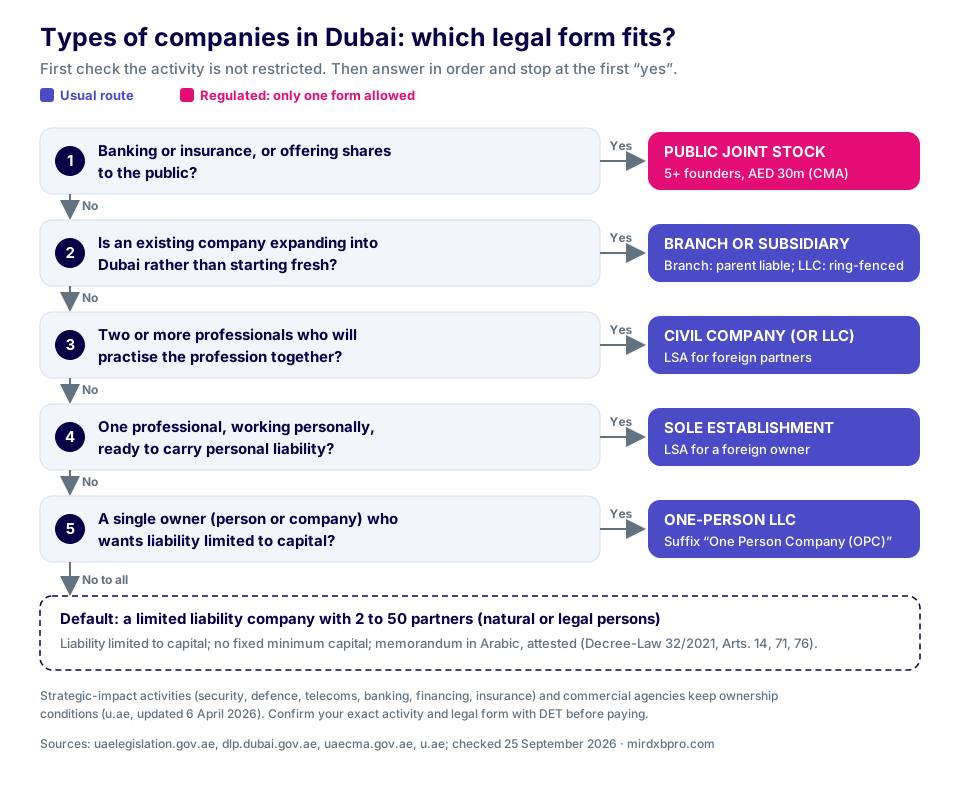
Work through these questions in order. Each one removes some legal forms. By the end, most founders have one clear option and at most one alternative worth comparing.
- What exactly will the business invoice for? Pick the activity first. Trading, manufacturing and most tourism activities lead to a commercial, industrial or tourism licence and, for a foreign owner, an LLC. Professional services open the sole establishment and civil company as well. Our Dubai mainland licence types guide explains the categories.
- Is the activity restricted? Banking and insurance need a PJSC unless the sector law says otherwise; strategic-impact activities and commercial agencies carry ownership conditions. Check before anything else.
- Is an existing company expanding into Dubai? Then compare a branch (no new legal person, parent liable) with a new LLC owned by the parent (liability ring-fenced).
- How many owners, and are any of them companies? One individual: sole establishment or one-person LLC. Several individuals practising a profession: civil company or LLC. Any corporate owner: LLC (or joint stock), since a sole establishment cannot have one.
- How much personal liability will the owners accept? If the answer is “none beyond what we put in”, the choice is an LLC or a joint stock company.
- Will you raise investment or give staff shares? An LLC with share classes now covers most early-stage needs; a PrJSC suits larger or board-led structures; a PJSC only for public offering.
- How much formality can you carry? An LLC needs an attested memorandum, an auditor and procedures for partner changes; a sole establishment needs almost none of that. Match the structure to the people who will run it.
Describing a trading business as a consultancy to get a sole establishment, or naming a nominee to fit a form, creates problems at the bank, with MOHRE and at renewal, and it leaves the real owners exposed. Pick the form that matches what the business does and who owns it.
Changing your legal form later
A legal form is not permanent, but changing it is work. Federal Decree-Law No. 20 of 2025 made conversion easier for commercial companies: MOET says a company may now convert between legal forms “while retaining its legal personality”, including conversion to a joint stock company without a founders’ committee. The same amendments let a company transfer its registration between emirates and between the mainland and free zones “without the need for re-establishment or liquidation” (Art. 15 bis).
Moving between Dubai’s categories is a different matter. A sole establishment has no legal personality to keep, so turning it into an LLC normally means licensing the new company and transferring the business, staff and contracts, or a DET legal-form amendment where DET offers one for your case. Each route has knock-on updates at MOHRE, GDRFA, the bank, the FTA and the beneficial owner register. Our trade licence amendment guide sets out the sequence.
| Change | What it usually involves |
|---|---|
| Add a partner to a sole establishment | A new legal form (LLC or civil company); a sole establishment cannot have partners |
| One-person LLC takes a second partner | Share transfer or new stake, amended and attested memorandum, name change from OPC to LLC |
| LLC to private joint stock company | Conversion under the Commercial Companies Law; since 2025 no founders’ committee needed |
| Civil company partner leaves | Amended, notarised partnership contract; the remaining partner may continue under the Civil Transactions Law |
| Free zone company wants to work onshore | DET branch licence or six-month permit (Resolution 11/2025), or relocation under Art. 15 bis |
Types of companies in Dubai in practice: five cases
These cases are built from the situations we see most often. Names and identifying details are left out, and the figures are the published ones.
1. A solo IT consultant weighing a sole establishment against a one-person LLC
Situation: A foreign resident developer plans to invoice three Dubai clients, no staff in year one, contracts with liability clauses.
Assessment: Both forms are open. A sole establishment is lighter but needs a local service agent and leaves her personally liable under the contracts. A one-person LLC needs a memorandum and an auditor but limits her exposure to the capital. Route: because the client contracts carried uncapped liability, she chose the one-person LLC. Corporate tax registration was diarised within three months of incorporation, since the LLC registers as a company whatever its turnover.
2. Three engineers forming a practice
Situation: Three qualified engineers, two foreign and one Emirati, want to practise together and sign drawings.
Assessment: A civil company fits a practising partnership, and the professional body expected partners who practise. The foreign partners need a local service agent under Law 13/2011, Art. 15(b), appointed under a separate notarised agreement; being a partner and being the agent are different roles with different rights, so the partners asked DET how to structure it before signing. Route: civil company, a notarised partnership contract covering profit shares, signing authority, exit and professional liability, and an LSA agreement on DET’s template.
3. A trading start-up with a foreign investor
Situation: Two founders importing kitchen equipment, with an investor who wants a preferred share and a board seat.
Assessment: Trading rules out the professional forms. An LLC with share classes, allowed since the 2025 amendments, gives the investor priority on distributions without a joint stock company. Route: LLC with a bespoke memorandum setting two classes of stake, manager powers and drag-along and tag-along terms; standard DET memorandum rejected as too thin for the deal.
4. A foreign group choosing between a branch and a subsidiary
Situation: A European logistics group wants a Dubai operation with its own staff and local contracts.
Assessment: A branch is quicker to explain to the parent’s board but exposes the parent to every Dubai liability. A one-person LLC owned by the parent ring-fences the risk. Both need the parent’s documents legalised, attested and translated. Route: after the parent’s lawyers reviewed both, a one-person LLC; see our branch of a foreign company guide for the comparison.
5. A sole establishment that outgrew itself
Situation: A design studio run for four years as a sole establishment, now 12 staff and a second owner joining.
Assessment: A sole establishment cannot take a partner, and the owner was carrying all the liability of a growing team. Route: a new LLC licensed alongside, staff moved across with MOHRE and GDRFA transfers timed to avoid gaps, client contracts assigned, and the establishment cancelled once empty. The lesson: if growth is likely, compare the cost of starting as an LLC with the cost of converting later.
Types of companies in Dubai: where the official sources are silent or disagree
| Point | What the sources say | How we handle it |
|---|---|---|
| Private joint stock company capital and shareholder numbers | The joint stock chapter of Decree-Law 32/2021 did not display fully when we checked. Secondary sources differ: one law firm gives AED 5 million and at least two shareholders; another AED 2 million and three to 50 shareholders | We quote no figure; confirm with MOET or the Department of Economy and Tourism before planning a PrJSC |
| Local service agent scope | Law 13/2011, Art. 15(b) ties the agent to non-UAE nationals conducting occupational (professional) activities; u.ae says businesses “owned completely by non-GCC residents” need one | We treat the agent as required for foreign-owned sole establishments and civil companies, and confirm each file with DET |
| Foreign nationals and commercial sole establishments | No DET page we could open states the rule; practice is that foreign nationals hold sole establishments for professional activities | Stated as practice; trading activities go through an LLC |
| Civil company tax treatment | Not addressed on a page we could open for Dubai civil companies specifically | We tell clients to take tax advice before choosing a civil company |
| Decree-Law 20/2025 effective date | MOET’s news (6 January 2026) gives no date; Cleary Gottlieb reports issue on 1 October 2025, gazette 14 October 2025, in force 15 October 2025 | Quoted as reported |
| Invest in Dubai “Legal forms of company structure” page | The page exists but is script-rendered and blocked to our tools; its list did not display | We rely on Law 13/2011, Decree-Law 32/2021, u.ae and MOET |
| Non-profit company resolution | Art. 8(3)(b) requires a Cabinet resolution on purposes and forms; we found no published resolution | Treat the non-profit company as not yet available until the resolution is confirmed |
Company types in Dubai: what circulates online that is not true
| What circulates | The position |
|---|---|
| “A foreigner needs a 51% Emirati partner in a mainland LLC” | Not for most activities since 2021 (u.ae; MOET). Strategic-impact activities and commercial agencies keep conditions |
| “An LLC needs at least two partners” | A single natural or legal person may own an LLC (Art. 71(2)), named as a one person company |
| “LLCs need AED 300,000 capital” | The law sets no fixed minimum; capital must be “sufficient” for the objects (Art. 76) |
| “A local service agent owns part of your business” | The agent “will bear no civil or financial liabilities” and holds no ownership; the relationship is a notarised agency (Law 13/2011, Art. 16) |
| “A sole establishment protects your personal assets” | Its legal personality “is not distinct from its owner” (Law 13/2011, Art. 2); the owner is personally liable |
| “A company can own a sole establishment” | Only a natural person can (Art. 2 definition); a company uses a one-person LLC or a branch |
| “LLC stakes must all carry the same rights” | Since the 2025 amendments stakes can be in classes with different voting, dividend and redemption rights (Art. 76(4)) |
| “You must liquidate to change your company’s form or move it to a free zone” | Commercial companies can now convert or relocate while keeping legal personality (Decree-Law 20/2025; Art. 15 bis) |
How to verify every rule in this guide
| Rule | Where to check it |
|---|---|
| The five company forms; LLC, OPC, partnership and PJSC articles | Federal Decree-Law No. 32 of 2021, Arts. 9, 39, 62, 71 to 103, 105 to 107 (uaelegislation.gov.ae) |
| Dubai’s four categories; establishment definition; civil company; local service agent | Dubai Law No. 13 of 2011, Arts. 2, 14, 15, 16 (Dubai Legislation Portal) |
| Forms available to investors; the LSA sentence; trade name suffixes | u.ae, “Steps to start a business on the mainland” (updated 16 July 2026) |
| MOET’s list of nine mainland structures | MOET, “Establishing businesses” (updated 24 September 2026) |
| Foreign ownership of every form | MOET FAQ, “Does full foreign company ownership include all forms of legal structures?” |
| PJSC capital, founders and fees | Capital Market Authority, “Offering shares of a public joint-stock company” |
| 2025 amendments | MOET news, 6 January 2026, on Federal Decree-Law No. 20 of 2025 |
| Natural person corporate tax threshold | Cabinet Decision No. 49 of 2023 (Ministry of Finance) |
| Civil Transactions Law dates | Federal Decree-Law No. 25 of 2025 (uaelegislation.gov.ae) |
If an official page has changed since we checked it, the official page wins.
Checked against official sources on 25 September 2026: Federal Decree-Law No. 32 of 2021 as amended, Dubai Law No. 13 of 2011, u.ae, the Ministry of Economy and Tourism, the Capital Market Authority, Cabinet Decision No. 49 of 2023 and Federal Decree-Law No. 25 of 2025. DET’s Invest in Dubai legal forms page did not display to us on that date. Points taken from law firm briefings are labelled as such.
What we will and will not do
We will compare the legal forms open to your activity and owners in writing, prepare and notarise the memorandum, partnership contract or local service agent agreement, run the DET file through licence, Chamber, establishment cards, labour file and visas, and tell you when a question belongs with a lawyer or tax adviser.
We will not act as your local service agent or nominee shareholder, describe your activity inaccurately to fit a cheaper form, promise a licence, approval, quota or bank account that another body decides, or give legal or tax advice on your structure.
Related guides
- Mainland company formation: the complete route
- Mainland business setup cost in Dubai, line by line
- 100% foreign ownership in Dubai
- Local service agent in Dubai
- Professional licence in Dubai
- Memorandum of association in Dubai
- Trade name registration in Dubai
- Branch of a foreign company in Dubai
- UBO register in the UAE
- Free zone vs mainland Dubai
- How to renew a trade licence in Dubai
- Why companies need PRO services
Types of companies in Dubai: frequently asked questions
What are the main types of companies in Dubai mainland?
Dubai Law No. 13 of 2011 allows four categories of business: sole proprietorship, civil works company, commercial company and branch. Commercial companies take one of the five federal forms: general partnership, limited partnership, limited liability company, private joint stock company or public joint stock company. In practice most founders choose an LLC, a one-person LLC, a sole establishment or a civil company.
Which legal form is best for a foreign founder in Dubai?
For trading and most services, a limited liability company, which foreigners can own 100% for most activities and which limits liability to the capital. A single owner can use a one-person LLC. A foreign professional working alone may also consider a sole establishment on a professional licence, with a local service agent, accepting personal liability. Restricted activities need checking first.
What is the difference between a sole establishment and a one-person LLC?
A sole establishment has no legal personality separate from its owner, so the owner is personally liable for its debts, and only an individual can own it. A one-person LLC is a separate company; its owner, which may be an individual or a company, is liable only up to the capital in the memorandum. The LLC needs a memorandum and an auditor; the establishment does not.
Can a foreigner open a sole establishment in Dubai?
Yes, for professional (occupational) activities. Dubai Law No. 13 of 2011, Article 15(b), lets non-UAE nationals conduct those activities if they appoint a local service agent who is a UAE national or a company wholly owned by UAE nationals. In practice, trading activities for foreign owners go through an LLC. Confirm your specific activity with DET before applying.
What is a civil company in Dubai?
A civil company is a partnership of two or more professionals practising a profession together on a Dubai professional licence, such as engineers, accountants or consultants. Dubai Law No. 13 of 2011, Article 15, provides for it, lets a company join if its activity is similar, and requires foreign partners to appoint a local service agent. The partners’ relationship falls under the Civil Transactions Law.
How many partners can a Dubai LLC have?
Between two and 50, or a single owner. Article 71 of Federal Decree-Law No. 32 of 2021 sets the range and allows any single natural or legal person to own an LLC. If the number rises above 50, Article 75 gives three months (extendable by three) to regularise, usually by conversion, or the partners become personally liable. Above 15 partners a supervisory board is required.
Is there a minimum capital for companies in Dubai?
Not for an LLC: Article 76 requires capital “sufficient” for the company’s objects, fully paid, without a fixed figure, though the Cabinet may set one. A public joint stock company needs at least AED 30 million according to the Capital Market Authority. Some activities and regulators set their own capital rules, and banks look at capital when opening accounts.
Does a local service agent own part of my company?
No. Under Article 16 of Dubai Law No. 13 of 2011 the agent helps the business deal with government bodies, “will bear no civil or financial liabilities” for its work, and acts under a notarised agency agreement on DET’s template. The agent takes an agreed fee, not a share of ownership or profit. LLCs do not need an agent for most activities.
Can a company own a Dubai mainland company?
Yes. A UAE or foreign company can own an LLC outright as a one-person company, be a partner in a multi-partner LLC, or hold shares in a joint stock company. It cannot own a sole establishment, which is reserved for individuals, and it can join a civil company only if its own activity is similar. A company can also open a branch instead of a subsidiary.
Can I have different classes of shares in a Dubai LLC?
Yes, since the 2025 amendments to the Commercial Companies Law. Article 76(4) lets the memorandum divide stakes into classes with different value, voting rights, redemption terms, or priority in profits and liquidation. This lets investors take preferred terms without a joint stock company. The classes must be set out in the memorandum, which must be in Arabic and attested.
Can I change my company’s legal form later?
Yes. Federal Decree-Law No. 20 of 2025 lets commercial companies convert between forms while keeping their legal personality, and move between emirates and free zones without liquidating. A sole establishment has no separate personality, so moving it to an LLC usually means licensing the new company and transferring the business, or a DET legal-form amendment where available.
How is a sole establishment taxed compared with an LLC?
An LLC registers for corporate tax as a company within three months of incorporation. A sole establishment’s income is the owner’s, and under Cabinet Decision No. 49 of 2023 a natural person’s business is subject to corporate tax only where turnover exceeds AED 1 million. VAT applies to both above the AED 375,000 mandatory threshold. Take tax advice for your case.
Can MIRDXB PRO help me choose and set up the right type of company?
Yes. We compare the legal forms open to your activity and owners in writing, then run the file: trade name, initial approval, Ejari, memorandum or partnership contract, local service agent agreement where needed, licence, Dubai Chambers, establishment cards, labour file and visas. Government fees are passed on at cost on the authority’s receipt, and our fee is quoted in writing before we start.
How much does MIRDXB PRO charge to set up an LLC or sole establishment?
It depends on the legal form, the number of owners, whether an outside approval or a local service agent is involved, and how many visas you need at the start, so we do not publish a single package price. Send your details on WhatsApp and we reply with the government fees we can publish, a timeline and our own fee, in writing.
Keeping a new company’s licence, Chamber membership, establishment cards and staff visas aligned after it is set up is what our PRO services in Dubai team handles.
- Federal Decree-Law No. 32 of 2021 on Commercial Companies, as amended (UAE Legislation)
- Dubai Legislation Portal: Law No. 13 of 2011 Regulating the Conduct of Economic Activities in the Emirate of Dubai (Arts. 2, 14, 15, 16)
- u.ae: Steps to start a business on the mainland (updated 16 July 2026)
- u.ae: Full foreign ownership of commercial companies (updated 6 April 2026)
- u.ae: Closing a business on the mainland (sole proprietorship and civil company in Dubai)
- Ministry of Economy and Tourism: Establishing businesses (updated 24 September 2026)
- Ministry of Economy and Tourism: Does full foreign company ownership include all forms of legal structures?
- Ministry of Economy and Tourism, 6 January 2026: amendments to the Commercial Companies Law (Federal Decree-Law No. 20 of 2025)
- Capital Market Authority: Offering shares of a public joint-stock company
- Ministry of Finance: Cabinet Decision No. 49 of 2023 on natural persons’ business activities
- Federal Decree-Law No. 25 of 2025 promulgating the Civil Transactions Law (in force 1 June 2026)
- Government of Dubai Media Office, 8 October 2025: Free Zone Mainland Operating Permit
- Invest in Dubai (DET): Legal forms of company structure (content did not display on 25 September 2026)
Secondary, attributed: Cleary Gottlieb, 2025, on Federal Decree-Law No. 20 of 2025 dates and changes, and 2024, on Ministerial Decision No. 137 of 2024 for private joint stock companies; Greenberg Traurig (via Mondaq), 3 July 2026, on the Civil Transactions Law; Al Tamimi & Company, 28 January 2026, on the Capital Market Authority.
Please note. The legal forms and rules in this guide are taken from Federal Decree-Law No. 32 of 2021 as amended, Dubai Law No. 13 of 2011, u.ae, the Ministry of Economy and Tourism, the Capital Market Authority, the Ministry of Finance and the UAE and Dubai legislation portals, verified 25 September 2026. DET’s own legal forms page did not display to us on that date, and some points are taken from law firm briefings, labelled as such. The cases are built from common situations and are illustrative. This guide is general information and not legal or tax advice.


