

Key takeaways
- Mainland company formation (Dubai) is a licensing process run by the Department of Economy and Tourism (DET), mostly online through the Invest in Dubai platform, followed by separate registrations with Dubai Chambers, GDRFA, MOHRE, a bank and the Federal Tax Authority. The licence is only the midpoint.
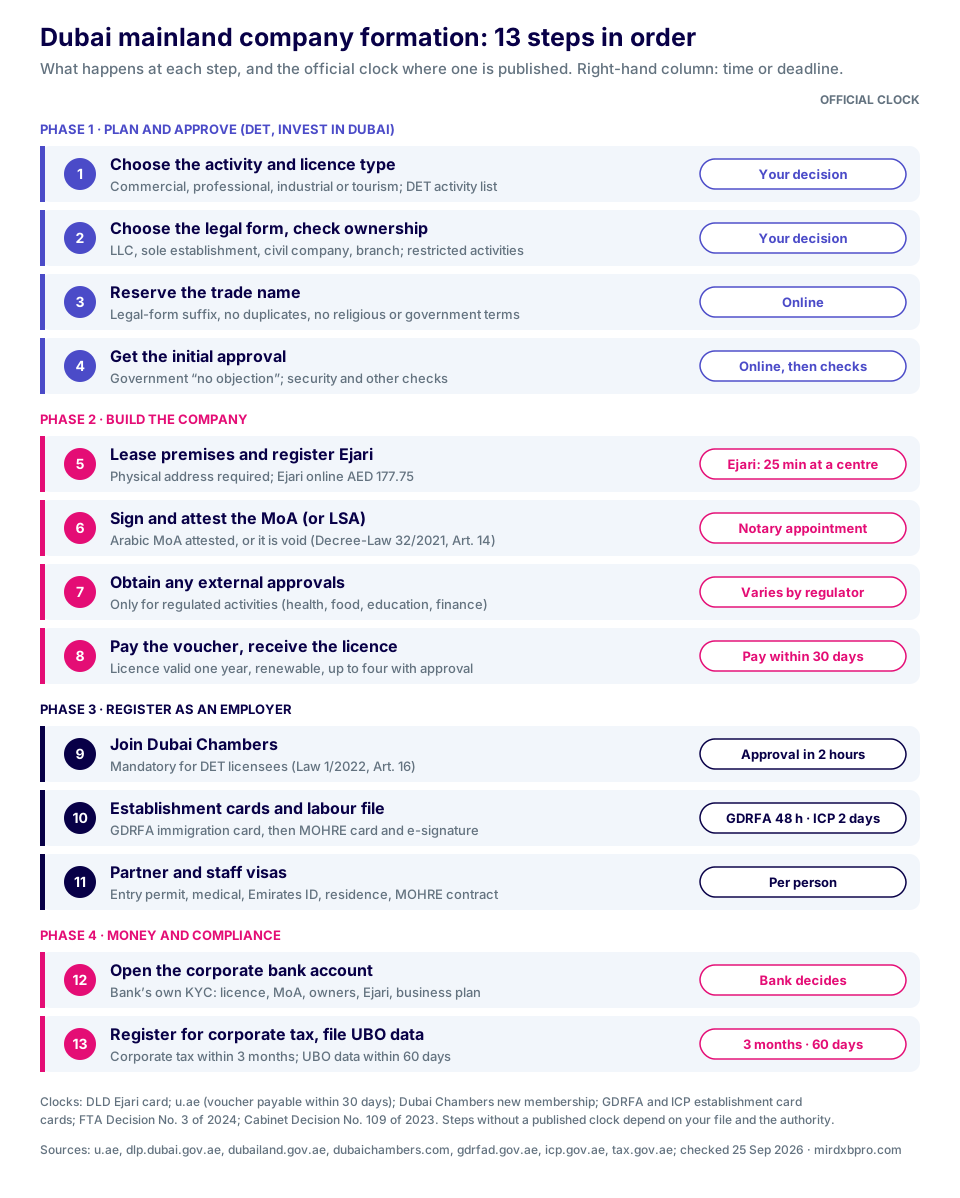
- The order is fixed: activity, legal form, trade name, initial approval, premises and Ejari, memorandum of association, any external approvals, licence, Chamber, establishment cards and labour file, visas, bank account, tax and beneficial owner filings.
- Full foreign ownership is the norm, not the exception. Federal Decree-Law No. 32 of 2021 lets foreigners own 100% of most mainland companies; activities of “strategic impact” such as banking, insurance, telecoms and defence keep conditions (u.ae, updated 6 April 2026).
- An LLC can have one owner or up to 50 partners (Decree-Law 32/2021, Art. 71), there is no fixed minimum capital in the law, and the memorandum must be in Arabic and attested or it is void (Art. 14).
- Premises are a legal requirement, not a formality. Dubai Law No. 13 of 2011 (Art. 17) requires you to name premises in Dubai; the lease is registered on Ejari (AED 177.75 online). Premises also drive your market fee and, later, your visa quota.
- Three clocks start when the licence issues: Dubai Chambers membership is mandatory for DET licensees (Law No. 1 of 2022, Art. 16), corporate tax registration is due within three months (FTA Decision No. 3 of 2024, AED 10,000 penalty if late) and beneficial owner data within 60 days (Cabinet Decision No. 109 of 2023).
- You cannot hire until the employer files exist: immigration establishment card (GDRFA publishes 48 hours), MOHRE establishment card and e-signature, then quota and work permits. Per-hire government lines run from about AED 1,944 to AED 5,144 depending on your MOHRE category.
- Each step has its own guide. This page is the map; the master step table below links every detailed guide in our mainland series.
Mainland company formation in the emirate of Dubai means licensing a business with the Department of Economy and Tourism (DET) so it can trade anywhere in the UAE: you choose an activity and legal form, reserve a trade name, obtain DET’s initial approval, register premises on Ejari, sign an attested memorandum of association, collect any external approvals and pay for the licence, then register the mainland company with Dubai Chambers, open the immigration and labour files, sponsor visas, open a bank account and register for tax. Most of the licensing runs online through Invest in Dubai. What takes time is everything around it: premises, notarisation, approvals for regulated activities and the bank.
This mainland company formation Dubai guide is the pillar of our mainland series. It covers the end-to-end process to set up a mainland company in Dubai, the order of the steps, the decisions that shape your cost and your hiring later, the published clocks and fees, and the mistakes that cost founders months. Every step has a detailed guide of its own; here we summarise each in a few lines and link it, so you can see the whole route on one page and go deep only where your file needs it.
If you are still deciding whether to set up on the mainland at all, start with our free zone vs mainland comparison. If you already know a mainland company is right and want someone to run the whole chain, our company formation support team does it for you.
Mainland company formation Dubai at a glance: the master step table
The table is the core of this guide. It shows each step of mainland company registration in Dubai in the order the systems accept it, who decides, what the official clock or fee is where one is published, and the guide that covers the step in full. Steps 1 to 8 produce the licence; steps 9 to 13 turn the licence into a mainland company that can employ, bank and file tax.
| Step | Mainland company formation Dubai step | Who decides | Official clock or fee (where published) | Full guide |
|---|---|---|---|---|
| 1 | Choose the activity and licence type (commercial, professional, industrial, tourism) | You, against DET’s activity list | Over 2,000 activities (u.ae); more than one allowed | Licence types; general trading |
| 2 | Choose the legal form and check foreign ownership | You, within Decree-Law 32/2021 and DET rules | LLC: 1 to 50 partners (Art. 71) | Types of companies; 100% foreign ownership; branch of a foreign company |
| 3 | Reserve the trade name | DET | Name must carry the legal-form suffix and be unique (u.ae) | Trade name registration |
| 4 | Obtain the initial approval | DET, with security and other checks | Government “no objection” to the business (u.ae) | Initial approval |
| 5 | Lease premises and register Ejari | Landlord, Dubai Land Department | Ejari AED 177.75 online, AED 220 at a trustee centre (DLD) | Office space for a licence; home business licence |
| 6 | Sign and attest the memorandum of association, or the local service agent agreement | Notary; DET | Arabic, attested, or void (Decree-Law 32/2021, Art. 14) | Memorandum of association; local service agent |
| 7 | Obtain external approvals for regulated activities | The sector regulator | Only where the activity requires it; time set by the regulator | Licence types (approvals by activity); professional licence |
| 8 | Pay the voucher and receive the licence | DET | Pay within 30 days of the voucher (u.ae); valid 1 year, up to 4 with approval (Law 13/2011, Art. 8) | Mainland set-up cost; instant licence |
| 9 | Join Dubai Chambers | Dubai Chambers | Mandatory for DET licensees (Law 1/2022, Art. 16); approval within two hours; AED 50 to 2,200 a year by category | Dubai Chamber membership |
| 10 | Open the immigration establishment card and MOHRE labour file | GDRFA; MOHRE | GDRFA AED 280, 48 hours; MOHRE card AED 406 | Establishment card; MOHRE labour card |
| 11 | Get quota and sponsor partner and staff visas | MOHRE; GDRFA; ICP | About AED 1,944 to 5,144 per overseas hire on published lines | Visa quota; employment visa cost |
| 12 | Open the corporate bank account | The bank | No official deadline; the bank’s own checks | Corporate bank account |
| 13 | Register for corporate tax (and VAT if due); file beneficial owner data | FTA; DET as registrar | Corporate tax within 3 months; UBO within 60 days; VAT above AED 375,000 | Corporate tax registration; UBO register |
| After | Amend, renew and keep the files aligned | DET and the others | Renew within the last month before expiry (Law 13/2011, Art. 8(b)) | Licence amendments; renewal |
Mainland company formation Dubai: how MIRDXB PRO helps
Many founders arrive with a single “package price” for mainland company formation, Dubai licence included, and cannot see what the government is charging or what happens after the licence. We map the full route for your activity first, show each government fee as its own line, quote our fee in writing, then run the steps with DET, the Dubai Land Department, the notary, Dubai Chambers, GDRFA, MOHRE and ICP. We are an Amer and Tasheel partner in Al Barsha 1, Dubai, and the post-licence steps, where many set-ups stall, are our daily work.
What we do when you set up a mainland company in Dubai
- Check the activity and form before you pay anything. We match your business to DET’s activity list, flag activities that need an outside approval or carry ownership conditions, and suggest the legal form that fits your owners and plans.
- Handle the DET file. Trade name reservation, initial approval, memorandum of association drafting with your lawyer or on the standard form, attestation, and licence issue on Invest in Dubai.
- Get the premises right. We check that the space you are about to lease can carry your activity and your hiring plan, and register the Ejari.
- Open the employer files. Dubai Chambers membership, the GDRFA immigration establishment card, the MOHRE establishment card and e-signature, and the first quota.
- Process the first visas. Partner or investor residence for the owners, then employees: work permits, entry permits or status changes, medicals, Emirates ID, residence and MOHRE contracts.
- Prepare the post-licence compliance. We hand over a dated calendar for corporate tax registration, beneficial owner filing, Chamber and licence renewal, and the documents your bank will ask for.
How our mainland company registration in Dubai works
- Message us on WhatsApp with your activity, the owners (individuals or companies, nationalities, in or outside the UAE), and how many people you plan to hire in the first year.
- We send a written plan: the steps in order, the documents each owner must provide, the government fees we can publish, the costs we cannot (rent, external approvals), a realistic timeline and our fee.
- You approve, and we start the DET file while you choose premises. Owners abroad can sign a power of attorney so we can act for them where the step allows.
- We finish the chain: licence, Chamber, establishment cards, labour file, visas, then the tax and beneficial owner filings are diarised and done.
What it costs
Government fees are passed on at cost, on the authority’s own receipt: DET’s licence voucher, Ejari, notary, Dubai Chambers, GDRFA, MOHRE and visa fees. Our own fee for a Dubai mainland company setup depends on the legal form, the number of owners, whether an external approval is involved and how many visas you need at the start, and it is always quoted in writing before we begin. You can see how we price our work on our fees page. For the government side of a mainland set-up line by line, with worked totals for typical company profiles, see our mainland business setup cost guide.
Why founders use us for a mainland company
- We publish our sources. Every rule and fee in this guide links to the official page it came from, and where official pages are silent or disagree, we say so.
- We cover the whole chain, not only the licence. DET, Dubai Chambers, GDRFA, MOHRE and ICP files are handled by the same team, so the mainland company’s licence, establishment cards, quota and visas stay aligned from day one.
- We tell you when you do not need us. If the Instant Licence or an e-trader licence on Invest in Dubai fits your case and you are happy to do it yourself, we will say so.
- We are easy to reach. Our office is in Al Barsha 1, Dubai (Monday to Thursday and Saturday 09:00 to 18:00, Friday 09:00 to 12:00), and we act under power of attorney for owners who are abroad where the step allows it.
Before you set up a mainland company in Dubai: four decisions that shape everything
Almost every expensive mistake in a Dubai mainland company setup is made before the first application: the wrong activity, the wrong legal form, premises that cannot carry the hiring plan, or a mainland company where a free zone would have done (or the reverse). Four decisions come first, and each is covered by its own guide.
1. A mainland company or a free zone company?
A mainland company is licensed by DET and may sell anywhere in the UAE and abroad; it hires through MOHRE, with visa numbers set by MOHRE quota. A free zone company is licensed by its zone, trades inside the zone and abroad, and needs extra authorisation to sell directly into the mainland. In Dubai, Executive Council Resolution No. 11 of 2025 now lets a free zone company obtain a DET branch licence or a six-month permit (the “Free Zone Mainland Operating Permit”, AED 5,000, announced by the Dubai Media Office on 8 October 2025). The full comparison, including tax and per-hire costs, is in our free zone vs mainland Dubai guide.
2. Which activity, and which licence type for the mainland company?
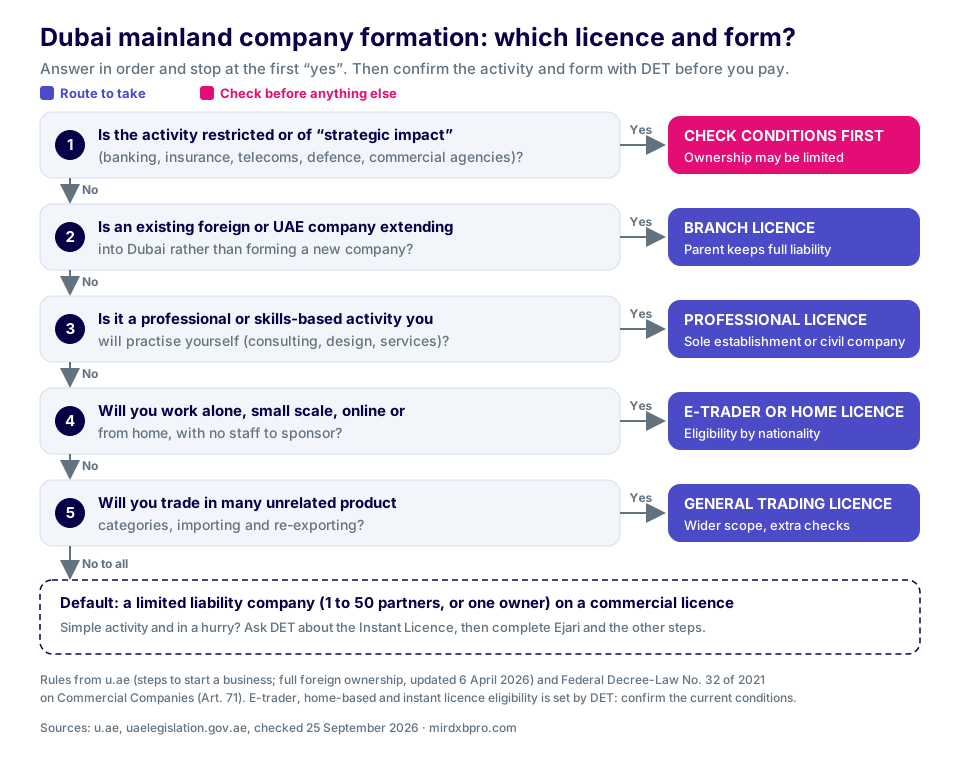
Your activity decides your licence type, the external approvals you need, whether ownership is restricted, the kind of premises you need and some of the DET fees. u.ae lists six licence types at federal level (commercial, industrial, professional, tourism, agricultural and crafts), with variations by emirate. In practice most mainland company licences in Dubai are commercial or professional. Our Dubai mainland licence types guide explains each type and how to combine activities, and our general trading licence guide covers the broadest trading option.
3. Which legal form for your mainland company?
The legal form decides who owns the business, how far the owners are liable, whether you need a memorandum of association or a local service agent agreement, and what the licence can do. The common mainland forms are the limited liability company (including the one-person LLC), the sole establishment, the civil company for professional partnerships, and the branch of a UAE or foreign company. Our types of companies in Dubai guide compares them side by side.
4. Where will the mainland company sit?
Dubai Law No. 13 of 2011 requires every applicant to “specify the premises in the Emirate through which its Economic Activities will be conducted” (Article 17). The premises decide your Ejari, feed into the market fee DET charges on your rent, and later shape the visa quota MOHRE will approve. A flexi-desk may license a consultancy with two staff; it will not carry a team of fifteen. Our office space for a trade licence guide covers offices, business centres, warehouses and what a “virtual office” can and cannot do.
Who does what in a Dubai mainland company setup
Mainland company registration in Dubai touches at least eight authorities. Knowing which one owns which record explains most delays: DET can issue your licence in minutes, but GDRFA cannot open your immigration file until it exists, MOHRE will not issue permits until the immigration card exists, and banks want to see most of the above.
| Authority | Role in mainland company registration in Dubai | What you get |
|---|---|---|
| Department of Economy and Tourism (DET), through its business registration and licensing arm | Licenses economic activity in Dubai; trade names, initial approval, licence, amendments, renewals | Trade licence and the Dubai Unified Licence number |
| Invest in Dubai | DET’s digital platform, launched in February 2021 (Dubai Media Office) | Online applications for names, approvals and licences |
| Ministry of Economy and Tourism | Federal company law, National Economic Register, federal policy on ownership and names | Registration of your licence in the national register |
| Dubai Land Department | Ejari registration of your lease | Ejari certificate |
| Notary public (Dubai Courts or a private notary) | Attests the memorandum of association and powers of attorney | Attested MoA and POAs |
| Sector regulators | Approve regulated activities, for example the Central Bank, TDRA, the Securities and Commodities Authority (u.ae), and Dubai bodies for health, food, education and transport | Approval letters or permits |
| Dubai Chambers | Mandatory membership for DET licensees | Membership certificate |
| GDRFA Dubai (ICP in other emirates) | Immigration establishment card; entry permits and residence | Establishment card; visas |
| MOHRE | Labour file, e-signature, quota, work permits, contracts, WPS | MOHRE establishment card; work permits |
| Federal Tax Authority | Corporate tax and VAT registration and returns | Tax registration number (TRN) |
Every mainland company also receives a Dubai Unified Licence number, “a unique commercial identification provided to all businesses in Dubai” (Dubai Media Office, 12 November 2025), which other authorities and banks use to find your record.
The legal framework behind mainland company registration in Dubai
You do not need to read the laws to set up a mainland company in Dubai, but knowing which rule sits where helps when an official tells you something unexpected.
| Rule | What it says that matters for mainland company formation, Dubai |
|---|---|
| Federal Decree-Law No. 32 of 2021 on Commercial Companies | Legal forms; LLC of 2 to 50 partners, or a single owner (Art. 71); MoA in Arabic and attested or void (Art. 14); managers appointed in the MoA (Art. 83); capital “sufficient” for the object, no fixed minimum (Art. 76) |
| Federal Decree-Law No. 26 of 2020 (now replaced by 32/2021) | Removed the Emirati majority requirement for most activities from 2021; strategic-impact activities keep conditions (u.ae) |
| Dubai Law No. 13 of 2011 on economic activities | Activity only through a licensed business (Art. 5); DET sets conditions and approvals (Art. 6); premises required (Art. 17); trade name used in all dealings (Art. 19); licence one year, up to four with approval (Art. 8); fines AED 100 to 100,000 (Art. 29) |
| Dubai Law No. 1 of 2022 establishing Dubai Chambers | DET licensees must join (Art. 16(a)); micro and small enterprises and handicrafts exempt as agreed with DET (Art. 16(d)) |
| Cabinet Decision No. 109 of 2023 on beneficial owners | UBO register and filing within 60 days of licensing (Arts. 8, 11); changes within 15 days (Art. 15) |
| Federal Decree-Law No. 47 of 2022 and FTA Decision No. 3 of 2024 | Corporate tax; new companies register within three months of incorporation |
Mainland company formation Dubai, step by step
Here is each step in the order DET and the other authorities accept it. For each we give what happens, what the official sources say, the usual reason it goes wrong, and the guide with the full detail. u.ae describes nine steps for the mainland in general and the Ministry of Economy and Tourism ten; we split the post-licence work into its real parts because that is where new companies lose the most time.
Mainland company step 1: choose the activity and the licence type
Everything starts with the activity code. u.ae says you can choose from more than 2,000 activities and that a business may hold several. DET groups activities into licence types, mainly commercial (trading), professional (services and skills), industrial and tourism. The activity decides whether an outside approval is needed, whether foreign ownership is restricted, what premises are acceptable and, for some activities, an extra DET fee.
Choose the activity that describes what your mainland company will actually invoice for. An activity that is too narrow means an amendment later; one that is too broad can pull in approvals or costs you do not need. Combining activities is usually possible within the same licence type and group, but not every combination is accepted. Detail: our Dubai mainland licence types guide. If you plan to trade across many unrelated product lines, read our general trading licence guide before you choose.
Solo founders sometimes do not need a full company. DET’s e-trader licence lets individuals sell online or from home; Emirates 24|7 reported on 24 September 2026 that UAE and GCC nationals may hold commercial or professional e-trader licences, while other residents may hold only a professional one. DET’s Instant Licence, which Gulf News reported in 2022 as issued “within five minutes” on Invest in Dubai with an electronic MoA and a virtual location for the first year, suits simple activities that need to start quickly. Both are covered in our home business licence guide and instant licence guide.
Mainland company step 2: choose the legal form and check ownership
u.ae lists the mainland company forms as general partnership, limited partnership, LLC, public joint stock company and private joint stock company, and the Ministry adds the sole establishment and branch offices. For most founders the choice is between four:
- Limited liability company (LLC). Two to 50 partners, or a single natural or legal person (Decree-Law 32/2021, Art. 71). Liability is limited to the capital. The default for trading and most services.
- Sole establishment. One owner, no separate legal personality, so the owner is personally liable. Usually on a professional licence for foreigners, and then with a local service agent.
- Civil company. A partnership of professionals practising a profession together, on a professional licence.
- Branch. An existing UAE, free zone or foreign company licensed to operate in Dubai without forming a new legal person; the parent stays liable.
Ownership is the next check. Since 2021 the law “abolishes the requirement for a majority Emirati shareholder or local partner” for most activities (u.ae, updated 6 April 2026). Activities with strategic impact (security, defence, telecoms, banking, exchange, financing and insurance) and some others (commercial agencies, Hajj and Umrah organisation, fishing and natural pearl harvesting among them) keep restrictions. Detail: types of companies in Dubai, 100% foreign ownership in Dubai and branch of a foreign company in Dubai.
Mainland company step 3: reserve the trade name
The trade name is reserved with DET, online. u.ae sets the basic rules: the name must include the acronym of the legal form (for example LLC), must not already be registered, and must not offend public morals or use religious or government references. Names in a foreign language, abbreviations, personal names and names that look like existing brands have their own conditions, and a foreign-language name has historically carried a higher DET fee.
The name must fit the activity: one that suggests a regulated service (a “bank”, a “clinic”) will draw questions. And a trade name is not a trademark: it gives you the right to trade under that name in Dubai, not protection of the brand across the UAE. Detail, including reservation validity and changing a name later: our trade name registration guide.
Mainland company step 4: obtain the initial approval
The initial approval is DET’s statement that the government has no objection to you carrying on this activity under this name and form. u.ae describes it as signifying “government non-objection” and says that for foreign investors an approval from the General Directorate of Residency and Foreigners Affairs is needed first, which in practice is a background check on the owners and managers that runs in the background of the application.
The initial approval does not let you trade. It lets you do the next things: sign a lease in the mainland company’s name, prepare the MoA and apply for outside approvals. It has a validity period set by DET; if premises or approvals take longer, it may need extending. Rejections usually come from a mismatch between activity, name and form, or from the security check. Detail: our initial approval guide.
Mainland company step 5: lease premises and register Ejari
This is often the slowest step in a Dubai mainland company setup, because it depends on the property market, not a government system. The space must suit the activity (a warehouse for storage, a shop for retail, an office for services) and be registered with Ejari at the Dubai Land Department. DLD’s service card lists AED 177.75 online (AED 100 registration, AED 10 Knowledge, AED 10 Innovation, AED 55 service partner fee plus VAT) or AED 220 at a real estate trustee centre, which it says takes about 25 minutes excluding waiting.
The choice lasts for years: the registered rent drives the DET market fee on every voucher, the space is one of the factors MOHRE uses to set your quota, and moving is an amendment. DET-approved business centre desks satisfy the premises rule for many service activities, not for storage, retail or a large team. Detail: our office space for a trade licence guide, our visa quota guide for the link between space and visas, and our Ejari registration service.
Mainland company step 6: sign and attest the memorandum of association (or LSA agreement)
Companies with partners, and single-owner LLCs, need a memorandum of association. Article 14(1) of Decree-Law 32/2021 is blunt: the MoA “and any amendment thereto shall be drafted in the Arabic language and attested by the Competent Authority; otherwise, the MOA or the amendment thereto shall be null and void”. In Dubai the attestation is done by a notary public; Dubai Courts lists an e-notary service titled “Memorandum of Association of L.L.C”, and DET’s standard MoA can be used for simple companies.
The MoA sets out partners, shares, capital, objects, the managers (Art. 83) and their powers, decisions and share transfers; these clauses matter when a bank asks who may sign or a partner wants to leave. A professional sole establishment or civil company owned entirely by foreigners instead signs a local service agent agreement with a UAE national, who represents the business with government bodies but takes no share of ownership or profit. Detail: our memorandum of association guide and our local service agent guide. Foreign corporate documents and powers of attorney usually need attestation and legal translation first; our document attestation service and legal translation service handle both.
Mainland company step 7: obtain external approvals for regulated activities
Many activities need no outside approval at all. Others cannot be licensed without one. u.ae gives the Central Bank of the UAE, the Telecommunications and Digital Government Regulatory Authority and the Securities and Commodities Authority as examples at federal level; in Dubai, health, food, education, transport, security and media activities are approved by the relevant Dubai or federal regulator. Law 13/2011 (Art. 7) has DET coordinate with those entities before it decides.
The regulator sets its own requirements and timeline, which can include inspections or qualified staff, and it often decides your launch date. Ask whether your activity needs one before you sign a long lease. Professional activities frequently require proof of the owner’s or manager’s qualifications; our professional licence guide explains how that works.
Mainland company step 8: pay the voucher and receive the licence
Once the name, approval, Ejari, MoA and any outside approvals are on the file, DET issues a payment voucher. u.ae is clear on the deadline: “You have to pay for your trade licence within 30 days of receiving the payment voucher.” After payment, the mainland company’s licence is issued electronically. Under Law 13/2011, Art. 8, it is valid for one year and renewable; at your request and with DET’s approval it can run for up to four years.
The voucher is built from separate lines: licence fees, trade name, the Knowledge and Innovation Dirhams, activity-specific fees for some activities, the market fee on your rent, and fees collected for other bodies. Read the voucher before paying: the activities, the rent figure, the owners and the manager should all match what you intended, because correcting them afterwards is an amendment. Every cost line, with worked totals, is in our mainland business setup cost guide.
A licence lets you trade. It does not let you employ anyone, sponsor your own residence, open a bank account on its own or stay compliant with tax law. Founders who stop at the licence usually discover the gap when they try to pay a salary or when the three-month tax registration deadline has passed. Steps 9 to 13 are part of the formation, not optional extras.
Mainland company step 9: join Dubai Chambers
Membership is a legal obligation, not a marketing extra. Article 16(a) of Dubai Law No. 1 of 2022 says a person licensed by DET to conduct any of the listed commercial, industrial, agricultural, vocational or service activities “must join the membership of the Dubai Chambers”. Article 16(d) exempts owners of micro and small enterprises and practitioners of manual professions and handicrafts, “as specified in agreement with the DET”, who may join voluntarily.
Dubai Chambers’ new membership page says applications are made on its services portal and approved “within two hours of submission if you meet all the requirements”, and lists annual fees from AED 50 (handicrafts) and AED 300 (e-traders) to AED 2,200 (banks, insurers, contractors), with most commercial and professional firms between AED 500 and AED 2,200. Members use the Chamber for certificates of origin, attestation of commercial documents and business services. Detail: our Dubai Chamber membership guide.
Mainland company step 10: open the immigration establishment card and MOHRE labour file
A mainland company is not an employer until two government records exist. The first is the immigration establishment card, issued in Dubai by GDRFA: our establishment card guide sets out GDRFA’s published total of AED 280 and 48-hour completion time. ICP’s card for the other emirates lists AED 100 application, AED 100 issue, AED 100 smart services and a AED 2,000 system subscription, completed in two days. The second is the MOHRE establishment registration, with its own card (AED 406) and the e-signature card an authorised signatory needs to sign work permit applications.
The order between the two is a point where official pages differ; we explain it in the “silent or disagree” table below. In practice we open the immigration card first. MOHRE then assigns your quota. Detail: our MOHRE labour card guide, our labour file opening service and our establishment card service.
Mainland company step 11: quota, then partner and staff visas
u.ae explains that the number of employees a company may hire “depends on the quota approved by the ministry”, assessed on legal status, facility size and business need; it also mentions an AED 3,000 bank guarantee per employee, which MOHRE now allows to be replaced by an insurance policy. Owners usually take residence as partners or investors on their own mainland company; staff get a MOHRE work permit, entry permit or status change, medical, Emirates ID, residence and a registered contract.
On published lines, one overseas hire costs about AED 1,944 in MOHRE category 1, AED 2,894 in category 2 and AED 5,144 in category 3 before health insurance, as broken down in our employment visa cost guide. New companies with larger investments or qualifying owners can look at longer residence: see our golden and investor visa service. Quota growth is in our visa quota guide, contracts in our UAE contract types guide, salary payment in our WPS guide, and national hiring targets, which start to apply from 20 employees in specified sectors, in our Emiratisation guide. Our employment visa service processes the files.
Mainland company step 12: open the corporate bank account
No law sets a deadline for a bank account, but in practice a new mainland company needs one quickly: salaries must go through WPS, and many government and supplier payments need a company account. Banks apply their own know-your-customer rules. Expect to provide the licence, the MoA, the Ejari, the establishment card, owners’ and signatories’ passports, Emirates IDs and proof of address, the beneficial owner details, a business plan and evidence of expected counterparties and turnover.
Timelines vary by bank and by the complexity of your ownership. DET reports that accounts opened through its Dubai Unified Licence service provider project took about five days instead of 65; outside that channel, allow longer and apply to more than one bank if your structure involves foreign corporate shareholders. Detail: our corporate bank account guide.
Mainland company step 13: corporate tax, VAT and beneficial owner filings
Three federal filings follow the licence, each with its own deadline:
- Corporate tax registration. A resident juridical person incorporated on or after 1 March 2024 “must apply to register for Corporate Tax within three months from the date of incorporation, establishment or recognition” (FTA Decision No. 3 of 2024). Missing it costs AED 10,000 under Cabinet Decision No. 10 of 2024 (Ministry of Finance). The rate is 0% on taxable income up to AED 375,000 and 9% above.
- VAT registration. Mandatory when taxable supplies and imports exceed AED 375,000 over the previous 12 months or are expected to within the next 30 days; voluntary from AED 187,500 (FTA).
- Beneficial owner data. Cabinet Decision No. 109 of 2023 requires every mainland company to keep a register of beneficial owners (anyone owning or controlling 25% or more, directly or indirectly) and to submit the data to the registrar within 60 days of licensing (Art. 11), then report any change within 15 days (Art. 15).
Detail: our corporate tax registration guide and our UBO register guide. Tax advice on your structure belongs with a tax adviser; the registrations themselves are administrative.
After mainland company formation: amendments, renewals and aligned files
A mainland company’s details change: a partner joins, a manager leaves, an activity is added, the office moves. Each change is an amendment with DET, often with an attested MoA amendment, and each has knock-on updates at GDRFA, MOHRE, the bank, the FTA and the beneficial owner register. Our trade licence amendment guide explains the sequence. Renewal falls due every year (or at the end of a multi-year term), within the last month before expiry: see our trade licence renewal guide and, if a renewal slips, our expired trade licence guide. Our trade licence renewal service handles it each year.
What a Dubai mainland company setup costs: the structure
There is no single price for a Dubai mainland company setup, because the largest lines depend on your choices: rent drives the market fee, the activity drives activity fees and outside approvals, the legal form decides whether you need an MoA or an LSA, and the number of visas multiplies the per-hire costs. What we can show is the structure, with the lines that are officially published. Our mainland business setup cost guide takes every line in turn and builds worked totals for typical company profiles.
| Mainland company cost line | Published figure | Source and status |
|---|---|---|
| DET licence voucher (licence, trade name, service, Knowledge and Innovation Dirhams, activity fees) | Built per file; the voucher governs | DET; the service pages are script-rendered and did not display fee tables when we checked; previously published lines are in our cost guide, labelled |
| Market fee | A percentage of the annual rent on your Ejari (2.5% in Dubai Media Office wording, 2020) | Dubai Media Office; not confirmed on a live DET page |
| Rent | Market price | Your landlord or business centre; the largest variable |
| Ejari | AED 177.75 online; AED 220 at a trustee centre | Dubai Land Department service card |
| MoA attestation and powers of attorney | Notary fees; Dubai Courts’ remote POA service lists AED 100 per signature | Dubai Courts |
| External approvals | Set by each regulator | Sector regulator |
| Dubai Chambers membership | AED 50 to 2,200 a year by category | Dubai Chambers new membership page |
| Immigration establishment card | GDRFA AED 280; for other emirates ICP lists AED 2,300 in fees on first issue, plus a subscription guarantee noted in our establishment card guide | GDRFA and ICP service cards |
| MOHRE establishment card | AED 406 | MOHRE, as published in our labour card guide |
| Visas, per overseas hire, two years | About AED 1,944 to 5,144 by MOHRE category, before insurance | MOHRE, GDRFA, ICP and DHA cards |
| Corporate tax and VAT registration | Filing through EmaraTax; late corporate tax registration AED 10,000 | FTA; Ministry of Finance |
To compare mainland company formation quotes in Dubai, separate one-off lines (name, approval, MoA, first visas) from annual ones (licence, market fee, rent, Chamber, card renewal), and government fees from service fees: the government lines are the same whoever files them. Our UAE government fees list collects the authority fees in one place, and our PRO services cost guide explains how to read a service quote.
How long it takes to set up a mainland company in Dubai
The Ministry of Economy and Tourism says a company can be established in “4 days” through an emirate’s economic department, and Invest in Dubai issues trade names, approvals and some licences instantly; Gulf News reported on 3 August 2026 that 53% of the platform’s services are now delivered instantly. Those figures describe the government’s processing. Your own timeline is set by the steps outside the platform.
| Mainland company phase | What sets the pace | Published clock |
|---|---|---|
| Activity, form, trade name, initial approval | A clear activity and complete owner documents; security checks on the owners | Online; names and approvals can be instant |
| Premises and Ejari | Finding space that fits the activity; landlord paperwork | Ejari registration about 25 minutes at a centre |
| MoA and attestation | Agreement between partners; attested and translated documents from abroad; notary appointment | None published for the MoA |
| External approvals | The regulator’s own process and any inspection | Set by each regulator |
| Licence issue | Paying the voucher | Within 30 days of the voucher |
| Chamber, establishment cards, labour file | Signatory’s Emirates ID or unified number; UAE PASS | Chamber two hours; GDRFA 48 hours; ICP two days |
| Visas | Quota, medicals, biometrics; attested degrees for skilled roles | Per person; entry permits valid two months (u.ae) |
| Bank account | Ownership structure and the bank’s checks | None; the bank decides |
| Tax and beneficial owners | Your diary | Corporate tax within three months; UBO within 60 days |
A simple service LLC with resident owners and no outside approval reaches its licence quickly; a restaurant, clinic or school waits on premises and regulators. The real planning question is not “how fast is the licence?” but “when can the mainland company pay its first salary through a bank account?”. For visa steps see our visa processing times guide.
Documents for mainland company registration in Dubai
The list depends on who the owners are. DET and the other authorities add requirements by activity, so treat this as the core set.
| Mainland company owner or role | Usually required | Watch out for |
|---|---|---|
| Individual owner, UAE resident | Passport, residence visa, Emirates ID; UAE PASS for online steps | Name spelling must match across all records |
| Individual owner living abroad | Passport; entry stamp or visit visa if signing in the UAE; power of attorney if someone signs for them | A POA signed abroad needs attestation and Arabic translation |
| Corporate shareholder (a UAE or foreign company) | Certificate of incorporation, articles, board resolution to invest and appoint a representative, good standing, register of shareholders and directors | Foreign documents must be legalised and translated; the beneficial owners behind the company must be identified |
| Manager | Passport, Emirates ID if resident; named in the MoA | The manager signs at the bank and often at MOHRE; appoint someone who will be available |
| Premises | Tenancy contract and Ejari certificate | Tenant name must be the company (or the initial approval holder) and the use must fit the activity |
| Regulated activity | Qualifications, experience letters, regulator forms | Degree certificates usually need attestation and, for MOHRE, may need equivalency |
Foreign documents are the most common source of delay. Allow time for legalisation abroad and attestation by the UAE Ministry of Foreign Affairs, then legal translation into Arabic. Our attestation process guide explains the order, and our apostille vs attestation guide explains why an apostille alone is usually not enough.
Setting up a mainland company from abroad
Much of a Dubai mainland company setup can be run while the owners are outside the UAE. Trade names, initial approvals and licence applications are online. Leases can be signed by a representative. Dubai Courts’ Smart Electronic Notary lets parties complete notarial transactions remotely, with verification by video or in person; its published fee for a power of attorney is AED 100 per signature, and foreign documents must be attested and translated into Arabic.
Residence visa biometrics and the bank’s identification of signatories still need the owner in person, so most owners run the licence stage remotely and plan one visit around the MoA, the visa medical and biometrics, and bank meetings.
Your mainland company’s first year: the compliance calendar
Most penalties new companies pay in their first year come from missed dates, not from wrongdoing. Put these in the diary on the day the licence issues.
| When | What falls due for the mainland company | Rule |
|---|---|---|
| Straight after the licence | Dubai Chambers membership; immigration establishment card; MOHRE registration | Law 1/2022, Art. 16; GDRFA and MOHRE service rules |
| Within 15 days of any change | Update the partners register and the UBO register; report changes to the registrar | Cabinet Decision 109/2023, Arts. 8, 10, 15 |
| Within 60 days of licensing | Submit beneficial owner data to the registrar | Cabinet Decision 109/2023, Art. 11 |
| Within three months of incorporation | Register for corporate tax | FTA Decision 3/2024; AED 10,000 penalty if late |
| When taxable supplies pass AED 375,000 | Register for VAT (within the FTA’s time limit) | FTA |
| Every month with staff | Pay salaries through WPS | Labour Law Executive Regulation, Art. 16 |
| Last month before licence expiry | Renew the licence; renew Ejari and Chamber membership in step | Law 13/2011, Art. 8(b) |
| Before the establishment card expires | Renew the immigration establishment card | GDRFA or ICP renewal card |
| Within nine months of the end of the first tax period | File the corporate tax return | Federal Decree-Law 47/2022 |
If headcount grows, Emiratisation rules start to apply at 20 employees in specified sectors and at 50 employees across the private sector; our Emiratisation guide sets out targets and contributions. For the running work in general, our why companies need PRO services guide explains what the government side of a mainland company involves month to month, and our corporate PRO services team takes it over.
Where a Dubai mainland company setup goes wrong
These are the problems we are asked to fix most often after someone else, or the founder, has started the file. Each is avoidable at the planning stage.
| Mainland company mistake | What it causes | How to avoid it |
|---|---|---|
| Activity chosen from a package list, not from what you will invoice | Contracts or invoices outside the licence; an amendment and new fees; sometimes a new outside approval | Match each revenue line to an activity before the name is reserved |
| Cheapest desk chosen without a hiring plan | Quota refused when the team grows; a move and an amendment in year one | Model headcount at 12 and 24 months and ask what the space will support |
| MoA copied from a template without thinking about exits | Deadlock between partners; no route for a partner to leave or sell | Agree manager powers, decisions and share transfer terms before attestation |
| Foreign corporate documents not legalised in time | The whole file waits for one certificate | Start legalisation and translation on day one |
| Stopping at the licence | No establishment card, no staff, no bank account; tax registration missed | Plan steps 9 to 13 in the same timetable |
| Corporate tax registration forgotten | AED 10,000 penalty | Diarise three months from the licence date |
| Beneficial owners not recorded or filed | Penalties under Cabinet Resolution 132/2023; bank questions | Keep the UBO register from day one; file within 60 days |
| Owner’s residence visa left to the end | Owner cannot get an Emirates ID, UAE PASS or bank signatory status in time | Sponsor the owner’s residence as soon as the establishment card issues |
Mainland company formation Dubai in practice: five cases
These cases are built from the situations we see most often. Names and identifying details are left out, and the figures are the published ones.
1. A two-partner IT services mainland company with resident founders
Situation: Two foreign residents plan an IT consultancy with four hires in year one, clients mostly Dubai companies.
Assessment: IT consultancy is not a restricted activity, so the partners can own 100% as an LLC. With four hires planned, a small serviced office suits better than a flexi-desk, since quota follows space. Route: LLC, small office on Ejari, Chamber membership the day the licence issues, immigration and MOHRE files the same week, partner residence for both founders, then four hires. Corporate tax registration diarised at month two, not month three.
2. An overseas parent choosing between a branch and a mainland company
Situation: A European engineering firm wants a Dubai presence to bid for regional projects, with a local manager and five engineers.
Assessment: Two options: a branch (the parent is liable and the branch has no separate personality) or a new LLC owned by the parent (liability limited to the subsidiary). Both need the parent’s documents legalised, attested and translated, and the beneficial owners behind the parent identified. Route: both options set out in writing; after legal advice, an LLC owned by the parent, with legalisation started abroad on day one because it was the longest step. See our branch of a foreign company guide.
3. A solo consultant who only needs a licence and her own visa
Situation: A marketing consultant on a spouse-sponsored visa wants to invoice Dubai clients in her own name. No staff planned.
Assessment: A full mainland company with an office is more than she needs. A professional licence (sole establishment with a local service agent) or DET’s e-trader route, where her nationality and activity allow, fits; she needs no quota while her residence stays with her spouse. Route: both compared against her two-year plan, and she was told which one she could complete herself. See our professional licence guide and home business licence guide.
4. A restaurant mainland company that signed a lease too early
Situation: Three partners signed a shop lease and started fit-out before applying for approvals.
Assessment: Food outlets need approvals from the relevant Dubai authorities before the licence, including premises and layout requirements. Fit-out done before approval can have to be redone. Route: initial approval first, then the premises and layout checked against the regulator’s requirements, then the MoA and licence; staff visas only when the opening date is fixed, because each hire starts a two-year cost. The lesson for everyone else: in regulated activities, the order is approval, then fit-out.
5. A free zone company whose Dubai clients now want a mainland company
Situation: A design agency in a Dubai free zone, eight staff, with a growing share of mainland clients.
Assessment: Under Executive Council Resolution No. 11 of 2025, a Dubai free zone company can apply for a DET branch licence or a six-month permit (AED 5,000) through Invest in Dubai, if it holds a Dubai Unified Licence and its zone approves. A new mainland LLC gives full onshore capacity but means a second company, a second immigration file and new visas for anyone who moves. Route: the permit covered the immediate work; a mainland LLC was planned for the following year when mainland revenue was expected to pass half the total. Our free zone vs mainland guide explains the trade-off.
Mainland company rules: where the official sources are silent or disagree
| Mainland company point | What the sources say | How we handle it |
|---|---|---|
| DET fee lines | DET’s and Invest in Dubai’s service pages are script-rendered and did not display fee tables when we checked; fees appear on the voucher | We describe the structure here, label previously published figures in our cost guide, and treat the voucher as final |
| Order of MOHRE and GDRFA files | u.ae describes MOHRE registration first, then GDRFA; MOHRE’s own process asks for a copy of the immigration establishment card before issuing its card | We open the immigration card first, then MOHRE, which is the order the systems accept today |
| Local service agent | u.ae says an LSA agreement is needed for “businesses owned completely by non-GCC residents”, while the same portal says the law removed local agent requirements for branches of foreign companies | In Dubai the LSA is used mainly for professional sole establishments and civil companies; we confirm with DET for each file |
| Initial approval and trade name validity | Validity periods are set by DET and were not displayed on a page we could open | Covered in our initial approval and trade name guides; confirm on the application |
| Instant Licence and e-trader conditions | Latest details come from news reports (Gulf News 2022, Emirates 24|7 September 2026), not a DET page we could open | Treated as reported; confirm current conditions on Invest in Dubai |
| Chamber exemption for small enterprises | Law 1/2022 exempts micro and small enterprises “as specified in agreement with the DET”; the criteria were not published on a page we found | Assume membership is required unless DET or the Chamber confirms the exemption |
Dubai mainland company setup myths: what circulates online that is not true
| What circulates about the mainland company process | The position |
|---|---|
| “You need an Emirati partner with 51% on the mainland” | Not for most activities since 2021 (Decree-Law 26/2020, now 32/2021; u.ae). Strategic-impact and some other activities keep conditions |
| “An LLC needs at least two partners” | A single natural or legal person may own an LLC (Decree-Law 32/2021, Art. 71(2)) |
| “There is a minimum capital of AED 300,000” | The law requires capital “sufficient” for the object (Art. 76) and sets no fixed figure; activity rules and banks may expect more |
| “You can use a virtual office for any licence” | Law 13/2011 requires premises in Dubai (Art. 17); virtual arrangements are limited to specific DET products |
| “Once you have the licence you can hire” | Hiring needs the immigration establishment card, MOHRE registration and quota first |
| “Chamber membership is optional” | Mandatory for DET licensees under Law 1/2022, Art. 16, with exemptions only for micro and small enterprises and handicrafts as agreed with DET |
| “Corporate tax registration can wait until you have profit” | New companies must register within three months of incorporation, whatever their income; AED 10,000 penalty if late |
| “A trade name protects your brand” | A trade name is licensing registration in Dubai; brand protection is a trademark with the Ministry of Economy and Tourism |
How to verify every mainland company figure in this guide
| Mainland company figure or rule | Where to check it |
|---|---|
| Mainland steps, legal forms, trade name rules, 30-day voucher payment, Ejari requirement | u.ae, “Steps to start a business on the mainland” (updated 16 July 2026) |
| 100% foreign ownership and restricted activities | u.ae, “Full foreign ownership of commercial companies” (updated 6 April 2026) |
| LLC partners, MoA attestation, managers, capital | Federal Decree-Law 32/2021, Arts. 14, 71, 76, 83 (uaelegislation.gov.ae) |
| Licence requirement, premises, term, fines | Dubai Law No. 13 of 2011 (Dubai Legislation Portal) |
| Mandatory Chamber membership; fees and two-hour approval | Dubai Law No. 1 of 2022, Art. 16; Dubai Chambers new membership page |
| Ejari fees and time | Dubai Land Department, Register / Renew Tenancy Contract |
| Establishment card fees and times | GDRFA and ICP service cards; our establishment card guide |
| Corporate tax deadline and penalty; VAT thresholds | FTA Decision No. 3 of 2024; Ministry of Finance on Cabinet Decision 10/2024; FTA VAT registration page |
| Beneficial owner deadlines | Cabinet Decision No. 109 of 2023 (Ministry of Economy and Tourism) |
If an official page has changed since we checked it, the official page wins.
Checked against official sources on 25 September 2026: u.ae mainland and foreign ownership pages, Federal Decree-Law No. 32 of 2021, Dubai Law No. 13 of 2011, Dubai Law No. 1 of 2022, Dubai Chambers, the Dubai Land Department, ICP, the Federal Tax Authority, the Ministry of Finance, Cabinet Decision No. 109 of 2023 and Dubai Media Office releases. DET’s own service pages did not display their content to us on that date, so DET fee figures are not quoted here.
What we will and will not do
We will plan your mainland company formation from the start: check your activity, legal form and premises against your plans before you pay; run the DET file, Ejari, MoA attestation, Chamber, establishment cards, labour file and first visas; separate government fees from our fee on every quote; diarise your tax and beneficial owner deadlines; and tell you when a question belongs with a lawyer, a tax adviser or the bank.
We will not promise a licence, an external approval, a visa quota or a bank account, which are decided by DET, the regulator, MOHRE and the bank; act as your local service agent or nominee shareholder; describe your activity in a way that does not match what you do to avoid an approval; or give tax or legal advice on your structure.
Related guides
- Free zone vs mainland Dubai: which set-up fits
- Mainland business setup cost in Dubai, line by line
- Types of companies in Dubai mainland
- Dubai mainland licence types
- Establishment card explained
- Company visa quota in Dubai
- MOHRE labour card guide
- Employment visa cost breakdown
- How to renew a trade licence in Dubai
- Expired trade licence in Dubai
- Emiratisation rules
- UAE government fees list 2026
- PRO services cost in Dubai
- Why companies need PRO services
Mainland company formation Dubai: frequently asked questions
What does mainland company formation involve in Dubai?
It is the process of licensing a business with Dubai’s Department of Economy and Tourism so it can trade anywhere in the UAE. You choose an activity and legal form, reserve a trade name, get initial approval, register premises on Ejari, attest a memorandum of association, obtain any outside approvals and pay for the licence. The mainland company then joins Dubai Chambers, opens its immigration and MOHRE files, sponsors visas, opens a bank account and registers for tax.
How long does it take to set up a mainland company in Dubai?
The government side can be quick: trade names and approvals are often instant on Invest in Dubai, and the Ministry of Economy and Tourism cites four days for establishment. Premises, attesting foreign documents, outside approvals and the bank set the real pace. A simple service company with resident owners moves fastest; restaurants, clinics and schools wait on regulators.
Can a foreigner own 100% of a Dubai mainland company?
Yes, for most activities. Federal Decree-Law No. 26 of 2020, now Federal Decree-Law No. 32 of 2021, removed the Emirati majority requirement from 2021. Activities of strategic impact, including security, defence, telecoms, banking, financing and insurance, and some others such as commercial agencies keep conditions. Check your exact activity with DET before choosing.
Can one person own a mainland LLC in Dubai?
Yes. Article 71 of Decree-Law 32/2021 sets an LLC at two to 50 partners but adds that “any single natural or legal person may incorporate and own a limited liability company”. The name then carries the one-person designation. A single owner still needs an attested memorandum, premises and the same post-licence registrations as any other company.
Is there a minimum share capital for a Dubai mainland LLC?
The Commercial Companies Law sets no fixed minimum. Article 76 requires capital “sufficient to achieve the object” of the company, divided into shares of equal value. Some activities and regulators set their own capital rules, and banks may look at capital when opening an account, so choose a figure that fits the business rather than the smallest possible.
Do I need a physical office for a mainland company in Dubai?
You need premises in Dubai. Dubai Law No. 13 of 2011 (Article 17) requires the applicant to specify the premises through which the business operates, and u.ae says the lease must be registered with Ejari. Many service businesses use a DET-approved business centre desk or small office; trading, retail and industrial activities need suitable space. Instant Licence holders may use a virtual location for the first year, as reported.
Does a mainland company need a local service agent?
Not for an LLC in most activities. A local service agent is a UAE national who represents a business with government bodies without owning it, and in Dubai is mainly used for professional licences held by foreigners as a sole establishment or civil company. u.ae links the requirement to businesses wholly owned by non-GCC residents. Our local service agent guide covers the role and agreement terms.
Is Dubai Chambers membership compulsory for a new mainland company?
Yes for most. Dubai Law No. 1 of 2022, Article 16, says anyone licensed by DET for commercial, industrial, agricultural, vocational or service activities must join. Micro and small enterprises and handicraft practitioners are exempt as agreed with DET and may join voluntarily. Dubai Chambers approves applications within two hours if complete; fees run from AED 50 to AED 2,200 a year.
When must a new mainland company register for corporate tax?
Within three months of incorporation for a mainland company incorporated on or after 1 March 2024, under FTA Decision No. 3 of 2024. Registration is through EmaraTax. Late registration carries an AED 10,000 penalty under Cabinet Decision No. 10 of 2024. The corporate tax rate is 0% on taxable income up to AED 375,000 and 9% above. VAT is separate and depends on turnover.
Can I get a residence visa through my own mainland company?
Yes. Once the mainland company has its immigration establishment card and MOHRE registration, owners can usually be sponsored as partners or investors on their own company, and employees on MOHRE work permits. Larger investments may qualify for longer residence such as the Golden Visa. The owner’s visa is often worth processing early because an Emirates ID makes UAE PASS, banking and signatory steps easier.
Can I set up a mainland company in Dubai without visiting the UAE?
Much of it. Trade names, initial approvals and licence applications are online, leases can be signed by a representative, and Dubai Courts offers remote notarisation with video verification. A properly attested power of attorney lets a representative act for you. Residence visa biometrics and the bank’s identification of signatories usually need you in person, so most owners plan one visit.
What happens after the mainland company licence is issued?
Join Dubai Chambers, open the immigration establishment card with GDRFA and the MOHRE labour file with its e-signature, obtain quota, sponsor the owners’ and staff visas, open the corporate bank account, register for corporate tax within three months, file beneficial owner data within 60 days, and diarise the licence, Ejari, Chamber and establishment card renewals. Missing these is how new companies collect their first fines.
Can MIRDXB PRO handle my mainland company formation, Dubai end to end?
Yes. We check your activity, legal form and premises first, then run the DET file, Ejari, memorandum attestation, Dubai Chambers membership, the immigration establishment card, MOHRE labour file, quota and first visas, and diarise your tax and beneficial owner filings. Government fees are passed on at cost on the authority’s receipt, and our fee is quoted in writing before we start.
How much does MIRDXB PRO charge to set up a mainland company in Dubai?
It depends on the legal form, the number of owners, any outside approval and how many visas you need at the start, so we do not publish a single package price. Send us your activity, owners and hiring plan on WhatsApp and we reply with the government fees we can publish, the costs we cannot, a timeline and our own fee, all in writing before anything starts.
Keeping a new company’s licence, Chamber membership, establishment cards, quota and staff visas aligned after formation is what our PRO services in Dubai team handles.
- u.ae: Steps to start a business on the mainland (updated 16 July 2026)
- u.ae: Full foreign ownership of commercial companies (updated 6 April 2026)
- u.ae: Recruiting on the mainland (MOHRE registration, quota, AED 3,000 guarantee)
- Ministry of Economy and Tourism: Establishing companies
- Federal Decree-Law No. 32 of 2021 on Commercial Companies
- Dubai Legislation Portal: Law No. 13 of 2011 Regulating the Conduct of Economic Activities in the Emirate of Dubai
- Dubai Legislation Portal: Law No. 1 of 2022 Establishing the Dubai Chambers (Art. 16)
- Dubai Chambers: New membership (fees, documents, two-hour approval)
- Dubai Land Department: Register / Renew Tenancy Contract (Ejari)
- Dubai Courts: Smart Electronic Notary
- ICP: Issuing an Establishment Card
- Federal Tax Authority: Decision No. 3 of 2024 on corporate tax registration timelines
- Ministry of Finance: AED 10,000 penalty for late corporate tax registration
- Federal Tax Authority: Registration for VAT
- Ministry of Economy and Tourism: Cabinet Decision No. 109 of 2023 on beneficial owner procedures
- Government of Dubai Media Office, 10 May 2021: Invest in Dubai platform
- Government of Dubai Media Office, 12 November 2025: Dubai Unified Licence and bank account opening
- Government of Dubai Media Office, 8 October 2025: Free Zone Mainland Operating Permit
- Invest in Dubai (DET): Request to issue a trade licence (content did not display on 25 September 2026)
Secondary, attributed: Gulf News, 3 August 2026, on instant services on Invest in Dubai; Gulf News, 18 May 2022, on the Instant Licence; Emirates 24|7, 24 September 2026, on the e-trader licence.
Please note. The steps, rules and fees in this guide are taken from u.ae, the Ministry of Economy and Tourism, the UAE and Dubai legislation portals, Dubai Chambers, the Dubai Land Department, Dubai Courts, ICP, the Federal Tax Authority, the Ministry of Finance and the Government of Dubai Media Office, verified 25 September 2026. DET’s own service pages did not display their content to us on that date, so DET’s fee lines and validity periods are not quoted and your payment voucher is final. The cases are built from common situations and are illustrative, not the records of named clients. This guide is general information and not legal or tax advice.


