

Key takeaways
- DIFC company setup means registering an entity with the DIFC Registrar of Companies and, if you will provide financial services, getting separate authorisation from the Dubai Financial Services Authority (DFSA). The DIFC free zone has its own English-language civil and commercial laws and its own courts.
- Your first decision is regulated or not. Banks, brokers, fund and wealth managers and insurers need DFSA authorisation (application fee USD 2,000 to USD 140,000). Consultancies, law firms, tech firms, holding companies, family offices and retailers register only with the Registrar.
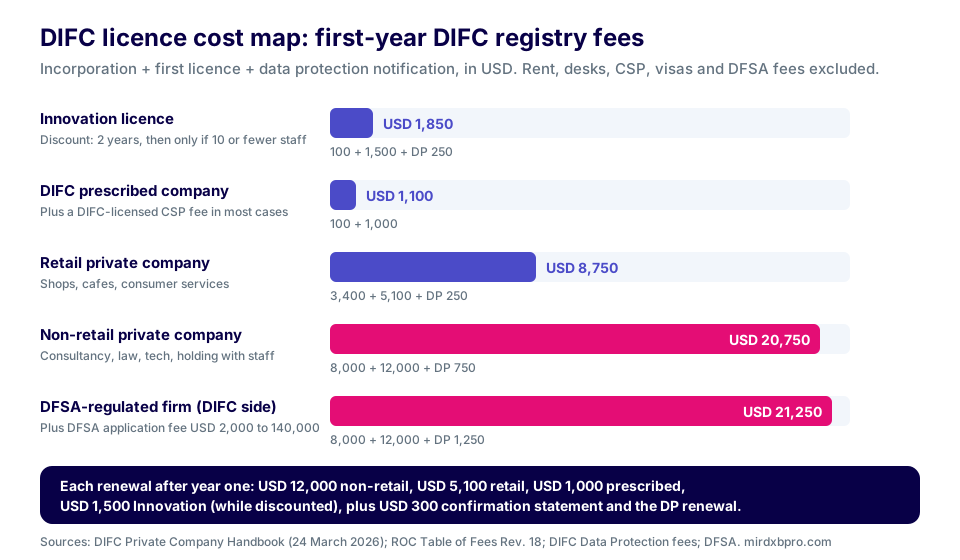
- The standard non-retail DIFC licence costs USD 8,000 to incorporate plus USD 12,000 a year (DIFC handbook, 24 March 2026). Retail is USD 3,400 plus USD 5,100; the Innovation licence USD 100 plus a subsidised USD 1,500.
- The DIFC prescribed company was opened to any applicant on 24 July 2026: USD 100 plus USD 1,000 a year for a passive holding vehicle with no staff, usually with a DIFC-licensed corporate service provider.
- Published clocks: initial approval 3 to 5 working days, incorporation 4, licence 5, establishment card 3 (1 express), DIFC visa 7 working days (3 express).
- Staff are hired under the DIFC Employment Law, not the federal labour law, and employers pay 5.83% of basic salary (8.33% after five years) into DEWS instead of gratuity.
- DIFC visa quota follows space: one per business centre desk, one per 80 sq ft of office, up to four on a first Innovation desk.
- Tax: DIFC entities can be Qualifying Free Zone Persons, but the DIFC free zone is not a VAT designated zone, and it keeps its own beneficial owner register.
DIFC company setup is the process of incorporating or registering a company, partnership, foundation or branch in the Dubai International Financial Centre, a financial free zone created by Federal Decree No. 35 of 2004 under Federal Law No. 8 of 2004 on Financial Free Zones and now governed by Dubai Law No. 5 of 2021. The DIFC Registrar of Companies, part of the DIFC Authority, registers and licenses entities; financial firms also need the Dubai Financial Services Authority, which the 2021 law makes “solely responsible” for regulating financial and ancillary services there. The DIFC free zone sits on Sheikh Zayed Road between the Trade Centre area and Downtown Dubai and is the region’s largest financial hub: on 28 July 2026 it reported 10,018 active registered companies, 1,134 of them regulated financial firms.
What sets the DIFC free zone apart from every other Dubai zone is the legal system. Companies, contracts, employment and data are governed by DIFC laws written in English on common-law lines, and disputes go to the DIFC Courts. That is why banks, funds, law firms and family offices choose it, and why a DIFC licence costs more than a flexi-desk licence elsewhere. Our overview of free zones in the UAE and the list of Dubai free zones put it in context; if you would rather hand the whole file to one team, that is what our business setup in Dubai service does.
This DIFC company setup guide is built from DIFC’s own handbooks and fee tables, DFSA service cards, the Dubai Legislation Portal and federal tax sources, checked on 26 September 2026. Where DIFC documents disagree with each other, we show both and say which to plan on.
DIFC free zone at a glance
| Item | DIFC free zone position | Source |
|---|---|---|
| Licensing authority | DIFC Registrar of Companies (DIFC Authority); DFSA for financial services | Dubai Law No. 5 of 2021 |
| Legal basis | Federal Law No. 8 of 2004; Federal Decree No. 35 of 2004; Dubai Law No. 5 of 2021 (replaced Law No. 9 of 2004) | difc.com; Dubai Legislation Portal |
| Established | 2004 | Federal Decree No. 35 of 2004 |
| Legal system | DIFC civil and commercial laws in English; DIFC Courts (Dubai Law No. 2 of 2025) | Dubai Legislation Portal |
| Best for | Banks, asset and wealth managers, funds, insurers, fintech, law and advisory firms, family offices, holding vehicles | DIFC sector pages; our assessment |
| Legal forms | Private and public company, recognised company (branch), LLP, partnerships, foundation, prescribed company, NPIO, fund and cell companies | DIFC Companies Law No. 5 of 2018; ROC fee table |
| DIFC licence types | Non-retail, retail, Innovation, prescribed company, restricted and short-term licences, commercial permissions; DFSA licence for financial firms | ROC fee table; Operating Regulations |
| Official setup time | Initial approval 3 to 5 working days; incorporation 4; licence 5; DFSA “TBC” | DIFC handbook (March 2026); ROC fee table; DFSA |
| Headline fees | Non-retail USD 8,000 + 12,000 a year; retail USD 3,400 + 5,100; Innovation USD 100 + 1,500; prescribed USD 100 + 1,000 | DIFC handbook; difc.com |
| DIFC visa allocation | 1 per business centre desk; 1 per 80 sq ft; up to 4 on a first Innovation desk | DIFC Government Services Office; Innovation Hub |
| Office options | Leased office, business centre, co-working, affiliate’s office, owned unit; none for prescribed companies | DIFC handbooks |
| VAT designated zone | No | Cabinet Decision No. 59 of 2017 list |
| Mainland trading | Non-regulated firms can seek a DET licence; Resolution No. 11 of 2025 excludes DIFC financial establishments | Res. 11/2025, Art. 2 |
| Websites | difc.com; dfsa.ae; difccourts.ae | – |
What the DIFC free zone is known for
Most Dubai free zones sell space and licences. The DIFC free zone sells a legal system. Dubai Law No. 5 of 2021 calls it “a financial free zone having financial and administrative autonomy”, and Article 22(b) says its bodies and establishments are not governed by Dubai Government legislation, except laws on the environment, health, public safety and food control. In their place the DIFC has its own Companies, Contract, Employment, Data Protection, Foundations, Trust and Insolvency laws, all in English. Four bodies run it:
- The DIFC Authority, which runs the Registrar of Companies, the Commissioner of Data Protection, the employment regime and the Government Services Office that processes each DIFC visa.
- The DFSA, the independent regulator of financial and ancillary services, which also supervises some non-financial businesses for anti-money-laundering.
- The DIFC Courts, now under Dubai Law No. 2 of 2025 (3 March 2025); proceedings are in English (Art. 7).
- The Arbitration Institute (Art. 32 of Law No. 5 of 2021).
DIFC’s results of 28 July 2026 list 10,018 active companies, 2,318 new registrations in the first half of 2026, 1,134 regulated firms (327 in banking and capital markets, 165 in insurance, 592 in wealth and asset management), 1,933 AI, fintech and innovation firms, 1,408 family business entities and 1,409 foundations. If your clients and investors are banks and funds, many are already a lift ride away.
DIFC free zone vs rival zones
Its only true peer is ADGM in Abu Dhabi, the other financial free zone, with its own courts and regulator (the FSRA). Choose between them on where your clients and staff are and which regulator knows your group. For trading, crypto or general services without a financial regulator, DMCC company setup is usually cheaper. Virtual asset firms outside the DIFC are supervised by VARA and often sit in the DWTC free zone; inside the DIFC free zone, crypto activity falls to the DFSA. A pure software business may fit Dubai Internet City unless it wants the Innovation licence and the finance network.
DFSA-regulated or non-regulated: the first decision in a DIFC company setup
Every DIFC file starts with one question: will the entity carry on a financial or ancillary service as the DFSA defines them? The answer decides the regulator, the timeline and the cost.
| Question | DFSA-regulated firm | Non-regulated firm |
|---|---|---|
| Typical businesses | Banking, dealing or arranging deals in investments, advising, asset and fund management, insurance, custody, crypto token services, representative offices | Consultancy, law, accounting, HR, marketing, tech, holding companies, family offices, retail, restaurants |
| Who you apply to | DFSA for authorisation; Registrar for incorporation and DIFC licence | Registrar only (plus DFSA registration for designated non-financial businesses) |
| Official process | Enquire, apply, evaluate, fulfil the in-principle conditions, approve | Portal application, initial approval, address, e-signing and payment, licence |
| Published time | “TBC” on the DFSA card | About 3 to 5 working days to initial approval; 4 and 5 working days for incorporation and licence |
| Regulator fee | USD 2,000 to USD 140,000 | None beyond DIFC fees |
| Data protection category | I: USD 1,250 initial, USD 500 renewal | II: USD 750 and 250; retail III: USD 250 and 100 |
The DFSA card asks you to read GEN Rule 7.2 of the Rulebook, submit an enquiry and meet the DFSA before getting ePortal access. The pack includes a board resolution, organisation chart, board CVs, beneficial owners’ passports, group structure, parent licences, source of wealth or parent accounts, a regulatory business plan and risk, AML and compliance policies (self-certifiable for low-risk models). An in-principle letter sets conditions such as capital, office and key people; the licence follows when they are met.
Designated non-financial businesses and professions (law firms, accountants, corporate service providers, real estate agents, precious metals dealers) are not authorised firms, but they register with the DFSA for anti-money-laundering supervision, and the DIFC handbook asks for that DFSA in-principle approval with the application.
DFSA authorisation is specialist regulatory work: the business plan, compliance manuals and licence category belong with a regulatory lawyer or compliance consultant. We support the corporate and government-service side of a regulated file and will tell you when you need someone else.
DIFC legal forms: private company, prescribed company, foundation and branch
The DIFC Companies Law (DIFC Law No. 5 of 2018) and the partnership, foundations and non-profit laws offer a wider menu than most free zones. The entity type you pick on the portal “cannot be edited” later, so choose before you start.
| Legal form | What it is | Key rules |
|---|---|---|
| Private company (Ltd) | Company limited by shares; the default operating vehicle | At least 1 shareholder and 1 director aged 18+; issued capital “greater than 0”; secretary optional |
| Public company (PLC) | Can offer shares to the public | Same DIFC licence fees as a private company; stricter governance |
| Recognised company | Branch of a company incorporated outside the DIFC | No separate legal personality; parent liable; no constitutional documents to sign |
| LLP | Body corporate with members and limited liability | Same fees as a private company |
| General or limited partnership | Partnerships, including fund structures | USD 4,000 incorporation (non-retail) |
| DIFC prescribed company | Passive holding or structuring vehicle, treated as a private company | No staff, no trading; CSP required unless exempt |
| Foundation | Ownerless entity run by a council under a charter | No incorporation fee; USD 200 licence |
| NPIO | Non-profit incorporated organisation | USD 100 incorporation; USD 1,000 licence |
| Investment, protected cell and variable capital companies | Fund and cell structures | Fund vehicles are DFSA-linked; PCC incorporation USD 1,000 |
Private company: what the handbook requires
DIFC’s Private Company Non-Financial and Retail Handbook (DIFC-CS-GL-12 Rev. 05, approved 24 March 2026) sets the minimum team: at least one shareholder (individual, body corporate or government entity), one director aged 18 or over, one authorised signatory aged 18 or over who appears on the DIFC licence, and one senior management representative, “the most senior individual working for the proposed DIFC entity”. A secretary is optional. Capital can be in AED, USD or another currency, in one or more classes, and all issued shares must be allocated before submission. There is no published minimum capital for a non-regulated company; regulated firms meet DFSA capital rules for their category.
DIFC prescribed company: open to everyone since July 2026
The DIFC prescribed company is the Centre’s special purpose vehicle. It used to be limited to qualifying purposes and applicants with a DIFC or regulatory link. DIFC consulted on removing those limits on 30 April 2026 (Consultation Paper No. 1 of 2026), and the amended Prescribed Company Regulations were enacted on 24 July 2026 (Gulf News, 3 August 2026; law firm briefings). The main points:
- Any applicant can now use a DIFC prescribed company, provided it stays passive: it may hold assets anywhere, including shares, but may not trade, run an operating business or employ staff.
- A DIFC-licensed corporate service provider (CSP) must be appointed unless the company is an “exempt prescribed company”, broadly one controlled by an eligible DIFC entity, a regulated firm, a listed body or a qualifying government entity.
- Existing non-exempt DIFC prescribed company owners must appoint a CSP by 24 January 2027, with penalties of up to USD 20,000, according to Gibson Dunn. We have not seen the regulation text, so confirm with your CSP.
- DIFC fees are unchanged: USD 100 incorporation and USD 1,000 a year, plus the AED 20 Knowledge and Innovation fee. The CSP’s fee is on top and not published.
- No lease is needed; the registered office is normally provided by the CSP or a group entity.
DIFC foundation
A foundation under the DIFC Foundations Law has no shareholders: a council runs it under a charter and by-laws, often with a guardian, for its objects or beneficiaries. DIFC counted 1,409 foundations in July 2026, up 67% in a year. They pay no incorporation fee and a USD 200 annual licence (USD 100 for a recognised foreign foundation). Families use them to hold businesses and property because the foundation’s own affairs are governed by DIFC law and heard by the DIFC Courts; how that interacts with a person’s estate is a question for a private-client lawyer.
Branch of a foreign company (recognised company)
A foreign company can register a DIFC branch as a recognised company, paying the same USD 8,000 and USD 12,000 non-retail lines. Regulated groups often prefer a branch because the DFSA can rely on the parent’s capital; non-regulated groups usually get cleaner liability and banking from a subsidiary. The mainland equivalent is in our guide to a branch of a foreign company in Dubai.
DIFC licence types and the activities list
The Registrar issues a commercial licence to non-regulated entities and an operating licence alongside a DFSA licence to regulated firms. The fee tables and Operating Regulations recognise these DIFC licence types:
- Non-retail commercial licence: the standard DIFC licence for professional, corporate and tech services.
- Retail licence: shops, restaurants, cafes and consumer services, at USD 3,400 and USD 5,100.
- Innovation (Fintech) licence: subsidised, for technology firms (below).
- Prescribed company licence: for the holding vehicles above.
- Restricted licence: for activity “of a limited, restricted or investigative nature” (Operating Regulations 2.4).
- Short-term licence: under a year, with extensions capped at 12 months in total (Regulation 2.5).
- Commercial permissions: for events and pocket shops, and the “dual licence” permission that lets a mainland (DET) firm operate from the DIFC free zone.
The DIFC Innovation licence
The Innovation Hub page lists a USD 1,500 annual licence plus USD 100 registration, a co-working desk at USD 500 a month plus VAT, “up to 4 visas on the first desk” and visa costs discounted by up to 40%. A DIFC offer page for new registrants advertises the desk at USD 250 a month billed annually, up to a 50% visa discount and a “90% subsidised” licence. The March 2026 handbook sets the rule that matters most: the discounted DIFC licence fee applies for the first two years, then for years three to seven only if the entity has ten or fewer employees; otherwise, and for everyone from year eight, the normal USD 12,000 applies.
Listed activities include distributed ledger technology services (excluding currency and crypto trading), innovation and AI research and consultancy, software houses, technology R&D, IT consultancy (a computer science or IT degree and three years’ experience are required) and internet and infrastructure services. The offer page names AI, AR/VR, gaming, Web3, fintech, healthtech, edtech, proptech and other tech sectors.
The Innovation Hub page says DIFC visa costs are discounted “up to 40%”; the new-registrant offer says “up to 50%”, and the desk price differs too (USD 500 list, USD 250 offer). Ask DIFC which terms apply on the day you apply and keep the email.
Checking your activity
DIFC publishes a Non-Retail Activities Guide and a Retail Activities Guide that flag activities needing another authority’s approval; the approval or NOC is uploaded with the application. Describe what you actually do. A DFSA financial service does not become a non-regulated consultancy by rewording, and carrying it on without authorisation is a regulatory breach. The entity type (financial, non-financial, retail or fund) is fixed per application and sets the fee category, so if you need both a retail outlet and a non-retail consultancy, ask DIFC early whether one entity can hold both.
DIFC company setup process, step by step
For a non-regulated private company, the March 2026 handbook describes “a simple five-step process” on the DIFC Client Portal. Here it is with the published clock for each step and what follows the licence.
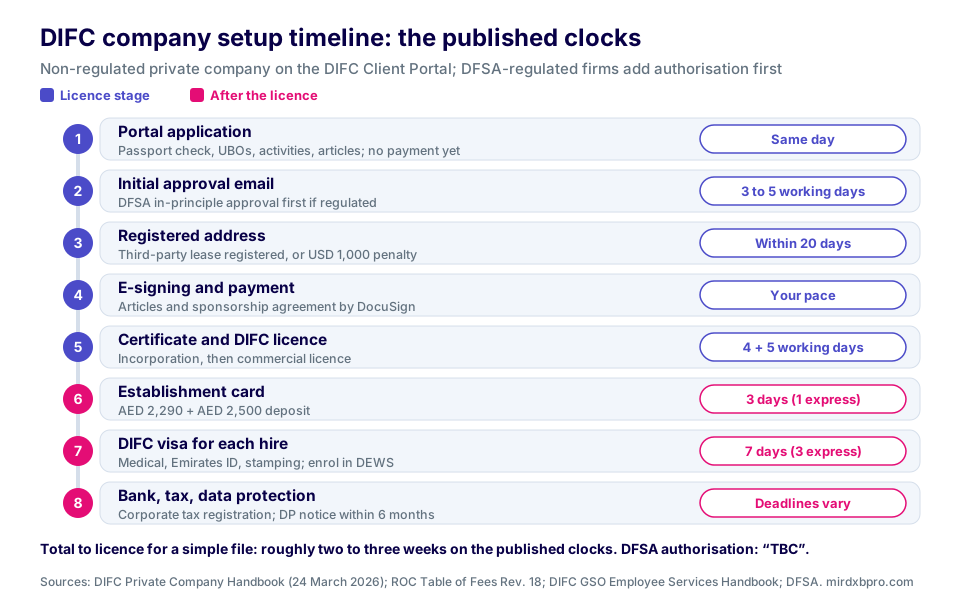
- Portal access and application. Self-register and verify your passport digitally (DIFC says it “might take up to 3 minutes”), or book a meeting with business development. Complete the single-submission form: structure, background, activities, name, capital, stakeholders, UBOs, contacts, data protection choice, articles and whether you want an establishment card now. No payment yet.
- Initial approval. An email arrives “typically within 3 to 5 working days” (2026 handbook; the 2024 handbook says a relationship manager reviews “within 3 working days”). Regulated firms need the DFSA in-principle approval first.
- Registered address. A lease from a third-party landlord (not DIFC Investments) is registered with the DIFC Registrar of Real Property “within 20 days” of signing, or a USD 1,000 penalty applies (2024 handbook). Co-working, an affiliate’s office with the host’s consent letter, or a DIFC Investments lease need no registration; an owned unit needs a “self-occupy” certificate.
- E-signing and payment. The articles (and the Personnel Sponsorship Agreement if you asked for an establishment card) arrive by DocuSign. Fees are paid from the portal wallet, topped up by card, transfer, cheque or cash at DIFC Services (cash up to AED 20,000; transfers and cheques take 2 working days).
- Certificate and DIFC licence. The ROC Table of Fees lists 4 working days for incorporation and 5 for the licence.
- Establishment card. If not taken at incorporation: 3 working days, or 1 express.
- DIFC visa and DEWS. Employment visas run through the Government Services Office (7 working days normal, 3 express). Sign the DEWS deed and enrol staff by the end of probation.
- Bank, tax and data protection. Open the account, register for corporate tax, and file the data protection notification within six months if you process personal data.
The published clocks add up to roughly two to three weeks from application to DIFC licence for a simple non-regulated company with digitally verified owners and a co-working desk. Corporate shareholders’ documents, lease negotiations, third-party approvals and DFSA files are what stretch it, sometimes to months.
Documents required for DIFC company setup
From the March 2026 handbook. Anything not in English needs a legal translation “certified to the satisfaction of the Registrar of Companies”.
Individuals: shareholders, directors, secretaries
- Passport certification: digital verification with a liveness check, or a copy certified by a law firm, corporate service provider or other authorised certifier under the DIFC Certification Policy.
- CV or short biography for shareholders, directors and each UBO.
- Six months of bank statements for each individual funding the company.
- Notarised power of attorney if someone else signs the articles for a shareholder.
- Director Appointment Declaration generated by the portal, signed by each director.
Corporate shareholders
- Certificate of incorporation certified by the issuing authority; if not electronic, issued within the last six months.
- Board resolution approving the company, adopting the articles, appointing signatories and naming who signs; not older than six months, with names matching the portal exactly.
- Two years of audited financial statements for a corporate funder, and a group structure chart.
For company registration the handbook asks for certification by the issuing authority and a certified translation; it does not require UAE embassy legalisation and MOFA attestation, a real difference from the mainland. Other steps can still need it: the DIFC visa file asks for degrees “attested by UAE embassy in the country of certificate origin as well as Ministry of Foreign Affairs” for many job titles, and banks may want legalised documents. Our document attestation service handles those chains.
UBOs and fit and proper
A UBO is anyone holding 25% or more of shares or votes, able to appoint or remove most directors, or exercising significant control; if no one qualifies, each director is deemed a UBO. The application also includes a fit and proper questionnaire, a third-party funding section with the investment agreement where outsiders fund the company, and any trust documents or name-consent letter.
DIFC licence cost: the official fee lines
The DIFC free zone publishes a real fee table rather than packages. Fees are in US dollars, paid from a portal wallet topped up in dirhams (pegged at AED 3.6725 to USD 1). We use the March 2026 private company handbook where it has a line and the Registrar of Companies Table of Fees (DIFC-RC-GL-02 Rev. 18, effective 23 February 2023) for other entity types, all checked on 26 September 2026. An AED 20 Knowledge and Innovation fee is added to each DIFC licence and Government Services transaction.
| Fee line | Non-retail | Retail | Source |
|---|---|---|---|
| Name reservation | Nil | Nil | ROC Table of Fees |
| Private or public company: incorporation | USD 8,000 | USD 3,400 | Handbook, March 2026 |
| DIFC licence, on incorporation and each year | USD 12,000 | USD 5,100 | Handbook, March 2026 |
| Recognised company or LLP: registration / licence | USD 8,000 / 12,000 | USD 3,400 / 5,100 | ROC Table of Fees |
| General or limited partnership: registration / licence | USD 4,000 / 12,000 | USD 1,700 / 5,100 | ROC Table of Fees |
| Innovation licence: registration / licence | USD 100 / 1,500 (discount conditions above) | n.a. | Handbook; Innovation Hub |
| DIFC prescribed company: incorporation / licence | USD 100 / 1,000 | n.a. | difc.com SPV page |
| Foundation: incorporation / licence | Nil / USD 200 | n.a. | ROC Table of Fees |
| Venture capital or future-economy fund manager | Nil incorporation; renewals USD 0, 4,000, 8,000, then 12,000 | n.a. | Handbook |
| Data protection notification (initial / annual) | Financial USD 1,250 / 500; non-financial USD 750 / 250 | USD 250 / 100 | Commissioner of Data Protection |
| Confirmation statement with each renewal | USD 300 | USD 300 | ROC Table of Fees |
| Establishment card (new) | USD 618 normal / USD 656 express (AED 2,290 / 2,430) plus USD 680 (AED 2,500) sponsorship deposit | Handbook; GSO handbook | |
| New DIFC visa, applicant outside UAE | AED 3,970 normal (7 working days) / AED 5,770 express (3) plus AED 2,500 deposit | GSO handbook, 23 December 2024 | |
| New DIFC visa, applicant inside UAE | AED 5,470 / AED 8,410 plus AED 2,500 deposit | GSO handbook | |
| DIFC visa renewal | AED 3,370 (5 working days) / AED 5,490 (3) | GSO handbook | |
| Non-sponsored employee card (e.g. shareholder on another visa) | AED 1,160 for 1 year / AED 2,020 for 2 years | GSO handbook | |
| DFSA application fee | USD 2,000 to USD 140,000 | DFSA service card | |
| Late lease registration | USD 1,000 penalty | Handbook, October 2024 | |
What the fee table does not show
- Space: desks and offices are priced by operators and landlords and are the largest cost for most DIFC companies.
- Corporate service provider: required for most DIFC prescribed company files; fees are private.
- Regulatory build: compliance staff, capital and insurance usually dwarf the DIFC licence for a DFSA firm.
- Audit, visas and insurance: annual audits for non-small companies; each hire adds visa, medical, Emirates ID, deposit, DHA-approved health insurance and monthly DEWS contributions.
The current ROC Table of Fees on DIFC’s document hub is Rev. 18 (February 2023). The March 2026 handbook repeats its private company and Innovation lines, so we treat them as current. If the portal shows a different line, the portal wins; the fee table itself says DIFC laws and regulations prevail.
Office options in the DIFC free zone and DIFC visa allocation
Space is your registered address and it sets your DIFC visa allocation. The Government Services Office publishes the ratios: business centres 1 visa per desk; kiosks 3; fine and casual dining 60 sq ft per person; hotels 200 sq ft per person; other businesses 80 sq ft per person.
| Option | Registration step | DIFC visa allocation |
|---|---|---|
| Co-working desk, including the Innovation Hub | No lease registration | Innovation: up to 4 on the first desk; business centre: 1 per desk |
| Business centre office | Operator agreement | 1 per desk |
| Office leased from DIFC Investments | Registered automatically | 1 per 80 sq ft |
| Office from a third-party landlord | Register within 20 days (USD 1,000 penalty if late) | 1 per 80 sq ft |
| Affiliate’s office | Host’s consent letter; host must be the leaseholder | From the host’s space |
| Owned unit | Self-occupy certificate | 1 per 80 sq ft |
| Retail unit | Retail lease | Kiosks 3; food outlets 60 sq ft per person |
| No premises | Registered office via CSP or group entity | None (DIFC prescribed company cannot employ) |
Plan space around hiring for the next 12 to 18 months. Moving mid-lease to unlock visas is the most common expensive surprise in a DIFC company setup.
DIFC visa and residency: establishment card, staff, owners and families
A DIFC visa is issued by GDRFA Dubai, but you apply through the DIFC Government Services Office on the Client Portal, not to GDRFA directly. The office works Monday to Friday, 08:00 to 15:00. Its Employee Services handbook (Rev. 21, 23 December 2024) is the source below.
Establishment card
Every visa service needs a valid establishment card, valid for one year or until the DIFC licence expires and renewed with it. A new card costs AED 2,290 (3 working days) or AED 2,430 express (1 working day), plus an AED 2,500 Personnel Sponsorship Agreement deposit. Renewing more than a month late brings GDRFA fines of AED 100 per month. See our establishment card guide.
Employee DIFC visa
The permanent employment DIFC visa is valid for two years. After submission, the entry permit or status change is normally issued within about 2 working days; the employee then takes the medical at the DIFC medical centre (express files at Smart Salem in Index Tower), registers Emirates ID and gets the visa stamped, and you arrange DHA-approved health insurance. Documents include the passport, photo, a DIFC-law employment contract whose job title matches the application, and for many titles an attested degree. Visas must be renewed or cancelled within 30 days of expiry or a fine of up to USD 2,000 applies. For the medical and Emirates ID steps see our medical fitness test and Emirates ID pages, and for sponsorship differences see free zone vs mainland visas.
Owners: no separate investor visa
The handbook lists no partner or investor visa. A resident shareholder takes a DIFC visa as an employee, with proof of ownership in place of the contract. A shareholder already holding UAE residence (Golden Visa, spouse’s sponsorship, another employer with an NOC) takes a non-sponsored employee card: AED 1,160 for one year or AED 2,020 for two.
Golden Visa through the DIFC
The office processes Golden Visa nominations for executives earning over AED 30,000 a month, sponsored for more than two years by an entity with at least ten sponsored employees; investors with at least AED 2 million in the DIFC entity; and DIFC property owners. The fee is AED 6,411 (AED 7,409 express) and approval is at GDRFA’s discretion. Our Golden Visa service covers other routes.
Family visas
DIFC-sponsored employees sponsor spouses and children through a separate Dependent Services package; we have not quoted its fees. Federal and GDRFA salary and document rules still apply.
DIFC Employment Law and DEWS
Staff in the DIFC free zone are employed under the DIFC Employment Law (DIFC Law No. 2 of 2019, amended in 2020, 2021, 2022, 2024 and 2025), not the federal labour law; there is no MOHRE work permit. From a Dubai law firm’s summary of the July 2025 consolidation:
- At least 20 working days’ annual leave (Art. 27); up to 60 working days’ sick leave (Art. 34).
- Maternity leave 65 working days (Art. 37); paternity leave 5 working days (Art. 39).
- Average working time capped at 48 hours over seven days (Art. 22).
- Notice of 7 days in the first three months, 30 days up to five years, 90 days after (Art. 62).
- Wages within seven days of each pay period; final dues within 14 days of termination.
DEWS replaces the gratuity. Since 1 February 2020, employers pay into the DIFC Employee Workplace Savings plan or another qualifying scheme. The handbook’s steps: appoint a DEWS authorised signatory to sign the deed on the portal, register on the DEWS platform, enrol employees “on or before completion of their probation period”, and contribute 5.83% of basic salary monthly, or 8.33% after five years. Zurich administers the plan. Employers with a statutory pension duty abroad, or a richer group scheme in at least four countries, can apply for an exemption certificate (AED 1,856.25).
DIFC Data Protection Law
The DIFC has its own Data Protection Law (DIFC Law No. 5 of 2020) and Commissioner. Hiring anyone or serving customers counts as processing personal data. If you do, file the notification within six months of the DIFC licence (handbook) and renew it annually; the Commissioner also asks for notification within 14 days of starting new processing. Fees: USD 1,250 and USD 500 for regulated firms, USD 750 and USD 250 for non-regulated non-retail, USD 250 and USD 100 for retail. Discounted Innovation licensees pay USD 250 then USD 200 (handbook), although a DIFC offer page shows USD 0. Failure to notify can lead to fines under Schedule 2 of the law.
Bank account for a DIFC company
Banks will ask for the certificate and DIFC licence, articles, registers, UBO details, passports and residence, the desk or lease agreement, a business plan with expected transactions and source-of-funds evidence. The portal offers an optional data-sharing link with Mashreq that “does not constitute a commitment to open an account”. Regulated firms may face DFSA client money rules. See our corporate bank account guide.
DIFC tax: corporate tax, VAT and beneficial ownership
Corporate tax. DIFC entities are within Federal Decree-Law No. 47 of 2022; DIFC’s page says they can benefit from “a zero per cent corporate tax rate on qualifying income”. A Qualifying Free Zone Person must meet Cabinet Decision No. 100 of 2023 (substance, audited statements) and earn qualifying income under Ministerial Decision No. 229 of 2025 (which replaced No. 265 of 2023). It lists, among others, regulated fund, wealth and investment management, holding shares and securities, regulated reinsurance, and treasury, financing and headquarter services to related parties; non-qualifying revenue must stay within the de minimis limit of 5% of revenue or AED 5 million, whichever is lower. Advisory and most professional services to third parties are not on the list, so a DIFC consultancy should not assume 0%. Other income is taxed at 9% above AED 375,000, and Small Business Relief is not available to a Qualifying Free Zone Person. Register within the FTA Decision No. 3 of 2024 timeframe; late registration costs AED 10,000. See our corporate tax registration guide.
VAT. The DIFC free zone is not a designated zone: the Cabinet Decision No. 59 of 2017 list names Dubai zones such as Jebel Ali Free Zone, Dubai Airport Free Zone and International Humanitarian City, not the DIFC. DIFC businesses register above AED 375,000 of taxable supplies (voluntary from AED 187,500) like mainland firms. Many financial services are exempt or zero-rated, which affects input tax recovery.
Beneficial ownership. Cabinet Decision No. 109 of 2023 does not apply to financial free zones (Art. 3(2)(b)). DIFC entities file with the Registrar under DIFC’s own Ultimate Beneficial Ownership Regulations, and changes are due within 30 days. Our UBO register guide compares the regimes.
Trading with the Dubai mainland from the DIFC free zone
- Regulated financial firms: Executive Council Resolution No. 11 of 2025, which offers Dubai free zone companies a DET branch licence or the six-month Free Zone Mainland Operating Permit (AED 5,000), excludes DIFC financial establishments (Art. 2). Onshore financial activity is licensed by federal regulators.
- Non-regulated DIFC firms: a 2018 MoU between DIFC and Dubai Economy (now DET) lets them obtain mainland licences, and Resolution No. 11 of 2025 does not exclude them. Ask DET which route fits your activity.
- The other direction: a DET-licensed firm can operate from the DIFC free zone under a dual licence permission; its staff get a “DL employee card” (AED 120).
If most revenue will come from mainland customers, compare a DIFC entity plus a mainland branch with straightforward mainland company formation.
DIFC Courts: why it matters to a small company
Under Dubai Law No. 2 of 2025, the DIFC Courts have exclusive jurisdiction over civil, commercial and employment claims involving DIFC establishments, contracts concluded or performed wholly or partly in the DIFC, and DIFC-seated arbitration matters (Art. 14A); others can opt in in writing (Art. 14B). There is a Court of First Instance, a Court of Appeal and a Small Claims Tribunal (Art. 16). Employment disputes, unpaid invoices and shareholder fights are argued in English under DIFC law, so draft contracts accordingly.
DIFC licence renewal and ongoing compliance
| Obligation | Deadline | Source |
|---|---|---|
| DIFC licence renewal and confirmation statement (USD 300) | On expiry; within 30 days no fine, after 30 days an automatic fine (Operating Law Art. 9(11)) | Handbook; Operating Regulations 2.9.3 |
| Establishment card | With the licence; AED 100 per month after one month late | GSO handbook |
| Audited accounts (non-small private company) | Within 7 months of year end | Handbook |
| Accounts (small: 20 or fewer shareholders or turnover up to USD 5 million) | Within 9 months | Handbook |
| Changes to officers, shareholders, UBOs, address, activities, articles, capital | Within 30 days | Handbook |
| Data protection notification | Within 6 months; annually after | Handbook |
| DIFC visa renewal or cancellation | Within 30 days of expiry; fine up to USD 2,000 | GSO handbook |
| DEWS contributions; corporate tax return | Monthly; within 9 months of year end | Handbook; FTA |
A small company filing unaudited accounts in the DIFC still needs audited statements if it claims Qualifying Free Zone Person status.
DIFC free zone pros and cons
| Pros | Cons |
|---|---|
| English common-law style laws and the DIFC Courts | Standard non-retail DIFC licence (USD 8,000 plus USD 12,000 a year) is far above typical free zone licences |
| A DFSA licence carries weight with banks and counterparties abroad | DFSA authorisation has no published timeline and needs real substance and compliance staff |
| Published fee tables and handbooks; one portal for everything | High office rents; DIFC visa quota is tied to space |
| Cheap specialist vehicles: DIFC prescribed company (USD 1,100 in year-one DIFC fees), foundations, Innovation licence | Innovation discounts end with growth: more than 10 staff from year 3 means USD 12,000 |
| Company documents need certification rather than full legalisation | Separate employment law, DEWS and data protection fees add admin |
| Eligible for Qualifying Free Zone Person status | Not a VAT designated zone; much advisory income is not qualifying |
Who DIFC company setup suits
- Firms that need an internationally recognised financial licence: asset and wealth managers, brokers, banks, insurers, fund platforms.
- Family offices, family holding companies and foundations wanting English-law structures.
- Holding, financing and structuring vehicles: the DIFC prescribed company is now open to any applicant.
- Law, advisory and consulting firms whose clients are in the Centre.
- Fintech, AI and Web3 start-ups that can use the Innovation licence.
Who should look elsewhere
- Traders in physical goods needing warehousing, customs or designated-zone VAT treatment: JAFZA, a designated zone, or DMCC for commodities.
- Solo consultants and small service firms selling mostly to UAE companies on a tight budget: a flexi-desk zone or mainland licence usually costs less.
- Virtual asset firms that want VARA supervision: the DWTC free zone.
- Abu Dhabi-focused financial businesses: ADGM company setup.
DIFC company setup: worked cases
These cases are built from the situations we see most often. Names and identifying details are left out, and the figures are the published ones.
Case 1: a two-partner consultancy
Two partners, one in Dubai and one abroad, want a DIFC private company because their clients are banks in the Centre. Route: non-retail, non-regulated. Year-one DIFC fees: USD 8,000 incorporation, USD 12,000 DIFC licence, USD 750 data protection and an establishment card (USD 618 plus a USD 680 deposit), before rent. The partner abroad verifies his passport digitally and signs by DocuSign. The tax point to raise early: third-party consulting is not a qualifying activity, so plan for 9% on profits above AED 375,000.
Case 2: a family holding structure
A family wants one vehicle to hold its operating companies in Dubai and abroad. Before July 2026 it needed a qualifying purpose; now a DIFC prescribed company is open to it for USD 100 plus USD 1,000 a year and the AED 20 fee. It must appoint a DIFC-licensed CSP (it is not “exempt”), cannot employ anyone and cannot trade. Its lawyer compares a DIFC foundation (USD 200 a year), which works differently for succession.
Case 3: an AI start-up on the Innovation licence
Three founders take the Innovation licence (USD 100 plus USD 1,500) and a co-working desk, which supports up to four DIFC visa slots on the first desk. The question to settle is year three: past ten employees, the licence goes to USD 12,000, and from year eight everyone pays it. Budget for that now, and get the visa discount confirmed in writing because two DIFC pages differ.
Case 4: a foreign asset manager opening a branch
A European asset manager needs DFSA authorisation plus a recognised company with the Registrar. The DFSA fee sits between USD 2,000 and USD 140,000 depending on category, and there is no fixed timeline. The regulatory business plan, manuals and key individuals are the critical path and belong with a regulatory specialist; in a file like this, the corporate documents, visas and dependants are the part we take on once the in-principle letter is issued.
Case 5: a mainland agency that wants a DIFC address
A mainland marketing agency whose clients are in the Centre does not need a new company: a DET-licensed firm can apply for a dual licence permission to operate from the DIFC free zone, and its staff get DL employee cards (AED 120).
What circulates online about the DIFC free zone that is not true
| Claim | What official sources say |
|---|---|
| “Every DIFC company needs a DFSA licence.” | Only financial and ancillary services do. Others register with the Registrar; DNFBPs register with the DFSA for AML only. |
| “DIFC companies pay no tax.” | Corporate tax applies; 0% only on qualifying income of a Qualifying Free Zone Person. VAT applies because DIFC is not a designated zone. |
| “A DIFC prescribed company is only for regulated firms and family offices.” | That was the pre-2026 rule; since 24 July 2026 any applicant can use one, usually with a CSP. |
| “The Innovation licence costs USD 1,500 forever.” | Two years discounted, then years 3 to 7 only with 10 or fewer employees; USD 12,000 from year 8. |
| “DIFC staff get gratuity under the UAE labour law.” | DIFC Employment Law applies; DEWS replaced gratuity from 1 February 2020. |
| “All documents must be embassy-legalised.” | Company registration needs certification and translation; DIFC visa files and banks may still ask for attestation. |
| “UBOs are filed with the Ministry of Economy.” | Decision 109/2023 excludes financial free zones; DIFC keeps its own register. |
| “A DIFC licence covers the whole UAE.” | Mainland activity needs a mainland licence or permit; Resolution 11/2025 excludes DIFC financial establishments. |
How to verify every figure in this guide
| Figure | Where to check |
|---|---|
| Private company and Innovation fees, roles, compliance calendar, DEWS | Private Company Non-Financial and Retail Handbook (DIFC-CS-GL-12 Rev. 05), difc.com Handbooks and Fees |
| Other entity fees and processing days | ROC Table of Fees DIFC-RC-GL-02 Rev. 18, DIFC document hub |
| DIFC prescribed company rules | DIFC Legal Database; difc.com SPV page |
| Data protection fees | Commissioner of Data Protection pages |
| DIFC visa, establishment card and Golden Visa fees; quota ratios | Government Services Employee Services handbook; Government Services Office page |
| DFSA fee range and stages | DFSA services site, new authorisation card |
| Legal basis and courts | Dubai Legislation Portal: Law No. 5 of 2021; Law No. 2 of 2025 |
| Corporate tax and VAT | Federal Tax Authority; Ministry of Finance |
DIFC company setup: how MIRDXB PRO helps
We are an independent PRO and business-setup consultancy in Al Barsha 1, Dubai, and an Amer and Tasheel partner. We are not the DIFC Authority, the DFSA or a DIFC-licensed corporate service provider, and the DIFC does not list us as a partner. We give you a clear route, a written quote with official fees separated from ours, and the practical work around a DIFC file. It is part of our free zone company setup support.
What we do
- Route check before you pay: DIFC free zone, ADGM, DMCC or mainland; regulated or not; which vehicle; whether you need a regulatory lawyer or CSP first.
- Document pack: resolutions, certified copies, translations, powers of attorney, CVs and source-of-funds evidence as the handbook asks, plus degree attestation for visas.
- Application support: we prepare the information for each portal section so the portal user (you, your lawyer or CSP) submits a complete file.
- After the DIFC licence: establishment card and DIFC visa documents, medical and Emirates ID coordination, dependants, Golden Visa files, DEWS checklist and data protection deadline.
- Tax, bank and mainland: corporate tax registration, the bank document pack, a compliance calendar, and DET licences or permits where needed.
How it works
- Message us on WhatsApp with your activity, the owners and where they live, whether client money or investments are involved, and hiring plans.
- We send a written plan: route, documents per owner, official fees, costs we cannot publish (rent, CSP, DFSA build) and our fee.
- You approve; we prepare the pack and coordinate with your lawyer or CSP where one is needed.
- We finish the chain: visas, bank pack, tax registration and a dated compliance calendar.
What it costs
DIFC, DFSA and government fees are paid at cost against official invoices. Our fee depends on the vehicle, owners, visas and whether a regulated file is involved, and is quoted in writing before we start; see our fees page.
Why founders use us
- We publish our sources and show conflicts instead of hiding them.
- We tell you when the DIFC free zone is not the answer, or when you need a lawyer or CSP rather than us.
- We cover the whole chain from documents to visas, dependants, bank and tax.
- We are easy to reach: Al Barsha 1, Monday to Thursday and Saturday 09:00 to 18:00, Friday 09:00 to 12:00; we act under power of attorney where a step allows.
What we will and will not do
We will check your route before you pay, prepare the documents the DIFC Registrar and Government Services Office ask for, coordinate visas, dependants, Golden Visa, bank and tax, separate official fees from ours in writing, and tell you when a lawyer, DFSA specialist or CSP is needed.
We will not give regulatory, legal or tax advice, draft DFSA business plans or compliance manuals, act as your CSP, nominee director or shareholder, describe a regulated activity as non-regulated, or promise a DIFC licence, visa, bank account or timeline that the DIFC, DFSA, GDRFA or a bank decides.
Related guides
- Free zones in the UAE
- Dubai free zones list
- ADGM company setup
- DMCC company setup
- Dubai Internet City company setup
- Free zone vs mainland visas
- Corporate bank account in the UAE
- Corporate tax registration
- UBO register in the UAE
- Free zone visa services in Dubai
DIFC company setup: frequently asked questions
How much does DIFC company setup cost in 2026?
DIFC’s published fees for a non-retail private company are USD 8,000 to incorporate and USD 12,000 a year for the licence, plus USD 750 for the data protection notification if you process personal data. Retail companies pay USD 3,400 and USD 5,100. The Innovation licence is USD 100 plus USD 1,500, and a prescribed company USD 100 plus USD 1,000. Rent, visas and any DFSA or service provider fees are extra.
How long does it take to set up a company in DIFC?
DIFC’s 2026 handbook says initial approval normally arrives within 3 to 5 working days, and its fee table lists 4 working days for incorporation and 5 for the licence. A simple non-regulated company with digitally verified owners and a co-working desk can be licensed in two to three weeks. DFSA-regulated firms take much longer because authorisation has no published timeline.
Do I need DFSA approval to open a company in DIFC?
Only if the company will carry on financial or ancillary services, such as dealing in or advising on investments, managing assets or funds, banking, insurance or crypto token services. Consultancies, tech firms, holding companies and retailers register only with the DIFC Registrar of Companies. Law firms, accountants and some other professions register with the DFSA for anti-money-laundering supervision.
What is a DIFC prescribed company?
It is a low-cost special purpose vehicle for holding and structuring, treated as a private company but not allowed to trade or employ staff. Since regulations enacted on 24 July 2026, any applicant can use one, but most must appoint a DIFC-licensed corporate service provider. DIFC fees are USD 100 to incorporate and USD 1,000 a year for the licence.
Is there a minimum share capital for a DIFC company?
For a non-regulated private company, DIFC’s handbook only requires issued share capital “greater than 0”, with at least one shareholder and one director. DFSA-regulated firms must meet the capital requirements that apply to their licence category, which the DFSA sets as part of authorisation.
How many visas does a DIFC company get?
DIFC visa allocation follows space. The Government Services Office allows one visa per business centre desk and one per 80 sq ft of ordinary office, with different ratios for kiosks, restaurants and hotels. An Innovation licence desk supports up to four visas on the first desk. Prescribed companies cannot employ staff, so they get none.
How much does a DIFC visa cost?
The Government Services handbook lists AED 3,970 (normal, 7 working days) or AED 5,770 (express, 3 working days) for a new employment visa when the applicant is outside the UAE, and AED 5,470 or AED 8,410 when inside, each plus a refundable AED 2,500 Personnel Sponsorship Agreement deposit. Health insurance is extra, and fees can change without notice.
Can I get an investor visa as a DIFC company owner?
DIFC does not list a separate investor or partner visa. A shareholder living in Dubai is sponsored on a DIFC employment visa, with proof of ownership replacing the contract. An owner who already holds a UAE residence visa can take a non-sponsored employee card. Investors with at least AED 2 million in a DIFC entity can be nominated for a Golden Visa.
Can a DIFC company work with clients on the Dubai mainland?
Service firms can usually serve clients anywhere, but carrying on business on the mainland needs a mainland licence or permit. Non-regulated DIFC firms can apply to DET, while Executive Council Resolution No. 11 of 2025 excludes DIFC financial establishments from its free zone branch and permit routes. Ask DET about your activity before you commit.
Is DIFC a VAT designated zone?
No. The DIFC is not on the designated-zone list under Cabinet Decision No. 59 of 2017, so DIFC businesses deal with VAT as mainland businesses do: register above AED 375,000 of taxable supplies. Many financial services are exempt or zero-rated, which affects input tax recovery.
Do DIFC companies pay corporate tax?
Yes, they are within the UAE corporate tax law. A Qualifying Free Zone Person pays 0% on qualifying income, such as regulated fund and wealth management or holding shares, if it meets the substance, audit and de minimis conditions. Other income, including most consulting for third parties, is taxed at 9% above AED 375,000.
What labour law applies to DIFC employees?
The DIFC Employment Law (DIFC Law No. 2 of 2019, as amended), not the federal labour law. It sets at least 20 working days of annual leave, 65 working days of maternity leave and notice periods of 7, 30 or 90 days. Instead of gratuity, employers pay 5.83% of basic salary into DEWS or an approved scheme, rising to 8.33% after five years.
Do DIFC companies need audited accounts?
A non-small private company must file audited accounts within seven months of its year end. A small private company, one with 20 or fewer shareholders or turnover up to USD 5 million, files accounts within nine months. A company claiming Qualifying Free Zone Person status for corporate tax needs audited financial statements anyway.
What is the difference between DIFC and ADGM?
Both are financial free zones with English-language courts and their own regulators: the DFSA in the DIFC and the FSRA in ADGM. The DIFC is in Dubai and has the larger company base; ADGM is in Abu Dhabi. Fees, vehicles and eligibility differ; for example, DIFC’s prescribed company no longer needs any link to the zone. Choose based on clients, staff and regulator.
Can MIRDXB PRO set up my DIFC company?
We plan the route, prepare the documents and application information, and handle the visa, dependant, Golden Visa, bank and tax steps around your DIFC company. We are an independent consultancy, not the DIFC Authority or a DIFC-licensed corporate service provider, so where the DIFC requires a CSP or a regulatory lawyer, we work alongside them. Our fee is quoted in writing first.
How much does MIRDXB PRO charge for DIFC company setup support?
It depends on the vehicle, the number of owners and visas and whether a DFSA file is involved. DIFC and government fees are passed on at cost against official receipts, and our own fee is quoted in writing before we start. Send us your details on WhatsApp and we will reply with a written plan and quote.
Establishment cards, visas, attestation and government filings for DIFC and mainland companies are what our PRO services in Dubai team handles every day.
- DIFC: Handbooks and Fees (Private Company Non-Financial and Retail Handbook, DIFC-CS-GL-12 Rev. 05, approved 24 March 2026; Setting up a Non-Financial Entity, Rev. 09, 8 October 2024)
- DIFC: Registrar of Companies Table of Fees, DIFC-RC-GL-02 Rev. 18 (effective 23 February 2023)
- DIFC: Special Purpose Vehicles (prescribed company fees and CSP requirement)
- DIFC: Consultation on amended Prescribed Company Regulations (30 April 2026)
- DIFC: H1 2026 results (28 July 2026)
- DIFC: Non-financial firms and corporate tax statement
- DIFC: Laws and regulations (legal framework)
- DIFC: Registrar of Companies
- DIFC Commissioner of Data Protection: notification fees
- DIFC Commissioner of Data Protection: notifications
- DIFC: Government Services Office (visa allocation ratios)
- DIFC: Government Services Client Handbook and Fees, Employee Services (Rev. 21, 23 December 2024)
- DIFC: Employment Law, DIFC Law No. 2 of 2019 and amendments
- DIFC: Companies Law, DIFC Law No. 5 of 2018
- DIFC Innovation Hub: Innovation Testing Licence
- DIFC: Innovation licence offer for new registrants
- DFSA: Request for New Authorisation (Financial Services)
- Dubai Legislation Portal: Law No. 5 of 2021 Concerning the DIFC
- Dubai Legislation Portal: Law No. 2 of 2025 Concerning DIFC Courts
- Government of Dubai Media Office: DEWS launch (21 January 2020)
- Government of Dubai Media Office: Free Zone Mainland Operating Permit (8 October 2025)
- Ministry of Economy and Tourism: Cabinet Decision No. 109 of 2023
- Federal Tax Authority: Decision No. 3 of 2024 on corporate tax registration timelines
Secondary, attributed: Gulf News, 3 August 2026, on the enacted Prescribed Company Regulations; Gibson Dunn briefing on the 2026 prescribed company regime (CSP deadline and penalties); Gulf News, 1 November 2018, on the DIFC and Dubai Economy MoU; Gulf News, 10 July 2019, on dual licences; a Dubai law firm’s July 2025 summary of the consolidated DIFC Employment Law; published compilations of Cabinet Decision No. 59 of 2017 designated zones.
26 September 2026. Fees and rules re-checked against DIFC’s March 2026 handbook, the ROC Table of Fees Rev. 18, the Government Services Employee Services handbook, the DFSA service card and the Dubai Legislation Portal on that date.
Please note. This guide was compiled from the DIFC Authority, the DFSA, the Dubai Legislation Portal, the Government of Dubai Media Office, the Federal Tax Authority and the Ministry of Economy and Tourism, verified 26 September 2026, with secondary sources labelled. DIFC fees and Government Services fees can change without notice, and the portal invoice is final. MIRDXB PRO is an independent consultancy and is not affiliated with the DIFC Authority, the DFSA or the DIFC Courts. The cases are illustrative. This guide is general information, not legal, regulatory or tax advice.


