

Key takeaways
- Dubai International Academic City (DIAC) is the TECOM Group free zone for universities, colleges, schools and nurseries, licensed by the Dubai Development Authority (DDA). It opened in 2007 and reports more than 28,000 students and 500 programmes.
- Three layers of approval for a university. DDA licenses the company; KHDA issues the academic authorisation and the Educational Services Permit; and, since Federal Decree-Law No. 31 of 2025 took effect on 1 January 2026, the Ministry of Higher Education and Scientific Research (MoHESR) licenses the institution and accredits its programmes.
- A foreign university branch campus can only operate inside a Dubai free zone. KHDA’s permit guide says the international branch route “is only permitted inside Dubai Free Zones”, which is why DIAC exists.
- DDA’s published lines: AED 3,500 registration and AED 15,000 a year per segment, with AED 50,000 minimum paid-up capital for every DIAC segment under DDA Decision No. 1 of 2021.
- The education approvals cost far more than the licence. KHDA’s permit for a branch campus is AED 150,000 to AED 200,000 a year by number of programmes; MoHESR’s institutional licensing fee is reported at AED 100,000, plus AED 15,000 per programme a year and a financial guarantee of AED 200,000 to AED 1 million (Cabinet Resolution No. 103 of 2026, as reported).
- Official timing: KHDA’s higher education permit takes 60 working days across three phases; DDA’s registration takes 10 plus 2 working days.
- Tax: education is not a qualifying activity for the 0% free zone rate, and private higher education is standard-rated at 5% VAT; zero-rating applies mainly to recognised schools and nurseries.
Dubai International Academic City (DIAC) is a free zone education community in Dubai, run by TECOM Group and licensed by the Dubai Development Authority, that hosts international university branch campuses, private higher education institutions, schools, nurseries and education service providers; it was established in 2007 and describes itself as “MENA’s largest education hub”. Setting up in Dubai International Academic City means combining a DDA company licence with KHDA’s academic authorisation and, for higher education, federal licensure and programme accreditation from MoHESR.
This guide is for universities, school groups and education investors weighing Dubai. It explains the DIAC free zone licence menu, the KHDA and MoHESR steps and fees, visas, tax, and how Academic City compares with other options for business setup in Dubai. For the wider picture, see our guides to free zones in the UAE and the Dubai free zones list.
Everything below was read on official pages on 26 September 2026: DDA’s legal database and service pages, KHDA service cards and permit guides, the UAE Legislation portal, the Dubai Legislation Portal, the MoHESR website and diacedu.ae. The 2026 federal licensing resolutions are new, so we mark where we rely on press reports.
Who regulates Dubai International Academic City
DDA: the licensing authority
The Dubai Development Authority licenses every TECOM Group business community, from Dubai Internet City to Dubai Knowledge Park. It descends from the Dubai Technology and Media Free Zone Authority (Dubai Law No. 1 of 2000); Dubai Law No. 15 of 2014 grouped the communities as creative clusters, and Dubai Law No. 10 of 2018 renamed the authority DDA. DDA registers the company, issues the commercial licence and applies its Private Companies Regulations. TECOM Group is the landlord and developer, and axs is its service channel, with a service centre in the DIAC service block.
KHDA: the local education authority
The Knowledge and Human Development Authority regulates private education in Dubai, including the free zones. For higher education in free zones, Executive Council Resolution No. 21 of 2011 says no entity may offer higher education programmes “unless it obtains prior Academic Authorisation from the KHDA”. KHDA also issues the Educational Services Permit that lets an institution start teaching, registers programmes, attests graduates’ certificates and regulates schools and early childhood centres. Its University Quality Assurance International Board (UQAIB) advises it on academic authorisation and programme registration.
MoHESR and the CAA: the federal layer
Federal Decree-Law No. 31 of 2025 on Higher Education and Scientific Research was issued on 1 October 2025 and took effect on 1 January 2026. MoHESR’s announcement says it applies to higher education institutions “across the UAE, including the free zones”, that no institution may operate without “institutional licensure” from the Ministry, and that programmes need “programme accreditation”. The Commission for Academic Accreditation (CAA) is MoHESR’s quality assurance arm. Free zone institutions still need local authorisation: federal licensing sits on top of KHDA, not instead of it.
In March 2025 MoHESR and KHDA signed an agreement to streamline licensing for Dubai institutions, including free zone branch campuses (reported by The PIE News, 19 March 2025). The federal decree-law followed, and in 2026 four Cabinet resolutions set the national licensing framework, fees, review charges and penalties (reported by Khaleej Times, 11 September 2026). Institutions already in DIAC and new applicants are both affected; read the transition rules before you plan a launch date.
Dubai International Academic City at a glance
| Question | Official position | Source |
|---|---|---|
| Licensing authority | Dubai Development Authority (DDA) | DDA service pages; DIAC FAQ |
| Education regulators | KHDA (academic authorisation, Educational Services Permit); MoHESR (institutional licensure, programme accreditation) for higher education | Executive Council Resolution 21/2011; Federal Decree-Law 31/2025 |
| Legal basis | Dubai Law No. 15 of 2014 as amended; DDA Private Companies Regulations; DDA Decision No. 1 of 2021; Executive Council Resolution No. 21 of 2011; Federal Decree-Law No. 31 of 2025 | DDA legal database; Dubai Legislation Portal; UAE Legislation |
| Developer | TECOM Group | diacedu.ae |
| Location | Academic City, off Emirates Road (E611), south-east Dubai | General location; confirm on diacedu.ae map |
| Established | 2007 | diacedu.ae |
| Scale | 28,000+ students; 500+ programmes | diacedu.ae (about us) |
| Best for | University branch campuses, private colleges and institutes, schools, nurseries, education support and non-academic service providers | DDA Decision No. 1 of 2021, segments 22.1 to 22.5 |
| Legal forms | FZ-LLC; branch of a foreign company (including a branch university); branch of a UAE company; freelance permit | DDA; DIAC FAQ; Decision Article 5.1 |
| Minimum capital | AED 50,000 for every DIAC segment | DDA Decision No. 1 of 2021, Article 15 |
| DDA fees | AED 3,500 registration; AED 15,000 a year per segment; AED 20 dirham fees | DDA registration pages; Decision No. 1 of 2021 |
| Official setup time | DDA 10 + 2 working days (FAQ: “usually” 7); KHDA higher education permit 60 working days | DDA; DIAC FAQ; KHDA |
| Visa allocation basis | One employee per 80 sq ft of leased space | DIAC FAQ |
| Space options | Campuses and commercial space for sale or rent, land for sale and lease, co-working, venues, laboratories, sports facilities | diacedu.ae |
| VAT designated zone | No | Cabinet Decision No. 59 of 2017 list (FTA) |
| Mainland route | Resolution No. 11 of 2025 for commercial activity; a branch campus itself is restricted to free zones | Dubai Legislation Portal; KHDA permit guide |
| Website | diacedu.ae; dda.gov.ae; web.khda.gov.ae; mohesr.gov.ae | Official sites |
What Dubai International Academic City is known for
Dubai International Academic City is Dubai’s purpose-built higher education district. Its own site calls it “MENA’s largest education hub”, says it hosts universities from Australia, the UK, India and elsewhere, and reports more than 28,000 students and 500 programmes. The community offers campuses and commercial buildings for sale or rent, land for sale and lease, laboratories, auditoriums and amphitheatres, sports facilities and student-facing retail, plus co-working through D/Quarters and start-up space through in5.
What sets the DIAC free zone apart is the regulatory position, not the buildings. KHDA’s permit guide describes two ways to open a higher education institution in Dubai: a private institution with local accreditation from the Commission for Academic Accreditation, or an “HEP Branch” of an internationally accredited university, and it says the branch route “is only permitted inside Dubai Free Zones”. For a foreign university that wants to award its own home degrees in Dubai, a free zone is therefore not a choice but a requirement, and the DIAC free zone is the zone built for it.
Several Dubai university branch campus operators have publicised their MoHESR licensure since 2025. The PIE News (19 March 2025) listed Curtin University, Murdoch University Dubai, Middlesex University Dubai and BITS Pilani Dubai Campus among the first institutions licensed, and the University of Birmingham Dubai states that it holds MoHESR licensure through the CAA while KHDA holds its Higher Education Permit. Those public statements are the clearest picture of how the layers work in practice.
How the Dubai academic city compares with other options
- Against Dubai Knowledge Park: same regulator, but Knowledge Park licenses training institutes, tutoring, HR and executive search at AED 10,000 default capital. DIAC licenses degree-awarding institutions, schools and nurseries at AED 50,000 capital.
- Against Dubai Healthcare City: medical and health sciences education sits naturally beside clinical facilities and the healthcare regulator there.
- Against Dubai Silicon Oasis: another Dubai free zone that has hosted university campuses; worth comparing for technology-led institutions and campus land.
- Against the mainland: a private university accredited locally by the CAA can operate outside a free zone, but it is not a branch campus and awards UAE-accredited qualifications. See our mainland company formation guide for the licensing side.
Legal forms in Dubai International Academic City
| Form | Who uses it | Key rule |
|---|---|---|
| Branch of a foreign company (branch university) | International universities opening a branch campus | Decision Article 5.1: a branch university licence goes “only” to “bona fide branches of an approved foreign university, college or school”; the parent is liable and no share capital is issued |
| FZ-LLC | Private colleges and institutes, school operators, nursery operators, education support and service companies | AED 50,000 minimum paid-up capital (Article 15); directors, auditor and registered office under the Private Companies Regulations |
| Branch of a UAE company | A UAE education group adding a DIAC entity | Parent’s UAE licence required; parent liable |
| Freelance permit | Individual education professionals (GoFreelance) | Listed in the DIAC FAQ; AED 7,500 a year DDA permit |
DDA’s registration documents are the same across its communities: application form, passports of directors and the general manager, the resolution to incorporate or register the branch, and for corporate owners the certificate of incorporation, good standing certificate and constitutional documents. The resolution and any power of attorney must be “Notarized by Notary Public & Attested by UAE Embassy”. A university’s board resolution authorising the branch is also one of KHDA’s initial approval documents, so one attested resolution can serve both.
DIAC free zone licence segments in Dubai International Academic City
DDA Decision No. 1 of 2021 gives Dubai International Academic City five segments. Each costs AED 15,000 a year and needs AED 50,000 paid-up capital; a second segment adds AED 10,000.
| Segment | Activities | Activity limit | Approval before DDA licence |
|---|---|---|---|
| 22.1 Higher Education Provider | Branch university, comprehensive university, college, institute | 1 | KHDA initial approval of academic authorisation (Article 5.3) |
| 22.2 Non-Academic Services Provider | Ancillary and support services for institutions | 1 | None listed |
| 22.3 Educational Support Services | Support services such as testing, assessment and academic counselling | 2 | KHDA no-objection certificate (Article 5.5) |
| 22.4 School | K-12 schools | 1 | KHDA no-objection certificate (Article 5.5) |
| 22.5 Early Learning Centre (Nursery) | Nursery and pre-school | 1 | KHDA and/or the Ministry of Social Affairs (Article 5.4) |
Two further rules apply across the DIAC free zone. Article 5.2 requires higher education licensees to give every enrolled student a valid student identity card, and Article 5.6 requires DIAC licensees’ advertising and publicity to “comply with the requirements of the KHDA”. The Ministry of Social Affairs reference in Article 5.4 dates from 2021; today KHDA runs the early childhood centre permit in Dubai, so start there.
Opening a university branch campus in Dubai International Academic City: the KHDA route
KHDA’s service card “Issue an Educational Services Permit for a Higher Education Institution” sets out three phases with a combined 60 working days once documents are complete.
- Eligibility (letter of intent), 10 working days. A branch campus provides the official accreditation letter from its home accrediting body. KHDA assesses institutional and programme accreditation, ranking (the card refers to the top 500 in the QS or Times Higher Education rankings, or programmes in the top 100), fit with the Dubai Economic Agenda D33 and labour market needs, campus suitability, financial viability and academic autonomy.
- Initial approval, 30 working days. A board resolution authorising the branch, a responsibility matrix, the appointment of a full-time academic head with a doctorate, and an independent, compliant campus location. This initial approval of academic authorisation is what DDA needs before issuing the segment 22.1 licence.
- Permit issuance, 20 working days. The DDA commercial licence and campus lease, a site inspection by KHDA’s compliance team, and fee payment. The permit is valid for one year and renewable.
| KHDA higher education permit | Fee (AED a year) |
|---|---|
| International branch campus, 1 to 5 programmes | 150,000 |
| International branch campus, 6 to 10 programmes | 175,000 |
| International branch campus, 11 or more programmes | 200,000 |
| Private university (UAE-accredited) | 1,000 |
| Innovation and Knowledge fee | 20 |
Renewal is filed at least 90 days before the permit expires, takes 15 working days, requires a valid commercial licence and cleared fees and fines, and carries the same tiered fee. Each new programme needs KHDA authorisation before launch, starting with an eligibility application per programme. Executive Council Resolution No. 21 of 2011 backs this with fines of up to AED 200,000, doubled for a repeat within a year.
Federal licensure and accreditation from MoHESR
Federal Decree-Law No. 31 of 2025 adds a federal layer for every higher education institution, including DIAC universities. MoHESR’s announcement of 31 December 2025 describes two requirements: institutional licensure from the Ministry, subject to conditions that include financial guarantees and local permits, and programme accreditation for each programme. It adds that internationally accredited programmes may be accredited without full re-accreditation where their standards meet national requirements.
The implementing rules came in 2026. As reported by Khaleej Times (11 September 2026) and Dubai Week (22 September 2026), four Cabinet resolutions set the national framework:
- Resolution No. 104 of 2026: the national framework for licensing higher education institutions. For free zone institutions, “a local permit must precede the federal institutional licence”.
- Resolution No. 103 of 2026: service fees and financial guarantees, reported as AED 100,000 for institutional licensing (one-time), AED 15,000 a year per programme for accreditation or renewal (capped at AED 200,000 per institution a year), and financial guarantees of AED 200,000 to AED 1 million depending on enrolment.
- Resolution No. 92 of 2026: review fees for higher education and vocational institutions.
- Resolution No. 143 of 2026: violations and penalties, reported as effective from 12 September 2026, including a warning for offering or advertising a programme without accreditation and AED 20,000 per misleading advertisement.
Dubai Week also reports that free zone institutions holding local authorisation can obtain the federal licence “without requiring repeat procedures or additional fees”. That sits uneasily with the fee schedule in Resolution No. 103, so ask MoHESR in writing which fees apply to your institution before you budget. The resolution texts were not yet on the UAE Legislation portal when we checked.
Between Article 5.6 of the DDA Decision (KHDA advertising rules) and the federal penalties for advertising unaccredited programmes, marketing a Dubai International Academic City programme before both KHDA and MoHESR approvals are in place is now a real enforcement risk.
Schools, nurseries and education services in Dubai Academic City
Not every applicant in Dubai International Academic City is a university. KHDA publishes separate permit processes for schools and early childhood centres, and they follow the DDA licence in the same way.
| Provider | KHDA process | KHDA permit fee (AED) | Service time |
|---|---|---|---|
| Private school (22.4) | Initial approval; principal appointment; building readiness with municipality, health and civil defence approvals and a KHDA inspection | 50,000 for-profit; 20,000 non-profit | 14 + 10 + 10 working days (34 overall) |
| Early childhood centre (22.5) | Initial approval; manager appointment; building readiness | 10,000 | 34 working days overall |
| Educational support services (22.3) | KHDA no-objection before the DDA licence | Depends on the activity | Not published for the NOC |
| Non-academic services (22.2) | No KHDA step listed in the Decision | None listed | DDA timing only |
Both the school and early childhood permits are valid for one year and renewed annually at least 30 days before expiry. A tutoring or test-preparation company deciding between DIAC segment 22.3 and a Dubai Knowledge Park training segment should compare capital (AED 50,000 against AED 10,000) and the KHDA permit that applies to its services.
Setting up a university branch campus in Dubai International Academic City, step by step
The order matters more here than in any other DDA community, because each authority wants the previous one’s approval. This is the sequence we plan for a university branch campus in Dubai International Academic City.
- Home-country groundwork. Accreditation letter, rankings evidence, programme list, board resolution and financial statements of the parent, notarised and attested for UAE use.
- KHDA eligibility (letter of intent). 10 working days.
- DDA application, stage 1. Branch of a foreign company under segment 22.1. DDA’s service time: 10 working days for provisional approval.
- KHDA initial approval. Academic head, responsibility matrix, campus plan. 30 working days.
- Campus lease or purchase with TECOM, sized for teaching space and the staff visas you need.
- DDA registration, stage 2. 2 working days; certificate of registration and commercial licence.
- KHDA inspection and Educational Services Permit. 20 working days; permit fee by programme tier.
- MoHESR institutional licensure and programme accreditation under Federal Decree-Law No. 31 of 2025 and the 2026 Cabinet resolutions. MoHESR’s service times for free zone institutions were not published on its site when we checked.
- Immigration file, faculty and staff visas through axs, issued by GDRFA Dubai.
- Marketing and enrolment, only once the approvals above are in place.
- Bank, tax registration and UBO filing (within 60 days of registration under Cabinet Decision No. 109 of 2023).
DDA’s FAQ for the community says registration “usually takes 7 working days” once documents and payment are complete; DDA’s service pages say 10 plus 2. For a branch campus, the KHDA phases (60 working days) and the federal step, not DDA, set the launch date. Most institutions plan backwards from an intake date at least one academic cycle away.
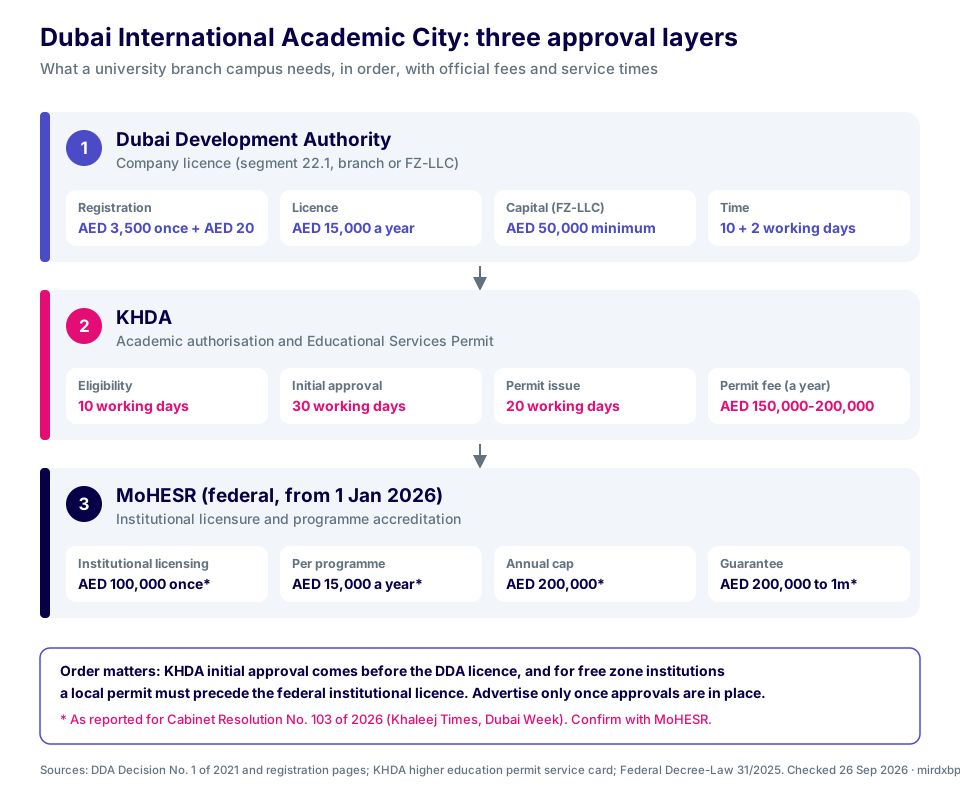
What it costs to open in Dubai International Academic City
Dubai International Academic City’s own FAQ describes pricing only as “competitive”. The official fee lines are below; figures from the 2026 federal resolutions are as reported in the press and flagged as such.
| Fee | Amount (AED) | When | Source |
|---|---|---|---|
| DDA registration (FZ-LLC or branch) | 3,500 | Once | DDA registration pages |
| Knowledge and Innovation Dirham | 10 + 10 | Per DDA transaction | DDA registration pages |
| DDA licence, any DIAC segment | 15,000 | Yearly | DDA Decision No. 1 of 2021 |
| Additional segment | 10,000 | Yearly | DDA Decision No. 1 of 2021 |
| Minimum paid-up capital (FZ-LLC) | 50,000 (capital, not a fee) | At incorporation | DDA Decision No. 1 of 2021, Article 15 |
| KHDA higher education permit, branch campus | 150,000 / 175,000 / 200,000 | Yearly, by programmes (1-5 / 6-10 / 11+) | KHDA service card |
| KHDA higher education permit, private university | 1,000 (+ AED 20) | Yearly | KHDA service card |
| MoHESR institutional licensing | 100,000 | One-time | Cabinet Resolution No. 103 of 2026 (as reported) |
| MoHESR programme accreditation or renewal | 15,000 per programme, capped at 200,000 per institution | Yearly | Cabinet Resolution No. 103 of 2026 (as reported) |
| Financial guarantee | 200,000 to 1,000,000 by enrolment (security, not a fee) | Held while licensed | Cabinet Resolution No. 103 of 2026 (as reported) |
| KHDA school permit | 50,000 for-profit; 20,000 non-profit | On issue | KHDA service card |
| KHDA early childhood centre permit | 10,000 | On issue | KHDA service card |
| KHDA attestation of a graduate’s certificate | 220 | Per request | KHDA service card |
| Campus rent or purchase, immigration file, visas | Not published publicly | Per lease or transaction | TECOM quote; axs portal |
For a branch campus with four programmes, the published minimum in year one is roughly AED 18,520 to DDA, AED 150,020 to KHDA, AED 100,000 plus AED 60,000 to MoHESR on the reported schedule, and a guarantee of at least AED 200,000 held aside, before campus costs and staff. A school or nursery operator pays DDA the same AED 18,520, keeps AED 50,000 of capital, and pays KHDA AED 50,000 (for-profit school) or AED 10,000 (nursery). The DDA licence is the smallest line in every Dubai International Academic City budget.
Campus and space options in the DIAC free zone
| Option | Suits | Visa effect |
|---|---|---|
| Campus building for rent or sale | Established branch campuses | One employee per 80 sq ft |
| Land for sale or lease | Build-to-suit campuses and schools | Negotiated with the developer |
| Commercial space | Colleges, institutes, education service providers | One employee per 80 sq ft |
| Co-working (D/Quarters) and in5 | EdTech and support-service start-ups | Set by the product |
| Venues, labs and sports facilities | Events, practical teaching, student life | Not a licensed address |
KHDA’s initial approval asks for an “independent, compliant campus location”, and the school and nursery processes require municipality, health and civil defence approvals before the KHDA inspection. Choose premises that can pass those checks, not only the DDA allocation.
Dubai International Academic City visas for faculty, staff and students
Companies and branch campuses in Dubai International Academic City sponsor residence visas through axs, and GDRFA Dubai issues them, so the file number starts with 2. The DIAC FAQ sets the allocation at one employee per 80 sq ft of leased space, which for a 20,000 sq ft campus means up to 250 staff visas. Each visa runs through the entry permit, medical fitness test, Emirates ID and residence stages, and visa holders can sponsor family through GDRFA; see our family visa service.
- Faculty: KHDA requires a full-time academic head with a doctorate; expect teaching staff qualifications to be reviewed as part of academic quality. Attest degrees early; see our document attestation service.
- Golden Visa: academics, researchers and teachers may qualify for 10-year residence in their own right; see our Golden Visa for teachers guide.
- Students: international students’ residence arrangements are handled by the institution through the free zone channel; confirm the student visa process and any allocation rules with DDA and axs before your first intake. DDA also publishes Student Part-Time Employment Regulations (2016) in its legal database.
Our free zone visa service covers the axs side, and our free zone vs mainland comparison explains how free zone visas differ from mainland ones.
Banking
A bank will want the DDA licence, the parent university’s constitutional documents and board resolution, the KHDA permit, the beneficial owner chart and a financial plan showing tuition flows. Branch campuses also need banking lines for the financial guarantee required under the 2026 federal rules. See our corporate bank account guide.
Tax for DIAC universities and schools
Corporate tax
A DIAC entity is a free zone person, but the 0% rate applies only to qualifying income of a Qualifying Free Zone Person under Cabinet Decision No. 100 of 2023. Education is not among the qualifying activities in Ministerial Decision No. 229 of 2025, and tuition from students is income from natural persons, which is generally non-qualifying. Plan for 9% on taxable income above AED 375,000 unless your tax adviser finds a specific exemption (for example, for a qualifying public benefit entity). Register on time to avoid the AED 10,000 late registration penalty; see our corporate tax registration guide.
VAT
Dubai International Academic City is not a designated zone. The FTA’s education sector guide (VATGED1, June 2026) limits zero-rating to qualifying institutions delivering a recognised curriculum, and for higher education the institution must be government-owned or receive more than 50% of its annual funding from federal or local government. A private university branch campus therefore generally charges 5% VAT on tuition, while a recognised school or nursery can zero-rate its core education. Application and admission fees, uniforms and devices are standard-rated. This is general information, not tax advice.
Operating outside the free zone
For commercial activity, Executive Council Resolution No. 11 of 2025 lets a Dubai free zone company obtain a DET branch licence or a Free Zone Mainland Operating Permit (AED 5,000, announced by the Dubai Media Office on 8 October 2025). For teaching, the education rules decide: KHDA’s guide confines the international branch route to Dubai free zones, and KHDA permits are tied to premises. Recruitment offices, marketing events and partnerships with mainland schools are one thing; a mainland teaching site for a branch campus is another, and needs its own analysis.
Renewal and ongoing compliance
- DDA licence: valid one year and renewed annually (DIAC FAQ).
- KHDA higher education permit: renew at least 90 days before expiry; 15 working days; valid commercial licence required. Resolution No. 21 of 2011 also requires renewal applications 90 days ahead.
- New programmes: KHDA authorisation before launch, and MoHESR programme accreditation under the federal regime.
- MoHESR: renewal of institutional licensure at least 90 days before expiry (as reported for Resolution No. 104 of 2026); annual programme fees.
- School and nursery permits: renew at least 30 days before expiry.
- Accounts, auditor, UBO: under DDA’s Private Companies Regulations and Cabinet Decision No. 109 of 2023 (changes within 15 days).
- Student ID cards and advertising: Articles 5.2 and 5.6 of the DDA Decision.
Dubai International Academic City: pros and cons for a university branch campus, school or nursery
| Pros | Cons |
|---|---|
| The free zone route that lets a foreign university run a branch campus in Dubai | Three regulators (DDA, KHDA, MoHESR) and a long approval path |
| Campus buildings, land, labs and venues in one community with 28,000+ students | KHDA and federal fees dwarf the DDA licence fee |
| Published DDA, KHDA and federal fee lines | AED 50,000 minimum capital for every segment |
| Graduates’ certificates attested by KHDA (AED 220, 2 working days), and MoHESR licensure supports federal recognition | New 2026 federal rules still bedding in; some texts not yet on the legislation portal |
| Staff visas at one per 80 sq ft | Education income is not qualifying income for the 0% rate; private higher education carries 5% VAT |
Who Dubai International Academic City suits
- Internationally accredited universities opening a branch campus that awards home degrees.
- Private colleges and institutes seeking CAA accreditation with a free zone base.
- School and nursery operators who want a campus in an education district.
- Education support and non-academic service providers working with institutions (testing, counselling, student services).
Who should look elsewhere
- Training institutes, tutoring centres and HR firms: Dubai Knowledge Park, at lower capital.
- Medical and health sciences education tied to hospitals: Dubai Healthcare City.
- EdTech software companies: Dubai Internet City.
- Institutions that do not meet KHDA’s eligibility tests (accreditation, ranking, academic head): fix those first, whatever the zone.
Dubai International Academic City in practice: five cases
These cases are built from the situations we see most often. Names and identifying details are left out, and the figures are the published ones.
1. A UK university planning its first branch campus
The university assumed the DDA licence was the main hurdle. On the published lines, the DDA side was AED 18,520 in year one; KHDA’s permit for five programmes was AED 150,000 a year, and the reported federal schedule added AED 100,000 for institutional licensing, AED 75,000 a year for five programmes and a guarantee of at least AED 200,000. The plan was rebuilt around KHDA’s 60 working days and the federal step, with the first intake set a full cycle later.
2. An Indian university adding programmes
A branch campus with five programmes wanted to add three. Each needed KHDA authorisation first, starting with an eligibility application per programme, and moving from five to eight programmes lifted the KHDA permit tier from AED 150,000 to AED 175,000. Under the federal regime, each new programme also needs MoHESR accreditation, reported at AED 15,000 a year.
3. A school operator comparing a Dubai Academic City campus
A school group chose segment 22.4. The DDA licence was AED 15,000 a year with AED 50,000 capital; KHDA’s school permit was AED 50,000 for a for-profit school after initial approval, principal appointment and building readiness (34 working days in total once documents were complete). Civil defence, municipality and health approvals for the building were on the critical path, not the licence.
4. A test-preparation company choosing between DIAC and Dubai Knowledge Park
The founder wanted the student footfall of Dubai International Academic City. Segment 22.3 (educational support services) needs AED 50,000 capital and a KHDA no-objection. A Dubai Knowledge Park tutoring segment needs AED 10,000 capital but its own KHDA training permit. The choice came down to where students would attend and which KHDA permit fitted the services; the DDA fees were identical.
5. A nursery in an education district
A nursery operator took segment 22.5. The 2021 Decision mentions KHDA “and/or the Ministry of Social Affairs”, but KHDA now runs the early childhood centre permit in Dubai: initial approval, manager appointment and building readiness, with an AED 10,000 permit fee. Recognised early years education can be zero-rated for VAT, unlike the university next door.
What circulates online about Dubai International Academic City that is not true
| Claim | What the official sources say |
|---|---|
| “A DIAC licence lets you start teaching.” | Higher education needs KHDA academic authorisation and an Educational Services Permit, and since 2026 MoHESR licensure and programme accreditation. |
| “Free zone universities are outside federal regulation.” | Federal Decree-Law No. 31 of 2025 applies to institutions “including the free zones”, effective 1 January 2026. |
| “A branch campus can open anywhere in Dubai.” | KHDA says the international branch route “is only permitted inside Dubai Free Zones”. |
| “Capital is AED 10,000 like other DDA zones.” | Every DIAC segment requires AED 50,000 (DDA Decision No. 1 of 2021, Article 15). |
| “University tuition is zero-rated.” | Only for government-owned or majority government-funded higher education; private branch campuses generally charge 5%. |
| “Education companies in free zones pay 0% corporate tax.” | Education is not a qualifying activity; plan for 9% above AED 375,000. |
| “You can market programmes while approvals are pending.” | DDA requires KHDA-compliant advertising, and the 2026 federal penalties target advertising unaccredited programmes. |
How to verify every Dubai International Academic City figure in this guide
| Figure or rule | Where to check it |
|---|---|
| Segments 22.1 to 22.5, AED 15,000 fee, AED 50,000 capital, Articles 5.1 to 5.6 | DDA Decision No. 1 of 2021 |
| AED 3,500 registration; 10 + 2 working days | DDA registration pages |
| 7 working days; one employee per 80 sq ft; one-year licence | diacedu.ae FAQs |
| Three KHDA phases, 60 working days, AED 150,000 to 200,000 | KHDA: Issue an Educational Services Permit for a Higher Education Institution |
| Renewal 90 days ahead, 15 working days | KHDA: Renewing an Educational Services Permit of a Higher Education Institution |
| Branch route only in free zones; UQAIB role | KHDA: Permits for a higher-education institute |
| Academic authorisation; fines up to AED 200,000 | Executive Council Resolution No. 21 of 2011 (Dubai Legislation Portal) |
| Federal Decree-Law No. 31 of 2025 dates | UAE Legislation portal; MoHESR announcement |
| 2026 Cabinet resolutions and federal fees | Khaleej Times, 11 September 2026; Dubai Week, 22 September 2026; confirm with MoHESR |
| School AED 50,000/20,000; nursery AED 10,000; attestation AED 220 | KHDA service cards |
| Education VAT | FTA education sector VAT guide (VATGED1) |
Dubai International Academic City setup: how MIRDXB PRO helps
MIRDXB PRO is an independent PRO and business-setup consultancy in Al Barsha 1, Dubai. We are not DDA, KHDA, MoHESR, TECOM Group or axs, and we are not listed as an official DIAC partner. We do not give academic accreditation advice; we handle the corporate, documentary and immigration work around it, and we coordinate with your academic team and advisers.
What we do
- Map your institution to the right DIAC segment and legal form, and list every approval in the right order.
- Prepare the DDA branch or FZ-LLC application, and arrange notarisation, UAE embassy attestation and legal translation of the parent’s documents and board resolution.
- Track the DDA stages against KHDA’s phases so the licence and permit dates line up.
- Open the immigration file and process faculty, staff and family visas, medical tests and Emirates ID.
- File the UBO register and keep a calendar of DDA, KHDA, MoHESR and visa renewals.
How it works
- WhatsApp us your institution type, accreditation and target intake.
- We reply in writing with the segment, the approval sequence, published fees and an itemised quote for our part.
- You approve; we collect and attest documents.
- We file with DDA and coordinate with your academic team on KHDA and MoHESR submissions.
- We run the immigration file and visas and hand over a compliance calendar.
What it costs
DDA, KHDA, MoHESR, TECOM, axs, GDRFA, medical and Emirates ID fees are passed on at cost, with receipts. Our own fee is quoted in writing before we start. See our fees page and our business setup service.
Why institutions use us
- We work from the published DDA, KHDA and federal sources and show you the reference for each fee.
- We flag conflicts between sources, such as the reported federal fee waiver for free zone institutions.
- We handle the visa, medical and Emirates ID work for faculty and staff alongside the licence.
- Our Al Barsha office is open Monday to Thursday and Saturday 09:00 to 18:00, and Friday 09:00 to 12:00.
If you are still choosing between zones, our free zone company setup support starts with a comparison.
What we will and will not do
- We will show you every official fee line and its source.
- We will tell you when Dubai Knowledge Park, another zone or the mainland fits better.
- We will give you our fee in writing before work starts.
- We will not present ourselves as DDA, KHDA, MoHESR or an official DIAC partner.
- We will not write academic submissions or promise accreditation outcomes.
- We will not give tax opinions; your tax adviser decides corporate tax and VAT positions.
Related guides
- Free zones in the UAE
- Dubai free zones list
- Dubai Knowledge Park company setup
- Dubai Healthcare City company setup
- Dubai Silicon Oasis company setup
- Golden Visa for teachers
- Degree equivalency in the UAE
- Corporate tax registration
- UBO register
- Corporate bank account
Dubai International Academic City: frequently asked questions
Who licenses companies in Dubai International Academic City?
The Dubai Development Authority (DDA) issues the company licence. Higher education also needs KHDA’s academic authorisation and Educational Services Permit and, since 1 January 2026, MoHESR institutional licensure and programme accreditation. Schools and nurseries need KHDA permits.
Can a foreign university open a branch campus in DIAC?
Yes. DDA licenses a branch university only for “bona fide branches of an approved foreign university”. KHDA says the international branch route is only permitted inside Dubai free zones, and it checks accreditation, rankings, fit with Dubai’s D33 agenda, campus and finances before approving.
How long does it take to open a university in Dubai International Academic City?
KHDA’s permit takes 60 working days across eligibility (10), initial approval (30) and permit issuance (20) once documents are complete; DDA takes 10 plus 2 working days. MoHESR’s federal licensure comes on top, and most institutions plan around an intake a full academic cycle away.
What does KHDA charge a branch campus?
AED 150,000 a year for one to five programmes, AED 175,000 for six to ten and AED 200,000 for eleven or more, plus AED 20. A UAE-accredited private university pays AED 1,000. The permit renews yearly, applied for at least 90 days before expiry.
What are the MoHESR fees for free zone universities?
Cabinet Resolution No. 103 of 2026 is reported to set AED 100,000 for institutional licensing, AED 15,000 a year per programme (capped at AED 200,000) and guarantees of AED 200,000 to AED 1 million. Another report says free zone institutions with local authorisation avoid extra fees, so confirm with MoHESR.
What is the DIAC licence cost and capital?
DDA charges AED 3,500 to register and AED 15,000 a year per segment, plus AED 20 in dirham fees; a second segment adds AED 10,000. Every DIAC segment needs AED 50,000 minimum paid-up capital for an FZ-LLC. Branches issue no share capital.
Can I open a school or nursery in Dubai International Academic City?
Yes, under segments 22.4 and 22.5. KHDA’s school permit costs AED 50,000 for a for-profit school or AED 20,000 for a non-profit, and the early childhood centre permit AED 10,000, each after initial approval, a principal or manager appointment and building readiness checks.
Are DIAC university degrees recognised?
KHDA attests certificates issued by KHDA-licensed institutions in Dubai (AED 220, 2 working days). Institutions with MoHESR licensure state that their graduates’ degrees can also be attested by the Ministry, which matters for federal employment and further study.
How many staff visas can a Dubai International Academic City institution get?
The DIAC FAQ allows one employee per 80 sq ft of leased space. Visas are processed through axs and issued by GDRFA Dubai, and staff can sponsor family. Confirm student visa arrangements with DDA and axs before your first intake.
Do DIAC universities charge VAT?
Private branch campuses generally charge 5%, because zero-rating for higher education requires government ownership or more than 50% government funding. Recognised schools and nurseries delivering a recognised curriculum can zero-rate core tuition.
Is Dubai Academic City the same as Dubai International Academic City?
Yes. “Dubai Academic City” and “Academic City” are common short names for Dubai International Academic City (DIAC), the TECOM Group education community licensed by DDA. The area name is also used for the surrounding district.
Can MIRDXB PRO help set up our institution in Dubai International Academic City?
Yes, on the corporate and immigration side: DDA registration, attestation of the parent’s documents, the immigration file, faculty and staff visas, medical tests and Emirates ID, and renewal tracking. We coordinate with your academic team on KHDA and MoHESR. Government fees are at cost and our fee is quoted in writing.
How much does MIRDXB PRO charge for DIAC setup?
It depends on the legal form, the documents to attest and the number of visas, so we quote in writing after a short call. DDA, KHDA, MoHESR and visa fees are listed separately at cost. Our fees page explains how we price.
Running the immigration file and renewing faculty and staff visas is what our PRO services in Dubai team handles every day.
- Dubai Development Authority: Decision No. 1 of 2021 concerning licence categories
- Dubai Development Authority: Private Companies Regulations 2016
- Dubai Development Authority: Laws and regulations
- DDA: Registration, branch of foreign company
- DDA: Registration, FZ-LLC with corporate person
- KHDA: Issue an Educational Services Permit for a Higher Education Institution
- KHDA: Renewing an Educational Services Permit of a Higher Education Institution
- KHDA: Permits for a higher-education institute
- KHDA: Issue an Educational Permit for a Private School
- KHDA: Issue a Permit for an Early Childhood Centre
- KHDA: Attest Higher Education Certificate
- Dubai Legislation Portal: Executive Council Resolution No. 21 of 2011
- UAE Legislation: Federal Decree-Law No. 31 of 2025 on Higher Education and Scientific Research
- MoHESR: Federal Decree-Law on Higher Education and Scientific Research
- Dubai International Academic City: About us
- Dubai International Academic City: FAQs
- Ministry of Finance: Ministerial Decision No. 229 of 2025
- Federal Tax Authority: VAT designated zones
- Dubai Legislation Portal: Executive Council Resolution No. 11 of 2025
- Cabinet Decision No. 109 of 2023 on real beneficiary procedures
- Khaleej Times (secondary): new national higher education rules, 11 September 2026
- Dubai Week (secondary): four Cabinet resolutions on university licensing, 22 September 2026
- The PIE News (secondary): MoHESR and KHDA streamline accreditation, 19 March 2025
- University of Birmingham Dubai: MoHESR licensure and KHDA permit
Also relied on: the FTA education sector VAT guide (VATGED1, June 2026, via specialist tax summaries), Cabinet Decision No. 100 of 2023, and the Dubai Media Office announcement of the Free Zone Mainland Operating Permit (8 October 2025).
26 September 2026. DDA, KHDA, UAE Legislation, MoHESR and diacedu.ae pages re-read on that date. The 2026 Cabinet resolutions were checked through press reports; their texts were not yet on the legislation portal.
Please note. The fees, segments, times and rules in this guide come from the Dubai Development Authority, KHDA, the Dubai Legislation Portal, the UAE Legislation portal, MoHESR, the Ministry of Finance and Dubai International Academic City, verified 26 September 2026, with the 2026 federal resolutions taken from named press reports. Each authority’s invoice and decision is final. The cases are built from common situations and are illustrative, not the records of named clients. This guide is general information and not legal, academic or tax advice. MIRDXB PRO is an independent consultancy and is not affiliated with the Dubai Development Authority, KHDA, MoHESR, TECOM Group or Dubai International Academic City.


