

Key takeaways
- Office space for trade licence (Dubai) is a legal requirement, not a formality. Article 17 of Dubai Law No. 13 of 2011 says every applicant “must specify the premises in the Emirate through which its Economic Activities will be conducted”, and the premises must suit the activity.
- A physical, registered address is the rule. u.ae states that “all businesses in the UAE must have a physical address to operate”, and that in Dubai the rental agreement “must be registered with Ejari”.
- A desk in a DET-licensed business centre counts as premises for many service activities. Business centres are themselves licensed by the Department of Economy and Tourism (DET); the business centre licence fee is AED 10,000 a year under Executive Council Resolution No. 19 of 2021.
- A “virtual office” that is only a mailing address does not satisfy the rule for a normal mainland licence. The exceptions are specific: DET’s Instant Licence comes with a virtual business site for its first year only, and home-based e-Trader and Intelaq licences use your home.
- Ejari costs AED 177.75 online or AED 220 at a trustee centre (Dubai Land Department). DET then adds a market fee of 2.5% of the registered annual rent to the licence voucher, every year.
- Shops, restaurants, clinics, warehouses and factories need more than a lease: Civil Defence certification (Dubai Law No. 4 of 2025, Article 16), Dubai Municipality or other regulator approvals, and DET permits for name boards, stores, counters and kiosks.
- Your office size affects your visas. MOHRE sets quota by legal form, premises area, projects and evidenced work demand, and inspects premises before issuing its e-signature card. No square-foot formula is published.
- Most costly mistakes happen before the lease is signed: the wrong kind of space for the activity, a sublease without the landlord’s written consent, or a desk that cannot carry the hiring plan.
Office space for trade licence (Dubai) means the registered business premises that every mainland company must name when it applies to the Department of Economy and Tourism: a physical office, shop, warehouse or other unit, or a desk in a DET-licensed business centre, leased on a tenancy registered with Ejari at the Dubai Land Department and suitable for the activities on the licence. The premises are fixed in law by Dubai Law No. 13 of 2011, feed straight into the licence fee through the 2.5% market fee on rent, and later shape how many work permits MOHRE will approve. Home-based and instant licences are the only routes that start without a commercial lease, and each has limits.
This guide covers the law, every premises option founders are offered, Ejari for commercial premises, the market fee, DEWA, Civil Defence and municipality approvals, DET premises permits and fines, the link to visa quota, and the lease mistakes that delay licences. Free zones set their own premises rules.
Office space for trade licence Dubai: options at a glance
The table compares the premises options you are likely to be offered. “Accepted” means accepted by DET as the licence premises for suitable activities; the regulator for your activity may add conditions.
| Premises option | Accepted for a mainland licence? | Ejari | Suits | Visa capacity |
|---|---|---|---|---|
| Private office (leased directly from a landlord) | Yes, if the unit is permitted for commercial use and suits the activity | Registered by the landlord or tenant (AED 177.75 online / AED 220 trustee centre) | Any office-based activity | Grows with the space; set by MOHRE |
| Serviced office in a business centre | Yes, when the operator holds a DET business centre licence | Issued through the operator, a registered Ejari system user | Consultancies, trading offices, IT, services | Usually more than a desk; depends on area |
| Flexi desk or shared desk in a business centre | Yes, for many service and office-trading activities | Issued through the operator | Owner-run firms, early-stage companies | Small; the premises factor limits it |
| Co-working membership | Only if the space is a DET-licensed business centre and gives you a registered Ejari | Must be a real Ejari, not just a membership letter | Freelance-style service companies | Small |
| “Virtual office” (address and mail only) | No, for a normal licence | None | Correspondence only | None |
| Instant Licence virtual business site | Yes, first year only | Not needed in year one; a valid location is required at renewal or any amendment | Activities with no outside approval | Instant bundle includes a MOHRE card for three employees |
| Premises of another licensed company | Yes, with DET’s licence for an establishment headquartered in another’s premises (AED 500) | Landlord’s written consent to share or sublet | Related companies, group structures | Shared area; assessed by MOHRE |
| Home (e-Trader, Intelaq) | Only under those licences | Your residential tenancy or title deed | Online sellers, home businesses | Very limited; see our home business licence guide |
| Shop or retail unit | Yes, for retail and customer-facing activities | Required | Retail, salons, cafes, showrooms | Grows with the space |
| Warehouse or store | Yes, for storage and trading of goods, plus DET’s store permit if it is an additional site | Required | Trading, logistics, e-commerce stock | Grows with the space |
| Industrial unit or factory | Yes, in areas zoned for the activity, with outside approvals | Required (or title deed / land lease) | Manufacturing and processing | Grows with the operation |
Office space for trade licence Dubai: how MIRDXB PRO helps
The premises decision is made once and paid for every year. We check the space against your activity, your hiring plan and the rules below before you sign, then register the lease and link it to the licence.
What we do
- Match your activities to the kind of premises DET and any outside regulator will accept: a desk, an office, a shop, a warehouse or an industrial unit.
- Check an offer before you sign it: whether the business centre holds a DET licence, whether the operator can issue Ejari, whether the contract term matches the licence term, and what the renewal price is.
- Work out the market fee and Ejari cost on the rent you are offered, and tell you what the space means for your visa plans.
- Register or renew the tenancy through our Ejari registration service, then carry it through the initial approval, the licence and the Dubai Chambers membership as part of our company formation support.
- When you move or add premises, handle the licence amendment, the new Ejari, the old Ejari cancellation and the updates to your MOHRE and immigration files.
How it works
- Message us on WhatsApp with your activity, the number of people you plan to hire in the first two years, and any offer you already hold.
- We send a written note: the premises options that fit, the government fees tied to each (Ejari, market fee, DET permits, DEWA), what to ask the landlord or operator, and our fee.
- Once you choose, we review the contract before signing, register the Ejari and file the licence or amendment.
- After the licence issues, we open or update the establishment cards and plan the quota request when you are ready to hire.
What it costs
Government fees are passed on at cost, on the authority’s receipt: the DLD Ejari charge, the DET voucher (including the market fee), DET permits, DEWA and any Civil Defence or municipality fee. Our own fee is quoted in writing before we start and depends on the work: checking and registering a business centre desk is simpler than taking a restaurant unit through its approvals. Our published service fees are on our fees page, and every government line of a set-up is in our mainland business setup cost guide.
Why founders use us
- We name the official source for every premises rule we apply, as this guide does, and show you the receipts.
- We are not a landlord or a business centre, so we have no space to sell you. We tell you when a desk is enough and when it is not.
- We handle the government files that depend on the premises (DET, MOHRE, GDRFA, Dubai Chambers), so the space is checked against visas from the start.
- Our office is in Al Barsha 1, Dubai, open Monday to Thursday and Saturday 09:00 to 18:00 and Friday 09:00 to 12:00. Owners abroad can instruct us under a power of attorney for the steps that allow it.
What the law says about premises for a Dubai trade licence
The premises rule for a mainland licence comes from Dubai Law No. 13 of 2011 Regulating the Conduct of Economic Activities in the Emirate of Dubai, which DET (formerly the Department of Economic Development, or DED) administers. Three articles matter.
Article 17: premises are required and must suit the activity
Article 17 says: “An applicant for a Licence must specify the premises in the Emirate through which its Economic Activities will be conducted.” The same article requires the premises to be suitable for the activities and to satisfy the procedures adopted by DET and the other competent entities, and it forbids using the premises for purposes other than those stated on the licence. So there are three tests, not one: you must have premises, they must suit the activity, and you must use them only for that activity.
Article 18: the home and incubator exception
Article 18 lets DET issue licences “authorising UAE nationals to conduct certain Economic Activities determined by the DED from home or through Business Incubators”. That is the legal root of the Intelaq home licence for Emiratis. DET has since added the e-Trader licence for home-based online businesses, which Invest in Dubai describes as allowing “freelancers and entrepreneurs to legally conduct business from their place of residence in Dubai”. Both are narrow routes with their own rules, covered in our home business licence guide.
Article 19: DET can inspect
Article 19 obliges every licensed business to “enable the DED authorised employees to access the premises of the Business and review its information and records”. An address where nobody can be found, or where the space is plainly used for something else, is the situation this article exists for.
The federal position
The UAE government portal u.ae (last updated 8 April 2026) adds the national layer: “All businesses in the UAE must have a physical address to operate.” It says premises “must comply with the requirements defined by the respective emirate’s Department of Economic Development, as well as the land planning regulations of the local municipalities”, that an “office and warehouse rental agreement must be provided”, and that “in Dubai, the agreement must be registered with Ejari.”
What happens if the premises are wrong
DET’s fines are in Schedule 2 of Executive Council Resolution No. 13 of 2011. The items tied to premises are listed below. The amounts are those in the resolution as published on the Dubai Legislation Portal; repeat violations can be charged more, and the notice you receive is what applies.
| Violation (Res. 13/2011, Schedule 2) | Fine | Typical situation |
|---|---|---|
| Item 3: conducting the activity at an unauthorised location | AED 1,000 | Trading from an address not on the licence |
| Item 8: conducting the authorised activity outside the establishment | AED 2,500 | Selling from a stall or vehicle without a permit |
| Item 10: using the premises for other than the permitted activities | AED 2,000 | Storing goods in an office licensed for consultancy |
| Item 32: opening an additional office without a permit | AED 2,000 | A second room or floor used without DET’s permit |
| Item 34: installing a kiosk, counter or commercial booth without a licence | AED 2,000 | A mall counter opened before the permit |
| Item 52: failure to maintain a name board | AED 500 | Shop front without the licensed name board |
| Item 1: conducting an activity without a licence | AED 5,000 | Trading after the licence has lapsed with the lease |
The practical consequence is usually bigger than the fine. A licence cannot be renewed on an expired tenancy, an amendment cannot be filed without a valid address, and MOHRE will not issue its e-signature card to a company whose premises fail inspection.
Your premises options, one by one
Founders hear the same words used loosely: office, desk, business centre, co-working, virtual office. DET cares about one question: is there a registered tenancy for a space that suits the licensed activity? Here is how each option answers it.
A private office leased from a landlord
This is the standard answer. You sign a tenancy directly with the owner or the owner’s property manager, the tenancy is registered on Ejari, and the Ejari number goes on the licence file. You control the space, its size and its layout, and the visa capacity grows with it.
Check three things before you sign. First, the unit must be permitted for commercial use: u.ae ties premises to municipal land planning rules, and a flat in a residential tower cannot become your office by writing “office” in the contract. Second, the building must suit the activity: a clinic, a school or a food business will need the regulator’s approval of the actual unit. Third, the contract term should cover the licence term, because DET renews the licence against a valid tenancy.
Direct leases usually ask for the rent in one or a few cheques, a security deposit (Law No. 26 of 2007, Article 20 allows one), and sometimes an agency fee. None of these are government fees, and none are published, so compare offers on the full first-year cash outlay.
A serviced office in a DET-licensed business centre
A business centre is a company licensed by DET to provide furnished offices and desks to other businesses. Executive Council Resolution No. 19 of 2021, in force from 12 July 2021, reduced the DET fees for “issuing a licence to a business centre” and “renewing the licence of a business centre” from AED 25,000 to AED 10,000 each, and the fee for changing or adding a business centre activity by the same amount. That fee is the operator’s, not yours, but it tells you business centres are a licensed category that DET recognises.
Business centres are also set up to issue tenancies. The Dubai Land Department (DLD) says that “business centers, shopping centers, and commercial complexes need to register online” as users of the Ejari system, which gives them “the authority to use Ejari system to register tenancy contracts”. A properly licensed and registered business centre can therefore register your office agreement on Ejari itself, often within the package price.
A serviced office suits companies that want a proper room, reception and meeting space without fitting out a unit. It typically carries more visa capacity than a desk because the area is larger, but the number is set by MOHRE, not by the centre.
A flexi desk or shared desk
A flexi desk (also sold as a hot desk, shared desk or business desk) is a right to use a workstation in a business centre, with a registered Ejari for that arrangement. For many owner-run service companies (consultancies, IT, marketing, trading offices that hold no stock) it is the lowest-cost premises DET will accept for a normal licence.
The limits are the ones Article 17 implies. A flexi desk cannot be used to store goods, receive customers for retail, or run a regulated activity that needs its own approved unit. And because MOHRE weighs “the area of the premises”, a desk supports a small team at most. As our mainland formation guide puts it, a flexi desk may license a consultancy with two staff; it will not carry a team of fifteen.
Ask the operator what the flexi desk package includes in writing: the Ejari, the registered address and P.O. Box, mail handling, meeting room hours, and how an upgrade to an office in the same centre is handled. An upgrade inside the same building still changes the Ejari, so it still needs to reach DET.
Co-working spaces
Co-working and business centres overlap. A co-working operator that also holds a DET business centre licence and issues registered Ejari contracts can provide licence premises in the same way. A co-working membership card, a monthly pass or a letter saying you “may use the space” is not a registered tenancy, and DET will not accept it as premises for a mainland licence. Ask for the operator’s trade licence and a sample Ejari before paying.
The “virtual office”: what it can and cannot do
“Virtual office” is a marketing term, not a licence category. It usually means a business address, mail and call handling, and sometimes meeting-room credits. For a normal Dubai mainland licence, an address without a registered tenancy for a usable space does not meet Article 17 or the u.ae requirement of a physical address with an Ejari-registered agreement.
Some packages sold as a virtual office do include a registered Ejari for a flexi desk. In that case, what makes it acceptable is the Ejari for a real desk in a licensed business centre, not the word “virtual”. Read the package terms: if there is no Ejari, it cannot be your licence premises.
Two official products use the word “virtual” and are often confused with this:
- The Instant Licence’s virtual business site. Invest in Dubai says the Instant Licence “includes a virtual business site for the first year only, after which a valid business location must be provided upon renewal or any amendments”. It is available only for activities that need no external approval. See our Instant Licence guide.
- The Dubai Virtual Company Licence. Gulf News reported in 2019 that Dubai launched a virtual company licence for non-residents from countries in the multilateral tax convention, run through a Virtual Commercial City platform, with “no physical office required”. The u.ae page on virtual licences now describes only the Abu Dhabi Virtual Licence, and we could not confirm that the Dubai product still accepts applications. Treat it as unavailable unless DET confirms otherwise for your case.
The Abu Dhabi Virtual Licence is an Abu Dhabi product and does not license you on the Dubai mainland.
Sharing another licensed company’s premises
A second company can be licensed at an address that already belongs to another licensed establishment. Resolution No. 19 of 2021 lists DET’s fee for “issuing a licence for an establishment headquartered in the premises of another licensed establishment”, reduced from AED 2,000 to AED 500. This is the official route for group companies, a trading arm and a services arm, or a founder with two licences who wants one office.
Two conditions sit around it. The tenancy law says “the Tenant may not assign the use of or sub-lease the Real Property to third parties unless written consent of the Landlord is obtained” (Law No. 26 of 2007, Article 24), and subletting without it is a ground for eviction under Article 25. And the shared space still has to suit both companies’ activities, and both companies’ staff count against the same area when MOHRE considers quota.
Home-based licences
Working from home is lawful only under a licence designed for it. DET’s e-Trader licence costs AED 1,070 (licence plus Knowledge and Innovation fees) plus AED 300 for Dubai Chambers, per Invest in Dubai, and is issued as a sole establishment. The Intelaq licence, for UAE and GCC nationals living in Dubai, costs AED 1,070 a year. A normal LLC cannot use a residential flat as its licence premises. Eligibility, activities, visas and limits are in our home business licence guide.
Shops and retail units
Retail, salons, cafes, showrooms and any business that serves walk-in customers need a unit that suits that use, in a location the municipality allows for it. On top of the lease, expect:
- DET’s permit to install a name board on the facade: AED 350 (Res. 13/2011, Schedule 1, item 60), with an AED 500 fine for failing to maintain one.
- A Civil Defence certificate for the unit (see the approvals section below).
- The approval of your activity’s regulator where one applies. Invest in Dubai lists Dubai Municipality for “restaurants and food establishments”, and the municipality’s service list includes a “Request for Layout Assessment for Food Establishment Licensing”.
- Fit-out approval from the building permit authority for the area before any works.
A mall kiosk or counter is a separate DET permit, not a shop licence: AED 5,000 for installing a kiosk and AED 1,500 for a counter under the fee schedule, and trading from one without a permit is an AED 2,000 fine.
Warehouses and stores
A trading company that holds stock needs somewhere lawful to keep it. An office licensed for trading is not a store, and keeping goods in it risks the “using premises for other than the permitted activities” fine. Two set-ups are common:
- The warehouse is the licence premises. Some trading and logistics companies lease a warehouse with office space attached and register that as the main address.
- An office plus a separate store. DET’s schedule has a “permit for establishing a store or a warehouse of an Establishment” at AED 300 (item 89), so a company licensed at an office can add a store as an additional site. The warehouse needs its own tenancy and, in practice, its own Civil Defence compliance.
DET also lists a fee for “inspecting a warehouse upon the request of an Establishment” (AED 2,500, item 43) and for site inspections at the company’s request (AED 1,000 for up to three sites, AED 300 for each additional site, item 42). If your goods are regulated (food, chemicals, medicines, cosmetics), the relevant regulator’s storage rules apply as well. Customs and import codes are covered in our general trading licence guide.
Industrial units, factories and land
Manufacturing, processing and packaging need space in an area zoned for industry and the approvals that come with it: the building permit authority, Civil Defence, often Dubai Municipality’s environment and health requirements, and, for the federal industrial licence, the Ministry of Industry and Advanced Technology (MoIAT). MoIAT’s industrial production licence asks for at least 10 employees and capital of at least AED 250,000, and an industrial licence from the local licensing department. The licence types are compared in our guide to Dubai mainland licence types.
A free zone company that also works on the mainland
A company licensed in a Dubai free zone that wants to operate in the emirate can take a DET branch licence (the dual licence) or a six-month permit. Whether the free zone office can serve as the branch address, or a separate mainland address is needed, depends on the route chosen. The rules and fees are in our guide to free zone vs mainland Dubai.
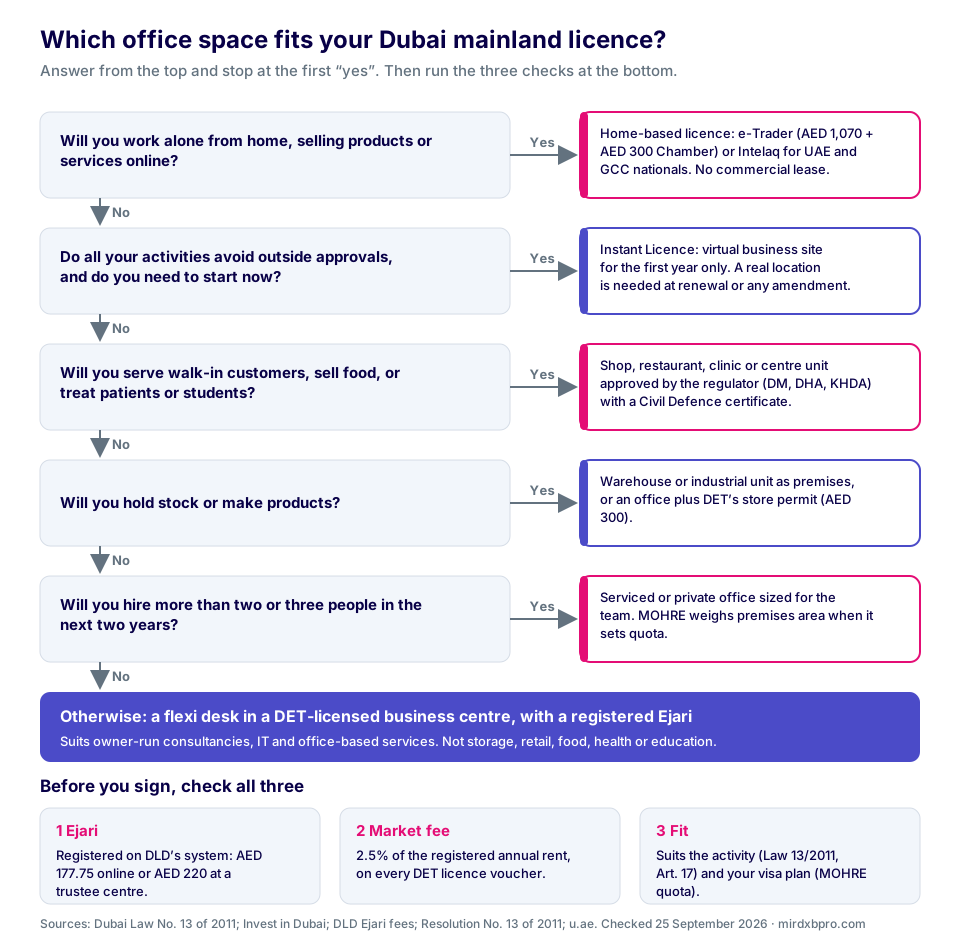
How to check a business centre before you sign
Most founders who start on a desk choose it from an online listing. The price is rarely the problem; the problems are a centre that cannot issue a valid Ejari, a package that does not suit the activity, or a renewal price nobody mentioned. Use this checklist.
- Ask for the operator’s trade licence. It should show a business centre activity issued by DET, valid beyond your start date. A centre operating on another activity cannot license you a desk as premises.
- Ask how the Ejari is issued. The operator should be a registered Ejari system user (DLD) or work through the building’s property manager. Ask for a redacted sample Ejari certificate from an existing tenant.
- Match the package to your activity. Tell the operator your exact activities. A desk is fine for most consultancy and office-based services; it is not acceptable for retail, storage, food, health or education, which need their own units and approvals.
- Match the term to the licence. DET renews the licence against a valid tenancy. A contract that expires two months before the licence forces an early renewal of both.
- Get the renewal price in writing. Many packages are priced for year one. The market fee is 2.5% of the registered annual rent, so ask what rent will appear on the Ejari as well.
- Ask about upgrades. If you plan to hire, ask whether you can move from a desk to an office in the same centre, and how the Ejari and licence change when you do.
- Check what “included” means. Address, P.O. Box, mail, phone answering, meeting rooms and DEWA are sometimes included and sometimes extra. A serviced centre normally covers DEWA in the price; a direct lease does not.
- Check the exit terms. What notice is needed, whether a deposit is refunded, and whether the operator will cancel the Ejari promptly when you leave. An Ejari left open on your company can block the next registration.
Offers that sell an Ejari with no real right to use a desk are a risk. Article 17 requires premises through which the activity is actually conducted, Article 19 allows DET inspections, and MOHRE inspects premises before issuing its e-signature card. A company found with no usable premises can be fined and can have its MOHRE file held up. If a price looks too low to include a real desk, ask to see the desk.
Ejari for commercial premises
Ejari is the Dubai Land Department’s tenancy registration system, run by the Real Estate Regulatory Agency (RERA). For commercial premises it is not optional.
The legal basis
Law No. 26 of 2007 Regulating the Relationship between Landlords and Tenants in the Emirate of Dubai applies to commercial as well as residential leases (Article 3 excludes hotels and employer-provided housing, among others). Article 4, as amended by Law No. 33 of 2008, says: “All Lease Contracts related to Real Property which is governed by the provisions of this Law … will be registered with RERA.” For your trade licence, that registration is the Ejari certificate DET asks for.
Ejari fees
DLD publishes the same fees for registering or renewing a tenancy contract, commercial or residential:
| Fee line | Dubai REST app or DLD website | Real estate services trustee centre |
|---|---|---|
| Registration | AED 100 | AED 100 |
| Knowledge fee | AED 10 | AED 10 |
| Innovation fee | AED 10 | AED 10 |
| Service partner fee | AED 55 + VAT (AED 2.75) | AED 95 + VAT |
| Total (DLD) | AED 177.75 | AED 220 |
DLD states a service time of 25 minutes at a trustee centre, excluding waiting time. Cancelling an expired tenancy for a vacated unit is free online and AED 40 + VAT at a trustee centre.
Who can register a commercial Ejari, and where
This detail catches many companies. DLD’s online channel (the Dubai REST app or website) is open only when “tenant and landlord must be individuals” and the owner’s data is current. A company tenant cannot register itself online in that way, so a commercial Ejari is usually registered by one of three routes:
- At a real estate services trustee centre, by the tenant or its legal representative, with the original unified tenancy contract and the applicant’s Emirates ID (and a power of attorney where someone acts for the company).
- Through the Ejari system by a property management company, which DLD allows for companies that “hold a license for property management activities”.
- Through the Ejari system by a business centre, shopping centre or commercial complex registered as an Ejari user.
DLD’s registration service uses the Unified Tenancy Contract. If your landlord hands you a private contract instead, the trustee centre will ask for the unified form.
The new-company sequence
For a new company, the lease and the licence depend on each other: DET wants a registered tenancy before it issues the licence, and the tenant does not yet have a licence. In practice the tenancy is signed after DET’s initial approval, in the name and details the approval uses, and registered before the licence is issued. Invest in Dubai describes the “normal licence” as requiring a memorandum of association “and a site lease contract”. Our initial approval guide covers what the approval allows you to do next. Ask the landlord or business centre to prepare the contract only once the trade name and initial approval are in hand, so the names match.
Ejari at renewal
DET renews the licence against a valid tenancy, so the Ejari has to be renewed in step. The exception proves the rule: during the 2020 stimulus, the Dubai Media Office announced that “commercial licenses can be renewed without the mandatory renewal of lease contracts” for a limited period. That concession ended; today, plan to renew the tenancy and its Ejari before the licence falls due. Our guides on how to renew a trade licence in Dubai and an expired trade licence in Dubai cover the timing and the fines.
The market fee on your rent
The rent you register does not only cost you rent. DET collects a Dubai Municipality market fee on the licence voucher, calculated on the annual rent in your registered tenancy, at issue and at every renewal.
The rate: 2.5%
The Dubai Executive Council cut the market fee from 5% to 2.5% on 6 June 2018, as reported by WAM and The National at the time and summarised by UNCTAD’s Investment Policy Monitor. Dubai Municipality’s announcement said that “the municipality will charge only 2.5% of the annual rent of company premises when renewing the trade license”. The Dubai Media Office’s July 2020 stimulus package referred to “the freeze on the 2.5% market fee”. We have not found a later official change. The rate on your voucher governs.
| Registered annual rent (illustrative) | Market fee at 2.5% | Plus Ejari online |
|---|---|---|
| AED 15,000 (a desk) | AED 375 | AED 552.75 |
| AED 40,000 (a small serviced office) | AED 1,000 | AED 1,177.75 |
| AED 90,000 (a direct-lease office) | AED 2,250 | AED 2,427.75 |
| AED 180,000 (a retail unit) | AED 4,500 | AED 4,677.75 |
| AED 300,000 (a warehouse) | AED 7,500 | AED 7,677.75 |
The rents are round numbers chosen to show the arithmetic, not market prices. A commercial Ejari usually goes through a trustee centre or the landlord’s system, where the total is AED 220 rather than AED 177.75.
Exemptions in 2026
The Dubai Media Office announced on 21 May 2026 that companies in named sectors facing “temporary business continuity challenges” would receive “a one-time full exemption from certain fees”, including market fees; the sectors named include desert safari and camping operators, marina-related businesses, aviation-related activities, drone and fireworks companies and event management companies. Early childhood facilities registered with KHDA were exempted from licence renewal fees, fines and Dubai Municipality market fees. Outside those sectors, budget the full 2.5%.
Why the registered rent must be the real rent
Because the fee follows the Ejari figure, some founders are tempted to register a lower rent than they pay. Do not. The registered contract is the one the Rental Disputes Centre will enforce, the one the landlord’s rent-increase rights are measured against, and the one banks and auditors see. A side agreement for the difference leaves you with rent you cannot prove and a document DET could treat as false information (AED 20,000 under Schedule 2, item 14).
DEWA for commercial premises
A direct lease usually means opening your own electricity and water account with the Dubai Electricity and Water Authority (DEWA). A business centre desk or serviced office normally includes utilities, so this section applies mainly to private offices, shops, warehouses and industrial units.
- What DEWA asks for. Tenants need a valid Ejari number. For commercial and industrial premises DEWA asks for the “Trade License for customers not registered with the Department of Economic Development”, and a passport or Emirates ID for the applicant.
- Security deposit. DEWA publishes AED 2,000 for a flat and AED 4,000 for a villa. For non-residential premises the deposit is “calculated based on the premise’s consumption”, so a shop, warehouse or factory will get its own figure.
- Activation. AED 125 for small meters or AED 300 for large meters, with AED 10 each listed for registration, Knowledge and Innovation fees.
- Timing. DEWA says supply “is connected within 15 working hours of payment of the security deposit”.
When you move out, close the DEWA account and cancel the Ejari together; a live account or tenancy on your old address can hold up the new one.
Civil Defence, Dubai Municipality and other premises approvals
For some activities, the lease is only half of the premises file. The unit itself has to be approved.
Civil Defence
Dubai Law No. 4 of 2025 established the Dubai Civil Defence General Command (issued 7 April 2025). Article 16 says: “All competent licensing authorities in the Emirate must ensure that no licence, permit, or approval is issued or renewed to any Person unless the applicant provides a valid official certificate issued by the CDGC confirming compliance with the Preventive Safety Requirements.” The same article bars insurers from covering a building or establishment against fire without that certificate.
The wording is broad. How DET applies it to a desk in a serviced building, where the building’s certificate already exists, is not spelled out on any page we could open. In practice the certificate becomes your own task when you fit out a unit, open a shop or restaurant, store goods or run an industrial process. Before you sign, ask the landlord for the building’s current Civil Defence certificate, and budget for your own if you will fit out or change the layout.
Dubai Municipality and the building permit authority
u.ae says premises must comply with “the land planning regulations of the local municipalities”, which is why the use permitted for the unit matters. Invest in Dubai’s list of additional approvals names Dubai Municipality for “construction companies, clinics, engineering firms” and for “restaurants and food establishments”. For food businesses the municipality runs a “Request for Layout Assessment for Food Establishment Licensing” service. Fit-out works need a permit from the building permit authority for the area, which is Dubai Municipality in most of the mainland and a master developer’s authority in some zones.
Regulators that approve the unit
- Healthcare. The Dubai Health Authority’s new facility licence asks for an engineering layout and a facility proposal; approved facilities are issued inactive and activated after the premises are ready.
- Training and education. KHDA’s permit for a training institute follows DET’s initial approval and must be completed within six months of it; the premises must meet KHDA’s requirements.
- Tourism. Desert camps, for example, need Civil Defence and Dubai Municipality approval among DET’s permit conditions.
- Real estate brokers. DLD’s real estate activity licence applies on top of DET’s.
The full list of outside approvals by activity is in our Dubai mainland licence types guide. The order that saves money is simple: confirm the regulator’s premises requirements after initial approval and before you sign a long lease or start fit-out.
DET permits linked to premises
Once licensed, a company that adds space or trades outside its unit needs DET’s permission. The fee schedule in Executive Council Resolution No. 13 of 2011 (Schedule 1) and the 2021 reductions give these amounts. DET’s voucher for your application is final; schedules can be amended.
| Permit or service | DET fee | Source |
|---|---|---|
| Licence for an establishment headquartered in the premises of another licensed establishment | AED 500 (was 2,000) | Res. 19/2021, Sch. 1, item 5 |
| Permit for opening additional offices within the same building | AED 1,500 | Res. 13/2011, Sch. 1, item 81 |
| Permit for establishing a store or a warehouse | AED 300 | Item 89 |
| Permit for installing a kiosk | AED 5,000 | Item 80 |
| Permit for installing a counter | AED 1,500 | Item 87 |
| Permit to install a name board on the facade | AED 350 | Item 60 |
| Inspecting any site at the establishment’s request | AED 1,000 for up to 3 sites; AED 300 per additional site | Item 42 |
| Inspecting a warehouse at the establishment’s request | AED 2,500 | Item 43 |
| Business centre licence, issue or renewal (operators) | AED 10,000 (was 25,000) | Res. 19/2021, Sch. 1, items 1 and 2 |
Office size and your visa quota
The premises you choose now set a ceiling on the team you can sponsor later. The UAE government portal’s recruiting page (updated 11 June 2025) says MOHRE “will determine the quota according to the legal form of the company, the area of the premises, the projects involved and the demand of the work operation”, and that it “will issue the card only after inspecting the business premises and verifying lack of any violations”.
Three practical points follow. There is no published ratio of visas to square feet, so ignore anyone who quotes one as a rule. A company asking for many permits from a desk should expect the premises to be questioned. And when you outgrow the space, the order matters: sign the larger or additional space, register the Ejari, amend the licence, let the change reach the MOHRE file, and only then request quota. Everything else about quota (the electronic request, evidence, free zone allocations and fees) is in our company visa quota guide, and our quota approval service files the request for you.
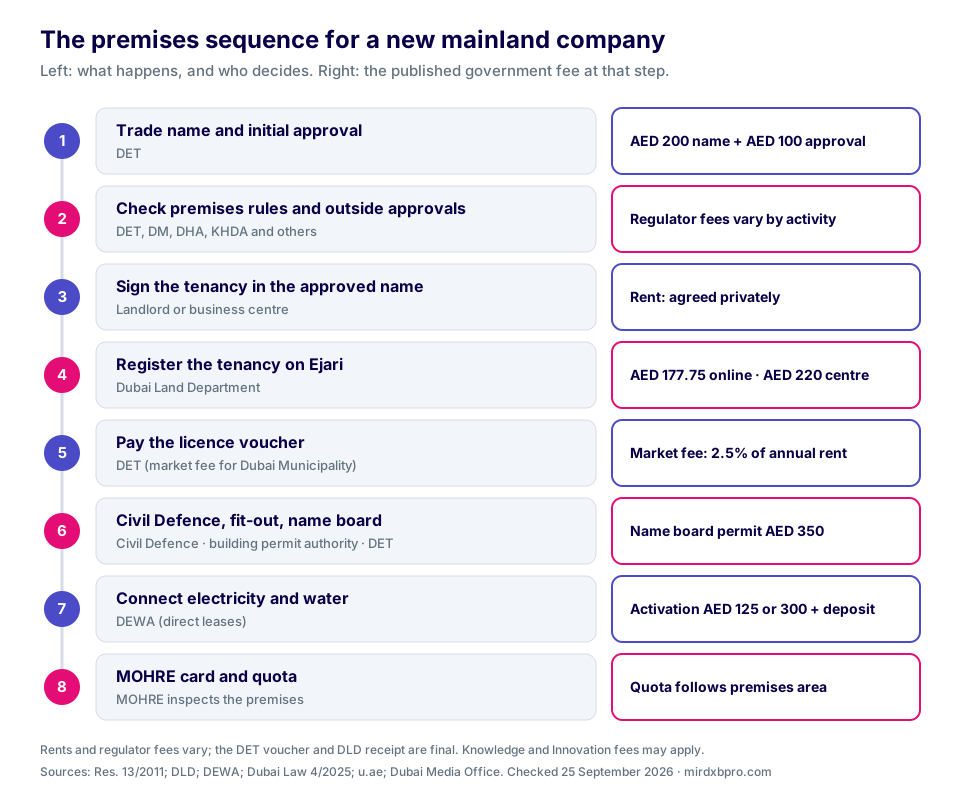
Tenancy law points every commercial tenant should know
Commercial leases in Dubai are governed by the same tenancy law as homes. The provisions below are the ones that most often affect a licence.
| Rule | What it says | Why it matters for the licence |
|---|---|---|
| Registration (Law 26/2007, Art. 4, as amended) | All lease contracts under the law are registered with RERA | No Ejari, no licence issue or renewal |
| Automatic renewal (Art. 6) | If you stay on without objection, the lease renews “for the same term or for a term of one year, whichever is shorter” | A renewed lease still needs its Ejari renewed |
| Notice of changes (Art. 14) | A party wanting to change the terms must notify the other at least 90 days before expiry | Plan renewals of the lease and licence together |
| Rent increases (Decree No. 43 of 2013) | Maximum increase depends on how far your rent is below the RERA rent index: none if within 10%, then 5%, 10%, 15% or 20%; applies to landlords across Dubai, including free zones | Your market fee rises with the registered rent |
| Subletting (Art. 24) | No sublease or assignment without the landlord’s written consent | Sharing premises with another company needs it |
| Eviction during the term (Art. 25(1)) | Grounds include non-payment, unauthorised subletting, illegal use and use for a purpose other than agreed | Using an office as a store can cost you the lease |
| Eviction at expiry (Art. 25(2)) | Allowed only on stated grounds, with at least 12 months’ notice | Gives time to move and amend the licence |
| Sale of the building (Art. 28) | A sale “does not affect the Tenant’s right to continue to occupy” | Your licence premises survive a change of owner |
Disputes go to the Rental Disputes Centre at the Dubai Land Department. The tenancy law protects registered contracts; an arrangement that was never registered is much harder to enforce.
Moving, adding or changing premises
A change of address is a licence amendment, not just a new lease. Invest in Dubai lists “change location” among the common modifications of a trade licence. The usual order is:
- Sign the new tenancy and register its Ejari.
- Apply to DET to amend the licence address. The market fee is recalculated on the new rent at the next voucher.
- Cancel the old Ejari. For an active contract, DLD asks for a letter from the owner requesting cancellation; for an expired one, cancellation is free online.
- Close or transfer the DEWA account at the old unit and open one at the new unit.
- Update the establishment cards and files at MOHRE and GDRFA, the bank, Dubai Chambers and the Federal Tax Authority so every record shows the same address.
- Replace the name board and any signage permits at a shop or outlet.
Adding space is similar. An extra office in the same building needs DET’s additional office permit (AED 1,500); a separate store needs the store permit (AED 300). A branch at a different location is a separate licence entry and is covered, with the other changes, in our trade licence amendment guide.
Lease registration pitfalls that delay a licence
These are the premises problems that most often hold up a new licence, a renewal or a visa file. Nearly all are avoidable before signing.
- Names that do not match. The tenant name on the Ejari must match the trade name and legal form on the licence file. A contract in the owner’s personal name, or with “LLC” missing, has to be corrected before DET will link it.
- A unit that is not commercial. A residential flat or a unit whose permitted use does not fit the activity cannot be the licence premises, whatever the contract says.
- A sublease without consent. A tenant who “rents you a room” without the landlord’s written consent cannot give you a registrable tenancy, and exposes both of you to eviction under Article 25.
- An old Ejari still open. A previous tenant’s registration on the same unit, or your own old Ejari at a former address, can block the new registration until cancelled.
- A term shorter than the licence. A six-month contract behind a one-year licence forces a second renewal mid-year.
- A desk for a regulated activity. Food, health, education, storage and retail cannot run from a flexi desk, and the regulator will say so after you have paid.
- Understated rent. Registering a lower rent to cut the market fee creates a contract that does not reflect the deal and risks a false-information fine.
Premises myths: what circulates online that is not true
| What you may read | What the official sources say |
|---|---|
| “A virtual office is enough for a Dubai mainland licence.” | Law 13/2011, Art. 17 requires premises through which the activity is conducted, and u.ae requires a physical address with an Ejari-registered agreement. Only the Instant Licence’s first-year virtual site and the home-based licences start without a commercial lease. |
| “You can use your flat as the company office.” | Only under the e-Trader or Intelaq home licences. A normal company’s premises must suit the activity and comply with municipal land planning rules. |
| “Each visa needs 80 (or 100, or 200) square feet.” | No such ratio is published. MOHRE weighs legal form, premises area, projects and evidenced work demand (u.ae). |
| “Commercial leases do not need Ejari.” | Law 26/2007 applies to commercial leases, and Article 4 requires all leases under it to be registered with RERA. |
| “The market fee is 5% of rent.” | It was cut to 2.5% in June 2018, and the Dubai Media Office referred to the 2.5% market fee in 2020. |
| “Any co-working space can give you a licence address.” | Only a space that can give you a registered Ejari, typically a DET-licensed business centre registered as an Ejari user. |
| “Civil Defence is only for restaurants.” | Dubai Law 4/2025, Art. 16 bars licensing authorities from issuing or renewing any licence without a valid Civil Defence certificate; how it is applied to small offices is not published, but it is not limited to food. |
| “Get the licence first and find an office later.” | DET’s normal licence requires the site lease contract before issue (Invest in Dubai). Only the Instant Licence defers the location, and only for its first year. |
| “Two companies can share an office informally.” | DET has a specific licence for an establishment headquartered in another’s premises (AED 500), and the landlord’s written consent is needed to sublet. |
Office space for trade licence Dubai in practice: five cases
These cases are built from the situations we see most often. Names and identifying details are left out, and the figures are the published ones.
1. A consultant who outgrew a flexi desk
A management consultant licensed as a sole establishment started on a flexi desk in a business centre, with a registered annual rent of AED 15,000 (market fee AED 375). A year later she won a contract that needed three analysts. A desk would not support that request, so she moved to a small serviced office in the same centre. The centre issued a new Ejari, the licence address was amended, the MOHRE file reflected the new area, and the quota request was filed afterwards with the signed contract as evidence. Doing it in that order meant the request was assessed on the office, not the desk.
2. An online seller who was offered a “virtual office”
A founder planning an LLC to sell homeware online was offered a “virtual office” with an address and mail forwarding but no Ejari. That would not satisfy Article 17. Two lawful routes fitted: an Instant Licence, whose activities needed no outside approval and which carries a virtual business site for year one, with a flexi desk to be arranged before renewal; or, since she would work alone, an e-Trader licence from home. She chose the Instant Licence because she planned to hire, and diarised the premises for month ten.
3. A trading company keeping stock in its office
A trading company licensed at a small office was receiving pallets of stock there. Storing goods in premises licensed as an office risks the AED 2,000 fine for using premises for other than the permitted activities, and breaches the lease’s permitted use. The company leased a small warehouse, registered its Ejari, and obtained DET’s store permit (AED 300). The warehouse needed its own Civil Defence compliance before the goods moved in.
4. A cafe that signed the lease before the layout check
A founder signed a two-year lease on a retail unit for a cafe before any approval. Invest in Dubai lists Dubai Municipality approval for food establishments, and the municipality assesses the layout of a food outlet before licensing. The unit’s kitchen area had to be redesigned, and the fit-out waited for the building permit and Civil Defence certificate. The licence followed, with the AED 350 name board permit. Checking the layout requirements first would have shaped the choice of unit and the fit-out budget.
5. Two related companies sharing one office
A founder held a consultancy and set up a separate trading company. Rather than lease a second office, the new company was licensed as an establishment headquartered in the premises of the first, at DET’s AED 500 fee under Resolution 19/2021. The landlord’s written consent to share the unit was obtained first, because Article 24 of the tenancy law forbids subletting without it. Both companies’ staff count against one area, so the founder accepted that a larger office would be needed before either company hired significantly.
Where the official sources are silent or unclear
We say plainly where we could not find an official answer, so you know which points to confirm with DET or the landlord.
- Business centre operating rules. Resolution 19/2021 sets the business centre licence fee, and DLD confirms business centres register as Ejari users, but we could not open a DET page setting out the conditions a business centre must meet, such as minimum area or desks per centre. Figures quoted by private providers are not official.
- Visa numbers per desk or per office. Not published by MOHRE. Business centres may quote typical allocations; treat these as their experience, not a rule.
- Civil Defence for small offices. Dubai Law 4/2025 is written broadly; no page we opened explains how DET applies it to a desk or office in an already certified building.
- Dubai Virtual Company Licence. Reported in 2019; the u.ae virtual licence page now covers only Abu Dhabi, and we could not confirm the Dubai product is open.
- The market fee. The 2.5% rate is confirmed by 2018 and 2020 official announcements, not on a live DET fee page. Your voucher governs.
- DEWA municipality charges on commercial accounts. The 5% housing fee is documented for residential tenancies; we found no official page confirming how any municipality charge appears on commercial DEWA accounts. Check your first bill.
How to verify every figure in this guide
| Figure or rule | Where to check it |
|---|---|
| Premises required; home and incubator exception; DET inspection | Dubai Law No. 13 of 2011, Arts. 17 to 19 (Dubai Legislation Portal) |
| Physical address; Ejari registration in Dubai | u.ae, Steps to start a business on the mainland |
| Premises fines; name board, kiosk, counter, store and office permits | Executive Council Resolution No. 13 of 2011, Schedules 1 and 2 |
| Business centre licence AED 10,000; shared premises licence AED 500 | Executive Council Resolution No. 19 of 2021, Schedule 1 |
| Ejari AED 177.75 / AED 220; cancellation free / AED 40 + VAT | DLD service pages: Register / Renew Tenancy Contract; Cancel Tenancy Contract |
| Business centres as Ejari users | DLD: Registration of a user in the Ejari system |
| Market fee 2.5% | Dubai Media Office, July 2020; UNCTAD Investment Policy Monitor (June 2018) |
| 2026 market fee exemptions | Dubai Media Office, 21 May 2026 |
| DEWA requirements, deposits, activation | DEWA: Activation of electricity and water (move-in) |
| Civil Defence certificate before licensing | Dubai Law No. 4 of 2025, Art. 16 |
| Quota factors; MOHRE premises inspection | u.ae, Recruiting on the mainland |
| Tenancy registration, renewal, subletting, eviction | Law No. 26 of 2007 and Law No. 33 of 2008 |
| Rent increase bands | Decree No. 43 of 2013 |
| Instant Licence virtual site; e-Trader fee; change of location | Invest in Dubai service pages |
Checked against official sources on 25 September 2026. The legislation was read on the Dubai Legislation Portal and the DLD, DEWA, u.ae and Dubai Media Office pages on that date; Invest in Dubai’s service wording was read for our sibling mainland guides the same day. Fees are those published; the DET voucher and the DLD receipt are final.
What we will and will not do
We will check premises offers against your activities and hiring plan before you sign; tell you when a flexi desk is enough and when it is not; register or renew the Ejari; file the licence, amendments and DET premises permits; update your MOHRE and immigration files after a move; and pass on every government fee at cost with the receipt.
We will not sell you office space or take a commission from a landlord or business centre; arrange an “Ejari only” address with no real premises behind it; register a rent lower than the one you pay; promise a visa quota, which MOHRE decides; or give legal advice on a lease dispute, which belongs with a lawyer or the Rental Disputes Centre.
Related guides
- Mainland company formation: the complete step-by-step guide
- Mainland business setup cost in Dubai, line by line
- Dubai mainland licence types
- Initial approval in Dubai
- Home business licence in Dubai
- Instant licence in Dubai
- Trade licence amendment in Dubai
- Company visa quota in Dubai
- Establishment card in the UAE
- Free zone vs mainland Dubai
- How to renew a trade licence in Dubai
- UAE government fees list 2026
Office space for trade licence Dubai: frequently asked questions
Do I need an office to get a trade licence in Dubai?
Yes, for a normal mainland licence. Dubai Law No. 13 of 2011, Article 17, requires every applicant to specify premises in Dubai through which the activity is conducted, and u.ae says the rental agreement must be registered with Ejari. A desk in a DET-licensed business centre counts for many service activities. The exceptions are the home-based e-Trader and Intelaq licences and the Instant Licence, which carries a virtual site for its first year only.
Can I use a virtual office for a Dubai mainland company?
Not if the virtual office is only an address, mail handling or phone answering. DET needs a registered tenancy for a usable space that suits your activity. Some packages marketed as a virtual office include an Ejari for a flexi desk in a licensed business centre; those can work because of the desk and the Ejari, not the label. Ask to see the Ejari before paying.
Is a flexi desk legal for a mainland licence?
Yes, when it is in a business centre licensed by DET and comes with a registered Ejari. It suits owner-run consultancies, IT and office-based services. It does not suit retail, storage, food, health or education, which need their own approved premises, and because MOHRE weighs premises area when it sets quota, a desk supports only a very small team.
How much does Ejari cost for an office in Dubai?
The Dubai Land Department charges AED 177.75 through the Dubai REST app or website, and AED 220 at a real estate services trustee centre. The fee is the same for registration and renewal. The online route is only for tenancies where both landlord and tenant are individuals, so a company’s office is usually registered at a trustee centre, by the property manager or by the business centre.
What is the market fee on commercial rent?
It is a Dubai Municipality fee that DET collects on the licence voucher, at 2.5% of the annual rent in your registered tenancy. The rate was cut from 5% in June 2018 and was referred to as the 2.5% market fee by the Dubai Media Office in 2020. On AED 40,000 of rent it is AED 1,000 a year. Certain sectors received one-time exemptions in May 2026.
How many visas can I get with a flexi desk or a small office?
MOHRE does not publish a number per desk or per square foot. It sets quota by legal form, premises area, projects and evidenced work demand, and inspects premises before issuing its e-signature card. A desk supports very few visas; a larger office supports more. Our company visa quota guide explains the request and the evidence MOHRE looks at.
Can I run my company from my apartment?
Only under a home-based licence. DET’s e-Trader licence (AED 1,070 plus AED 300 Chamber fee) lets residents run certain online businesses from home as a sole establishment, and the Intelaq licence does the same for UAE and GCC nationals. A normal LLC cannot use a residential flat as its licence premises. Our home business licence guide covers eligibility and limits.
Can two companies share one office?
Yes. DET issues a licence for an establishment headquartered in the premises of another licensed establishment, at AED 500 under Resolution No. 19 of 2021. The landlord’s written consent is needed, because the tenancy law forbids subletting without it. The space must suit both companies’ activities, and both teams count against the same area for quota.
Do I need to renew Ejari to renew my trade licence?
Yes. DET renews the licence against a valid registered tenancy, so renew the lease and its Ejari before the licence falls due. During the 2020 stimulus Dubai temporarily allowed licences to be renewed without renewing the lease, which shows the normal rule. The market fee is recalculated on the rent in the renewed Ejari.
What happens if I move office without telling DET?
Trading from an address not on the licence can be fined AED 1,000 under DET’s schedule, and renewal stops when the Ejari on file expires. Amend the licence address, cancel the old Ejari (an active contract needs the former landlord’s letter), and update the MOHRE and GDRFA files, the bank and your tax registration.
Do I need Civil Defence approval for my office?
Dubai Law No. 4 of 2025, Article 16, says licensing authorities must not issue or renew a licence without a valid Civil Defence certificate. In practice it is your own task when you fit out a unit, open a shop or restaurant, store goods or run an industrial process. For a serviced office, ask the landlord or operator for the building’s current certificate before signing.
Does the Instant Licence need an office?
Not in its first year. Invest in Dubai says the Instant Licence includes a virtual business site for the first year only, after which a valid business location must be provided on renewal or any amendment. It is available only for activities that need no outside approval. Plan the premises before month twelve, or before any amendment.
Can MIRDXB PRO find office space and register Ejari for my licence?
We do not sell or broker office space, so we have no premises to push. We check the offers you have against your activity, visa plans and DET’s rules, review the contract before signing, register the Ejari, and file the licence or address amendment. Our Ejari registration service and company formation support cover the steps, with government fees passed on at cost.
How much does MIRDXB PRO charge to handle premises and Ejari?
Our fee depends on the work and is quoted in writing before we start. Checking and registering a business centre desk is simpler than taking a shop or warehouse through its approvals. Government fees (DLD, DET voucher and permits, DEWA, Civil Defence) are passed on at cost with receipts. Our published service fees are on our fees page.
Keeping your Ejari, licence address, establishment cards and quota aligned as the company grows is what our PRO services in Dubai team handles, and our corporate PRO services cover it on a retained basis.
- Dubai Law No. 13 of 2011 Regulating the Conduct of Economic Activities (Arts. 17 to 19)
- Executive Council Resolution No. 13 of 2011: DED fees (Schedule 1) and fines (Schedule 2)
- Executive Council Resolution No. 19 of 2021 Concerning Reduction and Cancellation of Fees
- Law No. 26 of 2007 Regulating the Relationship between Landlords and Tenants
- Law No. 33 of 2008 Amending Law No. 26 of 2007
- Decree No. 43 of 2013 Determining Rent Increase for Real Property
- Law No. 4 of 2025 Establishing the Dubai Civil Defence General Command (Art. 16)
- u.ae: Steps to start a business on the mainland (updated 8 April 2026)
- u.ae: Recruiting on the mainland (updated 11 June 2025)
- Dubai Land Department: Register / Renew Tenancy Contract
- Dubai Land Department: Cancel Tenancy Contract
- Dubai Land Department: Registration of a user in the Ejari system
- DEWA: Activation of electricity and water (move-in)
- Dubai Media Office: third economic package, July 2020 (2.5% market fee)
- Dubai Media Office: economic incentives package, 21 May 2026
- UNCTAD Investment Policy Monitor: Dubai market fees cut from 5% to 2.5% (June 2018, secondary)
- Invest in Dubai: Request to issue a trade licence (normal, Instant and e-Trader)
- Invest in Dubai: Mainland companies (types of licences)
- Invest in Dubai: Additional approvals
- Invest in Dubai: Request to amend a trade licence
- Invest in Dubai: Request to issue a commercial permit
- Dubai Municipality: food establishment services
- MoIAT: Issue industrial production licence
- Gulf News: Dubai Virtual Company Licence for non-residents (2019, secondary)
Please note. The premises rules, fees and procedures in this guide are taken from the Dubai Legislation Portal, u.ae, the Dubai Land Department, DEWA, the Department of Economy and Tourism and its Invest in Dubai platform, Dubai Municipality, MoIAT and the Dubai Media Office, verified 25 September 2026. Rents in the examples are illustrative, not market prices. The cases are built from common situations and are illustrative, not the records of named clients. This guide is general information and not legal advice; DET’s decision, your payment voucher and the DLD receipt are final, and lease disputes belong with a lawyer or the Rental Disputes Centre.


