

Key takeaways
- Dubai CommerCity company setup means forming a free zone company or branch in Dubai CommerCity, the free zone in Umm Ramool built for digital commerce, developed by the Dubai Integrated Economic Zones Authority (DIEZ) with Wasl Properties and licensed under DIEZ rules.
- It is the e-commerce specialist among Dubai’s free zones: online retailers, marketplace sellers, brands selling direct to consumers, and the logistics, fulfilment and payment businesses that serve them.
- Six licences are on offer: e-commerce, trade, general trading, service, industrial and a dual licence with DET. Its FAQ says one licence can hold up to 20 activities from four industry groups.
- Offices and warehouses sit side by side. A Business Cluster (smart desks to fitted offices) and a Logistics Cluster (dedicated and third-party warehouses, a fulfilment centre and last-mile services) are both described as bonded.
- No prices are published. Dubai CommerCity lists licences and facilities without fees or visa allocations, so every figure must come from a written quotation.
- Its own pages conflict on capital (AED 1,000 in the FAQ; AED 1 in the DIEZ regulations) and still say “zero corporate or income tax”, which is out of date.
- Selling to UAE shoppers from a free zone warehouse has a cost: customs duty and VAT at import into the mainland, and a mainland permit if you operate there directly.
Dubai CommerCity company setup is the process of incorporating a free zone company or registering a branch in Dubai CommerCity, a free zone in Umm Ramool near Dubai International Airport dedicated to digital commerce, licensed and regulated by the Dubai Integrated Economic Zones Authority under Dubai Law No. 16 of 2021. A Dubai CommerCity company can be fully foreign-owned, hold an e-commerce, trade or service licence, lease an office and a bonded warehouse or fulfilment service in the same zone, and sell online to customers across the Middle East, Africa and South Asia.
Dubai CommerCity describes itself as “the first and leading free zone dedicated exclusively to digital commerce” in that region, and as a joint venture between DIEZ and Wasl Properties. Its plot is one of four free zones approved by DIEZ Resolution No. 1 of 2022, alongside Dubai Airport Freezone, Dubai Silicon Oasis and DAFZA Industrial Park.
This guide explains who the zone suits, its legal forms and licences, the setup steps and what is officially published about time and cost, documents, space and visas, customs, VAT and corporate tax for online sellers, mainland access, compliance and alternatives. For the free zone versus mainland decision in general, see our free zone vs mainland guide. If you want the whole file handled, our free zone company setup support covers Dubai CommerCity from first enquiry to bank account. The wider context is in our Dubai free zones list and free zones in the UAE guide.
Dubai CommerCity company setup at a glance
| Question | Short answer | Source (checked 26 Sep 2026) |
|---|---|---|
| Licensing authority | Dubai Integrated Economic Zones Authority (DIEZ) | Dubai Law No. 16 of 2021; dubaicommercity.ae |
| Legal basis | Dubai Law No. 16 of 2021; DIEZ Resolution No. 1 of 2022 (plot 2150115); DIEZA Implementing Regulations 2023 | Dubai Legislation Portal; dso.ae |
| Developer | Joint venture between DIEZ and Wasl Properties | dubaicommercity.ae |
| Location | Umm Ramool, about 5 minutes from Dubai International Airport and 15 from Downtown, near Emirates Metro Station | dubaicommercity.ae about and smart desk pages |
| Best for | E-commerce retailers, marketplace sellers, D2C brands, fulfilment and last-mile logistics, e-commerce service providers | dubaicommercity.ae |
| Legal forms | FZCO (1 to 50 shareholders), PLC, branch | Dubai CommerCity FAQ; DIEZA Regulation 8 |
| Licence types | E-commerce, trade, general trading, service, industrial, dual licence with DET (the FAQ also mentions a freelance licence) | dubaicommercity.ae licence types; FAQ |
| Activities per licence | Base licence: three activities from the same industry group; up to 20 activities from four groups | Dubai CommerCity FAQ |
| Minimum capital | Conflict: FAQ says AED 1,000 (USD 273); DIEZ regulations set AED 1 for an FZCO | FAQ; DIEZA Regulation 23 |
| Official setup time | Not published by Dubai CommerCity; u.ae states free zone approval “within 14 working days” (general) | u.ae |
| Space | Smart desk, premium, fitted and shell-and-core offices, co-working; dedicated and third-party warehouses, fulfilment centre, last-mile service; retail and food outlets | dubaicommercity.ae facilities |
| Visa allocation | Not published | dubaicommercity.ae |
| Customs status | Business Cluster and Logistics Cluster described as “bonded zones” | Dubai CommerCity FAQ |
| VAT designated zone | Yes, from 1 January 2021 (added to the list after the original 2017 decision); confirm on the FTA’s current list | FTA list of designated zones (Cabinet Decision No. 59 of 2017 as amended to No. 81 of 2021) |
| Mainland route | Dual licence with DET; Resolution 11/2025 permit or DET branch | dubaicommercity.ae; Dubai Media Office |
The headline for most founders: Dubai CommerCity makes most sense if you will actually use the logistics side. A seller who ships from a third-party warehouse elsewhere, or who sells digital services, may be better served by a licence-first zone; compare quotations. A seller who wants stock, packing and dispatch a few minutes from the airport, under the same free zone as the company, is exactly who it was built for.
DIEZ and Dubai CommerCity: one regulator, three different zones
Dubai Law No. 16 of 2021 created DIEZ and gave it power to “license, regulate, control, and supervise” activities in its zones. DIEZ Resolution No. 1 of 2022 named Dubai Commercity as one of its free zones. Every Dubai CommerCity company therefore follows the DIEZA Implementing Regulations 2023, the same company law as Dubai Airport Freezone and Dubai Silicon Oasis. On 17 August 2026, Dubai Media Office reported DIEZ-wide occupancy of 96% and a 13% rise in companies in the first half of 2026.
So the choice between the three is about the business model, not the paperwork:
| If your business is… | Choose | Why |
|---|---|---|
| Selling physical products online to consumers | Dubai CommerCity | E-commerce licence, bonded warehouses, fulfilment and last-mile services in one zone |
| Distributing high-value goods business to business by air | Dubai Airport Freezone | Beside DXB, VAT designated zone, cold storage in DAFZ Industrial Park |
| Building software, AI or hardware | Dubai Silicon Oasis | Tech campus, Dtec, R&D space, housing on site |
What Dubai CommerCity is known for
Dubai CommerCity was planned around one idea: an online seller should be able to register, sit, store, pack and ship from the same place, close to the airport and the region’s main trade routes. It organises the zone into three clusters.
- Business Cluster: offices from a smart desk to fitted and shell-and-core premises, co-working, meeting rooms and event venues.
- Logistics Cluster: dedicated warehouses (with temperature-controlled options), third-party warehousing, a fulfilment centre offering “order processing, packaging, and shipping”, and last-mile delivery services.
- Social Cluster: retail, restaurants, a food hall and kiosks for the people who work there.
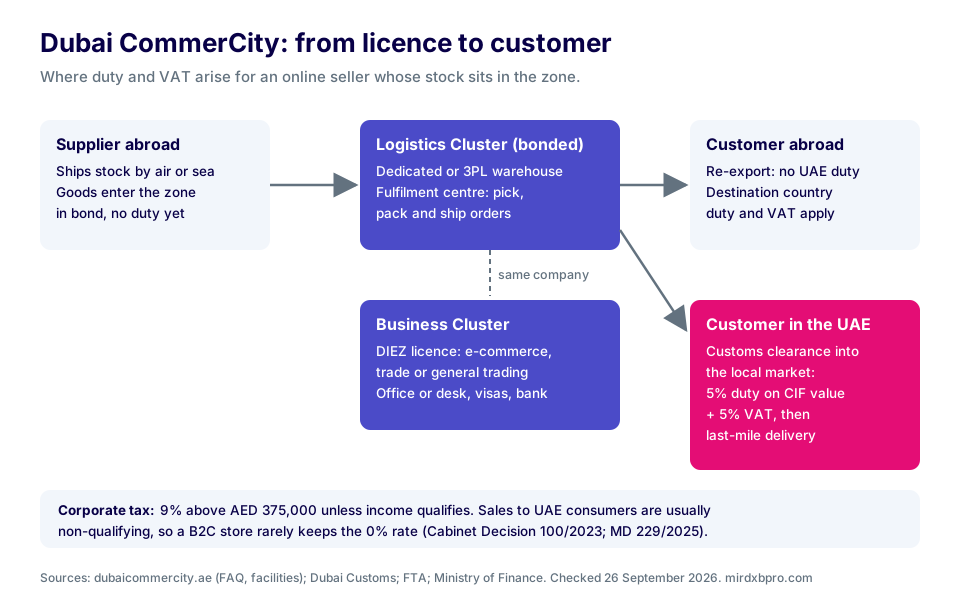
The zone’s FAQ says both the Business Cluster and the Logistics Cluster are “bonded zones” with “special customs, import, and export duty arrangements”. For an e-commerce business this is the core benefit: goods can arrive and be stored without duty being paid until they enter the local market, and goods re-exported to other countries can leave without ever entering it.
Dubai CommerCity positions itself for brands selling into the Middle East, Africa and South Asia, and in February 2026 published a thought-leadership paper on UAE-India digital trade under the CEPA agreement. It does not name tenant companies on its public pages, so we do not either.
How Dubai CommerCity differs from other options for online sellers
- Against the DET e-Trader licence on the mainland, which is aimed at individuals selling online on a small scale, Dubai CommerCity gives a full free zone company with foreign ownership, warehouses and visas.
- Against IFZA or Meydan Free Zone, which are licence-first zones without their own e-commerce logistics clusters, Dubai CommerCity keeps the company, stock and fulfilment in the same zone.
- Against JAFZA, which suits containerised sea freight and large warehouses, Dubai CommerCity is built for smaller parcels, fast dispatch and consumer delivery.
Legal forms, shareholders and capital in Dubai CommerCity
| Form | What Dubai CommerCity and DIEZ say | Capital |
|---|---|---|
| FZCO | Free zone company with “1 to 50 shareholders”, 100% foreign ownership, no UAE national partner needed | FAQ: AED 1,000 (USD 273). DIEZ regulations: AED 1, shares at least 25% paid up |
| PLC | Public limited company for businesses that may seek a listing | At least AED 250,000 (DIEZ regulations) |
| Branch | Branch of a foreign or UAE company; “no share capital required” | None |
The capital conflict matters only at the margin, but it is worth settling in writing. The DIEZA Implementing Regulations 2023, which apply to all DIEZ zones, set an FZCO minimum of AED 1. Dubai CommerCity’s FAQ still states AED 1,000. Ask Dubai CommerCity which figure it applies when it issues your quotation, and in practice set a capital that reflects your stock purchases, since banks and payment providers will ask how the business is funded.
An FZCO needs at least one director who is a natural person, a manager resident in the UAE and a company secretary (DIEZA Regulations 39, 48 and 49). A branch is run by a manager appointed by the parent, and the parent is liable for its debts.
Dubai CommerCity licence types and the e-commerce licence
| Licence | Dubai CommerCity’s description | Who uses it |
|---|---|---|
| E-commerce licence | “Enables businesses to trade goods and services online, manage digital transactions, and streamline operations” | Online stores, marketplace sellers, D2C brands |
| Trade licence | Trading “including import, export, re-export, storage, and distribution of specified products” | Importers and distributors of a defined product range |
| General trading licence | Import, export, re-export, storage and distribution “across multiple industries” | Multi-category online retailers and wholesalers |
| Service licence | Services “such as consulting, advisory, and other professional services” | E-commerce agencies, payment and software service providers, consultants |
| Industrial licence | “Light manufacturing, packaging, and assembly” | Kitting, private-label packing, light assembly |
| Dual licence with DET | Lets a Dubai CommerCity company obtain a DET licence “without the need for physical office space” | Sellers who also need a mainland licence |
According to the zone’s FAQ, a base licence includes three activities from the same industry group, and a single licence can carry up to 20 activities from four industry groups. Activities follow the ISIC Rev. 4 classification. An online seller of electronics and home goods, for example, might combine e-commerce activities with trading activities for each product family, and add a service activity if it also runs a marketplace for others.
Products that need another regulator
Selling online does not remove product rules. Cosmetics, food and supplements need Dubai Municipality registration; medicines and medical devices need approval from the Emirates Drug Establishment; wireless devices need TDRA type approval; and some goods are restricted or prohibited by Dubai Customs. Plan these before you list products, because your fulfilment partner will not release goods that lack the required registration.
Dubai CommerCity company setup process, step by step
Dubai CommerCity publishes a seven-stage process. It gives no time for any stage, so the times below come from general official statements where they exist.
- Initial consultation. Discuss your model, products and markets with Dubai CommerCity. No official time.
- Select the licence type and activities (up to 20 from four groups on one licence).
- Prepare documents, including beneficial owner documents (below).
- Company registration. DIEZ registers the company. Dubai CommerCity publishes no time; u.ae says free zone applications are approved “within 14 working days” as a general rule.
- Office space allocation, from a smart desk to a fitted office, and warehouse or fulfilment space if you hold stock.
- Visa processing for founders and staff: establishment card, entry permit or status change, medical, Emirates ID and residence.
- Bank account opening with Dubai CommerCity’s support; timing is the bank’s.
Two steps are missing from the zone’s list and matter for online sellers: corporate tax registration within three months of incorporation (FTA Decision No. 3 of 2024), and a Dubai Customs client code so that goods can be cleared in and out of the zone.
Documents required
Dubai CommerCity’s setup page lists beneficial owner documents: the UBO declaration form, certified passport or ID copies, proof of residential address (a utility bill or lease less than three months old), corporate structure charts, a certified copy of the shareholder register and the latest audited annual report. The full application checklist follows the DIEZ pattern:
- Individual shareholders and manager: passport copies, UAE visa and Emirates ID if resident, proof of address, and a no-objection letter from the manager’s sponsor if employed elsewhere in the UAE.
- Business information: a short business plan or profile explaining products, sales channels and markets.
- Corporate shareholders: certificate of incorporation “certified by the relevant authority” (DIEZA Regulation 18.2(b)), memorandum and articles, board resolution, good standing, shareholder register and group structure, notarised and attested for use in the UAE.
- Branches: the parent’s constitutional documents and a board resolution appointing the branch manager.
Foreign documents normally need notarisation, UAE embassy legalisation and Ministry of Foreign Affairs attestation, because the UAE is not a party to the Apostille Convention. Our document attestation service handles this, and our UBO register guide explains beneficial ownership.
Dubai CommerCity license cost: what is and is not published
Dubai CommerCity publishes no licence, registration, office, warehouse or visa fees on its website. Its licence comparison page lists features (business registration, virtual office services, customs and logistics services, office space) but no prices, and its facility pages invite enquiries. Any fixed “Dubai CommerCity license cost” you see online is a consultant’s package or an old quotation, not a published tariff.
| Cost line | Official figure | Source (checked 26 Sep 2026) |
|---|---|---|
| Registration and licence fees (all six licences) | Not published | dubaicommercity.ae licence pages |
| Smart desk, offices, co-working | Not published | dubaicommercity.ae facilities |
| Warehouses, fulfilment, last-mile services | Not published | dubaicommercity.ae facilities |
| Visa allocation per space | Not published | dubaicommercity.ae |
| Free Zone Mainland Operating Permit | AED 5,000 | Dubai Media Office, 8 October 2025 |
| DET branch of a free zone company | AED 10,000 a year | Executive Council Resolution No. 11 of 2025 |
| Import duty into the UAE market | Generally 5% of the CIF value | Dubai Customs |
| VAT on goods sold to UAE customers | 5% | FTA |
DIEZ’s relief measures of 9 April 2026 also apply to Dubai CommerCity companies: stable rents on renewal, monthly rent instalments without instalment fees, a waiver of “late licence renewal penalties, until conditions stabilise”, and waived or deferred fees for restructuring, capital, shareholder and activity amendments. Ask whether they still apply when you renew.
Build your budget from these lines
- Registration and licence (ask how many activities and industry groups are included).
- Office or desk rent, and whether a desk carries any visa allocation.
- Warehouse rent or fulfilment fees (per order, per pallet or per cubic metre), and last-mile delivery rates.
- Establishment card and per-visa costs, including medical, Emirates ID and health insurance.
- Dubai Customs client code, customs declarations and duty on goods sold locally.
- Payment gateway set-up, product registrations and trademark filing.
- Audit and bookkeeping, and year-two renewal.
Government and free zone fees are passed on at cost; our own fee is quoted in writing (see our fees page).
Offices, warehouses and visas in Dubai CommerCity
| Space | What Dubai CommerCity says | Suits |
|---|---|---|
| Smart desk | Dedicated, ready-to-use workstation with internet, utilities, lounge and pantry, “without long-term commitments” | Freelancers, founders, small online sellers |
| Premium office | Furnished, “turnkey” offices with “flexible sizing options” | SMEs and representative offices |
| Fitted office / shell and core | Fitted units, or shell space you fit out yourself | Growing teams |
| Co-working | Shared workspace | Early-stage teams |
| Dedicated warehouse | Private storage for “large-scale inventory management”, with temperature-controlled options | Established e-commerce companies and retailers |
| Third-party warehouse | Shared storage run by a provider | Sellers who do not want their own warehouse |
| Fulfilment centre | “Order processing, packaging, and shipping” with inventory tracking | Online stores that outsource fulfilment |
| Last-mile service | Delivery to customers | Sellers shipping to UAE consumers |
Offices are “available for lease only”, according to the FAQ. The zone does not publish how many visas each space carries. Because the visa count follows the space in every DIEZ zone, ask for the allocation in writing with the lease offer, and check whether warehouse space you rent through a third-party provider counts towards your company’s visa allowance (it usually will not, because the lease is the provider’s).
Visas
Once the company holds its licence, lease and establishment card, it can sponsor residence visas for owners and staff through the usual Dubai steps: entry permit or status change, medical test, Emirates ID and residence. Dubai CommerCity does not publish processing times. Owners and employees can sponsor families under the family visa rules, and founders who qualify for a Golden Visa may not need a company visa. Our free zone visa service can run each step.
Customs, VAT and corporate tax for an e-commerce company
Customs: the bonded advantage and its limit
Because Dubai CommerCity describes its Business and Logistics Clusters as bonded, goods can be imported and stored there without customs duty being paid on arrival. Duty becomes payable when goods leave the zone for the UAE local market: generally 5% of the CIF value, with higher rates for tobacco and alcohol and exemptions for some goods. Goods re-exported to other countries can leave without UAE duty. Register with Dubai Customs for a client code before your first shipment.
VAT: the question to settle before you trade
Whether Dubai CommerCity is a VAT designated zone changes how your sales are taxed. It was not on the original 2017 list in Cabinet Decision No. 59 of 2017, but the FTA’s published list of designated zones, as amended up to Cabinet Decision No. 81 of 2021, shows Dubai CommerCity as a designated zone effective 1 January 2021. We could not read the FTA’s live web page from our research environment, so check the current list, and remember that designated-zone treatment applies to goods under specific conditions (a fenced zone with customs controls), not automatically to every sale. Ask your tax adviser to confirm how it applies to your flows. Either way, sales of goods to UAE consumers are subject to 5% VAT, and a company must register once its taxable supplies exceed AED 375,000 in twelve months (voluntary from AED 187,500). Digital services supplied to UAE customers are also taxable.
Corporate tax
Dubai CommerCity’s FAQ still refers to “zero corporate or income tax”. That is no longer accurate: a Dubai CommerCity company is subject to UAE corporate tax at 9% on taxable income above AED 375,000, unless it is a Qualifying Free Zone Person earning qualifying income, which is taxed at 0% (Cabinet Decision No. 100 of 2023).
For online retailers the key rule is that sales of goods to consumers in the UAE mainland are generally not qualifying income. Ministerial Decision No. 229 of 2025 lists as qualifying the “distribution of goods or materials in or from a Designated Zone” (to customers that resell or process the goods) and logistics services, among others. A business-to-consumer online store selling mainly to UAE shoppers should therefore plan for 9% on profits above AED 375,000, while a logistics provider or a distributor selling to resellers abroad may be in a different position. The de minimis limit for non-qualifying revenue is the lower of 5% of revenue or AED 5 million, so even modest local retail sales can end 0% treatment for the whole company. Take tax advice before choosing your structure, and see our corporate tax registration guide.
Selling into the Dubai mainland from Dubai CommerCity
Shipping goods to UAE customers after customs clearance is how most Dubai CommerCity sellers reach the local market. Operating directly on the mainland, for example running a showroom, providing services on site or contracting as a mainland supplier, needs one of these:
- The dual licence with DET that Dubai CommerCity offers, which lets its companies obtain a DET licence “without the need for physical office space”.
- A Free Zone Mainland Operating Permit (AED 5,000) or a DET branch licence (AED 10,000 a year) under Executive Council Resolution No. 11 of 2025.
- A separate mainland company.
Banking and payments
An online business needs two things: a corporate bank account and a payment gateway. Banks will ask for the licence, lease, incorporation documents, passports and Emirates IDs of owners and signatories, a business plan with expected order volumes and average basket size, and the countries you ship to and buy from. Payment gateways run their own checks and usually want to see a live website with clear refund, delivery and privacy policies. Our company formation support includes preparing the bank pack; see also our corporate bank account guide.
Renewal and ongoing compliance
- Licence and lease: renew annually; DIEZ waived late renewal penalties “until conditions stabilise” (9 April 2026).
- Accounts and audit: keep records and appoint an auditor (DIEZA Regulations 65 to 72); audited statements are also required for 0% corporate tax.
- Beneficial owners: declaration annually and on renewal, changes within 14 days (DIEZA Regulation 22); the federal limit is 15 days (Cabinet Decision No. 109 of 2023).
- Tax: corporate tax return within nine months of year end; VAT returns if registered.
- Customs: keep the Dubai Customs client code renewed with the licence.
- Product registrations: renew them when they expire, or stock will be held.
Dubai CommerCity free zone: pros and cons
| Pros | Cons |
|---|---|
| Dedicated e-commerce licence and a zone built around online selling | No published fees or visa allocations |
| Offices, bonded warehouses, fulfilment and last-mile services in one zone | Its own FAQ is out of date on capital and corporate tax |
| About five minutes from Dubai International Airport, near a Metro station | Designated-zone VAT treatment is limited to qualifying goods movements; B2C sales still carry 5% VAT |
| Up to 20 activities from four industry groups on one licence | B2C sales to UAE consumers are usually taxed at 9% above AED 375,000 |
| Same DIEZ company law as DAFZ and DSO; dual licence with DET available | Less relevant if you do not use the logistics side |
Who Dubai CommerCity company setup suits
- Online retailers and D2C brands holding stock in Dubai for the GCC, Africa and South Asia.
- Marketplace sellers who want a local company and a fulfilment partner in the same zone.
- Regional and international brands running cross-border e-commerce hubs.
- Logistics, fulfilment and last-mile companies serving online sellers.
- E-commerce service providers: agencies, payment and software firms that want to sit among their clients.
Who should look elsewhere
- High-value B2B air-freight distributors: Dubai Airport Freezone.
- Software and AI companies with no physical goods: Dubai Silicon Oasis.
- Sellers who only need a licence and use a 3PL elsewhere: IFZA or Meydan Free Zone.
- Importers of full containers by sea: JAFZA.
- Businesses selling mainly to UAE consumers who want to avoid customs steps: a mainland company.
Dubai CommerCity company setup: worked cases
These cases are built from the situations we see most often. Names and identifying details are left out, and the figures are the published ones.
Case 1: a fashion brand selling across the GCC
A European fashion label wants to sell online to customers in Saudi Arabia, Kuwait and the UAE. It forms an FZCO with an e-commerce licence plus trading activities for apparel and accessories, takes a smart desk for the company, and uses the zone’s fulfilment centre instead of leasing its own warehouse. Goods sit in bond and are cleared only when orders ship. UAE orders attract 5% duty and 5% VAT on clearance; GCC orders leave as re-exports and are subject to the destination country’s rules. Because most revenue is B2C, it plans for 9% corporate tax above AED 375,000.
Case 2: a marketplace seller moving from a mainland e-Trader licence
A resident selling electronics accessories through marketplaces outgrew a DET e-Trader licence and wanted stock close to the airport and staff visas. We compared a mainland LLC with a Dubai CommerCity FZCO. Because nearly all customers were in the UAE, the mainland company avoided customs clearance on every order. She chose the mainland route. A colleague exporting the same products to Oman and Bahrain chose Dubai CommerCity.
Case 3: a last-mile delivery start-up
Two founders launching a same-day delivery service for online stores form an FZCO with a service licence for logistics and courier services and lease space in the Logistics Cluster. Logistics services are a qualifying activity under Ministerial Decision No. 229 of 2025, so revenue from other free zone companies and qualifying logistics work may qualify for 0% if they meet the substance and audit conditions. Deliveries to consumers on the mainland may also need approvals from the roads authority; we check those before launch.
Case 4: an Indian brand opening a regional hub
An Indian consumer brand wants a regional e-commerce hub under the UAE-India trade agreement. It registers a Dubai CommerCity branch so the parent’s brand and contracts carry over, leases a dedicated warehouse with temperature control, and obtains Dubai Municipality product registrations for its cosmetics. The parent’s documents are notarised in India and attested by the UAE embassy and MOFA before filing.
What circulates online about Dubai CommerCity that is not true
| Claim | What the sources say |
|---|---|
| “Dubai CommerCity companies pay no corporate tax.” | Out of date, even in the zone’s own FAQ. 9% applies above AED 375,000 unless income qualifies under Cabinet Decision No. 100 of 2023; B2C sales in the UAE usually do not. |
| “Goods in a bonded zone are never taxed.” | Duty and VAT are deferred, not removed. They are paid when goods enter the UAE market. |
| “The Dubai CommerCity license cost is fixed at AED X.” | The zone publishes no tariff. Any fixed figure is a package or quotation. |
| “An e-commerce licence lets you sell any product.” | Regulated products still need Dubai Municipality, Emirates Drug Establishment, TDRA or other approvals. |
| “Minimum capital is AED 1,000.” | The FAQ says so, but the DIEZ regulations set AED 1 for an FZCO. Confirm which figure applies. |
| “A free zone e-commerce company can open a shop on the mainland.” | A mainland outlet needs a DET licence, the dual licence route, a Resolution 11/2025 branch or permit, or a mainland company. |
How to verify every figure in this guide
| Figure or rule | Where to check |
|---|---|
| DIEZ and the Dubai Commercity plot | Dubai Legislation Portal: Law No. 16 of 2021; DIEZ Resolution No. 1 of 2022 |
| Company law, capital, directors, beneficial owners | DIEZA Implementing Regulations 2023 |
| Licence types and activities | dubaicommercity.ae licence types page and FAQ |
| Facilities and bonded status | dubaicommercity.ae facilities pages and FAQ |
| Mainland permit and branch fees | Dubai Media Office, 8 October 2025; Executive Council Resolution No. 11 of 2025 |
| Customs duty and client code | Dubai Customs |
| VAT and designated zone status | FTA designated zones list; FTA VAT guides |
| Corporate tax qualifying activities | Ministry of Finance: Ministerial Decision No. 229 of 2025 |
Dubai CommerCity company setup: how MIRDXB PRO helps
MIRDXB PRO is an independent PRO and company formation consultancy in Al Barsha 1, Dubai. We are not Dubai CommerCity, DIEZ or Wasl, and none of them lists us as a partner. We work on your side: we check the model, choose the licence and space, prepare the file and run the government steps.
What we do
- Test your e-commerce model against Dubai CommerCity, other free zones and the mainland, including customs and tax, and put the comparison in writing.
- Choose licence types and activities, and flag product registrations.
- Match office and warehouse or fulfilment space to your visas and volumes.
- Prepare the application and beneficial owner documents, and run attestation for corporate shareholders.
- Follow registration, lease, licence, establishment card and visas to Emirates ID.
- Prepare the bank pack and register for corporate tax, VAT and a Dubai Customs client code.
How it works
- Message us on WhatsApp with your products, markets, team and expected order volume.
- We reply in writing with the structure, the items to request from Dubai CommerCity and our fee.
- You approve; we prepare documents and file.
- After the licence we run visas, banking, tax and customs registration.
What it costs
Free zone and government fees are passed on at cost with receipts. Our fee is quoted in writing before we start; see our fees.
Why founders use us
- We cite the official source for each rule and flag where the zone’s own pages are out of date.
- We tell you when the mainland or another zone suits your sales model better.
- We handle visas, Emirates ID, attestation and tax registration too.
- Our Al Barsha 1 office is open Monday to Thursday and Saturday 09:00 to 18:00, and Friday 09:00 to 12:00.
To begin, see our business setup service, where we compare every route for business setup in Dubai.
What we will and will not do
- We will show the official source for every rule we rely on, and the free zone’s receipts.
- We will tell you if your model works better elsewhere.
- We will quote our fee in writing first.
- We will not promise approvals, payment gateways, bank accounts or timelines controlled by others.
- We will not present ourselves as Dubai CommerCity or DIEZ.
- We will not give tax opinions; we work with your tax adviser on VAT and corporate tax.
Related guides
- DAFZA company setup, the DIEZ airport zone
- Dubai Silicon Oasis company setup, the DIEZ technology zone
- IFZA company setup
- JAFZA company setup
- General trading licence in Dubai (mainland)
- Dubai free zones list
- Free zones in the UAE
- Corporate tax registration in the UAE
Dubai CommerCity company setup: frequently asked questions
Who licenses companies in Dubai CommerCity?
The Dubai Integrated Economic Zones Authority (DIEZ), under Dubai Law No. 16 of 2021. DIEZ Resolution No. 1 of 2022 approved Dubai Commercity as one of its free zones, and companies there follow the DIEZA Implementing Regulations 2023, the same rules as Dubai Airport Freezone and Dubai Silicon Oasis. Dubai CommerCity itself describes the zone as a joint venture between DIEZ and Wasl Properties.
What is the Dubai CommerCity e-commerce licence?
It is one of six licences the zone offers, and “enables businesses to trade goods and services online, manage digital transactions, and streamline operations”. Most online sellers combine it with trading activities for the products they sell. According to the zone’s FAQ, a licence can carry up to 20 activities from four industry groups, with three activities from one group in the base licence.
How much does a Dubai CommerCity licence cost?
Dubai CommerCity does not publish licence, registration, office, warehouse or visa fees on its website. Ask for an itemised written quotation covering registration, licence and activities, desk or office rent, warehouse or fulfilment charges, establishment card and visa costs, and year-two renewal, then compare it with other zones for the same visa count.
What is the minimum share capital?
Sources conflict. Dubai CommerCity’s FAQ states a minimum of AED 1,000 (USD 273) for an FZCO, while the DIEZA Implementing Regulations 2023 set AED 1, with shares at least 25% paid up. A PLC needs at least AED 250,000 and a branch needs no share capital. Ask the zone to confirm the figure in your quotation.
How many visas does a Dubai CommerCity company get?
Dubai CommerCity does not publish visa allocations. As in other DIEZ zones, the allowance depends on the space you lease, from a smart desk to a fitted office or dedicated warehouse. Ask for the number of visas in writing with the lease offer, and note that storage rented through a third-party provider usually does not add to your company’s allowance.
How long does Dubai CommerCity company setup take?
The zone publishes a seven-stage process but no times. u.ae states that free zone applications are generally approved within 14 working days. Corporate shareholder documents that need attestation, product registrations and bank or payment gateway onboarding usually take the longest.
Is Dubai CommerCity a bonded zone?
Its FAQ says both the Business Cluster and the Logistics Cluster are “bonded zones” with special customs arrangements. Goods can be stored without paying duty on arrival; duty, generally 5% of the CIF value, and 5% VAT are paid when goods enter the UAE market, while re-exports leave without UAE duty.
Is Dubai CommerCity a VAT designated zone?
Yes, according to the FTA’s published list of designated zones as amended up to Cabinet Decision No. 81 of 2021, which shows Dubai CommerCity from 1 January 2021 (it was not on the original 2017 list). Check the FTA’s current list before relying on it. Either way, goods sold to UAE consumers carry 5% VAT, and registration is mandatory above AED 375,000 of taxable supplies in twelve months.
Do Dubai CommerCity companies pay corporate tax?
Yes. Despite older wording in the zone’s FAQ, corporate tax applies at 9% on taxable income above AED 375,000. A Qualifying Free Zone Person pays 0% on qualifying income, but sales to consumers in the UAE are usually not qualifying, and non-qualifying revenue above the de minimis limit ends 0% treatment for the whole company.
Can I sell to customers in Dubai from Dubai CommerCity?
Yes, by clearing goods through customs and paying duty and VAT when they enter the local market, then delivering to the customer. Operating directly on the mainland, such as running a shop or providing on-site services, needs the dual licence with DET, a Free Zone Mainland Operating Permit (AED 5,000) or DET branch (AED 10,000 a year), or a mainland company.
Should an online store choose Dubai CommerCity or the mainland?
If most customers are in the UAE and you do not need bonded storage, a mainland company avoids clearing each shipment into the local market. If you hold stock for several countries, re-export regularly or want fulfilment in the same zone, Dubai CommerCity usually fits better. Compare the customs, VAT and corporate tax outcome for your own sales mix.
Can MIRDXB PRO set up my Dubai CommerCity company?
Yes. We check your model, choose licences and space, prepare and attest documents, file with the zone, and run the establishment card, visas, Emirates ID, bank pack, tax registration and Dubai Customs code. We are an independent consultancy, not Dubai CommerCity or DIEZ, and cannot promise approvals they control. Message us on WhatsApp to start.
How much does MIRDXB PRO charge for Dubai CommerCity setup?
Free zone and government fees are passed on at cost with receipts. Our own fee depends on the structure, documents, product registrations and number of visas, so we do not publish one package price. Send us your plan and we reply with the expected charges and our fee in writing before any work starts.
Keeping your Dubai CommerCity licence, lease, customs code, visas and beneficial owner filings current is what our PRO services in Dubai team handles.
- Dubai Legislation Portal: Law No. 16 of 2021 establishing the Dubai Integrated Economic Zones Authority
- Dubai Legislation Portal: DIEZ Resolution No. 1 of 2022 (Dubai Commercity plot 2150115)
- DIEZA Implementing Regulations 2023
- Dubai CommerCity: home (DIEZ and Wasl joint venture, clusters)
- Dubai CommerCity: Licence types
- Dubai CommerCity: Compare licence types
- Dubai CommerCity: Set up a business (process and UBO documents)
- Dubai CommerCity: FAQ (legal forms, capital, activities, bonded zones)
- Dubai CommerCity: Facilities (offices, warehouses, fulfilment, last mile)
- Dubai CommerCity: About (location and distances)
- Dubai Media Office: DIEZ economic measures, 9 April 2026
- Dubai Media Office: DIEZ results for the first half of 2026, 17 August 2026
- Government of Dubai: Free zones in Dubai
- u.ae: Starting a business in a free zone
- Ministry of Finance: Ministerial Decision No. 229 of 2025
- UAE Legislation: Cabinet Decision No. 100 of 2023 on Qualifying Free Zone Persons
Also relied on, as established across our business setup series: Executive Council Resolution No. 11 of 2025 and Dubai Media Office, 8 October 2025 (Free Zone Mainland Operating Permit); Dubai Customs duty rules; FTA Decision No. 3 of 2024; Cabinet Decision No. 59 of 2017; Cabinet Decision No. 109 of 2023.
This guide was last reviewed on 26 September 2026. Dubai CommerCity’s website publishes no fees; your quotation, lease and the FTA’s current designated zone list are final.
Please note. The rules and figures in this guide come from the Dubai Legislation Portal, the DIEZA Implementing Regulations 2023, dubaicommercity.ae, Dubai Media Office, u.ae and the Ministry of Finance, verified 26 September 2026. MIRDXB PRO is an independent consultancy and is not affiliated with, or an official partner of, Dubai CommerCity, Wasl or the Dubai Integrated Economic Zones Authority. The cases are illustrative. This guide is general information and not legal, customs or tax advice.


