

Key takeaways
- SAIF Zone company setup means registering a free zone establishment, company or branch with the Sharjah Airport International Free Zone Authority, the Sharjah Government free zone beside Sharjah International Airport, in operation since 1995.
- Four legal forms: FZE, FZC, branch of a UAE company and branch of a foreign company. The FAQ gives a minimum capital of AED 150,000 for an FZE or FZC; none for a branch.
- Three licence types: trade (up to three similar product lines), service and industrial, which also needs Health and Environment clearance.
- Your facility decides your SAIF Zone visa quota: 3 for the SAIF Office, 5 for the Executive Office, 8 for the SAIF Suite; warehouses and plots are quoted to the business.
- A SAIF Zone visa is a Sharjah residence issued through ICP, not GDRFA Dubai; the zone’s immigration counter prepares the file.
- SAIF Zone is a VAT designated zone on the FTA list under Cabinet Decision No. 59 of 2017. Corporate tax still applies: 0% only on qualifying income of a Qualifying Free Zone Person.
- No public price list. SAIF Zone quotes each application; any “all-in” SAIF Zone license cost you see online is a consultant’s package. Insist on an itemised quotation.
- Look elsewhere for a cheap one-visa licence with no premises, for a Dubai mainland client base, or for a media or freelance permit.
SAIF Zone company setup is the process of incorporating a free zone establishment (FZE), free zone company (FZC) or branch in the Sharjah Airport International Free Zone, a Government of Sharjah free zone founded in 1995 next to Sharjah International Airport and run by the Sharjah Airport International Free Zone Authority. A SAIF Zone company can be wholly foreign-owned, operates from a leased office, warehouse or plot inside the zone, sponsors residence visas in line with that facility, and is known for trading, light and heavy manufacturing, logistics and, above all, gold refining and jewellery.
The zone’s name is an acronym: SAIF stands for Sharjah Airport International Free zone. You will see it written SAIF Zone, SAIF-Zone or SAIFZ. It is not a Dubai free zone, even though it sits about twenty minutes from Dubai by road, and that single fact changes who issues your visas, which economic department controls mainland trading, and which customs office clears your goods.
This guide covers each part of SAIF Zone business setup, from legal forms and licences to costs, facilities, the SAIF Zone visa route through ICP, tax and mainland access. If you are still choosing between a free zone and the mainland, start with our free zone vs mainland guide. If you already want a Sharjah free zone company and would like the paperwork handled, our free zone company setup support covers SAIF Zone from enquiry to bank account.
SAIF Zone is one of several free zones in the emirate. For the wider picture, see our Sharjah free zones guide and the UAE-wide free zones in the UAE pillar guide. Every fact below comes from the official sources listed at the end, read on 26 September 2026. Where SAIF Zone’s own pages are out of date or silent, we say so plainly rather than fill the gap with a guess.
SAIF Zone company setup at a glance
The table answers the questions founders ask first, with the source for each answer.
| Question | Short answer | Source |
|---|---|---|
| Licensing authority for SAIF Zone business setup | Sharjah Airport International Free Zone Authority (SAIF Zone), a Government of Sharjah free zone authority | saif-zone.com |
| Legal basis | Established in 1995 by the Government of Sharjah. SAIF Zone’s website does not reproduce its founding decree, so we do not quote a decree number | saif-zone.com About us |
| Location | Adjacent to Sharjah International Airport and its cargo centre; about 10 minutes from Sharjah city centre and 20 minutes from Dubai by SAIF Zone’s own estimate | saif-zone.com Business set-up |
| Established | 1995 | saif-zone.com About us |
| Best for | Trading with stock, manufacturing, logistics, gold and jewellery, food production, companies that use air, sea and land freight | saif-zone.com; SAIF Zone news 2023 to 2026 |
| Legal forms | FZE, FZC, branch of a UAE company, branch of a foreign company | saif-zone.com Business set-up |
| Licence types | Trade (maximum three similar product lines), service, industrial | saif-zone.com Business set-up |
| Minimum capital | FZE or FZC: AED 150,000 (US$41,000); branch: none | saif-zone.com FAQ |
| Official SAIF Zone company setup time | SAIF Zone states licences and permits are delivered “within 1 hour” once the file is complete; u.ae says free zone applications are generally approved “within 14 working days” | saif-zone.com; u.ae |
| SAIF Zone visa allocation basis | By facility: SAIF Office 3, SAIF Executive Office 5, SAIF Suite 8; warehouses and plots by the size and nature of the business | saif-zone.com Business set-up and FAQ |
| Office options | SAIF Office, SAIF Executive Office, SAIF Suite, pre-built warehouses (125, 250, 400, 600 sqm), land plots from 2,500 sqm, Jewelry Park, container parking, labour accommodation | saif-zone.com Business set-up |
| VAT designated zone | Yes: “Sharjah Airport International Free Zone”, effective 1 January 2018 | FTA list of designated zones (Cabinet Decision No. 59 of 2017 as amended) |
| Who issues a SAIF Zone visa | SAIF Zone prepares the file; ICP issues the Sharjah residence and Emirates ID | saif-zone.com FAQ; ICP service cards |
| Mainland trading route | The SAIF Zone licence covers the free zone only; a Sharjah branch through the Sharjah Economic Development Department needs a SAIF Zone NOC; or sell through a mainland distributor | saif-zone.com FAQ; SEDD FAQ |
| Website and contact | saif-zone.com; +971 6 557 1111; Monday to Thursday 07:30 to 15:30, Friday 07:30 to 12:00 | saif-zone.com |
Two points decide most SAIF Zone company setup files. First, the visa count you need picks your facility, and the facility is where most of the money goes. Second, SAIF Zone earns its keep when you move physical goods: stock, raw materials, finished products, precious metals. A consultant with no goods and one visa can do the same work from a cheaper desk licence elsewhere. If you are still comparing routes for business setup in Dubai and the northern emirates, we set SAIF Zone against the mainland and other zones in writing.
Who runs the Sharjah Airport International Free Zone and where it fits among the Sharjah free zones
The Sharjah Airport International Free Zone Authority, a Sharjah Government body, licenses and regulates the companies in the zone. Its chairman is Sheikh Khaled bin Abdullah bin Sultan Al Qasimi, and its director, Saud Salim Al Mazrouei, is also director of the Hamriyah Free Zone Authority, as SAIF Zone’s own news release of 6 July 2025 confirms. The two industrial zones market themselves together as “Sharjah Free Zones” but remain separate authorities with separate licences, quotations and facilities.
Customs in both zones, including every SAIF Zone business setup that imports goods, is handled by Sharjah Customs, which describes itself as part of the Sharjah Ports, Customs and Free Zones Authority and runs a dedicated SAIF Zone Customs Centre and a Hamriyah Customs Centre. That on-site customs presence is one reason SAIF Zone can clear goods quickly for companies that import raw materials by air.
This series covers six Sharjah free zones: SAIF Zone, Hamriyah Free Zone (port-based heavy industry), Sharjah Media City (Shams) for media and freelancers, the Sharjah Research, Technology and Innovation Park (SRTIP), Sharjah Publishing City and Sharjah Healthcare City. SAIF Zone and Hamriyah are the two industrial and logistics zones; the other four are office-led.
What the Sharjah Airport International Free Zone is known for
Sectors and the SAIF Zone ecosystem
The Sharjah Airport International Free Zone describes itself as suitable for “all types of businesses in the trading, services and industrial industries”, and says the emphasis “is not on size but the type of business”. In practice, the companies that choose it have something physical to store, make or ship. Its own news releases between 2023 and 2026 show where investment has gone:
- Gold, precious metals and jewellery. SAIF Zone’s Gold, Diamonds and Commodities Park, according to the authority’s release of 22 September 2025, accommodates more than 55 gold refineries and over 250 companies trading or manufacturing gold, platinum, silver and titanium. It also runs a dedicated Jewelry Park for manufacturing units.
- Manufacturing. Releases describe Japan’s Tokai Optical starting manufacturing with an investment of over AED 8 million, Azerbaijan’s Vittorio fragrance company building a 215,000 square foot production facility (AED 25 million), Exeed Geotextile opening a production plant in January 2026, and an industrial enzyme formulation facility backed by BeeyahTech.
- Logistics. Herald Holdings signed a 173,000 square foot land lease in July 2023 for a multi-sector logistics facility; EMX, the logistics arm of 7X, opened a 6,500 square foot warehouse.
- Food and consumer goods. Japan’s Grape Tree expanded in the zone in September 2025, and SAIF Zone promotes its food-industry offer at SIAL Paris and World Food India.
- Recycling and materials. Korea’s Heesung PMTech set up to recycle platinum group metals.
We name only companies that SAIF Zone itself announced; we have not checked whether each remains active today.
How SAIF Zone business setup differs from rival zones
Four things separate the Sharjah Airport International Free Zone from its nearest competitors. It is airport-side, like Dubai Airport Freezone, but in Sharjah, so rents and visas run through Sharjah and ICP rather than Dubai and GDRFA. It has industrial land and a precious metals cluster, which most office-only zones cannot offer. It is a VAT designated zone, which matters for companies moving goods in and out of the zone. And it is a Government authority with on-site customs, immigration and a labour accommodation offer, which makes it a full operating base rather than a registered address.
Compared with Hamriyah Free Zone, SAIF Zone is closer to Sharjah city, the airport and Dubai, while Hamriyah has a deep-water port and larger heavy-industry plots. Compared with DAFZA or JAFZA, SAIF Zone companies follow Sharjah’s mainland and customs rules rather than Dubai’s. Compared with office-led zones such as Sharjah Publishing City, SAIF Zone asks for a real facility but lets you hold stock and manufacture.
SAIF Zone company setup: legal forms, shareholders and capital
SAIF Zone company setup offers four ways to hold a licence. The choice depends on who owns the business and whether the SAIF Zone entity should be a separate company or an extension of one that already exists.
| Legal form | Who owns it | Liability | Minimum capital (SAIF Zone FAQ) | Typical use |
|---|---|---|---|---|
| FZE (Free Zone Establishment) | One natural or juridical person | Limited to the capital; a distinct legal entity with “independent financial liability” | AED 150,000 | A single founder or a single parent company |
| FZC (Free Zone Company) | More than one shareholder, individuals or companies | Limited liability company with its own legal personality | AED 150,000 | Partners, joint ventures, family businesses |
| Branch of a UAE company | A company already registered in the UAE | The parent company is liable; the branch is not a separate company | None | A mainland or other free zone company adding a warehouse or factory in SAIF Zone |
| Branch of a foreign company | A company incorporated outside the UAE | The foreign parent is liable | None | Overseas manufacturers and traders that want a regional stock point |
Ownership. SAIF Zone’s FAQ is clear that no local partner is needed: foreign investors may hold 100% of an FZE or FZC, and there are no restrictions on the nationality of staff, provided immigration procedures are followed. An investor may also be a partner in more than one SAIF Zone company.
Capital. The AED 150,000 figure (US$41,000) comes from SAIF Zone’s FAQ, which has not been updated for several years. Many free zones have since cut or removed their capital floors, so ask SAIF Zone to confirm the current figure, whether it must be paid in or only declared, and whether a bank capital certificate is needed, before you plan cash flow around it. We found no newer published figure.
SAIF Zone business setup: choosing between an FZE, an FZC and a branch
Pick an FZE or FZC when the SAIF Zone business will have its own contracts, bank account and profit, when investors or lenders want a ring-fenced company, or when you may one day sell or bring in a partner. Pick a branch when the parent company already trades, you want one set of accounts, and the parent is happy to carry the liability. A branch avoids the capital requirement but brings more attestation work, because every parent company document must be legalised (see the documents section below).
SAIF Zone licence types and permitted activities
The Sharjah Airport International Free Zone issues three licence types. Each covers only the activities written on it, so the wording on the licence matters more than the category name.
| Licence | What SAIF Zone says it covers | Examples | Extra condition |
|---|---|---|---|
| Trade licence | “Import, export, distribution, consolidation, storage or warehousing of items with a maximum limit of 3 similar product lines” | Auto parts, foodstuff, building materials, electronics, gold and jewellery trading | Three similar product lines per licence; more lines means a further licence or amendment |
| Service licence | A service “specified in the license only”; “all types of services are allowed unless otherwise restricted by the Federal or local authorities” | Business consultancy, shipping and freight forwarding, e-commerce | Regulated services need the relevant regulator’s approval |
| Industrial licence | Import of raw materials, manufacturing, processing, assembling, packaging and export of the finished product | Manufacturing, packaging, processing, assembling, jewellery manufacturing | “Clearance from SAIF ZONE Health & Environment Department is required”; SAIF Zone also reviews the investor’s practical experience in the business plan |
Notice what is missing. SAIF Zone’s set-up page does not list a general trading licence, a freelance permit or a media licence. If you need a very broad range of unrelated goods, ask SAIF Zone in writing whether it will issue several trade activities on one licence or require separate licences, and what each costs. If you are a freelancer or content creator, Shams is built for that and SAIF Zone is not.
How to check your activity
SAIF Zone does not publish a searchable activity list; its advisers and its Lease, License and Legal Affairs Department confirm activities when you “customise your offer”. Before you pay, send SAIF Zone a short description of what you will buy, make, store and sell, and ask for the exact activity names for your licence. Check that every product fits within three similar lines, that manufacturing sits on an industrial licence, and that every service you invoice is named.
Activities that need another regulator
SAIF Zone’s FAQ says any industrial activity “passed by lease & licensing from federal authority is permissible”, and its Health and Environment Department applies Ministry of Health standards. The following are general UAE rules rather than a SAIF Zone list, but they are the ones we see most often:
- Food and pharmaceuticals: SAIF Zone health certificates and product testing for food sold locally; pharmaceutical plants are possible “according to the Environment & Health standards”, with federal product registration before sale in the UAE.
- Chemicals and dangerous goods: covered by SAIF Zone’s Environment Impact Assessment form (water discharge, waste, chemicals, dangerous goods) and customs import rules.
- Gold, precious metals and stones: dealers are Designated Non-Financial Businesses and Professions under Federal Decree-Law No. 10 of 2025. SAIF Zone’s DPMS page points members to goAML registration and to Ministerial Decree No. 68 of 2024 on responsible sourcing of gold for refineries.
- Freight forwarding and customs brokerage: a customs code with Sharjah Customs, and where relevant a customs broker registration.
SAIF Zone company setup process, step by step
SAIF Zone describes the licence stage of SAIF Zone business setup in three steps: customise your offer, submit your application and documents, then pay and receive the licence. The full journey to a working company is longer. The table shows every step, who handles it, and the official time where one is published.
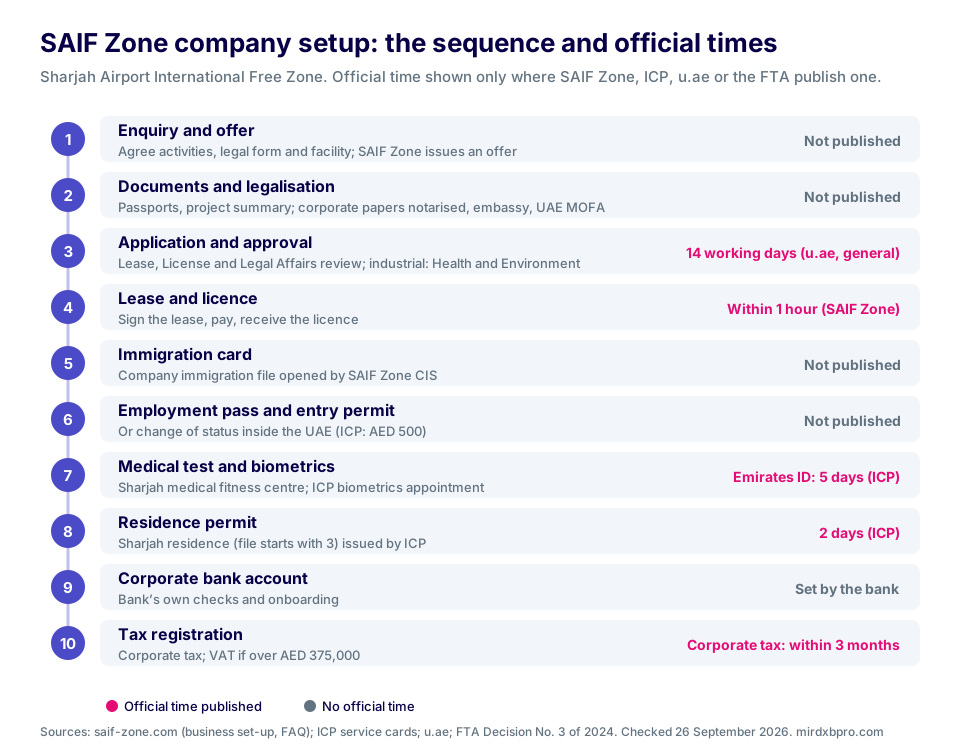
| Step | What happens | Who | Official time |
|---|---|---|---|
| 1. Enquiry and offer | Agree activities, legal form and facility; SAIF Zone issues an offer for licence and space | SAIF Zone business advisers | Not published |
| 2. Prepare documents | Passports, project summary; for corporate shareholders and branches, notarised and legalised parent documents | You (and your home country’s notary, foreign ministry and UAE embassy), then UAE MOFA | Not published; usually the longest step for corporate owners |
| 3. Application and approval | Submit the application form and documents; SAIF Zone reviews, including Health and Environment clearance for industrial licences | SAIF Zone Lease, License and Legal Affairs | u.ae: free zone approval generally “within 14 working days” |
| 4. Lease and licence | Sign the lease, pay the fees and receive the licence | SAIF Zone | SAIF Zone: licences and permits delivered “within 1 hour”; licences “issued on the same day” |
| 5. Immigration card | Open the company’s immigration file (establishment card) | SAIF Zone Client and Investor Services (CIS), with ICP | Not published |
| 6. SAIF Zone visa entry permits or status change | Employment pass and entry permit for each investor or employee; status change if already in the UAE | SAIF Zone CIS, ICP | Not published by SAIF Zone |
| 7. Medical and Emirates ID | Medical fitness test at a Sharjah centre; Emirates ID biometrics | Health authority; ICP | ICP: Emirates ID 5 days |
| 8. Residence | Residence permit issued on the Sharjah file | ICP through SAIF Zone CIS | ICP: 2 days for residence issue |
| 9. Bank account | Corporate account with a UAE bank | The bank | Not published; set by each bank |
| 10. Tax | Corporate tax registration; VAT registration if thresholds are met | FTA via EmaraTax | Corporate tax: within three months of incorporation under FTA Decision No. 3 of 2024 |
Read the “one hour” promise carefully. It runs from a complete, approved file to the licence in your hand. Attested documents, activity approvals, industrial clearance and the bank decide the real timeline, and a foreign parent opening a branch should allow for legalisation at home first.
SAIF Zone company setup documents required
The Sharjah Airport International Free Zone publishes one document checklist that applies to all four legal forms. It lists seven items:
- Application form, completed.
- Project summary (a short business plan; for industrial licences, SAIF Zone checks the investor’s practical experience here).
- Passport copies of owners and managers.
- Certificate of incorporation or registration.
- Memorandum and Articles of Association or equivalent.
- Board resolution to open a branch (or establish the entity) in SAIF Zone.
- Power of attorney appointing the person or persons in charge.
SAIF Zone’s checklist then says that documents 4 to 7 “must be notarized and attested by the Ministry of Foreign Affairs and by the UAE Embassy in the country of origin”, and then attested again by the UAE Ministry of Foreign Affairs.
Individual shareholders, directors and managers
Items 4 to 6 apply to corporate owners. An individual founder forming an FZE or FZC normally provides the application form, project summary and passport copies, plus any identification SAIF Zone’s form asks for (photo, contact details, UAE visa or entry stamp). A power of attorney signed outside the UAE must be legalised. Request the current application form before you start, because SAIF Zone’s published list is short.
Corporate shareholders in a SAIF Zone company setup
Where a company owns the FZE or FZC, the parent’s certificate of incorporation, Memorandum and Articles, board resolution and power of attorney follow the legalisation chain SAIF Zone describes: notary in the home country, the home country’s foreign ministry, the UAE embassy there, then UAE MOFA. Countries in the Apostille Convention do not shortcut UAE legalisation, because the UAE is not a party; see our guide on apostille vs attestation. Documents not in Arabic or English usually also need a legal translation. A recent certificate of good standing and a register of directors and shareholders are commonly requested to trace the owners, even though SAIF Zone’s short list does not name them.
Branch of a foreign or UAE company
For a branch of a foreign company, the same four parent documents need full legalisation. For a branch of a UAE company, the parent’s UAE licence and Memorandum replace the foreign documents; a notarised board resolution and power of attorney are still needed, but there is no embassy step. A UAE parent in a Dubai free zone or the mainland should also check that its own regulator allows a branch in another emirate’s free zone.
Beneficial owner declaration after SAIF Zone company setup
Every SAIF Zone company with its own legal personality must keep a register of beneficial owners and a register of partners or shareholders, and file them with SAIF Zone as registrar. SAIF Zone’s UBO page cites Cabinet Decision No. 109 of 2023, Cabinet Resolution No. 71 of 2024 and Cabinet Decision No. 132 of 2023 on penalties. A beneficial owner is a natural person who owns or controls 25% or more of the shares or voting rights, or controls the company by other means; if nobody meets that test, the senior manager is recorded. Our UBO register guide explains the deadlines and fines.
SAIF Zone license cost: what the zone actually publishes
SAIF Zone does not publish a fee schedule, so there is no official SAIF Zone license cost to quote. We checked its set-up pages, FAQ, forms library, e-services pages and “business support packages” page on 26 September 2026. None lists a registration fee, licence fee, rent per square metre, immigration card fee or visa fee. The packages page is a 2020 relief offer (valid 1 April to 30 June 2020) that describes discounts and payment plans without any prices. SAIF Zone quotes each applicant through its advisers once you choose a licence and facility.
Any fixed SAIF Zone license cost on a consultant’s website is that consultant’s package or an old rate sheet, not an official tariff, so we do not print one.
What we can give you is the list of lines to expect, with the ones that have a published government fee. Use it to check that your SAIF Zone license cost quotation is complete.
| Cost line | Who charges it | Published amount | Source (checked 26 Sep 2026) |
|---|---|---|---|
| Registration or incorporation fee | SAIF Zone | Not published; quoted | saif-zone.com |
| Licence fee (trade, service or industrial) | SAIF Zone | Not published; quoted | saif-zone.com |
| Facility rent (office, suite, warehouse, land) | SAIF Zone | Not published; leases are long-term, renewable and paid yearly | saif-zone.com FAQ |
| Share capital (FZE or FZC) | Your own money, not a fee | AED 150,000 minimum per the FAQ; confirm current rule | saif-zone.com FAQ |
| Immigration card (establishment card) | SAIF Zone and ICP | Not published by SAIF Zone | saif-zone.com |
| Residence permit issue | ICP | AED 100 application + AED 100 per year of validity + AED 100 smart services | ICP: Issuing Residency Permit |
| Change of status inside the UAE | ICP | AED 500 | ICP: Issuing Residency Permit |
| Emirates ID | ICP | AED 100 per year + AED 100 smart services | ICP: New Identity Card Issuance |
| Employment pass, visa deposit, medical test, insurance | SAIF Zone, health provider, insurer | Not published by SAIF Zone | n/a |
| Legalisation of parent documents (corporate owners) | Home country, UAE embassy, UAE MOFA | MOFA: AED 2,000 per commercial document | MOFA FAQ (see our attestation guide) |
| Annual renewal | SAIF Zone | Not published; licence and lease renewed yearly | saif-zone.com FAQ |
What a SAIF Zone license cost quotation should list
Ask for an itemised quotation, not a package figure. It should state the legal form, licence type and exact activities; the facility, its size and visa quota; registration, licence and rent separately; the immigration card; the cost per visa (employment pass, entry permit, residence, Emirates ID, medical, any deposit); insurance; approval fees; utilities for warehouses; and the renewal amount for year two, which founders most often forget to ask for.
Costs founders forget in SAIF Zone business setup
- Fit-out and equipment for warehouses and industrial units, plus construction on a land plot (SAIF Zone provides a list of contractors).
- Staff accommodation if you employ workers; SAIF Zone offers on-site labour accommodation at its own rates.
- Audit fees for the annual audit or undertaking report and, if you want the 0% corporate tax rate, audited financial statements.
- A second licence if your goods go beyond three similar product lines.
SAIF Zone office, warehouse and land options, and the visas each carries
The Sharjah Airport International Free Zone ties your SAIF Zone visa quota to your facility. Its set-up page publishes the quota for the three office products; for warehouses and land, the FAQ says the number of employees “will depend on the actual nature/proposal/size of your business”. The chart shows what is published.
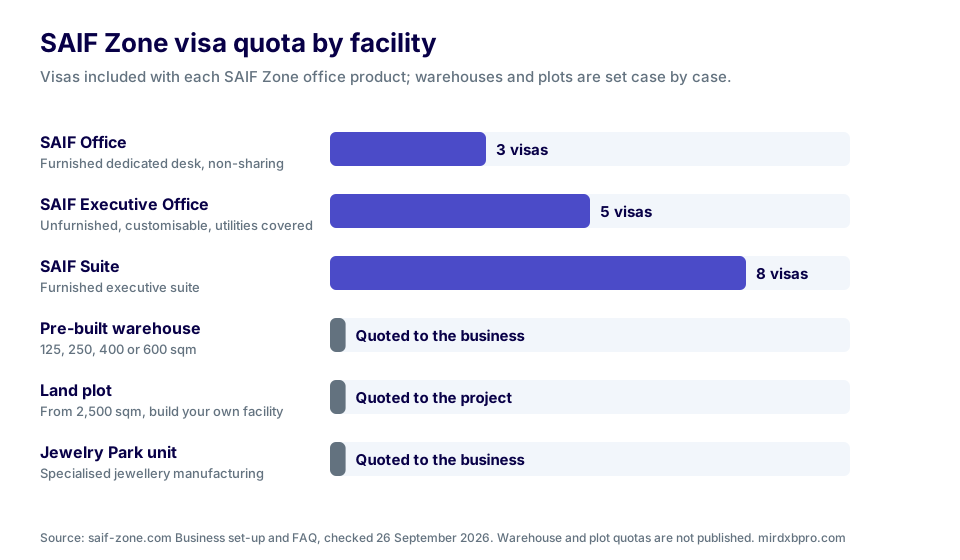
| Facility | What it is | SAIF Zone visa quota included | Suits |
|---|---|---|---|
| SAIF Office | “Fully furnished and dedicated executive desk space” with IT and telecoms, “on a non-sharing basis” | 3 visas included | Traders and service companies with a small team and goods held by a logistics provider |
| SAIF Executive Office | Unfurnished, customisable office; utilities covered; IT and telecoms | 5 visas included | Growing trading and service companies that want their own branded office |
| SAIF Suite | Fully furnished executive suite with IT and telecoms | 8 visas included | Regional offices and head offices of manufacturing groups |
| Pre-built warehouse | 125, 250, 400 or 600 sqm; built-in office, pantry and toilets; power for heavy equipment; industrial exhaust | Not published; set by business size and plan | Trading with stock, assembly, light manufacturing, logistics |
| Land plot | From 2,500 sqm, for a custom warehouse or factory; security and utilities; provision for on-site staff accommodation | Not published; set by project | Factories, refineries, large logistics facilities |
| Jewelry Park | Specialised jewellery manufacturing units in an existing jewellery community | Not published | Jewellery manufacturers and gold processors |
| Container parking | Designated container storage areas | Not a visa-bearing facility on its own | Logistics and trading companies |
| Labour accommodation | Furnished, air-conditioned staff housing with recreation | Housing, not a licence facility | Manufacturers and warehouses with workers |
How to pick the facility for your SAIF Zone visa needs
Start from the visa count you need in two years, not today: moving from a SAIF Office to a larger office later means a new lease and an amended immigration file. If you must hold stock yourself, you need a warehouse, which usually brings more visa room than an office. Check power, ceiling height and floor loading for any machine before you sign; SAIF Zone publishes warehouse sizes but not technical specifications.
A note on the word “flexi desk”: SAIF Zone does not sell a shared flexi desk. Its smallest product, the SAIF Office, is a dedicated desk on a non-sharing basis. If you only need a licence and a shared address, compare Sharjah Publishing City or Shams.
SAIF Zone visa and residency after SAIF Zone company setup
Every SAIF Zone visa is a Sharjah residence visa issued through the Federal Authority for Identity, Citizenship, Customs and Port Security (ICP), not through GDRFA Dubai. SAIF Zone acts in place of the Ministry of Human Resources and Emiratisation for its companies: it issues the employment pass and handles the labour side, while its Client and Investor Services team submits the immigration file. ICP issues the residence permit and the Emirates ID. The residence file number starts with 3, the code for Sharjah. Our ICP vs GDRFA guide explains why a Sharjah free zone employee is an ICP file even if they live in Dubai.
The Sharjah Airport International Free Zone lists an on-site immigration and customs office, and its app offers the whole visa cycle: new immigration card, employment pass, entry permit, change of visa status, residence stamping and renewal, transfer to a new passport, cancellations inside and outside the country, and E-Channel registration.
The SAIF Zone visa process, step by step
- Immigration card. Once the licence and lease are in place, SAIF Zone opens the company’s immigration file (the establishment card). Our establishment card guide explains what it does.
- Employment pass and entry permit. SAIF Zone issues the employment approval and applies for the entry permit. A person already in the UAE on another visa needs a change of status (ICP: AED 500).
- Medical fitness test. Taken at a Sharjah medical fitness centre for a Sharjah file. See our medical fitness test guide for what the test covers.
- Emirates ID biometrics. ICP gives the appointment; ICP’s service card publishes 5 days for the card.
- Residence permit. ICP publishes 2 days for issuing the residence. Fees on ICP’s card: AED 100 application, AED 100 for each year of validity and AED 100 smart services.
- Employment contract. SAIF Zone’s app includes the employment contract service; keep a signed copy on file.
SAIF Zone does not publish its own end-to-end visa time. The ICP times above cover ICP’s steps only; the employment pass, the medical result and the biometrics appointment come on top, so do not promise a start date to a new hire until the entry permit is issued.
SAIF Zone visa types: investor, partner and employee
SAIF Zone’s FAQ says residence visas issued from the zone are “valid for 3 years for investors and 2 years for employees”. Shareholders who are residents through their own company are investor or partner visa holders; everyone else is an employee visa holder. Each SAIF Zone visa counts against your facility’s quota.
Family sponsorship on a SAIF Zone visa
SAIF Zone’s FAQ confirms there are no restrictions on bringing your family “provided you follow the immigration procedures”, and that family members on residence visas may work if they follow UAE rules. Family residence for a SAIF Zone employee or investor is an ICP transaction on the Sharjah file; salary and housing conditions follow the federal rules and ICP’s service cards. See our family visa salary requirement guide and age limits for sponsoring children.
Golden Visa routes after SAIF Zone business setup
A SAIF Zone company can support a Golden Visa application under the federal investor or entrepreneur categories, processed by ICP for Sharjah; eligibility does not depend on the free zone. Our Golden Visa eligibility guide sets out the categories, and our Golden Visa service handles applications.
Opening a bank account after SAIF Zone company setup
The Sharjah Airport International Free Zone’s FAQ notes that “over 40 international banks” operate in Sharjah and that neither the Government nor SAIF Zone provides project finance; its home page also points to a financing partnership with the Emirates Development Bank. A SAIF Zone company can bank anywhere in the UAE. What banks look at is the same for every free zone: who owns and controls the company, where the money comes from, what the company will buy and sell, with whom, and whether it has real substance in the UAE.
Expect to provide the licence, certificate of incorporation, Memorandum and share register, lease, passports and Emirates IDs of shareholders and signatories, a business plan naming suppliers and customers, and for corporate owners the legalised group chart. Banks take extra care with gold traders, cash-heavy businesses and trade with high-risk countries; a visa-holding manager and a real SAIF Zone facility help. Our corporate bank account guide covers the process and common refusals.
Tax after SAIF Zone company setup: corporate tax, VAT and customs
Corporate tax and the Qualifying Free Zone Person
SAIF Zone’s FAQ still says there is “neither any income tax nor any corporate tax applicable”, while its free zone page, more recently updated, says “0% corporate income tax as per corporate tax law”. Both are incomplete. Federal Decree-Law No. 47 of 2022 applies to SAIF Zone companies. A company is taxed at 9% on taxable income above AED 375,000 unless it is a Qualifying Free Zone Person, in which case qualifying income is taxed at 0% and other income at 9%.
Under Cabinet Decision No. 100 of 2023, a Qualifying Free Zone Person must, in summary: keep adequate substance in the free zone; earn qualifying income; not elect to be taxed at the standard rate; comply with transfer pricing rules; prepare audited financial statements; and keep non-qualifying revenue within the de minimis limit (the lower of AED 5 million or 5% of total revenue). Qualifying activities are now listed in Ministerial Decision No. 229 of 2025, which replaced Ministerial Decision No. 265 of 2023 with effect from 1 June 2023. They include manufacturing and processing of goods, trading of qualifying commodities, holding shares, logistics services and distribution of goods from a designated zone, among others.
Because the Sharjah Airport International Free Zone is a designated zone, a distributor there can in principle earn qualifying income from mainland customers who resell the goods or use them in manufacturing; take advice before relying on it. Small Business Relief is not available to a Qualifying Free Zone Person. Every SAIF Zone company must register for corporate tax: our corporate tax registration guide explains the deadlines and the AED 10,000 late registration penalty.
VAT and the designated zone
The FTA’s list of designated zones under Cabinet Decision No. 59 of 2017, as amended up to Cabinet Decision No. 81 of 2021, names two zones in Sharjah: Hamriyah Free Zone and “Sharjah Airport International Free Zone”, both effective from 1 January 2018. The live FTA page could not be read on 26 September 2026, so we used the FTA’s consolidated list of 21 September 2021 (archived copy); check the current FTA list before relying on it.
Designated-zone status is about goods: supplies of goods within or between designated zones can be outside the scope of VAT if the conditions are met, while goods released to the mainland and almost all services are taxed. VAT registration is mandatory above AED 375,000 of taxable supplies a year. SAIF Zone’s claim of “100% tax exemption from all import and export duties” refers to customs duty on goods kept in the zone, not to VAT or corporate tax.
Customs
Goods enter and leave SAIF Zone under Sharjah Customs, which runs a SAIF Zone Customs Centre. SAIF Zone’s FAQ says there are no duties on goods imported into or exported from the zone “other than when goods are sold locally in the UAE market”, when customs duty is paid on entry to the mainland. Register your company for a customs code before your first shipment. Sharjah Customs, part of the Sharjah Ports, Customs and Free Zones Authority, publishes its import and export procedures on sharjahcustoms.gov.ae.
Trading with the mainland after SAIF Zone company setup
SAIF Zone’s FAQ is direct: “The license issued from SAIF Zone is valid for operating your business only inside the free zone territory.” Selling goods to UAE customers through customs, exporting, and trading with other free zone companies are all fine. Opening a shop, sending staff to perform services from a mainland base, or holding stock in a mainland warehouse needs more.
Dubai’s Executive Council Resolution No. 11 of 2025 and the Free Zone Mainland Operating Permit do not apply here, because SAIF Zone is not a Dubai free zone. The routes in Sharjah are the emirate’s own:
- A branch licensed by the Sharjah Economic Development Department (SEDD). SEDD’s FAQ lists the documents for “branches of free zones” in the emirate. They include the company’s licence and constitutional documents, the board resolution approving the branch, a power of attorney for the representative and a “No objection letter from the Department of Free Zones to open the branch in the Emirate”. SAIF Zone’s app issues NOC letters through its Lease and License department. Documents issued abroad must be attested and translated.
- A branch in another emirate. SAIF Zone’s FAQ says branches outside the zone need “the approval of local authorities” and a SAIF Zone NOC; in Dubai, ask Dubai Economy and Tourism for its rules on branches of other emirates’ free zone companies.
- A separate mainland company. A new SEDD-licensed company, owned by the SAIF Zone company or its shareholders, which holds its own premises and visas. See our mainland company formation guide for how mainland companies work.
- A distributor or agent. Sell to a mainland distributor who imports the goods from SAIF Zone through customs and resells them.
One caution: SAIF Zone’s FAQ answer on branches begins “With exception to FZE and FZC, there are no restrictions to establish a branch outside SAIF Zone”. It is not clear whether that means FZEs and FZCs cannot open outside branches or simply face different conditions. Ask SAIF Zone for its current position in writing before you plan a Sharjah or Dubai branch of an FZE or FZC.
Renewal and ongoing compliance after SAIF Zone business setup
- Licence and lease renewal: yearly. SAIF Zone’s leases are long-term and renewable but paid annually. Renew before expiry so that visa renewals are not blocked.
- Audit or undertaking report: SAIF Zone’s app has a Finance and Accounts service for the “Audit/undertaking Report”, and SAIF Zone keeps an auditors directory. Ask SAIF Zone whether your company must file audited accounts or may file an undertaking; if you want the 0% corporate tax rate, audited financial statements are required anyway.
- Beneficial owners: keep the registers up to date and notify SAIF Zone of changes; see the UBO section above.
- Anti-money laundering: SAIF Zone publishes AML guidance under Federal Decree-Law No. 10 of 2025 and Cabinet Decision No. 134 of 2025. Gold and precious metals dealers must register on goAML and report as required.
- Corporate tax and VAT: annual corporate tax return within nine months of the year end; VAT returns if registered.
- SAIF Zone visa renewals: renew each residence through SAIF Zone and ICP before expiry; cancel visas before staff leave. Our grace period guide covers what happens after cancellation.
- Health, safety and environment: industrial and food companies face EHS inspections; SAIF Zone’s FAQ says its EHS Department carries out “random surprise inspection” inside investors’ warehouses.
- Penalties: SAIF Zone publishes no penalty schedule; its FAQ says a cancelled company can be restored “by making the require payments”. Ask for the current schedule.
SAIF Zone free zone: pros and cons
| Pros | Cons |
|---|---|
| Next to Sharjah International Airport and its cargo centre, with sea ports and Dubai within reach | No public fee schedule; every price is a quotation |
| Offices, warehouses, land, a Jewelry Park, container parking and labour housing in one place | No shared flexi desk; the smallest product is a dedicated desk |
| On-site customs centre and immigration counter | Minimum capital of AED 150,000 for an FZE or FZC per the FAQ (confirm) |
| VAT designated zone for goods | Trade licence limited to three similar product lines |
| Established gold refining and precious metals cluster | Licence covers the free zone only; Sharjah mainland work needs an SEDD branch |
| Sharjah residence through ICP, with ICP’s published fees | Dubai clients may expect a Dubai licence and Dubai visa |
Who SAIF Zone company setup suits
- Importers and distributors that hold stock and ship by air, sea or land.
- Manufacturers, assemblers and packagers that need a warehouse or their own factory on leased land.
- Gold refiners, bullion traders and jewellery manufacturers who want to sit in an existing cluster.
- Food, fragrance and consumer goods producers exporting to the Gulf, Africa and South Asia.
- Logistics companies that need container parking and cargo access.
- Groups that want Sharjah residence and a Government-run zone.
Who should look elsewhere
- Consultants, agencies and freelancers with no goods: look at Shams or Sharjah Publishing City.
- Heavy industry needing a deep-water port and very large plots: compare Hamriyah Free Zone.
- Businesses whose customers are mainly in Dubai and who want a Dubai visa: compare DAFZA or JAFZA, which sit inside Dubai’s mainland permit system.
- Founders looking for the lowest-cost licence in the northern emirates: compare Ajman Free Zone and RAKEZ.
SAIF Zone company setup: worked cases
These cases are built from the situations we see most often. Names and identifying details are left out, and the figures are the published ones.
Case 1: an auto parts importer with three staff
A founder importing spare parts from Asia wanted a SAIF Zone trade licence and three SAIF Zone visa slots. Parts, filters and lubricants fitted one trade licence as similar lines, but tyres and batteries raised a fourth line, so we asked SAIF Zone to confirm the wording before any payment. The SAIF Office carried the three visas, stock sat with a logistics provider in the zone, and customs duty was paid only on sales to UAE workshops.
Case 2: a foreign manufacturer opening a branch with a factory
A European manufacturer wanted to assemble products for the Gulf market. For its SAIF Zone business setup it chose a branch of a foreign company, so no share capital applied, and leased a 600 square metre warehouse with an industrial licence. The long pole was legalisation: the certificate of incorporation, articles, board resolution and power of attorney went through a notary, the home foreign ministry, the UAE embassy and UAE MOFA (AED 2,000 per commercial document at MOFA). The industrial licence also needed SAIF Zone Health and Environment clearance for the assembly process.
Case 3: a gold trader choosing between SAIF Zone and a Dubai zone
A bullion and jewellery trader compared SAIF Zone’s Gold, Diamonds and Commodities Park with Dubai options. The Sharjah Airport International Free Zone offered proximity to refiners in the same park and a Sharjah visa; the Dubai zones offered a Dubai visa and Dubai’s mainland permit system. The trader chose SAIF Zone and registered on goAML from day one as a dealer in precious metals and stones. The bank asked for supplier due diligence and responsible sourcing policies before opening the account.
Case 4: a SAIF Zone company that wanted a Sharjah showroom
An FZC selling building materials wanted a showroom on the Sharjah mainland. The SAIF Zone licence did not cover it. We explained the two options: a branch licensed by SEDD, which needs a SAIF Zone NOC and SEDD’s branch documents, or a separate mainland company. Because of the ambiguous FAQ wording on FZE and FZC branches, the first step was a written enquiry to SAIF Zone.
What circulates online about SAIF Zone that is not true
| Claim | What the official sources say |
|---|---|
| “SAIF Zone companies pay no corporate tax.” | Out of date, even on SAIF Zone’s own FAQ. Corporate tax applies; 0% only on qualifying income of a Qualifying Free Zone Person (Cabinet Decision No. 100 of 2023, Ministerial Decision No. 229 of 2025). |
| “SAIF Zone is VAT-free.” | It is a designated zone for goods. Services and goods released to the mainland are taxed, and VAT registration thresholds apply. |
| “The SAIF Zone license cost is AED X all-in.” | SAIF Zone publishes no tariff. A fixed figure is a consultant’s package or an old rate sheet. |
| “SAIF Zone is a Dubai free zone, so the visa is a Dubai visa.” | SAIF Zone is in Sharjah. Visas are Sharjah residence permits issued through ICP; the file number starts with 3. |
| “A SAIF Zone licence lets you trade anywhere in the UAE.” | SAIF Zone’s FAQ says the licence is valid “only inside the free zone territory”. Mainland operations need an SEDD branch, a mainland company or a distributor. |
| “Dubai’s Free Zone Mainland Operating Permit covers SAIF Zone companies.” | That permit comes from Dubai Executive Council Resolution No. 11 of 2025 and is for Dubai free zones. Sharjah has its own branch rules through SEDD. |
| “You can get a flexi desk with unlimited SAIF Zone visa slots.” | The smallest SAIF Zone product is a dedicated desk with 3 visas; quotas rise with the facility. |
| “The licence is ready in one hour, so you can trade tomorrow.” | The one hour applies once the file is complete. Documents, approvals, visas and the bank take longer. |
How to verify every figure in this guide
| Figure or rule | Where to check it |
|---|---|
| Legal forms, licence types, facilities and SAIF Zone visa quotas | saif-zone.com, Business set-up page |
| Minimum capital, visa validity, ownership, lease terms, mainland limits | saif-zone.com FAQ (ask SAIF Zone to confirm; the page is dated) |
| Document checklist and attestation | SAIF Zone document requirements PDF |
| Company numbers and investments | SAIF Zone news releases (20 January 2025; 22 September 2025; 16 July 2023) |
| Beneficial owner rules | SAIF Zone UBO declaration page; Cabinet Decision No. 109 of 2023 |
| SAIF Zone visa residence and Emirates ID fees and times | ICP service cards: Issuing Residency Permit; New Identity Card Issuance |
| Designated zone status | FTA list of designated zones (Cabinet Decision No. 59 of 2017 as amended) |
| Corporate tax rules | Ministry of Finance: Cabinet Decision No. 100 of 2023 and Ministerial Decision No. 229 of 2025; FTA |
| Sharjah mainland branch documents | SEDD FAQ (Legal Affairs Department, question 4) |
| Customs centres | sharjahcustoms.gov.ae |
| A company’s licence status | SAIF Zone e-services or a certificate of good standing from SAIF Zone |
SAIF Zone company setup: how MIRDXB PRO helps
MIRDXB PRO is an independent PRO and company formation consultancy in Al Barsha 1, Dubai, and supports SAIF Zone business setup from Dubai. We are not SAIF Zone, and we are not an official SAIF Zone agent or partner; SAIF Zone does not list us. What we offer is an adviser on your side who checks the plan, prepares the file and runs the government steps.
What we do
- Plan your SAIF Zone company setup: check your products and services against the licence types, including the three-line limit on trade licences.
- Advise on FZE, FZC or branch, capital and signatories.
- Match the facility to your visa count and stock, and tell you when Hamriyah, another Sharjah zone or a Dubai zone fits better.
- Prepare the application and project summary, and run attestation and translation of corporate documents.
- Follow the licence, immigration card and each SAIF Zone visa through ICP to Emirates ID.
- Prepare the bank pack and register the company for corporate tax and, where needed, VAT.
- Keep renewals, beneficial owner filings and each SAIF Zone visa renewal on a calendar.
How it works
- Message us on WhatsApp with your activity, shareholders, visa count and whether you will hold stock or manufacture.
- We reply in writing with the recommended structure, the lines to request on your SAIF Zone quotation, and our own fee.
- You approve; we collect documents, file with SAIF Zone and keep you updated at each step.
- After the licence, we run visas, the bank pack and tax registration, then hand over a compliance calendar.
What it costs
SAIF Zone, ICP and other government fees are passed on at cost, with receipts. Our own fee depends on the structure, the documents and the number of visas, and we quote it in writing before any work starts. See our fees page for how we price.
Why founders use us
- We cite the official source for every rule we rely on, as this guide does.
- We work across Dubai and Sharjah, GDRFA and ICP, so we can compare zones without a stake in any of them.
- We handle the government side too: visas, Emirates ID, medical tests, attestation and tax registration.
- Our Al Barsha 1 office is open Monday to Thursday and Saturday 09:00 to 18:00, and Friday 09:00 to 12:00.
To start, see our business setup service or message us directly. For visas on an existing free zone company, see our free zone visa service.
What we will and will not do
- We will give you the official source for any rule we rely on, and show you SAIF Zone’s quotation and receipts.
- We will tell you if another zone, or the mainland, fits your plan better.
- We will quote our fee in writing before we start.
- We will not promise approval, a bank account or a processing time that SAIF Zone, ICP, a regulator or a bank controls.
- We will not present ourselves as SAIF Zone or as an official SAIF Zone agent.
- We will not give tax or legal opinions; for corporate tax structuring we work alongside your tax adviser or auditor.
Related guides
- Sharjah free zones, the emirate overview
- Hamriyah Free Zone company setup, SAIF Zone’s port-based sister zone
- SRTIP free zone company setup
- Sharjah Healthcare City free zone
- DAFZA company setup, Dubai’s airport free zone
- Free zones in the UAE
- ICP smart services guide
- How long an Emirates ID takes
- Attestation process explained
SAIF Zone company setup: frequently asked questions
What does SAIF Zone stand for?
SAIF stands for Sharjah Airport International Free zone, officially the Sharjah Airport International Free Zone. A Government of Sharjah authority runs it beside Sharjah International Airport, and it has operated since 1995. It is a Sharjah free zone, not a Dubai one, which affects visas, customs and mainland access.
How long does SAIF Zone company setup take?
SAIF Zone says licences are delivered “within 1 hour” and issued the same day once the file is complete and approved; u.ae says free zone approvals generally take up to 14 working days. Attested documents, industrial clearance, the SAIF Zone visa steps and the bank account take longer, so plan in weeks.
What is the SAIF Zone license cost?
SAIF Zone does not publish a fee schedule. It quotes registration, licence and facility rent after you choose your licence type and facility. ICP’s residence and Emirates ID fees are published separately. Ask SAIF Zone for an itemised quotation showing registration, licence, rent, immigration card, the cost per visa and the renewal amount for year two.
What is the minimum capital for a SAIF Zone company?
SAIF Zone’s FAQ gives AED 150,000 (US$41,000) for an FZE or FZC, and no minimum for a branch of a UAE or foreign company. The FAQ page has not been updated for some time, so ask SAIF Zone to confirm the current figure and whether it must be paid in before you plan your cash flow.
How many SAIF Zone visa slots can a company get?
It depends on the facility. SAIF Zone publishes a quota of 3 visas for the SAIF Office, 5 for the SAIF Executive Office and 8 for the SAIF Suite. For warehouses and land plots, the quota depends on the nature and size of the business and is agreed with SAIF Zone. Each investor and employee visa counts against the quota.
Who issues a SAIF Zone visa, GDRFA or ICP?
ICP. SAIF Zone is in Sharjah, so its companies sponsor Sharjah residence permits, issued by the Federal Authority for Identity, Citizenship, Customs and Port Security. SAIF Zone’s Client and Investor Services prepares the file and issues the employment pass. GDRFA Dubai is only involved for Dubai-issued residences.
Is SAIF Zone a VAT designated zone?
Yes. “Sharjah Airport International Free Zone” is on the FTA’s list of designated zones under Cabinet Decision No. 59 of 2017, effective 1 January 2018. The special treatment covers certain supplies of goods only. Services, and goods released to the mainland, are taxed normally. Check the current FTA list before relying on it.
Do SAIF Zone companies pay corporate tax?
Yes. A Qualifying Free Zone Person pays 0% on qualifying income and 9% on other taxable income; otherwise 9% applies above AED 375,000. Conditions include substance, audited accounts and the de minimis limit. Every company registers with the FTA.
After SAIF Zone business setup, can the company trade in the Sharjah mainland?
Not on the free zone licence alone, which covers the free zone only. Options are a branch licensed by the Sharjah Economic Development Department, with a SAIF Zone NOC, a separate mainland company, or selling through a mainland distributor. SAIF Zone’s FAQ wording on FZE and FZC branches is unclear, so confirm with SAIF Zone first.
Is SAIF Zone good for gold and jewellery businesses?
It is built for them. SAIF Zone reports more than 55 gold refineries and over 250 precious metals companies in its Gold, Diamonds and Commodities Park, plus a Jewelry Park. Dealers in precious metals and stones must register on goAML and meet the AML rules of Federal Decree-Law No. 10 of 2025.
Can MIRDXB PRO handle my SAIF Zone company setup from abroad?
Yes. We check the plan, prepare the application, guide the legalisation of your documents in your home country and file with SAIF Zone. You or your manager will need to enter the UAE for the medical test and Emirates ID biometrics. SAIF Zone and ICP fees are at cost; our fee is quoted in writing before we start.
Can MIRDXB PRO process a SAIF Zone visa for an existing company?
Yes. We handle new visas, renewals, status changes and cancellations through SAIF Zone and ICP, plus Emirates ID and medical appointments. Send us the company’s licence and the visa you need on WhatsApp and we will confirm the documents and our fee in writing.
Keeping a SAIF Zone company’s visas, renewals and government filings on schedule is what our PRO services in Dubai team handles.
- SAIF Zone: About us (established 1995, leadership, services)
- SAIF Zone: Business set-up (licence types, legal forms, facilities, visa quotas, one-hour licensing)
- SAIF Zone: Document requirements (PDF)
- SAIF Zone: FAQ (capital, visas, leases, mainland, customs, app services)
- SAIF Zone: Free zone overview (companies, location, on-site services)
- SAIF Zone: UBO declaration
- SAIF Zone: Dealers of precious metals and stones
- SAIF Zone news, 20 January 2025: Sharjah’s free zones in 2024
- SAIF Zone news, 22 September 2025: Gold, Diamonds and Commodities Park
- SAIF Zone news, 6 July 2025: shared director of SAIF Zone and HFZA
- Sharjah Economic Development Department: FAQ (branches of free zone companies)
- Sharjah Customs (SAIF Zone Customs Centre)
- ICP: Issuing Residency Permit (fees, status change AED 500, 2 days)
- ICP: New Identity Card Issuance
- u.ae: Starting a business in a free zone (updated 6 May 2026)
- Ministry of Finance: Ministerial Decision No. 229 of 2025 on qualifying and excluded activities
- UAE Legislation: Cabinet Decision No. 100 of 2023 on Qualifying Free Zone Persons
- UAE Legislation: Cabinet Decision No. 109 of 2023 on beneficial owners
- Federal Tax Authority: Designated zones (Cabinet Decision No. 59 of 2017 as amended)
Also relied on, as established across our business setup series: Federal Decree-Law No. 47 of 2022; FTA Decision No. 3 of 2024; Cabinet Decision No. 132 of 2023; Federal Decree-Law No. 10 of 2025. The FTA list of designated zones was read from the FTA’s consolidated list dated 21 September 2021 (archived copy), because the live FTA page could not be read on 26 September 2026.
This guide was last reviewed on 26 September 2026 against the sources above. SAIF Zone updates its offers and facilities often; your SAIF Zone quotation and portal are final.
Please note. The rules, quotas and figures in this guide come from saif-zone.com, the Sharjah Economic Development Department, Sharjah Customs, ICP, u.ae, the Ministry of Finance and the Federal Tax Authority, verified 26 September 2026. MIRDXB PRO is an independent consultancy and is not affiliated with, or an official agent or partner of, the Sharjah Airport International Free Zone Authority. The cases are built from common situations and are illustrative. This guide is general information and not legal or tax advice.


